The Tesla Model 3 remains one of the most popular electric sedans in the United States, praised for its efficiency, tech-forward cabin, and expansive Supercharger network access. But when buyers start researching Model 3 towing capability, the conversation gets complicated. Unlike the larger Model Y or the Cybertruck, the Model 3 was not engineered as a hauler — and understanding exactly what it can (and cannot) pull is essential before you hitch up a trailer.
In this review, we examine the Model 3's official towing rating, how towing affects real-world range, the full spec sheet for the 2026 model year, and whether this sedan makes sense if you need light-duty towing from an EV.
Tesla Model 3 Towing Capacity: The Hard Numbers
Tesla does not officially rate the Model 3 for towing in the United States. Unlike the Model Y (rated at 3,500 lbs) or the Cybertruck (up to 11,000 lbs depending on trim), the Model 3 lacks a factory-installed hitch option and carries no EPA or manufacturer-published tow rating for the North American market.
However, in Europe and other markets, the Model 3 has been homologated for towing up to 1,000 kg (approximately 2,200 lbs) when equipped with a factory tow bar. This European rating applies to the Long Range AWD variant with the 19-inch wheels. The Rear-Wheel Drive (RWD) base model typically carries no tow rating even in Europe.
Model 3 Towing at a Glance
| US Tow Rating | Not officially rated / no factory hitch offered |
| European Tow Rating (Long Range AWD) | 2,200 lbs (1,000 kg) braked |
| Recommended Max (US aftermarket hitch) | ~2,000 lbs (unofficial, at owner's risk) |
| Tongue Weight Limit | ~200 lbs (aftermarket hitch dependent) |
| Trailer Brake Controller | Not integrated — aftermarket required |
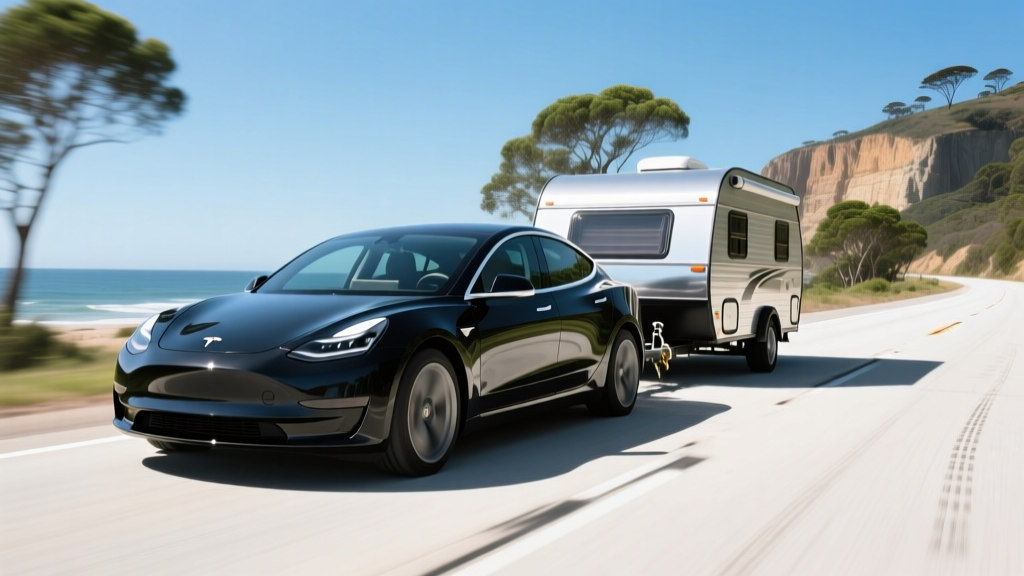
What this means practically: If you install an aftermarket hitch (companies like Curt and Draw-Tite offer options), you can physically attach a small trailer to a Model 3. Owners have successfully towed lightweight utility trailers, teardrop campers, and bike racks. But you're operating outside Tesla's official US guidance, which affects warranty coverage and liability. Always consult your owner's manual and insurance provider before towing.
How Towing Destroys Model 3 Range
Towing any trailer introduces aerodynamic drag and rolling resistance that an EV's efficiency calculations simply aren't designed to absorb. The Model 3's sedan profile is optimized for a low drag coefficient (Cd ~0.219 for the Long Range), but a box trailer or camper behind it shatters that advantage.
⚡ Real-World Range: Normal vs. Towing
| Condition | Est. Range (Long Range AWD) |
| EPA Rated (no trailer) | 363 miles |
| Real-World Highway (70 mph, no trailer) | ~290–320 miles |
| Cold Weather (30°F, highway, no trailer) | ~240–270 miles |
| Towing (small trailer, ~1,500 lbs, 55 mph) | ~170–210 miles |
| Towing (enclosed trailer, ~2,000 lbs, 65 mph) | ~130–170 miles |
Expect a 40–60% range reduction when towing, depending on trailer aerodynamics, weight, speed, and terrain. A teardrop camper (relatively aero-friendly) will cost less range than a boxy cargo trailer at the same weight.
The physics are unforgiving. Energy consumption while towing typically jumps from the Model 3 Long Range's normal ~25 kWh/100 mi to somewhere between 40 and 55 kWh/100 mi. With approximately 75 kWh of usable battery capacity, that math limits you severely on longer hauls. Plan charging stops every 130–180 miles when towing near the weight limit at highway speeds.
2026 Model 3 Full Spec Sheet: Range, Battery, Charging, and Performance
Whether you're considering towing or not, here's how the current Model 3 lineup stacks up across every metric that matters.
| Spec | RWD (Base) | Long Range AWD | Performance |
|---|---|---|---|
| EPA Range | 272 mi | 363 mi | 315 mi |
| Battery (usable) | ~57.5 kWh (LFP) | ~75 kWh (NMC) | ~75 kWh (NMC) |
| Efficiency | 132 MPGe / 25 kWh/100mi | 134 MPGe / 25 kWh/100mi | 119 MPGe / 28 kWh/100mi |
| Drivetrain | RWD | Dual-Motor AWD | Dual-Motor AWD |
| Horsepower | 271 hp | 346 hp | 510 hp |
| 0–60 mph | 5.8 sec | 4.2 sec | 2.9 sec |
| Max DC Fast Charge | 170 kW | 250 kW | 250 kW |
| 10–80% DCFC Time | ~25 min | ~22 min | ~22 min |
| Level 2 Home Charging | 11.5 kW (~44 mi/hr) | 11.5 kW (~44 mi/hr) | 11.5 kW (~44 mi/hr) |
| Base MSRP | $38,990 | $44,990 | $52,990 |
| Tow Rating (US) | Not rated | Not rated | Not rated |
Battery Chemistry: LFP vs. NMC in the Model 3
The base RWD Model 3 uses a lithium iron phosphate (LFP) battery pack. LFP cells are heavier and less energy-dense than NMC, which is why the RWD carries a smaller usable capacity (~57.5 kWh) and shorter range. However, LFP chemistry offers a longer cycle life, better thermal stability, and Tesla recommends charging LFP packs to 100% regularly — a significant daily-use advantage.
The Long Range and Performance trims use nickel manganese cobalt (NMC) cells, which deliver higher energy density (more range in a similar package) and better cold-weather performance. Tesla recommends daily charging to 80% for NMC packs to preserve longevity, reserving 100% for road trips.
For towing purposes, the Long Range AWD with its 75 kWh NMC pack is the only sensible choice — you need every available kilowatt-hour when a trailer is eating into your efficiency.
Charging While Towing: What You Need to Know
Charging infrastructure is the Model 3's strongest advantage for any road-trip scenario, including towing. Tesla's Supercharger network remains the most reliable and widely deployed DC fast-charging system in the US, and the Model 3's NACS connector is now the industry standard adopted by nearly every major automaker.
| Charging Level | Power (kW) | Speed | Notes for Towing |
|---|---|---|---|
| Level 1 (120V) | ~1.4 kW | ~4 mi/hr | Impractical — 50+ hrs for full charge |
| Level 2 (240V home) | 11.5 kW | ~44 mi/hr | Full charge in ~7–8 hrs overnight |
| DC Fast (V3 Supercharger) | Up to 250 kW | ~200 mi in 15 min | Taper above 80% SoC; plan 20–25 min stops |
| DC Fast (V4 Supercharger) | Up to 250+ kW | Similar to V3 | Newer locations; CCS vehicles can use via adapter |
Key towing-charge insight: When towing, you'll arrive at chargers at a much lower state of charge than normal driving, which actually works in your favor — DC fast charging is fastest at low SoC. A Model 3 Long Range arriving at 5% SoC can absorb energy at peak 250 kW for the first several minutes before tapering. But because your effective range is only ~150–200 miles with a trailer, expect to stop every 1.5 to 2.5 hours on the highway. Preconditioning the battery via the car's navigation routing to a Supercharger ensures you hit peak charge rates on arrival.
Pricing, Tax Credits, and Total Cost
The 2026 Model 3 lineup starts at $38,990 for the RWD and climbs to $52,990 for the Performance variant. Here's how federal incentives factor in under current IRS §30D rules:
| Trim | MSRP | Est. Federal Credit | Effective Price |
|---|---|---|---|
| RWD | $38,990 | Up to $3,750–$7,500* | ~$31,490–$35,240 |
| Long Range AWD | $44,990 | Up to $3,750–$7,500* | ~$37,490–$41,240 |
| Performance | $52,990 | Up to $3,750–$7,500* | ~$45,490–$49,240 |
*The §30D credit amount depends on battery-sourcing and critical-minerals requirements, which phase in stages. The full $7,500 requires meeting both criteria; partial credit ($3,750) applies if only one is met. Additionally, buyer income caps apply ($150K single / $300K joint AGI), and the vehicle MSRP must not exceed $55,000 for sedans. All Model 3 trims fall under the sedan MSRP cap. Credit can be transferred to the dealer at point of sale as an instant discount. Verify current-year eligibility on IRS.gov and fueleconomy.gov before purchasing.
Interior, Cargo, Tech, and Driver Assistance
The refreshed Model 3 (internally called "Highland") brought meaningful improvements to ride quality, cabin materials, and noise isolation compared to pre-2024 models. The interior is minimalist by design — a single 15.4-inch touchscreen handles infotainment, climate, and vehicle controls, with a rear 8-inch screen for back-seat passengers.
Cargo and Passenger Dimensions
- Front trunk (frunk): 3.1 cu ft
- Rear cargo (behind 2nd row): 21 cu ft
- Rear cargo (seats folded): 53 cu ft
- Front legroom: 42.7 in
- Rear legroom: 35.2 in
For towing trips, cargo space is adequate for gear but tight compared to a Model Y (which offers 76 cu ft with seats folded and a factory tow rating). The trunk opening is also relatively narrow, limiting what you can slide in.
Driver Assistance
⚠️ SAE Level 2 — Not Self-Driving
Tesla's Autopilot and Full Self-Driving (Supervised) are SAE Level 2 driver-assistance systems. They provide lane centering, adaptive cruise control, and automated lane changes, but the driver must remain fully engaged with hands on the wheel and eyes on the road at all times. When towing, Autopilot's braking and acceleration calibration may not account for trailer mass — Tesla recommends increased following distances and manual control in towing situations.
Standout Tech Features
- Tesla Supercharger network: 50,000+ stalls globally, best-in-class reliability
- Over-the-air updates: Continuous feature improvements post-purchase
- Sentry Mode & Dashcam: Built-in security recording using external cameras
- Tesla app: Remote climate, location, charging status, and Summon
- Heat pump (standard): Efficient cabin heating reduces cold-weather range loss vs. resistive heaters
Notable Drawbacks
- No physical instrument cluster — all info on center screen
- No Apple CarPlay or Android Auto
- Turn signals via steering-wheel buttons (not a stalk) on the refreshed model — divisive among owners
- No integrated trailer brake controller or trailer-sway mitigation
- Rear visibility is limited; rely heavily on the backup camera
Is the Model 3 the Right EV for Towing? Decision Framework
Choose the Model 3 if:
- You need a daily commuter that occasionally tows a very light trailer (bike rack, small utility trailer under 1,500 lbs)
- Most towing trips are under 100 miles round-trip with access to destination charging
- You prioritize efficiency and driving dynamics over cargo space and tow capability
- You already own or plan to use the Supercharger network for non-towing road trips
Choose a Different EV if:
- You need to tow a camper, boat, or enclosed cargo trailer regularly — consider the Model Y (3,500 lbs), Rivian R1T (11,000 lbs), or Ford F-150 Lightning (10,000 lbs)
- Your towing routes exceed 200 miles between charging stops
- You need a factory-installed hitch with integrated brake controller and trailer-sway control
- Warranty coverage while towing is important to you (Model 3 towing is unofficial in the US)
Model 3 Towing vs. Key Competitors
| Vehicle | Tow Rating | EPA Range | Starting MSRP | Factory Hitch |
|---|---|---|---|---|
| Tesla Model 3 LR AWD | Not rated (US) | 363 mi | $44,990 | No |
| Tesla Model Y LR AWD | 3,500 lbs | 320 mi | $44,990 | Yes |
| Hyundai Ioniq 5 (AWD) | 2,300 lbs | 290 mi | $46,000 | Dealer-installed |
| Ford F-150 Lightning | 7,700–10,000 lbs | 240–320 mi | $54,995 | Yes |
| Rivian R1T (Dual) | 11,000 lbs | 330–420 mi | $69,900 | Yes |
The Model Y is the obvious Tesla alternative if towing matters — same platform, similar pricing, but with a legitimate 3,500-lb rating and factory hitch. You sacrifice ~40 miles of range and a bit of driving refinement, but gain real towing legitimacy and warranty protection.
Warranty Coverage
Tesla's warranty coverage for the Model 3 is competitive within the EV segment:
- Basic vehicle: 5 years / 60,000 miles
- Battery & drive unit (RWD): 8 years / 100,000 miles
- Battery & drive unit (Long Range / Performance): 8 years / 120,000 miles
- Battery capacity retention threshold: 70% during warranty period
Important: if you tow with a Model 3 in the US using an aftermarket hitch, any drivetrain or suspension damage that Tesla attributes to towing may not be covered under warranty. Document your use case and discuss with your service center before committing to regular towing.
✅ Pros
- Best-in-class efficiency (25 kWh/100mi) when not towing
- Supercharger network makes road trips practical
- Excellent 0–60 performance even in base trim
- Strong over-the-air update cadence
- Low operating cost (~$0.04–$0.06/mi on home charging)
- Heat pump standard for cold-weather efficiency
❌ Cons
- No official US tow rating — towing is at owner's risk
- No factory hitch or integrated brake controller
- Range drops 40–60% while towing
- Minimal cargo space vs. SUVs and trucks
- No CarPlay/Android Auto
- Turn-signal buttons on steering wheel are polarizing
- Insurance premiums tend to run higher than average
Frequently Asked Questions
Can you legally tow with a Tesla Model 3 in the United States?
There is no law prohibiting it, but Tesla does not provide a US tow rating or a factory hitch for the Model 3. You can install an aftermarket hitch and tow within reasonable limits, but you assume all liability and risk. Any related warranty claims may be denied if Tesla determines towing caused the damage.
What's the maximum weight a Model 3 can realistically tow?
Based on the European rating and aftermarket hitch specifications, ~2,000 lbs is a practical ceiling for a Long Range AWD Model 3 with an aftermarket hitch. This covers small teardrop campers, lightweight utility trailers, and multi-bike racks. Never exceed the hitch manufacturer's rated tongue-weight limit.
How much range do you lose towing with a Model 3?
Expect a 40–60% range reduction depending on trailer weight, aerodynamics, speed, and terrain. A Long Range AWD rated at 363 miles EPA may deliver only 150–210 miles with a 1,500–2,000 lb trailer at highway speeds. Plan charging stops accordingly.
Does the Model 3 have a trailer brake controller?
No. The Model 3 does not include an integrated trailer brake controller or any factory trailer-sway mitigation software. If your trailer has electric brakes, you'll need an aftermarket brake controller — which adds complexity since the Model 3 lacks a standard 7-pin wiring harness.
Is the Model Y better for towing than the Model 3?
Significantly so. The Model Y carries a factory 3,500-lb tow rating, offers a Tesla-installed tow hitch, includes trailer-sway mitigation software, and provides far more cargo space. If towing is a priority, the Model Y is the clear Tesla sedan-adjacent choice.
Does towing void the Model 3 warranty?
Not automatically, but any damage Tesla attributes to towing (drivetrain stress, suspension wear, structural issues from an aftermarket hitch install) may be denied under warranty. Since Tesla does not endorse US towing for the Model 3, you carry this risk entirely.
Does the Model 3 qualify for the federal EV tax credit?
Yes — all Model 3 trims fall under the $55,000 MSRP cap for sedans under §30D. However, the credit amount ($3,750 or $7,500) depends on battery-sourcing and critical-minerals compliance, which changes periodically. Buyer income limits also apply ($150K single / $300K joint). Check the latest eligibility on fueleconomy.gov and confirm with your tax professional. The credit can be applied as a point-of-sale discount through a participating dealer.
The Bottom Line on Model 3 Towing
The Tesla Model 3 is an outstanding electric sedan for commuting, road trips, and daily efficiency. It is not a towing vehicle. In the US, Tesla does not rate it for towing, does not sell a factory hitch, and provides no trailer-integration software. The European 2,200-lb rating confirms the car is physically capable of light towing, but US owners who choose to tow do so without manufacturer support.
If you need occasional, very light towing (under 2,000 lbs, short distances, flat terrain), an aftermarket hitch on a Long Range AWD Model 3 can work — with careful range planning and an acceptance of warranty risk. For anything beyond that, look at the Model Y, Ioniq 5, or an electric truck. The right tool for the job matters, and for towing, the Model 3 simply isn't it.