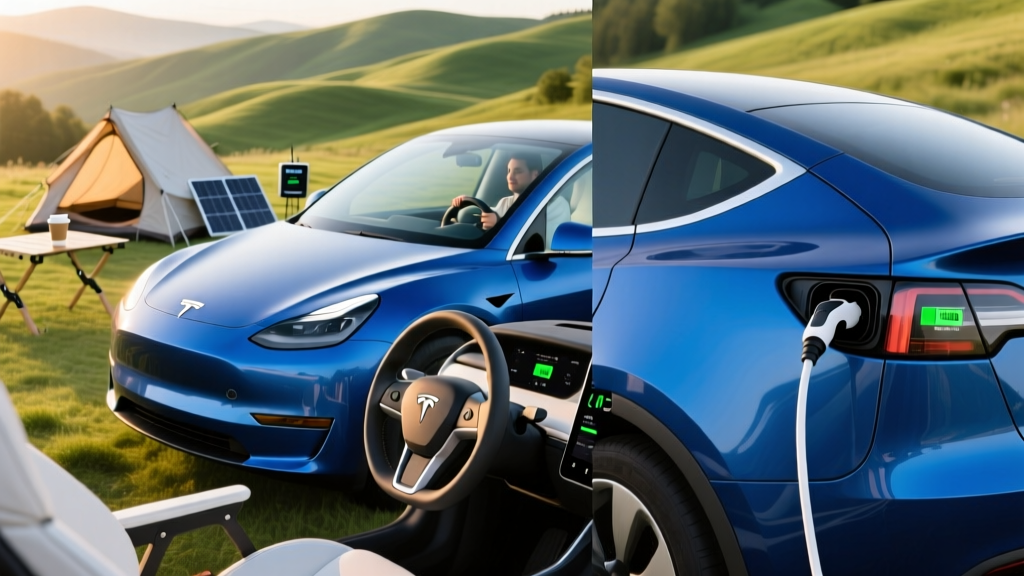
Tesla Party Mode isn't a new vehicle — it's one of the most compelling reasons to own one. This climate-control feature keeps your Tesla's HVAC system running while parked, maintaining cabin temperature, airflow, and even ambient lighting for hours without the car "going to sleep." Originally designed for camping and tailgating, Party Mode has become a defining feature of the Tesla ownership experience, turning the cabin into a climate-controlled lounge, a pet-safe waiting room, or a mobile office.
But running HVAC for hours isn't free. It draws from the same traction battery that powers your drive. In this review, we'll examine exactly how Party Mode affects range and battery state-of-charge (SoC), and then provide a full 2026 Tesla Model Y profile — the vehicle most owners use Party Mode with — covering EPA range, charging speeds, pricing, tax credits, and whether it still earns its spot against rising competition.
What Is Tesla Party Mode and How Does It Work?
Party Mode is a software setting (found under Controls → Safety → Power Off, then toggle "Keep Climate On") that prevents the vehicle from entering its default sleep state when parked. Normally, a Tesla powers down most systems within minutes of the driver exiting. Party Mode overrides this, keeping:
- HVAC compressor and blower active at the set cabin temperature
- Interior lighting available (manual or ambient)
- Infotainment screen powered for music, video, or gaming
- USB ports live for device charging
- 12V auxiliary system maintained by the DC-DC converter from the traction battery
Tesla also offers Camp Mode (a closely related setting) that similarly keeps climate on but defaults the cabin airflow to a gentle, continuous breeze and keeps USB-C ports powered. For practical purposes, Party Mode and Camp Mode consume energy at nearly identical rates — the difference is primarily in airflow behavior and screen timeout settings.
In mild weather (60–75°F / 15–24°C), Party Mode draws roughly 1–2% of battery SoC per hour. In extreme cold (below 32°F / 0°C) with the heat pump working hard, expect 3–5% per hour. On a 75 kWh usable battery, that's approximately 0.75–1.5 kWh per hour in mild conditions, and 2.25–3.75 kWh per hour in deep winter. An 8-hour camping session in 70°F weather will consume roughly 8–12 kWh — about 10–15% of a full Model Y Long Range battery.
2026 Tesla Model Y Long Range AWD — Full Specs
The Model Y remains Tesla's volume leader and the vehicle most associated with Party Mode use. Below are the 2026 Long Range AWD specifications based on EPA data and Tesla's current configurator.
| Specification | 2026 Model Y Long Range AWD |
|---|---|
| EPA Range | 311 miles |
| Battery Capacity | ~75 kWh usable (NMC chemistry) |
| Efficiency | 122 MPGe combined / 28 kWh/100 mi |
| Drivetrain | Dual-motor AWD |
| Horsepower | 384 hp (combined) |
| 0–60 mph | 4.8 seconds |
| Max DC Fast Charge | 250 kW (peak, CCS via NACS adapter or native NACS) |
| 10–80% DCFC Time | ~25 minutes (with battery preconditioning) |
| Level 2 Home Charging | 11.5 kW / 44 mi/hr (48A on Wall Connector) |
| Cargo Volume | 76.2 cu ft (rear seats folded) / 30.2 cu ft (seats up) |
| Rear Legroom | 41.6 inches |
| Towing Capacity | 3,500 lbs (with tow package) |
| Battery/Drive Unit Warranty | 8 years / 120,000 miles (min 70% retention) |
Source: fueleconomy.gov and Tesla Model Y configurator.
Real-World Range: What the EPA Sticker Doesn't Tell You
EPA sticker: 311 miles
Real-world highway (70 mph, 72°F): ~265–280 miles
Real-world mixed city/highway: ~285–300 miles
Cold weather (20°F, highway): ~210–240 miles (30–35% reduction)
With 8-hour Party Mode camping (mild weather): subtract ~35–45 miles of range equivalent
The Model Y Long Range AWD's 311-mile EPA figure assumes a mix of city and highway driving at moderate speeds. Sustained highway travel at 75+ mph increases aerodynamic drag substantially — EVs are disproportionately affected compared to ICE vehicles because they lack multi-gear transmissions to optimize efficiency at speed. Tesla's heat pump (standard on all current Model Y trims) significantly mitigates cold-weather range loss compared to older resistive-heater EVs, but you'll still see a 25–35% reduction in deep winter.
For Party Mode users, the practical math is straightforward: if you arrive at a campsite with 60% SoC (~187 miles of range remaining) on a mild evening, you can comfortably run Party Mode for 8 hours and still have ~50% SoC (~155 miles) the next morning. In sub-freezing conditions, plan for roughly double the energy draw and consider arriving with at least 70–80% SoC.
Charging Speed: DC Fast Charge, Home, and Destination
| Charging Level | Power (kW) | Rate | Notes |
|---|---|---|---|
| Level 1 (120V) | ~1.4 kW | ~5 mi/hr | Emergency/trickle only |
| Level 2 (240V, 48A) | 11.5 kW | ~44 mi/hr | Tesla Wall Connector or equivalent |
| DC Fast (Tesla Supercharger V3) | 250 kW peak | 10–80% in ~25 min | Tapers significantly above 80% |
| DC Fast (non-Tesla CCS) | Up to 250 kW | Varies by station | NACS-to-CCS adapter may be needed at older stations |
A critical nuance for road-trippers and campers: the 250 kW peak is only sustained between roughly 10–30% SoC. The charge curve tapers to ~150 kW by 50% SoC, ~80 kW by 70%, and ~40 kW above 85%. This is why the 10–80% metric matters more than peak kW. Tesla's navigation-based battery preconditioning warms the pack before you arrive at a Supercharger, which is essential for hitting advertised charge speeds — without it, a cold battery may peak at only 100–120 kW.
For Party Mode camping scenarios, Level 2 destination charging at campgrounds (where available) can fully replenish the overnight energy draw of Party Mode in roughly 1–2 hours, making it essentially sustainable for multi-night trips.
Pricing, Trims, and Federal Tax Credit Eligibility
| Trim | Base MSRP | Est. After §30D Credit | Drivetrain / Range |
|---|---|---|---|
| Model Y Long Range AWD | ~$46,630 | ~$39,130* | AWD / 311 mi |
| Model Y Performance | ~$51,630 | ~$44,130* | AWD / 285 mi |
| Model Y Long Range RWD | ~$44,130 | ~$36,630* | RWD / 320 mi |
*Tax credit estimates assume full $7,500 §30D eligibility. Actual credit depends on buyer income, battery sourcing, and MSRP caps. See IRS rules below.
- ✅ MSRP cap: SUVs/vans/pickups must be ≤ $80,000 (Model Y qualifies at all trims)
- ✅ Buyer income cap: Modified AGI ≤ $300,000 (joint) / $225,000 (head of household) / $150,000 (single)
- ⚠️ Battery sourcing: Critical minerals and battery component requirements phase in annually — check IRS.gov §30D guidance for current-year Tesla eligibility, as sourcing changes can reduce the credit to $3,750 or $0 mid-year
- ✅ Point-of-sale transfer: Eligible buyers can apply the credit as an immediate price reduction at delivery rather than waiting for tax filing
- ✅ Assembly: Model Y is assembled at Giga Texas — meets North American final assembly requirement
Tesla's pricing has shifted frequently over the past two years, and the configurator should always be checked for the most current MSRP. Destination and order fees add approximately $1,390–$1,990 to the base price. Full Self-Driving (Supervised) remains a $8,000 add-on or $99/month subscription — it does not affect tax credit eligibility.
Standout Tech: Party Mode, Autopilot, and the Tesla Ecosystem
Party Mode lives within a broader tech suite that remains Tesla's strongest competitive moat:
- Party Mode / Camp Mode: Sustained HVAC while parked, with configurable airflow and screen behavior. Unique among mainstream EVs — most competitors' climate systems shut down within 30 minutes of parking.
- Dog Mode: A related feature that keeps climate on for pets and displays cabin temperature on the exterior screen for passersby.
- 15.4" touchscreen: Netflix, YouTube, arcade games (Cyberpunk 2077-capable on newer hardware), and a full web browser while parked.
- Autopilot (standard): SAE Level 2 adaptive cruise + lane centering. Competent for highway driving but requires hands-on-wheel attention at all times.
- FSD Supervised ($8,000 / $99/mo): Also SAE Level 2 — despite the name, the driver must remain fully engaged and is legally responsible. City-street capability is impressive but not autonomous.
- Sentry Mode: 360° camera recording while parked, with motion-triggered alerts and cloud clips (requires USB storage).
- Over-the-air updates: Tesla pushes feature additions, efficiency improvements, and UI refinements regularly — the car you buy today may gain capabilities tomorrow.
Autopilot and FSD (Supervised) are SAE Level 2 systems. This means the driver must continuously supervise, keep hands available for steering, and remain prepared to take full control at any moment. These are not self-driving systems. Tesla's NHTSA-reported incident data and IIHS evaluations should be reviewed before relying on these features for extended highway stretches.
Who Should Buy the Model Y (and Who Should Look Elsewhere)?
✅ Pros
- Best-in-class Supercharger network access (20,000+ stalls in North America)
- Party Mode / Camp Mode / Dog Mode — sustained parked climate is a genuine differentiator
- 250 kW DCFC with excellent preconditioning = reliable road-trip charging
- Spacious cargo area (76.2 cu ft) with flat load floor — ideal for camping mattresses
- OTA updates continue to add value post-purchase
- Strong resale value relative to most EV competitors
- Qualifies for §30D credit at all trims (subject to sourcing rules)
❌ Cons
- Minimalist interior lacks physical controls — HVAC adjustments require touchscreen interaction
- No Apple CarPlay or Android Auto — Tesla's native infotainment only
- Rear-seat comfort is adequate but not class-leading (vs. Hyundai Ioniq 5, Kia EV6)
- Panel gaps and build-quality inconsistency remain occasional complaints
- FSD Supervised is expensive and still requires full driver attention
- No heads-up display or traditional instrument cluster
- Insurance premiums run 15–25% above comparable non-Tesla EVs
Best For:
- Campers and outdoor enthusiasts — Party Mode + flat cargo floor + Supercharger coverage make it the default overlanding EV
- Tech-forward commuters who value OTA updates, app integration, and the Supercharger ecosystem
- Families needing cargo versatility — 76 cu ft with seats down rivals many midsize SUVs
- Road-trippers who prioritize charging infrastructure reliability over cabin luxury
Consider Instead If:
- You want physical climate knobs and Apple CarPlay → Hyundai Ioniq 5 or Kia EV6
- You prioritize rear-seat luxury and ride quality → BMW iX or Genesis GV60
- You need 3 rows of seating → Kia EV9 or Tesla Model X
- You want maximum range per dollar → Chevrolet Equinox EV (319 mi EPA at ~$33,000 after credit)
Is the Model Y Still Worth It in 2026?
The competitive landscape has shifted dramatically. The Hyundai Ioniq 5 now offers 800V charging (10–80% in ~18 minutes), the Kia EV9 provides three rows, and the Chevrolet Equinox EV undercuts on price. Yet the Model Y retains two structural advantages that competitors haven't matched:
- The Supercharger network — while Tesla has opened access to Ford, Rivian, and others via NACS adapters, native Tesla vehicles still enjoy the most seamless plug-and-charge experience with the largest reliable DCFC footprint.
- Sustained parked-climate features — Party Mode, Camp Mode, and Dog Mode remain uniquely well-executed. Most competitors shut down HVAC within 15–30 minutes of parking, making overnight camping impractical.
If Party Mode and camping capability are priorities on your EV wish list, the Model Y remains the strongest choice in its price segment. If you primarily need a commuter with great charging and don't plan to sleep in your car, the Ioniq 5 and EV6 now offer compelling alternatives with faster peak charging and more conventional interiors.
Frequently Asked Questions
How much battery does Tesla Party Mode use per hour?
In mild weather (60–75°F), expect 1–2% SoC draw per hour (~0.75–1.5 kWh). In freezing conditions with the heat pump active, draw increases to 3–5% per hour. Over an 8-hour night, budget roughly 10–15% SoC in mild weather and 25–40% in deep winter.
Can I use Party Mode while charging at a Supercharger?
Yes. Party Mode works simultaneously with charging — the HVAC draws from incoming charge power, and excess goes into the battery. This is ideal for staying warm or cool during a 20–30 minute charging stop.
Does Party Mode drain the 12V battery?
No. While Party Mode is active, the DC-DC converter continuously maintains the 12V auxiliary battery from the high-voltage traction pack. The 12V battery is only at risk if the traction battery is completely depleted — Tesla will alert you and shut down Party Mode if SoC drops below ~5%.
What's the real-world range of the 2026 Model Y Long Range?
The EPA rates it at 311 miles. Expect ~265–280 miles on sustained highway driving at 70+ mph, ~285–300 miles in mixed city/highway use, and ~210–240 miles in sub-freezing winter conditions. These figures are consistent with independent testing from fueleconomy.gov and third-party evaluators.
Does the 2026 Model Y qualify for the $7,500 federal tax credit?
It qualifies on MSRP (under the $80,000 SUV cap) and is assembled in North America. However, eligibility depends on your income (≤$300K joint / ≤$150K single), and the battery must meet critical-mineral and component sourcing thresholds that change annually. Check the current IRS §30D guidance before purchasing, as Tesla's sourcing compliance can shift mid-year.
How does the Model Y compare to the Hyundai Ioniq 5 for camping?
The Ioniq 5 charges faster (10–80% in ~18 min on 350 kW stations) and offers V2L (vehicle-to-load) to power external devices. However, it lacks a true Party Mode equivalent — its HVAC system does not sustain indefinitely while parked. If overnight cabin climate is your priority, the Model Y wins. If fast charging and V2L matter more, the Ioniq 5 is the stronger pick.
Is Tesla Autopilot self-driving?
No. Autopilot and FSD (Supervised) are both SAE Level 2 driver-assistance systems. You must keep your hands available, eyes on the road, and remain prepared to take full control. Only Level 4 robotaxi services like Waymo operate without a human driver.