Quick Verdict: Still the Benchmark Electric SUV
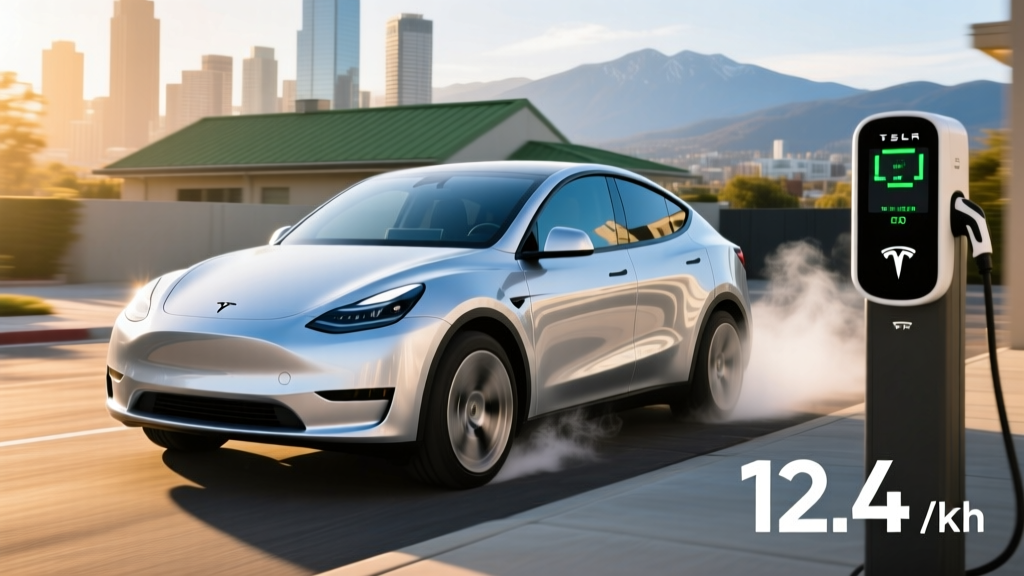
The 2025 Tesla Model Y Performance (officially sold as the Long Range with Performance Package) remains the default answer for buyers who want sports-sedan acceleration in a practical electric crossover. Its 3.5-second 0-60 mph time is legitimately supercar territory, yet it still delivers an EPA-estimated 277 miles of range and 76 cubic feet of cargo space. For 2025, the refreshed "Juniper" update brings a quieter cabin, ventilated seats, and a rear touchscreen — addressing the most common complaints from pre-refresh owners. At a base MSRP of $52,490 (before destination), it undercuts the Porsche Macan Electric and BMW iX on price while outperforming both in a straight line. The question isn't whether it's fast — it's whether the real-world range and charging reality match the spec sheet.
2025 Model Y Performance Specs at a Glance
| Spec | Value |
|---|---|
| EPA Range | 277 miles (with 21" Performance wheels) |
| Battery Capacity | ~78 kWh usable (NMC chemistry) |
| Drivetrain | Dual Motor AWD |
| Horsepower | 456 hp (combined) |
| 0-60 mph | 3.5 seconds |
| Top Speed | 155 mph |
| Max DC Fast Charge | 250 kW peak |
| 10-80% DC Charge Time | ~25 minutes |
| Level 2 Charge Rate | 11.5 kW (~44 miles/hr) |
| Efficiency | 111 MPGe combined / 30 kWh/100mi |
| Cargo Volume | 76 cu ft (rear seats folded) |
| Base MSRP | $52,490 (+$1,390 destination) |
| Battery Warranty | 8 years / 120,000 miles |
Range Reality: EPA Sticker vs. the Real World
Real-World Highway (70 mph, 75°F): ~240-250 miles
Real-World Cold Weather (30°F, mixed driving): ~200-220 miles
Note: The 21" Überturbine wheels on the Performance trim cost roughly 20-30 miles vs. the 19" Long Range setup. If maximum range is your priority, the Long Range AWD (320 miles EPA) is the better pick.
Tesla's efficiency engineering is genuinely best-in-class. The Model Y's heat pump and octovalve thermal management system minimize energy waste, and you'll see that in the 30 kWh/100mi consumption figure — competitive with smaller, lighter EVs. But physics is physics: the Performance trim's sticky 21" Michelin Pilot Sport tires and larger contact patch increase rolling resistance. On a 300-mile road trip at 75 mph in moderate temperatures, expect to arrive with roughly 10-15% SoC remaining, meaning one 20-minute Supercharger stop is mandatory.
Cold weather is where the gap widens. In sustained sub-freezing driving, battery preconditioning helps, but you'll lose 20-30% of rated range depending on cabin heat usage. The heat pump mitigates this better than resistive heating, but 200 miles is a realistic winter highway expectation. For context, that's still more usable range than most competitors in this price bracket.
Charging Speed: Supercharger Network Advantage
| Charging Level | Power | Speed |
|---|---|---|
| Level 1 (120V household) | ~1.4 kW | ~4-5 miles/hr |
| Level 2 (240V, 48A home charger) | 11.5 kW | ~44 miles/hr |
| DC Fast Charge (V3 Supercharger) | 250 kW peak | 10-80% in ~25 min |
| DC Fast Charge (V4 Supercharger) | Up to 250 kW* | Similar curve to V3 |
*V4 Supercharger cabinets can deliver higher power, but the 2025 Model Y's onboard architecture peaks at 250 kW.
The 2025 Model Y Performance uses the NACS (North American Charging Standard) connector natively — no adapter needed at Tesla Superchargers. The charge curve peaks at 250 kW from roughly 10-30% SoC, then tapers progressively: expect ~150 kW at 50%, ~100 kW at 70%, and ~50 kW above 85%. This taper is normal for NMC lithium-ion chemistry and protects long-term battery health, but it means the advertised "250 kW" is a peak, not a sustained rate.
For home charging, a Tesla Wall Connector on a 60A circuit delivers the full 11.5 kW (48A continuous), adding roughly 44 miles per hour of charging. An overnight 8-hour session restores ~350 miles — more than enough for any daily driving. Installation typically runs $500-$2,000 depending on panel proximity and whether a 200A service upgrade is needed.
The Supercharger network remains Tesla's strongest ownership advantage. As of early 2025, there are over 6,500 Superchargers in North America, with V3 and V4 stations offering reliable plug-and-charge functionality. Per Tesla's Supercharger page, typical pricing ranges from $0.25-$0.40/kWh depending on location and time of day, making a 10-80% top-up roughly $15-$25.
Performance: 3.5 Seconds Changes How You Drive
The 0-60 time is the headline, but the dual-motor AWD system's instant torque delivery is what reshapes daily driving. There's no turbo lag, no transmission downshift, no drama — just immediate, linear acceleration from any speed. Merging onto a 70-mph freeway requires roughly half the gap you'd need in a gas crossover. The Performance Package includes a lowered sport suspension, performance brakes, and 21" wheels with Michelin Pilot Sport 4S tires, giving genuinely capable cornering grip for a 4,400-lb vehicle.
Track Mode (available via software) lets you adjust front/rear torque bias and regenerative braking intensity — a feature lifted from the Model 3 Performance. It's a party trick for most owners but demonstrates the software-defined flexibility of Tesla's powertrain. In everyday driving, the standard "Chill" mode limits torque to something more manageable for stoplight-to-stoplight commuting, while "Sport" unleashes the full 456 hp.
One honest drawback: the sport suspension is firm. You'll feel sharp pavement imperfections more than in the standard Long Range trim, and the 21" low-profile tires are more susceptible to pothole damage. If your commute includes poorly maintained roads, the Long Range AWD with 19" wheels offers a noticeably more compliant ride.
Interior, Tech, and Daily Livability
The Juniper refresh transformed the Model Y interior from "minimalist to a fault" to genuinely premium. Key 2025 updates include:
- Ambient lighting strips across the dashboard and doors
- Ventilated front seats (heated front and rear standard)
- Rear 8" touchscreen for rear passengers (HVAC, entertainment)
- Acoustic glass on all windows — cabin noise reduced significantly
- Power-folding second-row seats (60/40 split)
- Updated center console with wireless charging and improved cupholders
The 15.4" center touchscreen runs Tesla's proprietary OS, which remains the most responsive and feature-rich infotainment system in any EV. Navigation with real-time Supercharger routing, Netflix/YouTube streaming while parked, and over-the-air updates that add features post-purchase are all standard. The removal of turn signal stalks (replaced by steering-wheel buttons) and the lack of a traditional instrument cluster still divide opinion — plan on a 1-2 week adaptation period if you're coming from a conventional vehicle.
Cargo space: 26.6 cu ft behind the second row, expanding to 76 cu ft with seats folded. The front trunk (frunk) adds 4.1 cu ft — useful for charging cables or a small bag. Rear legroom measures 41.6 inches, competitive with midsize crossovers. Two adults and a child seat fit comfortably; three adults across the rear bench is tight for long trips.
Driver Assistance: Autopilot and FSD Supervised
Both Autopilot and FSD (Supervised) require continuous driver attention. You must keep your hands on the wheel and eyes on the road. This is not self-driving — it is an advanced driver-assistance system.
Standard Basic Autopilot includes Traffic-Aware Cruise Control and Autosteer (lane centering) and works well on well-marked highways. The optional FSD (Supervised) package ($8,000 one-time or $99/month as of 2025) adds automatic lane changes, traffic light and stop sign recognition, and city-street autosteer. FSD has improved substantially with the v12 neural-network-based architecture, but it still makes errors — phantom braking, occasional missed turns, and inconsistent behavior in construction zones remain documented issues. Per NHTSA guidance, the driver remains fully responsible for vehicle operation at all times.
For most buyers, Basic Autopilot is sufficient. FSD is worth considering only if you have a long, repetitive highway commute and understand its limitations.
Pricing, Tax Credit, and Ownership Cost
| Item | Amount |
|---|---|
| Base MSRP (Long Range w/ Performance Pkg) | $52,490 |
| Destination Fee | $1,390 |
| FSD (Supervised) Add-On | +$8,000 |
| As-Tested Price (with FSD) | $61,880 |
| Federal Tax Credit (§30D, if eligible) | Up to $7,500 |
| Effective Price (after max credit) | ~$46,380 |
The 2025 Model Y qualifies for the full $7,500 federal EV tax credit under IRS §30D for eligible buyers. Per IRS guidelines, eligibility requires:
- Modified adjusted gross income (MAGI) below $150,000 (single) / $300,000 (joint)
- Vehicle MSRP below $80,000 (SUVs/trucks) — the Model Y qualifies at all trims
- Battery critical minerals and components must meet North American sourcing thresholds (2025 rules: 60% critical minerals, 75% battery components)
- The credit can be transferred to the dealer at point of sale as an immediate price reduction
Tesla's US-made battery supply chain currently satisfies these requirements, but sourcing rules tighten annually. Always verify current eligibility on fueleconomy.gov before purchasing, as component sourcing can shift mid-year.
5-year ownership cost estimate: Assuming 12,000 miles/year, $0.13/kWh home charging, and $0.32/kWh occasional DC fast charging, annual fuel cost is roughly $650-$800 — compared to $2,200-$2,800 for a comparable gas crossover at 25 MPG and $3.50/gallon. Insurance runs higher than average ($1,800-$2,400/year depending on state and driving record) due to Tesla's repair-cost profile. Maintenance is minimal: cabin air filter, tire rotation, wiper fluid. No oil changes, no brake pad replacement (regen braking saves friction brakes). Total 5-year savings vs. a gas equivalent: roughly $8,000-$12,000 after accounting for the higher purchase price.
Pros and Cons
Pros
- 3.5-second 0-60 is supercar-fast in a family crossover
- Supercharger network reliability is unmatched
- Best-in-class efficiency (30 kWh/100mi)
- Juniper refresh fixed cabin noise and seat comfort
- 76 cu ft cargo space with flat load floor
- Over-the-air updates add features over time
- $7,500 tax credit eligible (point-of-sale transfer)
Cons
- Performance 21" wheels reduce range by 20-30 miles vs Long Range
- Firm sport suspension transmits road imperfections
- FSD ($8,000) remains Level 2 — not truly autonomous
- No Apple CarPlay or Android Auto
- Turn-signal buttons on steering wheel require adaptation
- Insurance premiums above segment average
- 250 kW peak DC charge is slower than Hyundai/Kia's 800V platforms
Who Should Buy the 2025 Model Y Performance?
- You want maximum acceleration without sacrificing cargo space or range
- You have access to home Level 2 charging (garage or driveway)
- You road-trip frequently and value Supercharger network coverage
- You appreciate software-driven features and OTA updates
- Maximum range (320 miles EPA) matters more than 0-60 time
- Your daily roads are rough — the 19" wheels ride much better
- You want to save $4,500 on the purchase price
- You prefer traditional dealer service and physical controls
- You need 800V charging (Ioniq 5 peaks at ~350 kW on compatible chargers)
- Apple CarPlay integration is non-negotiable
Frequently Asked Questions
What is the real-world range of the 2025 Model Y Performance?
The EPA rates it at 277 miles. In real-world highway driving at 70 mph and moderate temperatures, expect 240-250 miles. In cold weather (below freezing), plan for 200-220 miles depending on cabin heat usage and trip length. Battery preconditioning before Supercharger stops helps mitigate cold-weather losses.
How fast does it charge at home and on the road?
At home on a 240V/48A Level 2 charger, it adds ~44 miles per hour (11.5 kW). An overnight charge fully replenishes the battery. On a V3 Tesla Supercharger, it peaks at 250 kW and charges from 10-80% in approximately 25 minutes. The charge curve tapers significantly above 80% — avoid charging past 80% on road trips unless necessary, as the last 20% can add 15-20 minutes.
Does the 2025 Model Y qualify for the $7,500 federal tax credit?
Yes, as of early 2025, the Model Y qualifies for the full $7,500 §30D credit, provided the buyer meets income requirements (under $150K single / $300K joint MAGI) and the vehicle's battery sourcing meets critical-mineral and component thresholds. The credit can be applied as a point-of-sale reduction through the dealer. Verify current eligibility on fueleconomy.gov before purchasing, as sourcing rules update annually.
Is the Model Y Performance worth it over the Long Range?
If acceleration and sport handling matter to you, yes — the 3.5-second 0-60 and performance brakes are genuinely thrilling. If you prioritize maximum range, ride comfort, and value, the Long Range AWD at $47,990 with 320 miles EPA is the more practical choice. The Performance Package is a $4,500 premium for speed and aesthetics, not efficiency.
How does it compare to the Hyundai Ioniq 5 N and Porsche Macan Electric?
The Ioniq 5 N offers more engaging driver dynamics and 800V charging (~350 kW peak) at a similar price (~$67,000), but has less range (260 miles EPA) and no Supercharger access. The Porsche Macan Electric starts at ~$78,000, offers superior build quality, but is slower (3.7 sec 0-60 for the 4S) and more expensive. The Model Y wins on value, range, and charging infrastructure.
What is the battery warranty?
Tesla covers the Model Y battery and drive unit for 8 years or 120,000 miles (whichever comes first), with a minimum 70% capacity retention threshold. If the battery degrades below 70% SoH within the warranty period, Tesla will repair or replace it. Real-world data from Tesla's 2024 Impact Report shows average battery degradation of ~12% at 150,000 miles for NMC packs — well within the warranty buffer.