Quick Verdict: The Model Y Is Surprisingly Capable Off-Pavement
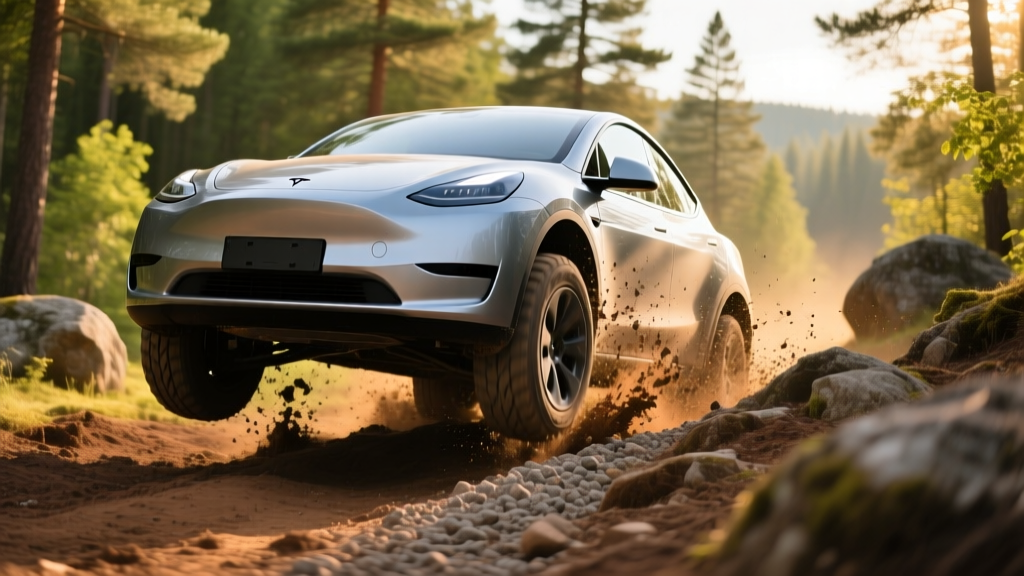
When Tesla launched the Model Y, few buyers considered it for anything beyond suburban commuting and grocery runs. But search interest in "model y offroad" has grown steadily, and for good reason: with available dual-motor all-wheel drive, 6.6 inches of ground clearance, and instant torque delivery, the Model Y Long Range AWD handles light-to-moderate trails better than most expect. It's no Jeep Wrangler, but for forest service roads, snowy mountain passes, and gravel camping routes, it delivers competent capability while maintaining 300+ miles of EPA range.
This review evaluates the 2025 Tesla Model Y Long Range AWD specifically for off-pavement use cases, while providing the full ownership picture—range, charging, cost, and how it stacks up against rugged EV competitors like the Rivian R1S and Ford Bronco Sport hybrid.
Range, Efficiency, and Real-World Expectations
EPA Estimated Range: 311 miles (Long Range AWD, 19" wheels)
Real-World Highway: ~275-295 miles at 70-75 mph
Off-Road/Trail Range: ~240-270 miles (low-speed technical terrain, elevation changes)
Cold Weather (below 32°F): Expect 20-30% reduction, ~220-250 miles
The Model Y Long Range AWD uses an 81 kWh battery pack (75 kWh usable) with NMC (nickel manganese cobalt) chemistry. NMC offers higher energy density than LFP, which is why Tesla reserves it for Long Range and Performance trims—the Standard Range RWD uses LFP for cost savings and cycle longevity but sacrifices ~50 miles of range.
For off-road use, range anxiety is legitimate but manageable. Low-speed trail driving actually consumes less energy than highway cruising because regenerative braking recaptures energy on descents, and you're not fighting aerodynamic drag. However, climbing steep grades at low speed without regen recovery opportunities can spike consumption to 400-500 Wh/mile (versus the EPA-rated 279 Wh/mile combined). Plan off-road routes with charging stops if you'll exceed 200 miles round-trip from home.
Efficiency ratings from fueleconomy.gov show 122 MPGe combined (city 127 / highway 117), or 27 kWh per 100 miles. That's best-in-class for an AWD electric SUV—the Rivian R1S Dual-Motor achieves 111 MPGe combined.
Charging Speed: Fast Enough for Trailhead Access
| Charging Level | Power (kW) | Charge Time | Miles Added per Hour |
|---|---|---|---|
| Level 1 (120V household) | 1.4 kW | N/A (trickle) | 3-4 miles/hour |
| Level 2 (240V home/public) | 11.5 kW (48A) | ~8 hours (0-100%) | 37 miles/hour |
| DC Fast Charge (V3 Supercharger) | 250 kW peak | 15-18 min (10-80%) | ~175 miles in 15 min |
| DC Fast Charge (CCS adapter, non-Tesla) | ~150-170 kW typical | 22-28 min (10-80%) | Varies by station |
The Model Y's 250 kW peak DC fast-charging capability is excellent, but real-world charging curves matter more than peak numbers. The battery management system limits charge rate above 80% state-of-charge to protect cell longevity—expect the rate to taper from 250 kW down to 50-60 kW in the 80-100% range. That's why we quote 10-80% times rather than 0-100%.
For off-road trips, Tesla's Supercharger network is a major advantage. As of 2025, there are over 6,000 Supercharger stations in North America, and many are located near national forests, ski resorts, and trailheads. The native NACS (North American Charging Standard) connector means no adapter needed at Tesla stations. For Electrify America, EVgo, or other CCS networks, you'll need Tesla's $250 CCS adapter (available in the Tesla shop).
Home charging at 11.5 kW (48 amps on a 60-amp circuit) is standard with the Tesla Wall Connector. Installation typically costs $800-2,000 depending on panel proximity and whether your electrical panel needs an upgrade. Most off-road enthusiasts charge overnight at home and start trail days with a full battery, which is the most cost-effective and convenient approach.
Off-Road Capability: What the Model Y Can and Cannot Do
The Model Y Long Range AWD uses dual independent motors—one front, one rear—with torque vectoring that can send power to individual wheels. This provides excellent traction on loose surfaces like gravel, snow, and sand. The instant torque delivery (no transmission lag) is ideal for technical low-speed crawling, and the low center of gravity from the under-floor battery pack reduces rollover risk compared to body-on-frame SUVs.
Ground clearance: 6.6 inches (unladen). This is adequate for most forest service roads and maintained dirt trails but insufficient for rock crawling or deeply rutted terrain. For comparison, the Rivian R1S offers 14.9 inches in max ride height, and the Subaru Outback Wilderness provides 9.5 inches.
Approach/departure angles: 17.8° approach, 20.0° departure. These are modest numbers—the Model Y's car-like crossover design prioritizes aerodynamics over off-road geometry. You'll need to pick careful lines on steep inclines to avoid scraping the front bumper or rear diffuser.
Traction modes: Tesla's software includes "Off-Road Assist" (accessible via the touchscreen under Controls > Driving > Off-Road Assist). This mode adjusts throttle response, regenerative braking, and traction control for loose surfaces. It's not a low-range transfer case, but it does improve predictability on gravel and snow.
Tire considerations: The stock 19" Gemini wheels come with all-season tires that are adequate for light trails but not aggressive mud or rock terrain. Many Model Y off-road enthusiasts upgrade to all-terrain tires (like the Falken Wildpeak A/T Trail in 255/45R19) for better puncture resistance and traction. Tesla doesn't offer a factory off-road tire package, so this is an aftermarket modification.
Water fording: Tesla does not publish an official water fording depth, and submerging the battery pack or electric motors is not covered under warranty. Avoid water crossings deeper than the lower door sill (~8-10 inches). Rivian rates the R1S for 43 inches of water fording—this is not the Model Y's strength.
Performance and Drivetrain Specs
| Drivetrain | Dual-motor AWD |
| Horsepower | 384 hp combined (front + rear) |
| Torque | 376 lb-ft combined |
| 0-60 mph | 4.8 seconds |
| Top Speed | 135 mph |
| Battery Capacity | 81 kWh total / 75 kWh usable |
| Battery Chemistry | NMC (nickel manganese cobalt) |
| EPA Range | 311 miles (19" wheels) |
| Towing Capacity | 3,500 lbs (with factory tow package) |
| Cargo Volume | 30.2 cu ft (rear seats up) / 72.1 cu ft (rear seats folded) |
| Ground Clearance | 6.6 inches |
The dual-motor setup provides redundant traction—if one axle loses grip, the other can compensate instantly. This is superior to mechanical AWD systems that rely on differentials and driveshafts. The 384 hp and 376 lb-ft of torque are more than sufficient for trail obstacles, and the linear power delivery makes throttle modulation precise.
Towing capacity of 3,500 lbs is adequate for small camping trailers, ATVs, or a pair of dirt bikes, but falls short of the Rivian R1S (7,700 lbs) or Ford F-150 Lightning (10,000 lbs). If you're towing a heavy overlanding trailer, the Model Y isn't the right tool.
Pricing, Tax Credits, and Total Cost
| Trim | MSRP | Federal Tax Credit (§30D) | Effective Price |
|---|---|---|---|
| Long Range RWD | $44,990 | $7,500 (if eligible) | $37,490 |
| Long Range AWD | $47,990 | $7,500 (if eligible) | $40,490 |
| Performance AWD | $51,490 | $7,500 (if eligible) | $43,990 |
Federal tax credit eligibility (IRS §30D): The Model Y qualifies for the full $7,500 credit if you meet all requirements: adjusted gross income below $150,000 (single) / $300,000 (married filing jointly), and the vehicle is used primarily in the United States. As of 2025, the Model Y is assembled in Fremont, California, and meets battery component and critical mineral sourcing requirements under current IRS guidelines. However, sourcing rules tighten annually—verify eligibility on the IRS website before purchase, as Tesla's supply chain can shift.
Starting in 2024, you can transfer the credit to the dealer at point-of-sale, reducing your purchase price directly rather than waiting for a tax refund. This makes the effective price $40,490 for the Long Range AWD at purchase, not after filing taxes.
For off-road use, budget an additional $1,200-2,000 for all-terrain tires and potentially $500-1,000 for underbody skid plates (aftermarket, as Tesla doesn't offer factory rock sliders or skid plates for the Model Y).
Interior, Tech, and Daily Livability
The Model Y's minimalist interior is polarizing—everything routes through the 15.4" center touchscreen, including climate controls, glovebox release, and mirror adjustments. There's no instrument cluster, no heads-up display, and no physical buttons for common functions. For off-road use, this is a drawback: adjusting regen braking or checking a camera view requires taking your eyes off the trail to tap a screen.
Driver assistance: Tesla's Autopilot (standard) provides adaptive cruise control and lane-keeping assist, classified as SAE Level 2—you must remain engaged with hands on the wheel and eyes on the road. Full Self-Driving (Supervised) adds automatic lane changes, traffic light recognition, and navigation on autopilot, but it's still Level 2, not autonomous. FSD costs $8,000 upfront or $99/month and is not useful off-road (it's designed for paved roads with clear lane markings).
Cargo and passenger space: The Model Y offers 30.2 cubic feet behind the rear seats (expandable to 72.1 cu ft with seats folded) plus a 4.1 cu ft front trunk (frunk). Rear legroom is 41.6 inches, which is generous for adults. The flat load floor and wide hatch opening make it practical for camping gear, coolers, and recovery equipment. However, there's no roof rack from the factory—Tesla offers cross bars ($350) for roof-top tents or cargo boxes.
Notable drawbacks for off-road use: No spare tire (Tesla provides a tire repair kit and roadside assistance). Limited ground clearance and approach/departure angles. No factory underbody protection. Touchscreen-dependent controls are frustrating on bumpy trails. No low-range gearing or locking differentials (though the dual-motor torque vectoring compensates somewhat).
Warranty and Long-Term Reliability
Tesla provides a 4-year/50,000-mile basic vehicle warranty and an 8-year/120,000-mile battery and drive unit warranty. The battery warranty guarantees at least 70% capacity retention over 8 years or 120,000 miles—below that threshold, Tesla will repair or replace the pack. NMC batteries typically degrade 10-15% over 150,000 miles based on real-world data from Tesla owners, which is within the warranty coverage.
For off-road use, be aware that suspension components, wheels, and tires are considered wear items and are not covered under warranty for damage from trail use. If you bend a control arm on a rock or puncture a tire, that's out-of-pocket. Tesla's roadside assistance covers towing to the nearest service center for 4 years/50,000 miles, but if you're stuck on a remote trail, you'll need a third-party recovery service or satellite communicator (like a Garmin inReach) to call for help.
Long-term reliability data from Consumer Reports and J.D. Power shows the Model Y has average-to-below-average reliability ratings, with common issues including panel gaps, paint defects, and suspension noise. Tesla's service network is expanding, but wait times for non-critical repairs can stretch to weeks in some markets. For a vehicle you'll use off-road, consider an extended warranty or third-party service contract.
Competitor Comparison: Model Y vs. Rivian R1S vs. Ford Bronco Sport
The Model Y occupies a unique space: it's a car-based crossover that can handle light trails, not a purpose-built off-roader. Here's how it compares to alternatives:
Rivian R1S Dual-Motor: 352 miles EPA range, $79,900 MSRP (before $7,500 credit), 14.9" ground clearance, 7,700-lb towing, true off-road capability with quad-motor option. The R1S is vastly more capable off-road but costs nearly double and has lower efficiency (111 MPGe vs. 122 MPGe). Choose Rivian if off-road performance is the priority.
Ford Bronco Sport Badlands (hybrid): Not fully electric, but the 2025 Bronco Sport offers a 1.5L hybrid powertrain with ~35 MPG combined, $38,000 MSRP, 8.8" ground clearance, and serious off-road hardware (locking rear differential, terrain modes). It's less efficient than the Model Y and has no electric-only range, but it's more capable on technical trails and costs less upfront. Choose Bronco Sport if you need serious off-road chops without range anxiety.
Subaru Outback Wilderness (gas): 26 MPG combined, $40,000 MSRP, 9.5" ground clearance, standard AWD, and proven reliability. It's not electric, but it's the benchmark for affordable off-road wagons. Choose Outback if you want simplicity and don't want to deal with charging logistics on remote trails.
The Model Y makes sense for buyers who want an EV for daily commuting and occasional light off-road use—think weekend forest service roads, snowy ski trips, or gravel camping access. It's not a rock crawler, and it shouldn't be your only vehicle if you regularly tackle challenging terrain.
Pros and Cons
Pros
- 311 miles EPA range is best-in-class for AWD electric SUVs
- Dual-motor AWD with instant torque delivery provides excellent traction on loose surfaces
- Low center of gravity reduces rollover risk vs. body-on-frame SUVs
- Tesla Supercharger network is the most reliable and extensive in North America
- 250 kW DC fast charging (10-80% in ~18 minutes) minimizes trailhead wait times
- $7,500 federal tax credit brings effective price to ~$40,490 for Long Range AWD
- Spacious cargo area (72.1 cu ft) with flat load floor for camping gear
- Low operating costs: ~$0.04-0.06 per mile on home charging vs. $0.15-0.20 for gas SUVs
Cons
- 6.6" ground clearance is insufficient for technical rock crawling or deep ruts
- Modest approach/departure angles (17.8°/20.0°) limit steep incline capability
- No factory underbody skid plates or rock sliders—aftermarket only
- Touchscreen-dependent controls are frustrating and unsafe on bumpy trails
- No spare tire—only tire repair kit and roadside assistance
- Water fording depth is limited and not covered under warranty
- 3,500-lb towing capacity is low for overlanding trailers or heavy gear haulers
- Service network can have long wait times for non-critical repairs
Who Should Buy the Model Y for Off-Road Use?
Buy the Model Y Long Range AWD if: You want an electric SUV for daily commuting (90% paved roads) that can handle weekend forest service roads, gravel camping access, snowy mountain passes, and light trail duty. You have home charging access, live within 200 miles of your typical off-road destinations, and prioritize efficiency and low operating costs over extreme off-road capability.
Look elsewhere if: You regularly tackle technical rock crawling, deep mud, or water crossings. You need to tow heavy overlanding trailers (5,000+ lbs). You want a purpose-built off-roader with factory skid plates, locking differentials, and 10+ inches of ground clearance. You frequently drive in remote areas with no charging infrastructure and can't afford range anxiety.
The Model Y is a competent light off-roader that excels as a daily driver first, trail vehicle second. For most buyers searching "model y offroad," that's exactly the right balance.
FAQ
Can the Tesla Model Y go off-road?
Yes, the Model Y Long Range AWD can handle light-to-moderate off-road terrain including gravel roads, snow, sand, and maintained dirt trails. Its 6.6" ground clearance and dual-motor AWD provide adequate traction for forest service roads and camping access, but it's not designed for technical rock crawling or deep water crossings.
What is the ground clearance of the Tesla Model Y?
The 2025 Tesla Model Y has 6.6 inches of ground clearance (unladen). This is lower than dedicated off-road SUVs like the Rivian R1S (14.9") or Subaru Outback Wilderness (9.5") but typical for car-based crossovers.
Does the Model Y have off-road driving modes?
Yes, Tesla includes "Off-Road Assist" mode, which adjusts throttle response, regenerative braking, and traction control for loose surfaces. Access it via Controls > Driving > Off-Road Assist on the touchscreen.
Can I put all-terrain tires on the Model Y?
Yes, many owners upgrade to all-terrain tires like the Falken Wildpeak A/T Trail (255/45R19) for better puncture resistance and off-road traction. This is an aftermarket modification—Tesla doesn't offer factory off-road tires.
How much range does the Model Y lose off-road?
Off-road driving typically reduces range by 15-25% compared to EPA estimates due to elevation changes, low-speed climbing, and increased rolling resistance. Expect 240-270 miles of range on technical trails versus 311 miles EPA combined.
Does the Model Y qualify for the $7,500 federal tax credit?
Yes, the 2025 Model Y qualifies for the full $7,500 federal tax credit under IRS §30D if you meet income requirements (below $150,000 single / $300,000 married filing jointly). The credit can be transferred to the dealer at point-of-sale, reducing your purchase price directly.
Is the Model Y good for overlanding?
The Model Y is adequate for light overlanding (car camping on maintained dirt roads) but not ideal for remote, multi-day expeditions. Limited ground clearance, no spare tire, and charging logistics in remote areas are constraints. Consider a Rivian R1S or traditional SUV for serious overlanding.
What's the towing capacity of the Model Y?
The 2025 Tesla Model Y can tow up to 3,500 lbs with the factory tow package ($1,000 option). This is sufficient for small camping trailers, ATVs, or dirt bikes but insufficient for heavy overlanding trailers or boats.