Quick Verdict: Who Should Buy the 2025 Electric Hummer?
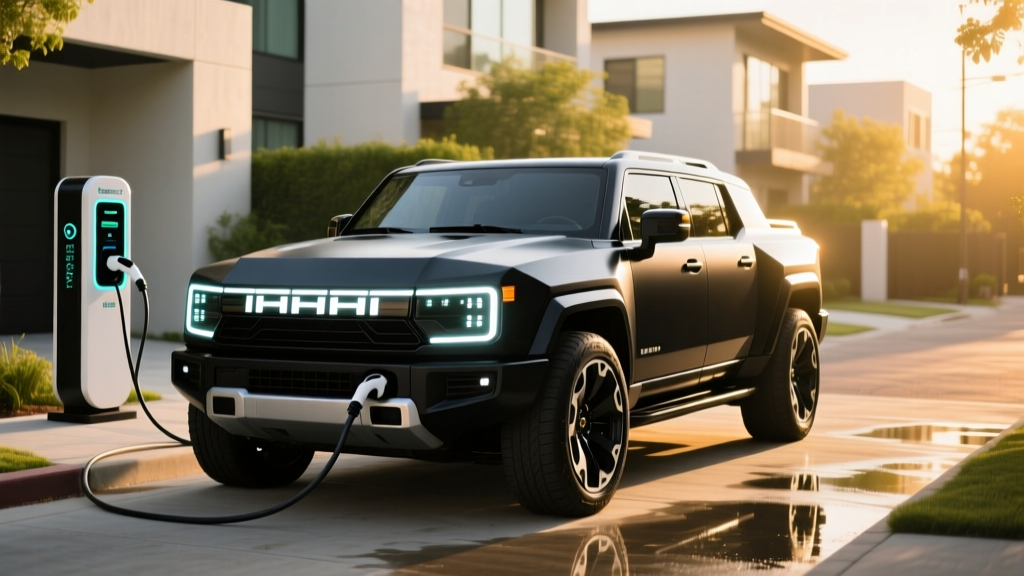
The 2025 GMC Hummer EV is a 9,000-pound electric supertruck that delivers a 314-mile EPA range (Pickup Edition 1), up to 1,000 horsepower, and 350 kW DC fast charging. Starting around $98,545 for the 2X pickup and climbing past $110,000 for the Edition 1 SUV, it is not an efficiency play — it's a statement vehicle with genuine off-road capability and surprisingly rapid charging for a 212 kWh battery. Buy it if you need a massive tow-capable electric truck, have access to a Level 2 home charger (ideally 80A), and value performance over efficiency. Skip it if you prioritize cost-per-mile, live in an apartment without charging access, or want a practical daily commuter.
2025 Hummer EV Lineup: Trims, Pricing, and EPA Range
GMC restructured the Hummer EV lineup for the 2025 model year, simplifying what was previously a confusing array of Edition 1 reservations and launch packages. Both the pickup and SUV body styles remain available, sharing the same Ultium-based platform but differing in wheelbase, range, and cargo utility.
| Trim / Body | Base MSRP | EPA Range | Battery (usable) | Horsepower | 0-60 mph | Max DC Charge |
|---|---|---|---|---|---|---|
| 2X Pickup | $98,545 | 314 mi | ~175 kWh (NMC) | 655 hp | ~4.0 sec | 350 kW |
| 3X Pickup (Tri-Motor) | $119,995 | 298 mi | ~212 kWh (NMC) | 830 hp | ~3.0 sec | |
| Edition 1 Pickup | $110,295 | 314 mi | ~212 kWh (NMC) | 1,000 hp (Watts to Freedom) | ~3.0 sec | |
| 2X SUV | $99,745 | 314 mi | ~175 kWh (NMC) | 655 hp | ~4.5 sec | |
| 3X SUV | $104,995 | 298 mi | ~212 kWh (NMC) | 830 hp | ~3.5 sec |
All prices exclude the $1,995 destination charge. The Edition 1 includes the Extreme Off-Road Package with underbody armor, adaptive air suspension, and CrabWalk four-wheel steering as standard. The 3X tri-motor variants add a rear dual-motor setup for torque vectoring and the Watts to Freedom launch mode.
Source: GMC Hummer EV official specs
Real-World Range: What the EPA Sticker Doesn't Tell You
EPA vs. Reality
EPA sticker: 314 miles (2X Pickup)
Real-world highway (70-75 mph, 65°F): ~250–270 miles
Cold weather (20°F, highway): ~195–220 miles
Towing (5,000-lb trailer, mixed): ~150–180 miles
The Hummer EV's massive frontal area and 9,000-pound curb weight punish efficiency at highway speeds. EPA testing includes a generous city-cycle weighting where regenerative braking recovers energy, inflating the combined figure. On a flat interstate run at 75 mph, expect consumption around 55–60 kWh/100mi — roughly half the efficiency of a Tesla Model Y or Hyundai Ioniq 5.
Cold weather compounds the problem. The Ultium battery pack uses a liquid thermal management system, but heating a 212 kWh pack from cold-soaked temperatures consumes substantial energy before you even start driving. Preconditioning the battery while plugged in is essential in sub-freezing climates — it can recover 15–25 miles of range that would otherwise be lost to cabin and battery heating.
Towing is where the Hummer EV's range collapses most dramatically. At its 7,500-pound max tow rating (pickup), range effectively halves. If you plan to tow a boat or camper more than 80 miles one-way, you need a destination charger or must accept a mid-route DC fast-charge stop.
Charging the Hummer EV: Speed, Infrastructure, and Home Setup
The Hummer EV supports up to 350 kW DC fast charging on 800V-capable infrastructure — one of the fastest peak rates among production trucks. However, peak rate is not sustained rate. Here's what charging actually looks like across levels:
| Level | Power (kW) | Miles Added per Hour | 10-80% Time (212 kWh pack) | Use Case |
|---|---|---|---|---|
| Level 1 (120V, 12A) | ~1.4 kW | ~2–3 mi/hr | ~150+ hours | Emergency trickle only |
| Level 2 (240V, 48A) | ~11.5 kW | ~18–20 mi/hr | ~18–20 hours | Standard home (overnight insufficient for full charge) |
| Level 2 (240V, 80A) | ~19.2 kW | ~30–33 mi/hr | ~11–12 hours | Recommended home setup |
| DC Fast (350 kW peak) | 350 kW → tapering | ~500+ mi/hr (peak) | ~35–45 minutes | Road trips |
The charging curve matters enormously here. The 212 kWh pack can accept 350 kW at low states of charge (10–30%), but charging speed tapers significantly above 60% SoC to protect the NMC cells. Expect a 10–80% session at a 350 kW Electrify America or EVgo station to take roughly 35–45 minutes, not the 12 minutes a naive kW ÷ kWh calculation might suggest.
At home, the Hummer EV's onboard charger accepts up to 19.2 kW (80A) on a hardwired Level 2 circuit. This requires a 100-amp dedicated breaker — meaning many homes with 100A or even 150A main panels will need a panel upgrade ($1,500–$3,500) before installation. Budget $800–$1,500 for the EVSE (charger unit) and $1,200–$3,000 for electrician labor and permits, depending on run length from panel to garage.
The Hummer EV uses the CCS1 connector for DC fast charging. As of 2025, GM has committed to Supercharger network access for GM EVs via an included NACS adapter, expanding the public fast-charging network substantially for road trips.
Cost of Ownership: Hummer EV vs. Gas Hummer H2 vs. Rivian R1T
The most common comparison shoppers make is against the last gas Hummer (H2, discontinued 2009, 10–12 MPG combined) or the current Rivian R1T. Here's a 5-year cost projection assuming 12,000 miles/year, $0.14/kWh home electricity, $3.50/gallon gas, and DC fast charging at $0.45/kWh for 20% of miles:
| Category | Hummer EV 2X Pickup | Rivian R1T Dual-Motor | Gas Hummer H2 (used) |
|---|---|---|---|
| Purchase Price | $98,545 | $75,900 | $18,000 (used market) |
| Federal Tax Credit (§30D) | Up to $7,500* | Up to $7,500* | $0 |
| Fuel/Energy (5 yrs) | $7,800 | $6,100 | $21,000 |
| Maintenance (5 yrs) | $1,800 | $1,600 | $5,500 |
| Insurance (5 yrs est.) | $14,500 | $10,200 | $6,500 |
| Estimated Depreciation (5 yrs) | $42,000 | $32,000 | $5,000 |
| 5-Year Total Cost | ~$157,645 | ~$115,800 | ~$46,000 |
*Federal tax credit eligibility under IRS §30D depends on buyer income caps ($300k joint / $150k single), MSRP caps ($80k for trucks — the Hummer EV exceeds this cap and does NOT qualify for the new-vehicle credit), and battery sourcing requirements. See IRS clean vehicle credit rules. The Hummer EV may qualify for the used EV credit (up to $4,000) on the secondary market once eligible models appear.
The numbers reveal the Hummer EV's ownership paradox: energy costs are a fraction of the gas H2's, but the purchase premium, steep depreciation on a six-figure niche vehicle, and high insurance premiums dominate the total cost. Compared to the Rivian R1T, you're paying roughly $40,000 more over five years for the Hummer badge, CrabWalk, and a larger battery.
Myths vs. Facts: Common Hummer EV Misconceptions
| Myth | Fact |
|---|---|
| "It gets the $7,500 federal tax credit." | The Hummer EV's MSRP exceeds the §30D truck cap of $80,000. It does not qualify for the new-vehicle credit. Only the used-EV credit may apply on resale. |
| "314 miles of range means I can road-trip without planning." | Real highway range is ~250–270 miles; towing cuts it to ~150–180 miles. You still need to plan DC fast-charge stops on trips over 200 miles. |
| "I can charge it overnight on a standard outlet." | Level 1 (120V) adds only ~2–3 miles per hour. A full charge from 10% would take over 6 days. A 240V Level 2 charger is effectively mandatory. |
| "1,000 horsepower makes it the fastest truck ever." | The Watts to Freedom mode delivers ~3.0-second 0-60 times, which is extraordinary for a 9,000-lb vehicle. But a Tesla Model S Plaid or Rivian R1T Quad-Motor posts similar or faster times at lower weight and price. |
| "The battery will need replacing in a few years." | GM covers the Ultium battery for 8 years / 100,000 miles against defects and capacity loss below 60%. NMC degradation data from similar GM packs suggests 10–15% loss over 150,000 miles under normal use. |
| "Super Cruise means it drives itself." | Super Cruise is an SAE Level 2 driver-assist system. It requires your attention, monitors your eyes, and only operates on pre-mapped divided highways. You remain legally responsible. |
Real-World Ownership Considerations
Home charging access is non-negotiable. The Hummer EV's 212 kWh battery is simply too large for public-only charging to be practical. Even at a 350 kW DC fast charger, a full charge takes nearly an hour and costs $40–$65 depending on local rates. Daily reliance on public charging with a pack this size will test your patience and wallet. If you cannot install a Level 2 charger at home or work, this is not the EV for you.
Garage size matters. The Hummer EV Pickup is 217 inches long and 81 inches wide (excluding mirrors). Many standard single-car garages won't accommodate it, and even some two-car garages are tight. Measure before committing.
Insurance premiums are steep. Six-figure EVs with high repair costs and expensive battery packs carry higher insurance rates. Expect $2,500–$3,500 annually depending on your state, driving record, and coverage level. Get a quote before purchasing — it can add $200+/month to your carrying cost.
Tire costs are significant. The 35-inch Goodyear all-terrain tires on the Edition 1 cost $400–$500 each and may need replacement every 30,000–40,000 miles given the vehicle's weight and torque. Budget $1,600–$2,000 per tire rotation cycle.
Super Cruise availability. GM's hands-free Level 2 driver-assist system works on over 400,000 miles of compatible roads in the US and Canada. It's excellent for highway commuting but is not autonomous driving — you must remain alert, and the system will disengage on unmapped routes, in construction zones, or if the driver-monitoring camera detects inattention.
SAE Automation Level: Level 2
Super Cruise is classified as SAE Level 2 — partial driving automation. The system controls steering and speed on compatible highways, but the driver must continuously supervise and be ready to take over immediately. This is fundamentally different from Level 4 robotaxi services like Waymo, which operate without a human driver in geofenced areas.
Decision Framework: Should You Buy the 2025 Hummer EV?
Choose the Hummer EV If:
- You want a full-size electric truck with genuine off-road capability ( CrabWalk, Extract Mode, underbody armor)
- You have a garage that fits a 217-inch truck and can install an 80A Level 2 charger
- Towing up to 7,500 lbs on short-to-medium trips (under 100 miles) is part of your routine
- You value performance (3.0-sec 0-60) and presence over efficiency metrics
- Budget is flexible — you're comfortable with a $100k+ purchase and ~$3,000/year insurance
Choose Something Else If:
- Efficiency is a priority → Rivian R1T (328 mi EPA, ~$75,900) or Tesla Cybertruck AWD (340 mi EPA, ~$79,990) deliver similar utility with better efficiency
- You can't install home charging → No 212 kWh battery EV is practical on public charging alone; consider a PHEV like the Jeep Wrangler 4xe instead
- You want the federal tax credit → The Hummer EV exceeds the $80k MSRP cap; look at the Ford F-150 Lightning (starts ~$55k, credit-eligible) or R1T configurations under $80k
- You mostly drive in cities → The Hummer's 81-inch width and 44-foot turning circle make urban driving miserable; consider the BMW iX or Hyundai Ioniq 5
- You tow long distances regularly → Range drops to ~150 miles towing; a diesel truck or PHEV remains more practical for 200+ mile towing runs
Warranty, Battery Longevity, and Resale Outlook
GM provides a 3-year / 36,000-mile bumper-to-bumper warranty and a 5-year / 60,000-mile powertrain warranty on the Hummer EV. The Ultium battery pack is covered for 8 years / 100,000 miles against defects and capacity retention below 60% of original capacity — consistent with industry standards for NMC packs.
Long-term degradation data specific to the Hummer EV is still limited given its late-2022 launch, but comparable Ultium-based vehicles and other large NMC packs from LG Energy Solution suggest 10–15% capacity loss over 150,000 miles under moderate use. Frequent DC fast charging above 200 kW and habitual charging to 100% accelerate degradation; GM recommends daily charging to 80–90% and using DC fast charging primarily for road trips.
Resale values for the Hummer EV have softened since the initial reservation-holder hype. Early used listings show Edition 1 pickups trading at 75–85% of MSRP with under 10,000 miles — a steeper first-year drop than the Rivian R1T or Ford F-150 Lightning. Buyers who plan to keep the vehicle 5+ years should factor in 40–50% depreciation over that period.
Frequently Asked Questions
Does the 2025 Hummer EV qualify for the $7,500 federal tax credit?
No. Under current IRS §30D rules, new electric trucks must have an MSRP at or below $80,000 to qualify. Every Hummer EV trim exceeds this cap. You may become eligible for the used-EV credit (up to $4,000) when these vehicles appear on the pre-owned market and meet income requirements ($150k joint / $75k single for used). Always verify current rules at irs.gov.
How much does it cost to charge the Hummer EV at home?
A full charge of the 212 kWh pack from 10% to 90% (~170 kWh) at the US average residential rate of $0.16/kWh costs roughly $27. At ~2.0 kWh/mile, that's about $0.32 per mile driven on home electricity — roughly one-third the per-mile fuel cost of the old gas Hummer H2 at 11 MPG and $3.50/gallon ($0.32/mile). However, DC fast charging at $0.45–$0.55/kWh pushes the cost to $0.90–$1.10 per mile, approaching gas-car territory.
Can I tow a trailer with the Hummer EV?
Yes. The Hummer EV Pickup is rated to tow up to 7,500 lbs (with the available tow package). The SUV is rated at 7,500 lbs as well. However, towing at or near max capacity cuts effective range to roughly 150–180 miles. Plan routes around DC fast-charger availability, and precondition the battery before departure.
What's the difference between the Hummer EV Pickup and SUV?
The Pickup has a 5-foot bed and 135.6-inch wheelbase; the SUV is shorter overall with a 126.7-inch wheelbase, sacrificing some range and cargo volume for tighter maneuverability. The SUV's rear window drops down for a pass-through to the cargo area. Both share the same powertrain options, battery sizes, and tech. The Pickup edges ahead on range (due to aerodynamics at highway speed) and towing utility; the SUV is slightly easier to park and garage.
Is Super Cruise included or does it cost extra?
Super Cruise comes with a 3-year complimentary subscription on new Hummer EVs. After that, it requires a paid OnStar subscription (approximately $25/month or $250/year). The system works only on GM-mapped compatible highways — currently over 400,000 miles of roads in North America per GM's Super Cruise page.
How does the Hummer EV compare to the Tesla Cybertruck?
The Cybertruck AWD starts at ~$79,990 with a 340-mile EPA range and a more aerodynamic profile, yielding better highway efficiency (~48 kWh/100mi vs. the Hummer's ~55–60). The Hummer EV counters with genuine off-road hardware (locking differentials, Extract Mode, CrabWalk), a more conventional truck bed, and access to GM's Super Cruise. The Cybertruck is the efficiency and value play; the Hummer EV is the capability and presence play. Both are impractical for tight urban environments.
Range and efficiency data sourced from fueleconomy.gov (EPA). Pricing reflects 2025 model-year MSRP as published by GMC and may vary by dealer. Tax credit rules reflect 2025 IRS §30D guidance and are subject to legislative change.