If you've ever searched for the Tesla Model Y maximum speed before a highway merge or a track day curiosity check, you're not alone. The Model Y remains Tesla's volume leader and one of the best-selling vehicles in the United States, but buyers evaluating the 2026 lineup need more than a top-speed number. They need to know how that speed translates to real-world efficiency, what happens to range when you actually use the right pedal, and whether the latest Juniper-refreshed Model Y still justifies its price against a growing field of electric SUV competitors.
This review covers every spec that matters: top speed by trim, acceleration, EPA range versus what you'll actually see on the highway, DC fast-charge curves, home charging realities, cargo dimensions, and the current state of the §30D federal tax credit. We'll also break down who should buy the 2026 Model Y and who should look elsewhere.
2026 Tesla Model Y Performance & Maximum Speed by Trim
The 2026 Tesla Model Y is offered in three primary configurations in the U.S. market: Long Range RWD, Long Range AWD, and Performance AWD. Each carries a different electronically limited top speed and acceleration profile.
| Specification | Long Range RWD | Long Range AWD | Performance AWD |
|---|---|---|---|
| Maximum Speed (electronically limited) | 125 mph | 135 mph | 155 mph |
| 0-60 mph | 5.8 sec | 4.6 sec | 3.5 sec |
| Drivetrain | Rear-Wheel Drive | Dual-Motor AWD | Dual-Motor AWD |
| Horsepower (combined) | ~346 hp | ~384 hp | ~456 hp |
| Torque (lb-ft) | ~389 | ~376 | ~471 |
The Tesla Model Y maximum speed of 155 mph on the Performance trim is electronically governed. Tesla has historically limited its non-Plaid vehicles to this threshold, and the 2026 Model Y Performance is no exception. The Long Range AWD's 135 mph limiter is more than adequate for any U.S. highway, while the RWD model's 125 mph cap is the most conservative but still exceeds legal speed limits everywhere in the country.
For context, sustaining speeds near the Model Y's maximum will dramatically reduce range. Aerodynamic drag increases with the square of velocity, meaning driving at 80 mph consumes roughly 55% more energy per mile than driving at 60 mph. If you plan to regularly drive at 85+ mph on unrestricted roads, expect your real-world range to drop significantly below EPA estimates.
EPA Range, Efficiency & Real-World Expectations
The Juniper-refreshed 2026 Model Y benefits from improved aerodynamics and a slightly revised battery pack. Here's what the EPA says versus what you should actually plan for.
| Trim | EPA Range | MPGe (Combined) | kWh/100 mi | Battery (usable, est.) |
|---|---|---|---|---|
| Long Range RWD | 320 mi | 123 MPGe | 27 kWh | ~75 kWh (NMC) |
| Long Range AWD | 300 mi | 117 MPGe | 29 kWh | ~75 kWh (NMC) |
| Performance AWD | 280 mi | 111 MPGe | 30 kWh | ~75 kWh (NMC) |
The 2026 Model Y continues to use nickel-manganese-cobalt (NMC) lithium-ion cells across all trims, prioritizing energy density over the cycle-life advantages of LFP chemistry. Tesla sources cells from multiple suppliers including CATL and Panasonic, and the exact cell format may vary by production batch. NMC chemistry provides excellent cold-weather performance relative to LFP but is more sensitive to sustained high state-of-charge storage — Tesla recommends daily charging to 80% for NMC packs and 100% only before long trips.
Efficiency-wise, the Model Y Long Range RWD at 27 kWh/100 miles remains one of the most efficient electric SUVs on the market. The Juniper body refresh reduced the drag coefficient, and Tesla's industry-leading powertrain efficiency continues to pay dividends on the road trip. For comparison, the Ford Mustang Mach-E Extended Range AWD consumes approximately 33 kWh/100 mi, and the Hyundai Ioniq 5 AWD sits around 32 kWh/100 mi.
Charging Speed: DC Fast Charging & Home Level 2
Charging infrastructure compatibility is where Tesla owners retain a distinct advantage. The 2026 Model Y ships with the North American Charging Standard (NACS) connector natively, granting direct access to Tesla's Supercharger network — the most reliable and widely deployed DC fast-charging system in North America — without an adapter.
| Charging Method | Max Rate | 10-80% Time | Miles of Range Added |
|---|---|---|---|
| DC Fast Charge (Supercharger V4 / CCS adapter) | 250 kW (peak) | ~25 minutes | ~160 mi in 15 min |
| Level 2 Home (Tesla Wall Connector, 48A) | 11.5 kW | ~7.5 hours (0-100%) | ~44 mi/hr |
| Level 2 Public (typical 7.2 kW station) | 7.2 kW | ~10 hours (0-100%) | ~28 mi/hr |
| Level 1 (120V household outlet) | ~1.4 kW | ~50+ hours (0-100%) | ~4-5 mi/hr |
A critical nuance on DC fast charging: the 250 kW figure is a peak rate, not a sustained rate. The Model Y's charge curve peaks around 250 kW between approximately 10-25% state of charge, then tapers progressively. From 50-80%, expect average charge rates closer to 80-110 kW. This is why the 10-80% time of ~25 minutes is the more useful metric than the headline peak number. Battery preconditioning — automatically initiated when you navigate to a Supercharger — is essential for achieving peak rates, especially in cold weather. Without preconditioning, a cold battery may accept only 50-80 kW initially.
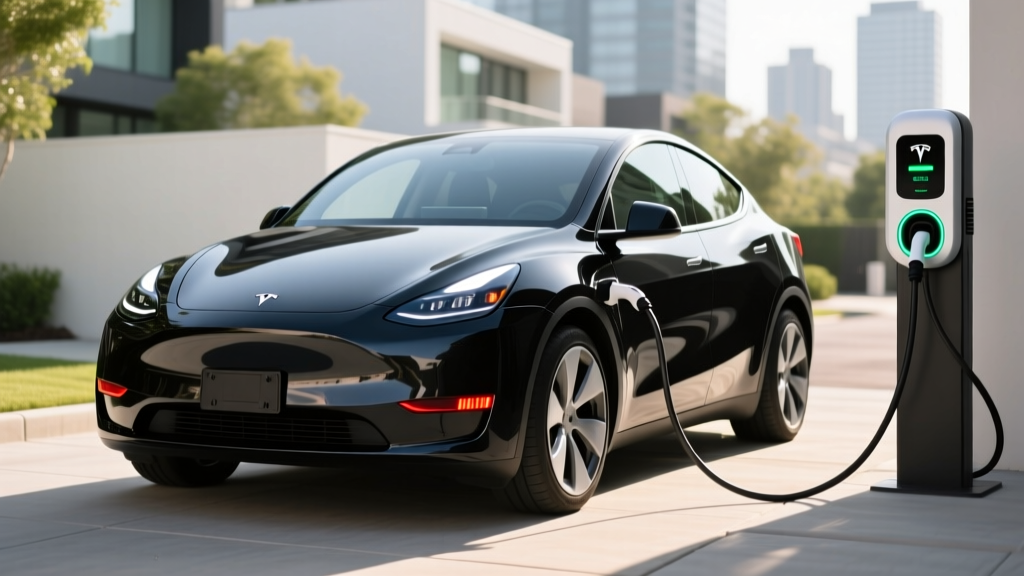
For home charging, the Tesla Wall Connector at 48 amps on a 240V/60A circuit delivers 11.5 kW, adding roughly 44 miles of range per hour of charging. This means an overnight session of 7-8 hours easily replenishes a full day's driving for most owners. Installation costs for a Level 2 home setup typically range from $500 to $2,500 depending on panel proximity, whether a panel upgrade to 200A service is needed, and local permitting requirements. Always consult a licensed electrician for a site-specific quote.
Interior, Cargo & Technology
The Juniper refresh brought meaningful interior upgrades to the Model Y for 2025-2026, addressing many of the prior generation's most common complaints around ride quality, cabin noise, and material finishes.
| Dimension | Measurement |
|---|---|
| Front Headroom | 40.0 in |
| Front Legroom | 41.8 in |
| Rear Headroom | 37.7 in |
| Rear Legroom | 37.0 in |
| Cargo Volume (rear seats up) | 30.2 cu ft |
| Cargo Volume (rear seats folded) | 72.0 cu ft |
| Front Trunk (Frunk) | 4.1 cu ft |
The 30.2 cu ft of cargo space behind the second row is competitive with the Hyundai Ioniq 5 (27.2 cu ft) and slightly less than the Ford Mustang Mach-E (29.7 cu ft behind the rear seats, though the Mach-E's total volume with seats folded is similar). The Model Y's hatchback design and flat load floor make it practical for bulky items, and the 72.0 cu ft total volume with seats folded is sufficient for camping gear, furniture runs, or airport trips with four passengers and luggage.
The 15.4-inch central touchscreen remains the primary interface for nearly all vehicle functions, including climate controls, media, and navigation. The 2026 Model Y runs Tesla's latest software with improved voice recognition, a redesigned navigation interface with better Supercharger routing, and wireless Apple CarPlay support (added in late 2024 software updates). The rear-seat 8-inch entertainment screen introduced with the Juniper refresh continues into 2026.
Driver Assistance: Tesla's Basic Autopilot is standard and includes adaptive cruise control and lane-centering. Full Self-Driving (Supervised) remains an $8,000 option or $99/month subscription. It is critical to understand that FSD is an SAE Level 2 driver-assistance system — the driver must remain fully engaged, hands on or near the wheel, and eyes on the road at all times. It is not autonomous driving. Tesla's camera-only vision system has improved significantly, but it can still struggle with construction zones, faded lane markings, and complex intersections.
Pricing, Trims & Federal Tax Credit Eligibility
The 2026 Model Y pricing reflects Tesla's ongoing strategy of balancing volume with margin, though competition has forced more aggressive positioning than in prior years.
| Trim | Base MSRP | As-Tested (typical options) | Est. Price After §30D Credit |
|---|---|---|---|
| Long Range RWD | $44,990 | $46,490 (w/ paint + wheels) | ~$37,490* |
| Long Range AWD | $47,990 | $50,990 (w/ FSD subscription not incl.) | ~$40,490* |
| Performance AWD | $52,490 | $55,490 (w/ paint + Performance wheels) | ~$44,990* |
*Estimated after-credit prices assume full §30D eligibility. Actual credit amount varies.
- MSRP Cap: SUVs must have an MSRP at or below $80,000 — all 2026 Model Y trims qualify.
- Buyer Income Cap: Modified AGI must not exceed $150,000 (single), $225,000 (head of household), or $300,000 (joint). Check current IRS rules.
- Battery Sourcing: A percentage of critical minerals and battery components must meet North American sourcing or free-trade-agreement requirements. The credit is split into two $3,750 halves — you may qualify for $3,750 or the full $7,500 depending on the specific battery batch.
- Point-of-Sale Transfer: Eligible buyers can transfer the credit to the dealer at purchase, reducing the out-of-pocket price immediately rather than waiting for a tax refund.
- Consult a tax professional — eligibility rules are complex and subject to legislative change.
The §30D credit's battery-sourcing requirements remain the most unpredictable variable. Tesla's supply chain has diversified, but specific vehicles may qualify for the full $7,500 or only $3,750 depending on the battery cell batch. Always confirm the credit amount with Tesla at the time of purchase and verify against the EPA/DOE qualifying vehicle list.
Warranty Coverage
Tesla's warranty structure for the 2026 Model Y is straightforward:
- Basic Vehicle Limited Warranty: 4 years / 50,000 miles, whichever comes first
- Battery & Drive Unit Warranty (Long Range & Performance): 8 years / 120,000 miles, whichever comes first, with minimum 70% battery capacity retention over the warranty period
- Battery & Drive Unit Warranty (Standard/RWD): 8 years / 100,000 miles, with minimum 70% retention
The 70% retention threshold is the key figure. If your battery's usable capacity drops below 70% of its original capacity within the warranty window, Tesla will repair or replace it. In practice, Tesla's NMC packs have demonstrated strong longevity — Tesla's own impact reports have shown average degradation of approximately 12-15% after 150,000 miles across their fleet, well within the warranty threshold. However, degradation is not linear: the steepest drop typically occurs in the first 10,000-20,000 miles (2-5%), then slows considerably.
How the 2026 Model Y Compares to Key Competitors
The electric midsize SUV segment has matured significantly. Here's how the Model Y Long Range AWD stacks up against its most direct rivals.
| Spec | Tesla Model Y LR AWD | Hyundai Ioniq 5 AWD | Ford Mach-E Ext. Range AWD |
|---|---|---|---|
| EPA Range | 300 mi | 290 mi | 290 mi |
| 0-60 mph | 4.6 sec | 5.1 sec | 5.1 sec |
| Peak DC Charge | 250 kW | 235 kW (350 kW capable, limited) | 150 kW |
| 10-80% DC Time | ~25 min | ~18 min | ~38 min |
| Base MSRP (AWD) | $47,990 | $52,200 | $53,995 |
| Cargo (rear seats up) | 30.2 cu ft | 27.2 cu ft | 29.7 cu ft |
| NACS Native? | Yes | No (CCS, adapter avail.) | No (CCS, adapter avail.) |
The Ioniq 5's 800V architecture gives it a faster 10-80% charge time on compatible 350 kW chargers, but the Model Y's native NACS connector and Supercharger access remain a significant real-world advantage — the Supercharger network consistently outperforms third-party networks in uptime and reliability. The Mach-E's slower charging is its biggest road-trip liability.
The Model Y's efficiency advantage (fewer kWh per 100 miles) translates directly to lower electricity costs over ownership and less time spent charging. However, the Ioniq 5 offers a more conventional interior with physical buttons and a more compliant ride, and the Mach-E provides a more engaging driving feel on winding roads. These are subjective trade-offs worth test-driving.
Pros, Cons & Who Should Buy
Pros
- Best-in-class efficiency (27-30 kWh/100 mi)
- Native NACS / Supercharger network access
- Strong real-world range (300 mi EPA LR AWD)
- Class-leading cargo volume (30.2 cu ft)
- Over-the-air updates continuously add features
- Competitive pricing after §30D credit
- Excellent resale value relative to EV segment average
Cons
- No physical buttons — all controls via touchscreen
- FSD (Supervised) is expensive and still Level 2
- Ride quality improved but still firm on 20"/21" wheels
- Visibility compromised by thick rear pillars
- Panel gaps and paint quality can vary by production batch
- No Apple CarPlay integration prior to late-2024 software
- Service center wait times can be long in some markets
Who the 2026 Model Y Is For
Buy it if: You prioritize efficiency and range, want access to the most reliable fast-charging network, need practical cargo space for a family, and are comfortable with a touchscreen-centric interface. The Model Y Long Range RWD at ~$37,500 after the tax credit is arguably the best value in the electric SUV segment.
Look elsewhere if: You want physical buttons and knobs (Ioniq 5, Mach-E), you need the fastest possible DC charging on non-Tesla networks (Ioniq 5 with 800V), you want a more luxurious interior (BMW iX, Genesis GV70 Electrified), or you need three-row seating (Kia EV9).
Frequently Asked Questions
What is the Tesla Model Y maximum speed?
The 2026 Tesla Model Y Performance has an electronically limited maximum speed of 155 mph. The Long Range AWD is limited to 135 mph, and the Long Range RWD is limited to 125 mph. All limits are governed by software.
What is the real-world range of the Tesla Model Y?
The EPA rates the 2026 Model Y Long Range AWD at 300 miles. In real-world highway driving at 70-75 mph in moderate temperatures, expect 245-265 miles. In cold weather below freezing, plan for 200-230 miles. The Long Range RWD's 320-mile EPA estimate translates to roughly 260-280 real-world highway miles in fair conditions.
How fast does the Model Y charge at home and on the road?
On a Tesla Supercharger (DC fast charge), the Model Y peaks at 250 kW and charges from 10-80% in approximately 25 minutes. At home on a Level 2 Tesla Wall Connector (48A/240V), it charges at 11.5 kW, adding about 44 miles of range per hour — a full charge takes roughly 7.5 hours.
Does the 2026 Tesla Model Y qualify for the federal EV tax credit?
The 2026 Model Y qualifies for the §30D federal tax credit, which can be up to $7,500. However, eligibility depends on your income (AGI caps apply), the specific battery sourcing of your vehicle (which determines whether you get $3,750 or $7,500), and MSRP limits (all trims are under the $80,000 SUV cap). The credit can be transferred at point of sale. Always verify eligibility with Tesla and consult IRS guidelines or a tax professional.
Is the Tesla Model Y worth buying over the Ioniq 5 or Mach-E?
The Model Y wins on efficiency, Supercharger network access, and cargo space. The Ioniq 5 offers faster DC charging on 350 kW stations and a more conventional interior. The Mach-E provides a sportier driving feel but charges significantly slower. For road-trippers and first-time EV buyers, the Model Y's Supercharger advantage is often decisive. For buyers who primarily charge at home and want a more traditional cabin, the Ioniq 5 is a compelling alternative.
What battery does the 2026 Model Y use?
The 2026 Model Y uses an NMC (nickel-manganese-cobalt) lithium-ion battery pack with approximately 75 kWh of usable capacity. Tesla does not publish exact pack specifications by model year, and cell suppliers (Panasonic, CATL, LG) may vary by production run. The battery is warranted for 8 years/120,000 miles (AWD trims) with a minimum 70% capacity retention guarantee.