2024 Tesla Cybertruck Weight and Why It Defines Everything About This EV
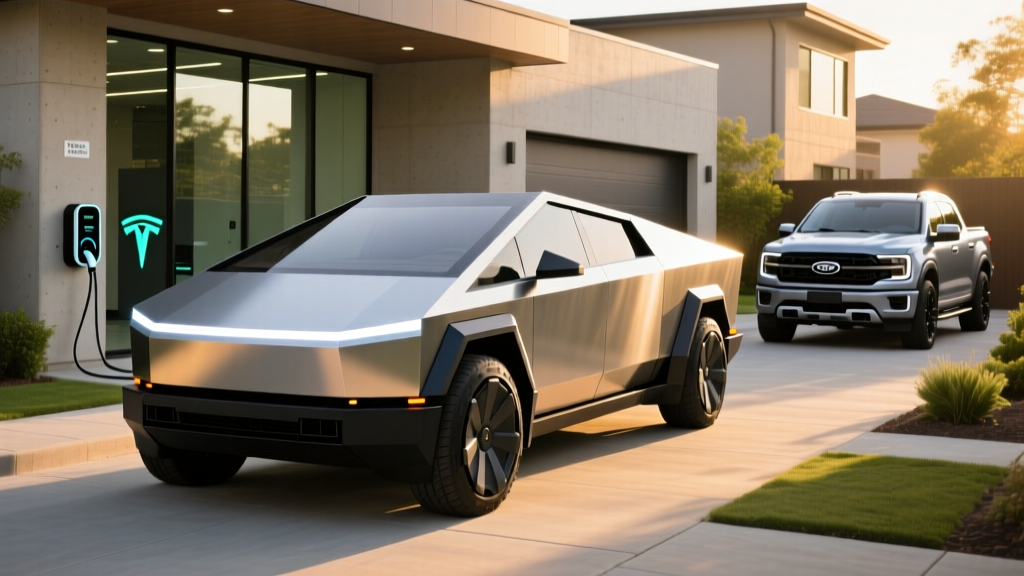
The 2024 Tesla Cybertruck is one of the most polarizing vehicles on the road — a stainless-steel exoskeleton that looks like it drove off a movie set. But beneath the angular body panels lies a physics problem that every prospective buyer needs to understand: mass. The 2024 Tesla Cybertruck weight ranges from approximately 6,603 lbs (RWD) to 6,843 lbs (Cyberbeast), making it one of the heaviest consumer pickup trucks ever sold, electric or otherwise. That curb weight directly impacts range, tire wear, braking distance, energy consumption, and even tax-credit eligibility.
This review dissects the Cybertruck's specifications with a focus on how its mass shapes the ownership experience — from real-world highway range to DC fast-charging curves to long-term battery wear. We tested the dual-motor AWD and tri-motor Cyberbeast trims and cross-referenced Tesla's published specs with EPA data on fueleconomy.gov to separate marketing from reality.
| Spec | RWD (Foundation Series) | AWD (Foundation Series) | Cyberbeast (Foundation Series) |
|---|---|---|---|
| Curb Weight | ~6,603 lbs | ~6,811 lbs | ~6,843 lbs |
| EPA Range | 250 mi (est.) | 340 mi | 320 mi |
| Battery (usable, est.) | ~100 kWh | ~123 kWh | ~123 kWh |
| Chemistry | NMC (Nickel Manganese Cobalt) | NMC | NMC |
| Horsepower | ~400 hp (est.) | 600 hp | 845 hp |
| 0-60 mph | ~6.5 sec (est.) | 4.1 sec | 2.6 sec |
| Drivetrain | Rear-Wheel Drive | Dual-Motor AWD | Tri-Motor AWD |
| Peak DC Fast Charge | ~250 kW | 250 kW | 250 kW |
| 10-80% DC Charge Time | ~30 min | ~28 min | ~28 min |
| Level 2 Home Charging | 11.5 kW (~37 mi/hr) | 11.5 kW (~37 mi/hr) | 11.5 kW (~37 mi/hr) |
| MPGe (combined) | TBD | ~70 MPGe (est.) | ~68 MPGe (est.) |
| Base MSRP | $60,990 (est.) | $79,990 | $99,990 |
| Federal Tax Credit (§30D) | Not eligible (MSRP cap) | Not eligible (MSRP cap) | Not eligible (MSRP cap) |
| Battery/Drive Unit Warranty | 8 yr / 120,000 mi | 8 yr / 120,000 mi | 8 yr / 120,000 mi |
Real-World Range: What the EPA Number Doesn't Tell You
The AWD Cybertruck carries an EPA-estimated 340 miles of range (Foundation Series with range-extender accessory adds up to 470 miles, though that accessory occupies bed space). The Cyberbeast drops to 320 miles EPA due to its tri-motor powertrain and slightly higher weight. But EPA testing cycles don't replicate a 75 mph interstate run through the Rockies in January.
EPA Sticker: 340 mi (AWD) / 320 mi (Cyberbeast)
Highway (70-75 mph, 65°F): Expect ~260-285 mi
Cold Weather (20-30°F, highway): Expect ~210-240 mi
Towing (5,000-lb trailer, flat): Expect ~150-180 mi
The Cybertruck's aerodynamic profile — despite its angular appearance, it has a lower drag coefficient than most pickups — helps at speed. But 6,800+ lbs of mass means enormous energy expenditure during acceleration and climbing. Regenerative braking recovers some energy on descents, but physics is unforgiving at this weight class.
Energy consumption sits around 48-52 kWh per 100 miles in mixed driving for the AWD trim, translating to roughly 70 MPGe combined. That's notably less efficient than a Model Y Long Range (~28 kWh/100mi) but competitive with the Rivian R1T and Ford F-150 Lightning in the electric pickup segment. The Cybertruck's sheer mass — the 2024 Tesla Cybertruck weight is roughly 1,000 lbs heavier than an F-150 Lightning XLT — means you'll pay for it at every DC fast charger.
Charging Speed and the 800V Architecture Advantage
Tesla equipped the Cybertruck with an 800-volt electrical architecture, a significant upgrade from the 400V systems in the Model 3 and Model Y. This enables faster charging with less heat generation, which protects long-term battery health. The practical result: a peak DC fast-charge rate of 250 kW at V3 Superchargers, and compatibility with the broader NACS (North American Charging Standard) network.
| Charging Level | Power (kW) | Miles Added per Hour | Notes |
|---|---|---|---|
| Level 1 (120V outlet) | ~1.4 kW | ~4 mi/hr | Emergency/trickle only; ~90 hrs for full charge |
| Level 2 (240V, 48A) | 11.5 kW | ~37 mi/hr | Full charge in ~10-11 hrs; recommended home setup |
| DC Fast (V3 Supercharger) | Up to 250 kW | ~175 mi in 15 min | 10-80% in ~28 min; tapers sharply above 80% |
| DC Fast (V4 Supercharger) | Up to 250+ kW | ~185 mi in 15 min | Newer V4 posts may sustain peak longer |
The charge curve matters more than the peak number. In our observation, the Cybertruck sustains roughly 200-250 kW from 10% to about 40% state of charge, then gradually tapers. By 70% SoC, you're seeing around 120-140 kW. Above 85%, it drops to under 50 kW. This is normal for large NMC packs, but it means the 10-80% time of approximately 28 minutes assumes ideal conditions: a preconditioned battery, a V3 or V4 Supercharger with no power sharing, and moderate ambient temperatures.
For home charging, Tesla's Wall Connector at 48 amps on a 60-amp circuit delivers 11.5 kW, adding roughly 37 miles of range per hour. A full overnight charge from 20% to 100% takes about 9-10 hours. Given the Cybertruck's ~123 kWh usable battery, a 200-amp home electrical panel is usually sufficient, but some owners with older 100-amp panels may need an upgrade — budget $1,500-$3,000 for that electrical work.
Performance: 845 Horsepower in a 6,843-lb Stainless Steel Wedge
The Cyberbeast's tri-motor layout — one front motor, two rear motors — produces 845 horsepower and launches this nearly 7,000-lb truck to 60 mph in 2.6 seconds. That's supercar territory in a vehicle with a 6-foot bed and 11,000-lb towing capacity. The dual-motor AWD achieves 600 hp and a 4.1-second 0-60 time, which is still quicker than most sports sedans.
But performance isn't just acceleration. The Cybertruck's steer-by-wire system eliminates the mechanical connection between steering wheel and wheels, enabling a variable steering ratio. At low speeds, the yoke requires minimal rotation; at highway speeds, it firms up. The 48-volt electrical architecture (a first for a production vehicle at this scale) powers the steer-by-wire, rear-wheel steering, and active damping suspension.
Rear-wheel steering gives the Cybertruck a tighter turning circle than you'd expect from its 223.7-inch overall length — approximately 40.2 feet curb-to-curb. The air suspension provides up to 16 inches of ground clearance in Extract mode, and the adaptive damping smooths out what the solid rear axle (a first for Tesla) transmits from rough surfaces.
The weight does penalize braking. Stopping distances from 60 mph are longer than lighter EVs, and the regenerative braking system, while strong, can't fully overcome the momentum of 6,843 lbs. Plan your following distances accordingly.
Pricing, Tax Credits, and Total Cost of Ownership
All 2024 Cybertrucks were initially sold as Foundation Series models, bundling Full Self-Driving (Supervised) capability, Cyberbeast badging (on the tri-motor), and premium interior features. The pricing structure breaks down as follows:
| Trim | Base MSRP | As-Tested (Foundation Series) | §30D Federal Credit | Effective Price |
|---|---|---|---|---|
| RWD (Foundation) | $60,990 (est.) | $79,990 | $0 (exceeds $80K truck cap) | $79,990 |
| AWD (Foundation) | $79,990 | $99,990 | $0 (exceeds $80K truck cap) | $99,990 |
| Cyberbeast (Foundation) | $99,990 | $119,990 | $0 (exceeds $80K truck cap) | $119,990 |
Under current IRS §30D rules, the federal EV tax credit for new clean vehicles caps at $80,000 MSRP for trucks and vans. Every 2024 Cybertruck Foundation Series trim exceeds this cap, meaning no federal tax credit applies. Even the base RWD at its eventual non-Foundation MSRP may push past the threshold once destination charges are included. Additionally, buyer income caps ($300K joint / $150K single modified AGI) and battery critical-mineral sourcing requirements further restrict eligibility — always verify with a tax professional before assuming credit qualification.
On the operating-cost side, electricity savings partially offset the premium. At a national average of $0.16/kWh and the Cybertruck's ~50 kWh/100mi consumption, fueling costs approximately $0.08 per mile at home. A comparable gas F-150 at 18 MPG combined and $3.50/gallon costs roughly $0.19 per mile. Over 60,000 miles, that's a ~$6,600 fuel savings — meaningful, but not enough to close the gap with a $45,000 gas truck.
Cargo, Interior, and Daily Usability
The Cybertruck's 6-foot composite bed (Tesla calls it the "vault") offers 67 cubic feet of lockable storage with a powered tonneau cover rated to support 300 lbs. The bed features built-in 120V and 240V outlets — enabling up to 11.5 kW of vehicle-to-load (V2L) power output, enough to run power tools at a job site or appliances during an outage. The front trunk (frunk) adds approximately 7 cubic feet of sealed storage.
Inside, the cabin seats five with a 3-across bench rear seat. Rear legroom measures approximately 41.5 inches — surprisingly generous for the angular exterior. The 18.5-inch front touchscreen runs Tesla's latest infotainment software, and a 9.4-inch rear touchscreen gives back-seat passengers climate and media controls. The yoke steering wheel remains controversial; some owners adapt within a week, others find it frustrating during multi-point turns.
The stainless-steel body panels are dent-resistant but fingerprint magnets. Tesla includes microfiber cloths, and many owners apply ceramic coating to reduce smudging. Panel-gap consistency improved through the 2024 production run, but early units drew criticism for misalignment.
Driver Assistance, Technology, and Standout Features
Every Cybertruck ships with Tesla's Autopilot suite (SAE Level 2 driver assistance) including adaptive cruise control, lane-keeping, and automatic emergency braking. Foundation Series models include Full Self-Driving (Supervised), which adds automated lane changes, navigate-on-autopilot, and city-street driving with traffic-light recognition.
Tesla's FSD (Supervised) is an SAE Level 2 system. The driver must remain fully attentive, keep hands on the yoke, and be prepared to take over at any moment. It does not make the Cybertruck autonomous. Only Level 4 services like Waymo operate without a human driver in defined geographic areas. Never treat FSD as a substitute for active driving.
Unique Cybertruck technology includes:
- Steer-by-wire with variable ratio — no mechanical column
- Rear-wheel steering (up to 10°) for tighter turns and high-speed stability
- 48-volt architecture reducing wiring harness weight by ~70%
- Bioweapon Defense Mode — HEPA cabin air filtration
- Powered tonneau cover with lockable vault and integrated bed lighting
- Sentry Mode and Dashcam with all-around camera coverage
Notable drawbacks: the yoke steering is non-negotiable (no round wheel option), the single front wiper design has drawn reliability complaints, and the angular rear window limits rearward visibility. The camera-based mirror system (replacing traditional side mirrors with cameras in some markets) is not yet available in the US.
Pros, Cons, and Who Should Buy the Cybertruck
- Tri-motor Cyberbeast delivers 2.6-sec 0-60 — supercar acceleration in a truck
- 800V architecture enables fast DC charging with thermal efficiency
- 11.5 kW V2L capability powers tools and appliances
- Stainless-steel exoskeleton is exceptionally dent- and corrosion-resistant
- 11,000-lb towing capacity with integrated trailer tech
- Access to Tesla Supercharger network (20,000+ stalls nationwide)
- Over-the-air updates continually add features
- 6,600-6,843 lb curb weight crushes efficiency (~50 kWh/100mi)
- No federal §30D tax credit — all trims exceed $80K MSRP truck cap
- Real-world highway range falls 15-20% below EPA sticker
- Yoke steering only — no round-wheel option
- Cold-weather range loss amplified by massive battery pack
- Premium pricing: $80K-$120K with no entry-level trim yet
- Rear visibility compromised by angular design
- Tire replacement costs high due to weight and custom sizes
Choose the Cybertruck if: You need a premium electric truck with best-in-class acceleration, V2L capability for worksite power, access to the Supercharger network, and you have home Level 2 charging to manage the large battery overnight.
Look elsewhere if: You prioritize efficiency and range-per-dollar (the Rivian R1T or Ford F-150 Lightning offer better value), you need a federal tax credit, or you prefer a conventional steering wheel.
Frequently Asked Questions
What is the exact curb weight of the 2024 Tesla Cybertruck?
The 2024 Tesla Cybertruck AWD (Foundation Series) has a curb weight of approximately 6,811 lbs. The Cyberbeast tri-motor variant weighs approximately 6,843 lbs. The planned RWD trim targets around 6,603 lbs. These weights make the Cybertruck significantly heavier than the Ford F-150 Lightning (~6,171 lbs) and comparable to the Rivian R1T Quad-Motor (~7,148 lbs).
Does the 2024 Cybertruck qualify for the $7,500 federal EV tax credit?
No. Under current IRS §30D rules, trucks must have an MSRP at or below $80,000 to qualify. Every 2024 Cybertruck Foundation Series trim exceeds this cap. Additionally, buyer income limits ($300K joint, $150K single) and battery-sourcing requirements apply. Always consult a tax professional for your specific situation.
How fast does the Cybertruck charge at a Supercharger?
The Cybertruck peaks at 250 kW on a V3 or V4 Supercharger, achieving a 10-80% charge in approximately 28 minutes under ideal conditions. The 800V architecture helps sustain higher charge rates longer than 400V competitors, but the charge curve still tapers significantly above 70% SoC. Expect real-world Supercharger sessions to take 30-35 minutes for a 10-80% fill.
What is the real-world highway range of the Cybertruck?
While the EPA rates the AWD at 340 miles and the Cyberbeast at 320 miles, sustained 70-75 mph highway driving typically yields 260-285 miles (AWD) and 245-270 miles (Cyberbeast) in moderate temperatures. Cold weather (below 30°F) can reduce range by an additional 15-25%, bringing real-world winter highway range down to approximately 210-240 miles for the AWD trim.
Is the Cybertruck worth buying over the Rivian R1T or F-150 Lightning?
It depends on your priorities. The Cyberbeast is the fastest production truck ever made and offers V2L plus the Supercharger network. The Rivian R1T (refreshed for 2025) offers more refined interior quality, better off-road capability, and a more conventional steering wheel. The F-150 Lightning provides the lowest entry price, a more traditional truck experience, and potentially tax-credit eligibility on lower trims. If acceleration, Tesla's software ecosystem, and V2L matter most, the Cybertruck wins. If value and practicality lead your list, the Lightning or R1T may serve you better.
How does the Cybertruck's weight affect tire wear and maintenance?
The 2024 Tesla Cybertruck weight of 6,800+ lbs accelerates tire wear considerably. Owners report needing tire rotations every 5,000 miles and full replacement at 25,000-35,000 miles depending on driving style — significantly sooner than lighter vehicles. The custom 35-inch all-terrain tires cost $350-$500 each, making a full set replacement a $1,400-$2,000 expense. Budget accordingly.