Tesla Model Y Legroom: Front, Rear, and Third-Row Reality
Searches for Tesla Model Y legroom spike every time a family shopper cross-shops the compact electric SUV segment — and for good reason. The Model Y's sloping roofline and battery-pack floor create a cabin geometry that differs meaningfully from rivals like the Hyundai Ioniq 5 or Ford Mustang Mach-E. Here are the exact interior dimensions for the current-generation Model Y (2025–2026 refresh):
| Measurement | Front Row | Second Row | Third Row (Optional) |
|---|---|---|---|
| Legroom | 41.8 in | 38.4 in | 26.5 in |
| Headroom | 40.3 in | 37.7 in | 33.1 in |
| Shoulder Room | 56.4 in | 54.0 in | 40.5 in |
| Hip Room | 53.8 in | 51.2 in | 38.0 in |
The front row is genuinely spacious — 41.8 inches of legroom beats the Ioniq 5 (39.4 in) and matches the Mach-E. The second row's 38.4 inches is adequate for adults on shorter trips but tighter than the Ioniq 5's 39.4 inches. The real controversy is the optional third row: at just 26.5 inches of legroom, it is strictly for small children or very short commutes. Adults over 5'6" will find their knees pressed firmly into the second-row seatbacks.
Range, Efficiency, and Battery: What the EPA Says vs. the Road
The 2026 Tesla Model Y is offered in three primary configurations, each with different range and efficiency profiles. Tesla has transitioned the standard-range RWD model to a lithium iron phosphate (LFP) battery, while Long Range and Performance trims use nickel-manganese-cobalt (NMC) chemistry for higher energy density.
| Trim | Battery (usable kWh) | Chemistry | EPA Range | MPGe (combined) | kWh/100 mi |
|---|---|---|---|---|---|
| Standard Range RWD | ~57.5 kWh | LFP | 279 mi | 118 MPGe | 28 |
| Long Range AWD | ~75.0 kWh | NMC | 320 mi | 111 MPGe | 30 |
| Performance AWD | ~75.0 kWh | NMC | 298 mi | 103 MPGe | 33 |
The LFP battery in the Standard Range trim is a significant ownership advantage: Tesla recommends periodic charging to 100% for LFP packs (unlike NMC, which they suggest keeping at 80–90% for daily use), and LFP chemistry shows slower long-term degradation. Data from fleet analytics suggests LFP packs retain roughly 90%+ capacity after 150,000 miles, versus 85–88% for NMC at the same mileage. Source: Tesla Battery Care.
Charging Speed: DC Fast Charge, Level 2, and the Supercharger Network
Charging speed remains one of the Model Y's strongest competitive advantages, thanks to Tesla's Supercharger network and the vehicle's thermal management system. Here is the breakdown by charging level:
| Charging Level | Connector | Max Power | Speed / Time |
|---|---|---|---|
| Level 1 (120V household) | J1772 / NACS adapter | ~1.4 kW | ~3–4 mi/hr |
| Level 2 (240V home/public) | NACS (native) | 11.5 kW (48A) | ~34–37 mi/hr |
| DC Fast Charge (V3 Supercharger) | NACS | 250 kW peak | 10–80% in ~22 min |
| DC Fast Charge (V4 Supercharger) | NACS | ~250 kW peak | 10–80% in ~20 min |
A critical detail for buyers: the 250 kW peak rate is not sustained across the entire charging session. The Model Y's charge curve peaks near 250 kW between roughly 10–30% state of charge, then tapers to ~150 kW through 50%, and drops further above 80%. This is why Tesla (and the EPA) quote 10–80% times rather than 0–100% — charging above 80% slows dramatically to protect battery health. A full 10–80% session on a V3 Supercharger takes approximately 22 minutes for the Long Range AWD. The LFP Standard Range model charges slightly slower in absolute kW but benefits from a flatter charge curve, sustaining closer to peak for longer.
For home charging, a Tesla Wall Connector on a 60-amp circuit delivers 11.5 kW (48 amps), adding roughly 35 miles of range per hour. This means an overnight charge of 8 hours easily replenishes 250+ miles — more than enough for daily driving. Installation costs vary widely: expect $800–$2,000 if your electrical panel has capacity, or $2,500–$5,000+ if a panel upgrade (100A → 200A) is needed. Always consult a licensed electrician for a site assessment.
Performance and Drivetrain: 0-60, Horsepower, and Daily Drivability
| Trim | Drivetrain | Horsepower | 0–60 mph | Top Speed |
|---|---|---|---|---|
| Standard Range RWD | Rear-Wheel Drive | ~295 hp | 6.6 sec | 135 mph |
| Long Range AWD | Dual-Motor AWD | ~384 hp | 4.8 sec | 135 mph |
| Performance AWD | Dual-Motor AWD | ~456 hp | 3.5 sec | 155 mph |
Even the base RWD Model Y delivers instant electric torque that makes it feel quicker than its 6.6-second 0–60 time suggests — there's no transmission lag, and throttle response is immediate at any speed. The Long Range AWD is the sweet spot for most buyers: dual-motor all-wheel drive provides confident traction in rain and light snow, and 4.8 seconds to 60 mph is genuinely quick for a family crossover. The Performance trim's 3.5-second sprint is thrilling but comes at the cost of roughly 22 miles of EPA range and a firmer ride due to its sport-tuned suspension.
All trims feature regenerative braking with adjustable intensity. Tesla's one-pedal driving mode allows you to come to a complete stop without touching the brake pedal in most city driving — a feature that significantly reduces brake wear. Owners routinely report 80,000+ miles on original brake pads.
Pricing, Tax Credits, and Total Cost of Ownership
| Trim | Base MSRP | §30D Credit Eligibility | Est. Price After Credit |
|---|---|---|---|
| Standard Range RWD | $44,990 | Eligible (up to $7,500) | ~$37,490 |
| Long Range AWD | $48,990 | Eligible (up to $7,500) | ~$41,490 |
| Performance AWD | $53,990 | Eligible (up to $7,500) | ~$46,490 |
The Model Y qualifies for the full $7,500 federal tax credit under IRS §30D for eligible buyers, and as of 2024, this credit can be transferred to the dealer at the point of sale — meaning you get it as an immediate price reduction rather than waiting to claim it on your tax return. However, eligibility is not automatic. Per IRS guidelines, you must meet all of the following:
- Income caps: Modified AGI ≤ $150,000 (single), $225,000 (head of household), or $300,000 (joint filers)
- MSRP cap: SUVs must have an MSRP ≤ $80,000 (all Model Y trims qualify)
- Battery sourcing: The vehicle must meet critical-mineral and battery-component requirements that phase in annually — Tesla's US-assembled Model Y has met these thresholds through 2026, but verify at fueleconomy.gov before purchasing
- Not claimed previously: The credit is per-VIN, not per-buyer, and cannot be claimed on a vehicle that has already received it
Purchase price after credit: ~$41,490
Estimated electricity cost (15,000 mi/yr × 5 yr at $0.14/kWh avg): ~$3,150
Estimated maintenance (tire rotation, cabin filter, wiper fluid): ~$1,200
Estimated insurance premium (varies by state/driver): ~$9,000–$12,000
5-year estimated running cost (excluding insurance): ~$4,350 — compared to ~$10,500+ in fuel and maintenance for a comparably priced gas SUV.
Technology, Driver Assistance, and Interior Features
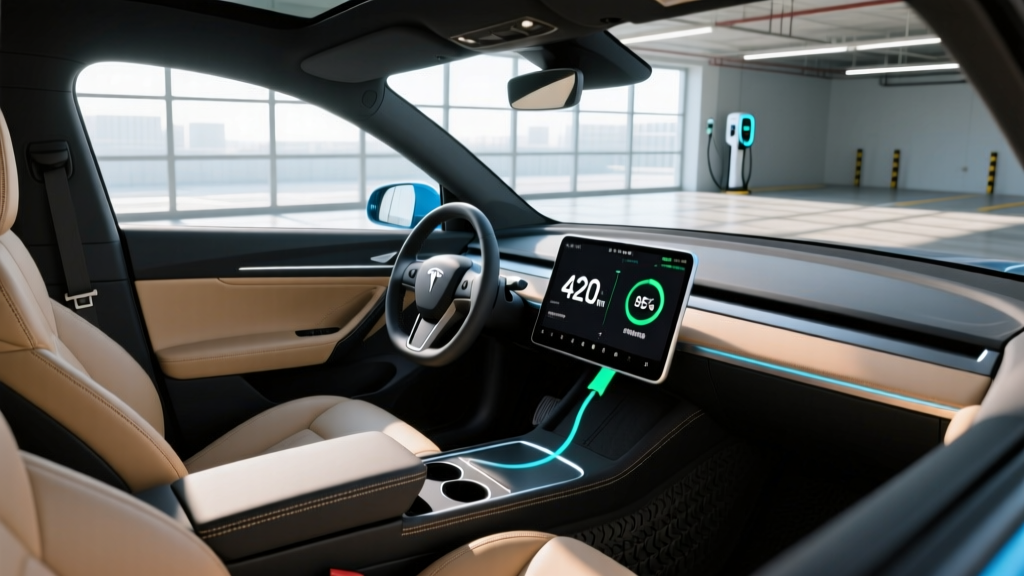
The Model Y's interior is defined by radical minimalism: a single 15.4-inch center touchscreen controls virtually every vehicle function, from climate to mirrors to glove-box release. There is no instrument cluster, no heads-up display, and no physical buttons for core functions. This is either liberating or frustrating depending on your tolerance for screen-based controls.
Key technology features across all trims:
- Tesla Autopilot (standard): Adaptive cruise control, lane-keeping assist, automatic emergency braking, blind-spot monitoring — this is SAE Level 2 driver assistance, requiring full driver attention at all times
- Full Self-Driving (Supervised) ($8,000 option or $99/mo): Adds auto lane-change, navigate on Autopilot, traffic-light/stop-sign recognition, and parking assist. Despite the name, FSD is SAE Level 2 — you must remain fully engaged and ready to take over immediately. It is not autonomous driving.
- Over-the-air updates: Tesla regularly pushes software updates that add features, improve efficiency, and refine the UI — no dealer visit required
- Sentry Mode & Dashcam: Uses the car's external cameras to record incidents and monitor surroundings while parked
- Heat pump: Standard on all trims, significantly improving cold-weather efficiency and range compared to resistive heating
Cargo Space and Practicality: Family SUV Credentials
| Configuration | Cargo Volume |
|---|---|
| Behind third row (if equipped) | 12.8 cu ft |
| Behind second row (5-seat mode) | 30.2 cu ft |
| Second row folded flat | 72.1 cu ft |
| Front trunk (frunk) | 4.1 cu ft |
With the second row upright, 30.2 cubic feet of cargo space is competitive with the segment — roughly matching the Mach-E (29.7 cu ft) and slightly less than the Ioniq 5 with seats up. Fold the second row and the Model Y's 72.1 cubic feet is class-leading, swallowing luggage for four on a week-long trip or a full Costco run with room to spare. The frunk adds 4.1 cubic feet — useful for charging cables, a laptop bag, or groceries you want to keep separate from the main cabin.
For towing, the Model Y is rated at 3,500 pounds (with the factory tow package), sufficient for a small utility trailer, a pair of dirt bikes, or a light camping trailer. This is less than the Rivian R1S (7,700 lb) but typical for the compact electric SUV class.
Warranty, Reliability, and Long-Term Ownership
| Component | Coverage |
|---|---|
| Basic Vehicle | 4 years / 50,000 miles |
| Battery & Drive Unit | 8 years / 120,000 miles (Long Range/Performance) or 8 years / 100,000 miles (RWD) |
| Battery Capacity Retention | Warranted to retain ≥70% capacity during coverage period |
Tesla's battery warranty is straightforward: if your pack drops below 70% state of health within the coverage period, Tesla will repair or replace it. In practice, Tesla's degradation data — and independent fleet analyses — show most Model Y packs retain 88–92% capacity at 100,000 miles. Battery replacement out of warranty is expensive: current estimates range from $12,000–$16,000 for a full pack replacement, though partial module repairs may be less.
Build quality has improved significantly since the 2020–2021 Fremont production ramp, and the refreshed Model Y (produced at Gigafactory Texas and Berlin) shows better panel-gap consistency and interior material quality. However, Tesla's service-center network remains thinner than legacy automakers — plan for mobile service or potentially longer wait times for bodywork in some markets.
Pros, Cons, and Who Should Buy the Model Y
- Supercharger network — the most reliable and extensive DC fast-charging network in North America
- Class-leading efficiency (28–33 kWh/100 mi)
- Over-the-air updates keep the car current for years
- Strong cargo capacity (72.1 cu ft max)
- LFP battery option with 100% daily charging and slower degradation
- Low running costs vs. gas competitors
- Rear legroom (38.4 in) trails the Ioniq 5; third row (26.5 in) is children-only
- Minimalist interior lacks physical controls — polarizing for many drivers
- No Apple CarPlay or Android Auto — Tesla's proprietary infotainment only
- Insurance premiums run 15–30% higher than comparable gas SUVs
- FSD ($8,000) remains Level 2 despite the "self-driving" branding
- Service-center availability varies by region
- Tech-forward commuters who want low running costs, over-the-air updates, and Supercharger access for road trips
- Families of 4 or fewer who don't need a usable third row and value cargo space
- Home-charging owners with a garage or driveway where a Level 2 Wall Connector can be installed
- Not ideal for: Families needing a real third row (look at the Kia EV9 or Rivian R1S), buyers who want Apple CarPlay, or those without reliable home/workplace charging access
Frequently Asked Questions
Is the Tesla Model Y rear seat comfortable for adults?
For adults under 5'10", the 38.4 inches of rear legroom is adequate on trips up to a few hours. Taller passengers will find it tighter than competitors like the Hyundai Ioniq 5 (39.4 in) or Kia EV6 (39.6 in). The slightly elevated floor position also creates a knees-up seating posture that can cause fatigue on long drives.
Does the 2026 Tesla Model Y qualify for the $7,500 federal tax credit?
Yes, all current Model Y trims qualify for the full §30D credit for eligible buyers, provided you meet IRS income caps (≤$300,000 joint / $150,000 single) and the vehicle meets battery-sourcing requirements — which Tesla's US-built Model Y has satisfied through 2026. The credit can be applied at the point of sale. Always verify current eligibility at fueleconomy.gov and consult a tax professional for your specific situation.
How fast does the Model Y charge at home?
On a Tesla Wall Connector (240V, 60-amp circuit), the Model Y charges at up to 11.5 kW, adding roughly 35 miles of range per hour. A full overnight charge (8 hours) replenishes approximately 280 miles. A standard 120V outlet (Level 1) adds only 3–4 miles per hour — adequate only for low-mileage drivers or as a trickle-charge supplement.
What is the real-world range of the Tesla Model Y Long Range?
The EPA rates the Long Range AWD at 320 miles. In real-world highway driving at 70–75 mph, expect roughly 270–290 miles. In cold weather (below 32°F), range drops to approximately 220–250 miles due to heating demands and reduced battery efficiency. Preconditioning the battery before departure helps mitigate cold-weather losses.
Is the Model Y worth buying over the Hyundai Ioniq 5 or Ford Mustang Mach-E?
The Model Y wins on Supercharger network access, cargo space (72.1 cu ft max), efficiency, and software updates. The Ioniq 5 offers more rear legroom, 800V ultra-fast charging (10–80% in ~18 min on 350 kW chargers), and Apple CarPlay. The Mach-E provides a more traditional interior layout and competitive pricing. If Supercharger reliability and Tesla's software ecosystem are priorities, the Model Y remains the segment benchmark. If rear-seat comfort and physical controls matter more, test-drive the Ioniq 5.