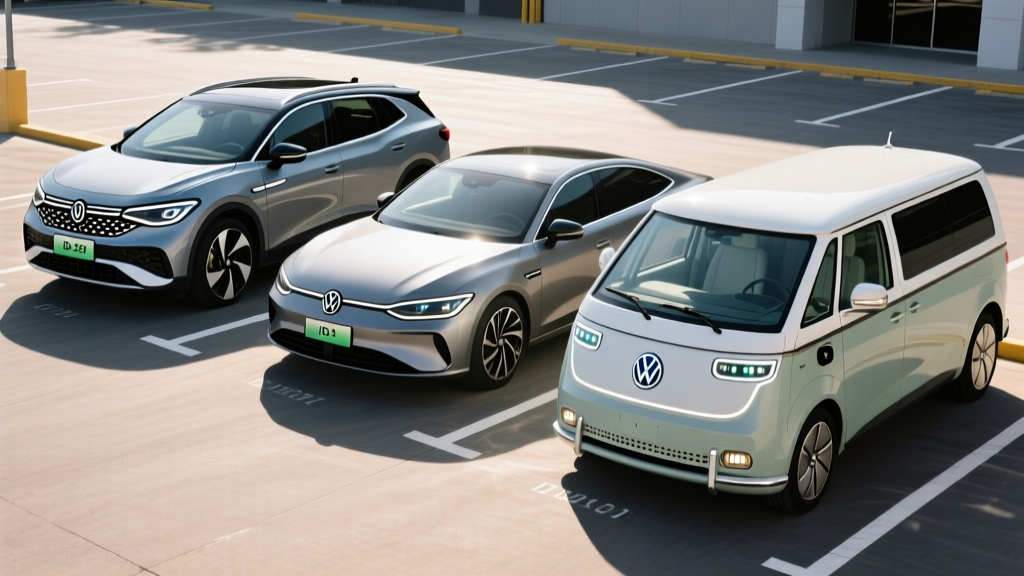
If you're researching Volkswagen EV offers in 2026, the brand currently sells three fully electric models in the U.S.: the ID.4 compact SUV (starting around $39,735), the ID.7 sedan (starting near $49,995), and the ID.Buzz three-row minivan (starting at $59,995). The ID.4 qualifies for the full $7,500 federal tax credit under IRS §30D when leased (point-of-sale lease-loophole) and, depending on battery sourcing and buyer income, potentially on purchase as well. Expect 206–291 miles of EPA range depending on the model and trim, DC fast charging from 170–200 kW peak, and VW's 8-year/100,000-mile battery warranty. The strongest offers right now are typically on the ID.4, where dealer discounts and lease incentives can stack with federal credits to bring effective monthly payments well below gas-powered SUV competitors.
Quick Answer: Which VW EV Should You Buy?
Best value: ID.4 Pro S — ~275 mi range, ~$45,000 MSRP, widely eligible for incentives.
Best for families needing 3 rows: ID.Buzz — only EV minivan, but limited to ~234 mi range and higher price.
Best for commuters/sedans: ID.7 Pro S — up to ~291 mi range, premium ride, but limited dealer inventory in some regions.
Best deal stacking: Lease an ID.4 through VW Credit to capture the $7,500 lessor credit passed to the lessee, reducing monthly cost substantially.
2026 Volkswagen EV Lineup at a Glance
Volkswagen's U.S. EV strategy in 2026 centers on vehicles built on the MEB platform, all featuring rear-wheel-drive or dual-motor AWD configurations, NMC (nickel manganese cobalt) battery chemistry in most trims, and CCS1 charging connectors (with NACS adapter support for Tesla Supercharger access expanding through 2025–2026). Here's the full spec breakdown:
| Spec | ID.4 Pro S (AWD) | ID.7 Pro S | ID.Buzz Pro S (AWD) |
|---|---|---|---|
| Base MSRP | ~$47,735 | ~$49,995 | ~$65,495 |
| EPA Range | 263 mi | 291 mi | 234 mi |
| Battery (usable) | 77 kWh (NMC) | 86 kWh (NMC) | 86 kWh (NMC) |
| Peak DC Charge Rate | 185 kW | 200 kW | 170 kW |
| 10–80% DC Charge | ~28 min | ~26 min | ~30 min |
| Level 2 Rate | 11 kW | 11 kW | 11 kW |
| 0–60 mph | 5.4 sec | 6.5 sec | 7.3 sec |
| Horsepower | 295 hp | 282 hp | 282 hp |
| MPGe (combined) | 102 MPGe | 111 MPGe | 87 MPGe |
| Battery Warranty | 8 yr / 100k mi | 8 yr / 100k mi | 8 yr / 100k mi |
| §30D Credit Eligibility | Lease: yes; Purchase: varies | Lease: yes; Purchase: varies | Lease: yes; Purchase: varies |
Current Volkswagen EV Offers & Incentive Stacking
VW dealers and VW Credit typically run overlapping promotions that can dramatically reduce out-of-pocket cost. Here's how the incentive layers work in 2026:
Federal §30D Tax Credit (up to $7,500)
The IRS §30D credit has specific eligibility requirements that change based on battery-sourcing rules, buyer income caps, and MSRP limits:
- MSRP cap: SUVs/vans (ID.4, ID.Buzz) must be ≤$80,000; sedans (ID.7) must be ≤$55,000
- Income cap: $150,000 single / $225,000 head of household / $300,000 joint filers
- Battery sourcing: Critical minerals and battery component requirements phase in annually — some VW trims qualify for $3,750 (partial) while others hit $7,500 (full)
- Point-of-sale transfer: You can transfer the credit to the dealer at purchase to reduce the sale price directly
Lease Loophole (Commercial Clean Vehicle Credit)
When you lease a VW EV through VW Credit, the lessor (not you) claims the $7,500 commercial credit under IRC §45W. VW Credit has consistently passed this savings through as a lease capital-cost reduction. This means even if you wouldn't qualify for §30D on a purchase (due to sourcing rules or income), a lease typically captures the full $7,500 benefit regardless. Consult a tax professional to confirm your situation.
Dealer & Regional Incentives
Beyond federal credits, VW frequently offers:
- Customer cash: $1,000–$3,000 on ID.4 trims (varies monthly)
- Lease rate subsidies: Money factor buydowns bringing effective APR to 1–3%
- Conquest/loyalty bonuses: $500–$1,000 for switching from non-VW brands
- Free charging: VW has partnered with Electrify America for 3 years / unlimited or capped kWh of complimentary DC fast charging on new EV purchases (verify current terms at time of purchase)
Example: ID.4 Pro S Effective Cost After Incentives
| Item | Amount |
|---|---|
| MSRP (ID.4 Pro S AWD) | $47,735 |
| Dealer discount (negotiated) | −$2,000 |
| VW customer cash (if active) | −$1,500 |
| §30D federal credit (point-of-sale) | −$7,500 |
| State/utility rebate (varies) | −$1,000 to $4,000 |
| Effective net price | ~$32,735 – $35,735 |
Incentive stacking varies by state, dealer, and current-month programs. Always confirm eligibility before signing.
VW EV vs. Gas vs. Hybrid: 5-Year Ownership Cost Comparison
The purchase price is only half the equation. Here's how a Volkswagen ID.4 stacks up against its closest gas and hybrid competitors over 5 years of ownership (assuming 12,000 miles/year, national average electricity at $0.16/kWh and gas at $3.40/gallon):
| Cost Category (5 yr) | VW ID.4 Pro S | Toyota RAV4 Gas | Toyota RAV4 Hybrid |
|---|---|---|---|
| Net Purchase (after credits) | ~$35,735 | ~$33,500 | ~$35,200 |
| Fuel / Electricity | ~$4,800 | ~$10,200 | ~$7,400 |
| Maintenance | ~$1,800 | ~$3,500 | ~$3,200 |
| Insurance (avg) | ~$9,500 | ~$7,800 | ~$8,100 |
| Estimated Depreciation | ~$16,000 | ~$12,500 | ~$13,000 |
| Total 5-Year Cost | ~$67,835 | ~$67,500 | ~$66,900 |
Key takeaways: The ID.4's fuel savings (~$5,400 less than gas over 5 years) and lower maintenance nearly offset its higher insurance premiums and steeper depreciation. At parity with the gas RAV4 on total cost, the EV wins on driving experience, quietness, and home refueling convenience. If you charge primarily at home on cheap overnight electricity (under $0.10/kWh in many states), the ID.4 pulls ahead decisively. But if you rely solely on public DC fast charging at $0.35–$0.50/kWh, your "fuel" costs can exceed gas.
What First-Time VW EV Buyers Need to Know
Home Charging Is Non-Negotiable for Most Owners
Every VW EV comes with a Level 1 (120V) charging cable that adds roughly 3–4 miles per hour — enough for low-mileage commuters but inadequate for road trips or the ID.Buzz's larger battery. A Level 2 home charger (240V, 40–48 amps) adds 25–35 miles per hour and fills any VW EV overnight. Budget $500–$800 for the charger hardware (VW sells an optional home unit, but third-party options like ChargePoint Home Flex or Emporia Vue are excellent) plus $500–$2,000 for electrician installation, depending on whether your panel needs an upgrade to support a 50-amp circuit.
Charging Connector: CCS1 with NACS Adapter
VW's MEB vehicles use the CCS1 connector natively. Through a partnership announced in 2024, VW EVs can access Tesla Superchargers using a VW-approved NACS adapter. As of 2026, the Supercharger network adds over 15,000 fast-charging stalls to your available infrastructure — a major advantage for road trips. Confirm adapter availability and any included credit with your dealer at purchase.
Cold-Weather Range Loss Is Real
NMC batteries in VW's MEB platform lose 15–30% of range in sustained sub-freezing temperatures, primarily due to cabin heating demands and reduced battery efficiency. The ID.4 and ID.7 include a heat pump (standard on most trims), which recovers waste heat and reduces the range penalty compared to resistive heating — but it doesn't eliminate it. If you live in northern climates, plan for ~200 real-world winter miles from the ID.4 AWD, not the EPA's 263.
VW's Software Story: Improved but Not Class-Leading
VW's ID. Software (version 4.x in 2026 models) has improved significantly over the buggy 3.x launch-era system. The infotainment is faster, the voice assistant is more reliable, and over-the-air updates are more consistent. However, the touch-capacitive steering wheel controls remain a frustration for many drivers, and the lack of physical HVAC buttons means you're tapping through menus to adjust temperature. This is a known complaint — test it during your test drive.
Common Misconceptions About VW EVs
| Myth | Fact |
|---|---|
| "VW EVs have terrible reliability" | Early 2021–2022 ID.4 models had software issues, but VW issued multiple OTA patches and recalls. The 2025–2026 models on software 4.x are significantly more stable. Check NHTSA for any open recalls on specific VINs. |
| "The battery will need expensive replacement" | VW warranties the battery for 8 years/100,000 miles against degradation below 70% capacity. Independent fleet data from European ID.3/ID.4 taxis shows less than 8% degradation at 100,000 miles. Replacement cost (if out of warranty) is estimated at $12,000–$18,000, but most owners will never need one. |
| "You can't road trip in an ID.4" | At 185 kW peak DC charging with Electrify America and Supercharger access, the ID.4 adds ~150 miles in 20 minutes. A 500-mile trip requires one 25-minute stop — manageable with planning via the in-car route planner or A Better Routeplanner. |
| "The $7,500 credit applies to everyone" | Income caps, MSRP caps, and battery-sourcing rules apply. Leasing bypasses many restrictions via the §45W lessor credit. Always verify on IRS.gov before committing. |
| "EV insurance is unaffordable" | ID.4 insurance averages ~$1,900/year nationally — about 15–25% more than a gas RAV4. Shop multiple quotes; GEICO, Progressive, and State Farm have improved EV pricing. Some insurers offer EV-specific discounts. |
Decision Framework: Which VW EV Is Right for You?
Choose based on your situation:
→ Choose the ID.4 if: You need a practical compact SUV for daily commuting and occasional road trips, want the best incentive stacking, and value a sub-$36,000 effective price after credits. Best for 1–2 person households or small families.
→ Choose the ID.7 if: You prefer a sedan, commute long distances (the 291-mile EPA range is VW's best), want a quieter and more refined ride, and don't need a third row. Best for highway commuters and those who want Tesla Model S-like space at half the price.
→ Choose the ID.Buzz if: You need three rows, want a distinctive vehicle, and most of your driving is local/suburban (the 234-mile range limits road-trip comfort). Best for families who would otherwise buy a minivan and have home charging.
→ Skip VW and look at Hyundai/Kia if: You prioritize the fastest DC charging (Hyundai's E-GMP platform charges at up to 350 kW, 10–80% in ~18 min) or want an NACS-native port without an adapter.
→ Skip VW and look at Tesla if: You want the most mature Supercharger experience without adapters, the best software/app ecosystem, or access to FSD (Supervised) for highway driver assistance (SAE Level 2 — not self-driving).
→ Consider a PHEV instead if: You lack reliable home charging, regularly drive in areas with sparse charging infrastructure, or frequently tow. A Toyota RAV4 Prime (42 mi electric-only range, then hybrid) eliminates range anxiety while still providing electric commuting.
Frequently Asked Questions
Does the VW ID.4 qualify for the full $7,500 federal tax credit?
It depends. When purchased, eligibility hinges on battery-sourcing compliance (which changes annually), your income, and the MSRP cap. When leased through VW Credit, the $7,500 commercial credit (§45W) is typically passed through as a capital-cost reduction regardless of sourcing rules. Verify current sourcing compliance on the IRS clean vehicle credit list before purchasing.
How much does it cost to charge a VW ID.4 at home?
The ID.4 AWD has a 77 kWh usable battery. At the national average of $0.16/kWh, a full charge costs about $12.32 and provides ~263 EPA miles — roughly $0.047 per mile. Compare that to a gas RAV4 at 30 MPG combined and $3.40/gallon: ~$0.113 per mile. If you have time-of-use rates and charge overnight at $0.08/kWh, your cost drops to ~$0.024/mile.
Can I use Tesla Superchargers with a VW ID.4?
Yes, using a VW-approved NACS-to-CCS adapter. VW began supporting Supercharger access for MEB-platform vehicles in 2025, and the network integration has expanded through 2026. Check with your dealer for adapter availability and whether it's included or sold separately (~$200–$400).
How does VW's battery warranty compare to competitors?
VW's 8-year/100,000-mile battery warranty (70% capacity retention threshold) matches Hyundai/Kia and Tesla. This is the industry standard. The warranty covers defects and excessive degradation — not damage from accidents, flooding, or improper charging.
Is the ID.Buzz worth the premium over the ID.4?
Only if you need three rows and minivan cargo space. The ID.Buzz costs ~$17,000 more than an ID.4 Pro S, has 30 fewer miles of range, charges slower, and gets lower MPGe. As the only electric minivan in the U.S. market, it has no direct EV rival — but if three rows aren't essential, the ID.4 is the far better financial decision.
What's VW's plan for future EV models?
VW has announced a next-generation ID.2 (smaller, more affordable crossover) for Europe and is evaluating a U.S. introduction. The ID. GTX performance variants are available on the ID.4. A refreshed ID.4 with updated software and potentially NACS-native charging is expected for the 2027 model year. All future models remain preliminary until officially on sale.
Bottom Line: Are VW EV Offers Worth It in 2026?
Volkswagen's EV lineup won't win any awards for the fastest charging or the longest range in class — Hyundai's Ioniq 5 and Tesla's Model Y lead there. But when you stack federal credits, lease incentives, dealer discounts, and free Electrify America charging, the ID.4 becomes one of the most affordable compact electric SUVs available, with a real-world effective price that undercuts many gas-powered competitors. The ID.7 is a solid sedan alternative for those who prefer cars over SUVs, and the ID.Buzz fills a niche no other EV currently occupies. If you have home charging, drive under 250 miles most days, and can navigate the incentive landscape, VW's 2026 EV offers deserve serious consideration.