Tesla's Model Y remains the best-selling electric vehicle in the United States for good reason: it blends practical crossover space with class-leading efficiency, access to the Supercharger network, and frequent promotional pricing that makes it surprisingly accessible. As of July 2026, Tesla is aggressively pushing lease deals on the refreshed Model Y (internally dubbed "Juniper") to maintain volume against a growing field of competitors including the Hyundai Ioniq 5, Ford Mustang Mach-E, and Chevrolet Equinox EV. But before you sign on the dotted line, you need to understand exactly what you're getting — and what you're giving up — with a Model Y lease in today's market.
This review dissects the July 2026 Model Y lease landscape, pairs it with a thorough technical profile of the current Juniper-generation vehicle, and gives you the data you need to decide whether leasing beats buying, and whether the Model Y beats its rivals for your specific use case.
July 2026 Tesla Model Y Lease Deals: What's Actually Available
Tesla doesn't publish lease terms through third-party aggregators the way legacy automakers do. Instead, lease offers appear directly on Tesla's configurator and can change weekly — sometimes daily. As of early July 2026, the most widely advertised Model Y lease structure is:
- Model Y Long Range AWD: ~$399/month for 36 months, $4,500 due at signing (10,000 miles/year)
- Model Y Long Range AWD (12k mi/yr): ~$449/month for 36 months, $4,500 due at signing
- Model Y Performance: ~$519/month for 36 months, $5,500 due at signing (10,000 miles/year)
These figures assume a credit tier of 720+ FICO and do not include destination fees, state registration, or acquisition fees — expect $1,000–$1,500 additional at signing depending on your state. Tesla's lease deals are structured through US Bank and are non-transferable at lease-end with no purchase option, which is a significant drawback compared to some competitors.
2026 Tesla Model Y: Full Spec Profile
The Juniper-refreshed Model Y carries meaningful improvements over the pre-2025 model: a quieter cabin, ventilated front seats, a rear touchscreen for passengers, ambient lighting, power-folding second row, and a slightly larger battery pack. Here are the numbers that matter:
| Specification | Long Range AWD | Performance |
|---|---|---|
| EPA Range | 320 miles | 295 miles |
| Battery (usable) | ~78 kWh (NMC) | ~78 kWh (NMC) |
| Drivetrain | Dual Motor AWD | Dual Motor AWD |
| Horsepower | 384 hp | ~456 hp |
| 0–60 mph | 4.8 seconds | 3.5 seconds |
| Max DC Fast Charge | 250 kW (peak) | 250 kW (peak) |
| 10–80% DC Charge | ~25 minutes | ~25 minutes |
| Level 2 Home Charging | 11.5 kW / ~44 mi/hr | 11.5 kW / ~44 mi/hr |
| Efficiency | 120 MPGe / 28 kWh/100mi | 111 MPGe / 30 kWh/100mi |
| Cargo (rear seats up) | 30.2 cu ft | 30.2 cu ft |
| Cargo (rear seats folded) | 72.1 cu ft | 72.1 cu ft |
| Base MSRP | $47,990 | $52,490 |
| Battery Warranty | 8 years / 120,000 miles | 8 years / 120,000 miles |
Sources: fueleconomy.gov, Tesla Model Y configurator
Real-World Range: What the EPA Sticker Doesn't Tell You
Model Y Long Range AWD: EPA 320 miles — expect ~270–290 miles in mixed highway/city driving at 70+ mph, and ~220–250 miles in sustained cold weather (below 32°F) with cabin heating.
Model Y Performance: EPA 295 miles — expect ~250–270 miles highway, ~200–230 miles cold weather.
The Juniper refresh added a heat pump as standard (carried over from the 2025 update), which significantly reduces cold-weather range loss compared to the pre-2024 resistance-heating models. You'll still see 15–25% range reduction in deep winter, but it's manageable.
Tesla's efficiency remains best-in-class among electric crossovers. The Model Y Long Range achieves 28 kWh per 100 miles, meaning you extract more miles per kilowatt-hour than the Ioniq 5 (30 kWh/100mi), Mach-E Extended Range (33 kWh/100mi), or Equinox EV 3RS (32 kWh/100mi). This matters for two reasons: lower electricity costs per mile, and more effective range from DC fast charging sessions — you add more miles in the same amount of time because each kW goes further.
Charging Speed: DC Fast, Level 2, and the Supercharger Advantage
The Model Y supports up to 250 kW peak DC fast charging on Tesla's V3/V4 Superchargers and compatible CCS stations (via the built-in NACS port, which now serves as the de facto North American standard). Here's what that looks like in practice:
| Charging Level | Power (kW) | Miles Added per Hour | Notes |
|---|---|---|---|
| Level 1 (120V outlet) | ~1.4 kW | ~3–5 mi/hr | Emergency/trickle only |
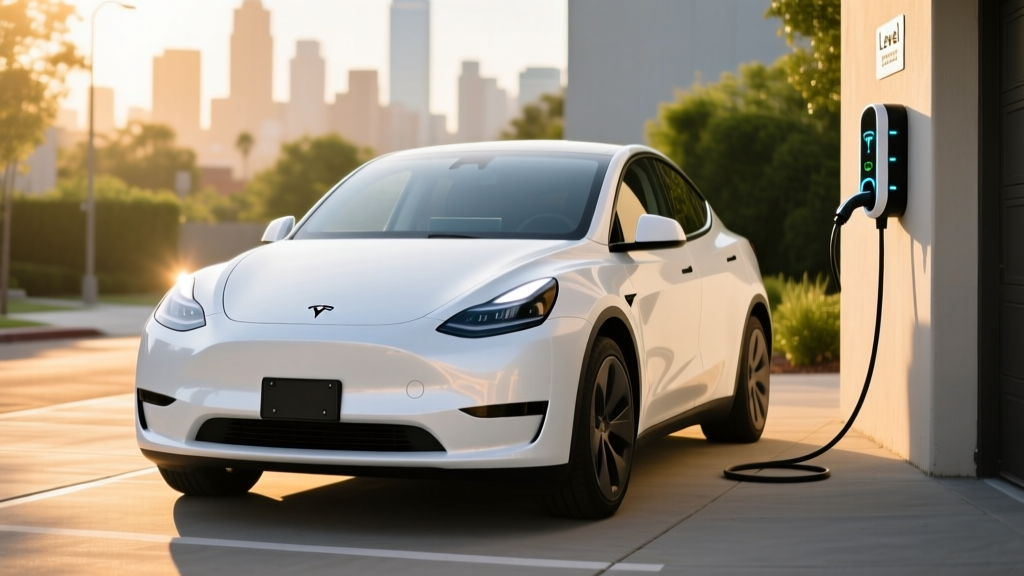
| Level 2 (240V, 48A) | 11.5 kW | ~44 mi/hr | Full overnight charge in ~7 hrs |
| DC Fast (V3 Supercharger) | 250 kW peak | ~200+ mi in 15 min | 10–80% in ~25 min |
| DC Fast (CCS adapter, non-Tesla) | Up to 250 kW | Varies by station | NACS port is native; CCS adapters no longer needed at most networks |
Charging curve reality: The 250 kW figure is a peak, not a sustained rate. In real-world testing, the Model Y Juniper holds close to peak power from roughly 10% to 40% state of charge, then tapers progressively. From 80% to 100%, charging slows dramatically to protect the NMC battery — expect that final 20% to take as long as the 10–80% session. For road trips, plan your stops around the 10–80% window for maximum time efficiency.
One major ownership advantage: Tesla's Supercharger network now includes over 20,000 stalls in North America, and with the NACS standard adoption by Ford, GM, Rivian, and others, Tesla owners no longer have exclusive access. However, the Supercharger network still leads in reliability — J.D. Power's 2025 EV Charging Index continues to rank Tesla's network highest for uptime and ease of use.
Pricing, Tax Credits, and True Cost of Ownership
The 2026 Model Y Long Range AWD starts at $47,990 (including destination), while the Performance trim begins at $52,490. Tesla periodically adjusts pricing, so always verify on the configurator before committing.
Federal Tax Credit Eligibility (IRS §30D)
The Model Y qualifies for the full $7,500 federal EV tax credit under current IRS rules — but only if you meet all eligibility criteria. Here's the checklist:
- ✅ MSRP Cap: Model Y MSRP is under the $80,000 SUV/van cap — QUALIFIES
- ✅ Final Assembly: Assembled in Austin, TX (North America) — QUALIFIES
- ⚠️ Battery Sourcing: Tesla sources critical minerals and battery components under evolving §30D rules. As of July 2026, the Model Y's LFP cells (for RWD) and NMC cells (for Long Range/Performance) continue to meet critical-mineral and battery-component thresholds — but verify at fueleconomy.gov before purchase, as sourcing requirements tighten annually
- ⚠️ Buyer Income Cap: AGI must not exceed $150,000 (single), $225,000 (head of household), or $300,000 (joint) — check your tax return
- ✅ Point-of-Sale Transfer: You can transfer the $7,500 credit to the dealer at purchase, reducing your out-of-pocket cost immediately
| Trim | MSRP | §30D Credit | Net Price (if eligible) |
|---|---|---|---|
| Long Range AWD | $47,990 | −$7,500 | $40,490 |
| Performance | $52,490 | −$7,500 | $44,990 |
Important: Tax credit eligibility depends on your individual tax situation. Consult a tax professional and verify current rules at IRS.gov. State and local incentives vary by jurisdiction — check your state's EV rebate programs separately.
Lease vs. Buy: The Tax Credit Catch
Here's the critical detail many lease shoppers miss: the §30D tax credit goes to the vehicle's legal owner — which in a lease is the leasing company (US Bank), not you. Tesla may pass some of that benefit through as a capitalized-cost reduction (which lowers your monthly payment), but there's no guarantee the full $7,500 is reflected in the lease terms. When comparing a $399/month lease to a purchase, factor in that the buyer gets the $7,500 credit directly while the lessee may receive only a portion as a cap-cost discount. Ask Tesla's sales advisor for the exact cap-cost reduction applied to your lease quote.
Interior, Tech, and Daily Livability
The Juniper refresh brought the Model Y's interior quality meaningfully closer to premium competitors. Notable updates for the 2026 model year include:
- Ventilated front seats — a welcome addition for warm-climate buyers who previously had to rely on aftermarket solutions
- 8-inch rear touchscreen for rear passengers (climate, media, entertainment)
- Power-folding second row with 60/40 split and near-flat load floor
- Ambient lighting strip across the dashboard, replacing the previous minimalist wood/metal trim
- Improved acoustic glass — cabin noise at 70 mph is noticeably reduced versus pre-Juniper models
- 15.4-inch center touchscreen running Tesla's latest software with Netflix, YouTube, and gaming while parked
Driver assistance: The Model Y comes standard with Tesla's Basic Autopilot (adaptive cruise control, lane-keeping, automatic emergency braking). Full Self-Driving (Supervised) remains a $8,000 add-on or $99/month subscription. It is critical to understand that FSD is an SAE Level 2 system — it requires continuous driver supervision and is not autonomous driving. Tesla's FSD has improved significantly in urban navigation, but the driver must remain engaged at all times. For hands-off-highway driving, GM's Super Cruise and Ford's BlueCruise offer more clearly defined operational domains, though they cover fewer roads.
Tesla's Autopilot and FSD (Supervised) are SAE Level 2 driver-assistance systems. They do NOT make the vehicle self-driving. You must keep your hands on the wheel, eyes on the road, and be prepared to take over instantly. FSD performs well on highways but can behave unpredictably in construction zones, unmapped areas, and adverse weather. Treat it as an advanced cruise control, not a chauffeur.
Drawbacks to note: The Model Y still lacks Apple CarPlay and Android Auto — Tesla's ecosystem is closed, and while the native navigation and media apps are competent, iPhone/Android integration purists will find this frustrating. The panoramic glass roof, while beautiful, can make the cabin uncomfortably warm in summer despite the UV-tinted glass; many owners add an aftermarket sunshade. Turn-signal stalks were removed in favor of steering-wheel buttons in the Juniper refresh — a polarizing design choice that takes adaptation.
Who Should Lease the Model Y in July 2026?
- You drive 10,000–12,000 miles per year and want predictable monthly costs
- You want access to Tesla's Supercharger network for road trips without long-term commitment
- You upgrade vehicles every 3 years and don't want to worry about EV resale-value depreciation
- You need a practical family hauler with 30+ cu ft of cargo space and strong safety ratings (5-star NHTSA)
- You value best-in-class efficiency (28 kWh/100mi) for low per-mile electricity costs
- You drive 15,000+ miles/year — excess mileage penalties ($0.20–$0.25/mi) will destroy the value proposition
- You want to claim the full $7,500 federal tax credit directly (buyers get it; lessees may not)
- You need Apple CarPlay/Android Auto for your daily workflow
- You want a purchase option at lease-end (Tesla leases do not include one)
- You prefer traditional dealership service — Tesla's mobile ranger and service-center model can mean longer wait times for body repairs
Model Y vs. Key Competitors: Quick Comparison
| Metric | Tesla Model Y LR | Hyundai Ioniq 5 Limited | Ford Mach-E ER AWD |
|---|---|---|---|
| EPA Range | 320 mi | 305 mi | 290 mi |
| Max DC Charge | 250 kW | 350 kW (800V) | 150 kW |
| 10–80% DC Time | ~25 min | ~18 min | ~38 min |
| Efficiency | 28 kWh/100mi | 30 kWh/100mi | 33 kWh/100mi |
| Cargo (rear up) | 30.2 cu ft | 27.2 cu ft | 29.7 cu ft |
| Base MSRP (AWD) | $47,990 | $52,600 | $48,995 |
| CarPlay/Android Auto | ❌ No | ✅ Yes | ✅ Yes |
Bottom line: The Model Y wins on efficiency, cargo space, and Supercharger access. The Ioniq 5 wins on DC charging speed (800V architecture is genuinely faster on compatible chargers). The Mach-E offers a more traditional driving feel and dealer service network. All three qualify for the federal tax credit (verify your individual eligibility).
Frequently Asked Questions
What is the real-world range of the 2026 Tesla Model Y?
The EPA rates the Model Y Long Range AWD at 320 miles and the Performance at 295 miles. In real-world mixed driving at highway speeds, expect 270–290 miles (Long Range) and 250–270 miles (Performance). In sustained cold weather below freezing, plan for 220–250 miles (Long Range) and 200–230 miles (Performance). The standard heat pump helps mitigate winter losses significantly compared to older models.
How fast does the Model Y charge at home and on road trips?
At home on a 240V/48A Level 2 charger, the Model Y adds approximately 44 miles of range per hour, reaching a full charge from empty in about 7 hours. On DC fast charging (Supercharger V3/V4 or compatible NACS stations), it peaks at 250 kW and charges from 10% to 80% in approximately 25 minutes. Above 80%, charging slows dramatically to protect the battery.
How much does a Tesla Model Y cost after the federal tax credit?
If you purchase and qualify for the full §30D credit, the Model Y Long Range AWD drops from $47,990 to approximately $40,490, and the Performance drops from $52,490 to $44,990. Eligibility requires meeting income caps ($150K single / $300K joint AGI), the vehicle must meet battery-sourcing requirements (currently met), and MSRP must be under $80,000 (met). Verify at IRS.gov and consult a tax professional.
Does the Model Y qualify for the federal EV tax credit in 2026?
Yes, as of July 2026 the Tesla Model Y qualifies for the full $7,500 federal tax credit under IRS §30D, provided the buyer meets income requirements and the vehicle's battery sourcing continues to satisfy annual thresholds. The credit can be transferred to the dealer at point of sale for an immediate price reduction. Rules tighten each year — always verify current eligibility before purchasing.
Is it better to lease or buy the Tesla Model Y in 2026?
Buying is better if you plan to keep the vehicle 5+ years, drive 12,000+ miles annually, and qualify for the $7,500 tax credit (which you claim directly as a purchaser). Leasing makes sense if you want lower monthly payments (~$399 vs. ~$600+ financing), drive under 12,000 miles/year, and prefer to upgrade every 3 years. Note that Tesla leases do not include a purchase option at lease-end, and the tax credit may only partially pass through as a cap-cost reduction.
What are the biggest pros and cons of the 2026 Model Y?
Pros: Best-in-class efficiency (28 kWh/100mi), 320-mile EPA range, excellent Supercharger network access, strong safety ratings (5-star NHTSA, IIHS Top Safety Pick+), spacious 30.2 cu ft cargo area, continuous over-the-air software improvements, heat pump standard for cold-weather efficiency.
Cons: No Apple CarPlay/Android Auto, no lease-end purchase option, turn-signal buttons on steering wheel take adaptation, glass roof can cause cabin heat in summer, service wait times can be long in some markets, FSD remains Level 2 requiring full driver engagement despite the "Full Self-Driving" name.