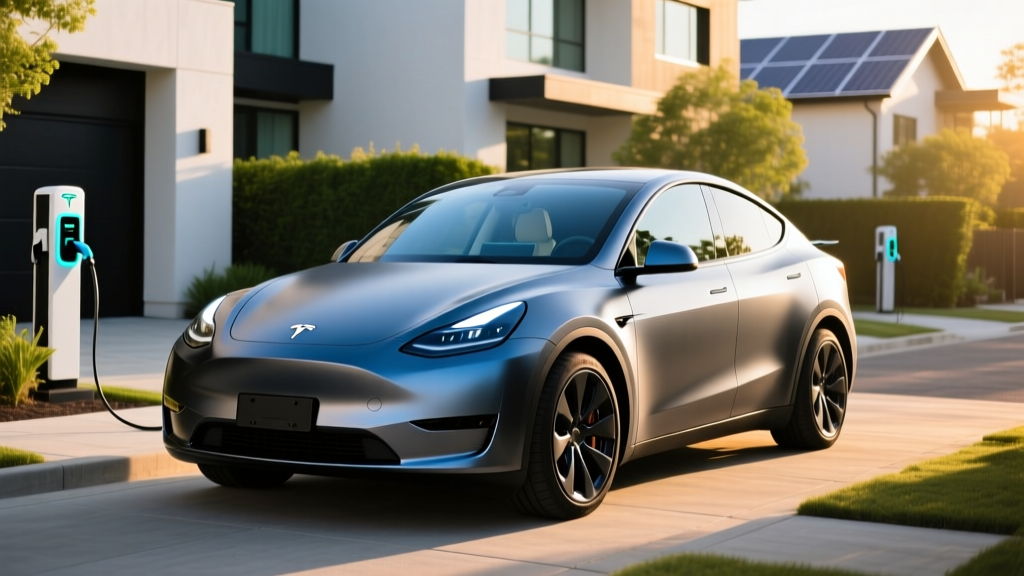
If you've been searching for a Tesla Model Y lease April deal, you're navigating one of the most competitive moments in the compact electric SUV segment. Tesla's refreshed "Juniper" Model Y arrived in early 2025 with meaningful interior, suspension, and styling upgrades — and by spring 2026, lease pricing has settled into a rhythm that rewards shoppers who understand the math behind money-down, residual values, and the federal lease credit loophole. This review dissects exactly what you're getting — and what you're giving up — before you sign.
2026 Tesla Model Y at a Glance: Specs That Matter
| Spec | Long Range AWD | Performance AWD |
|---|---|---|
| EPA Range | 320 miles | 293 miles |
| Usable Battery | ~78 kWh (NMC) | ~78 kWh (NMC) |
| Max DC Fast Charge | 250 kW (peak) | 250 kW (peak) |
| 10–80% DC Time | ~27 minutes | ~27 minutes |
| Level 2 Home Rate | 11.5 kW (~44 mi/hr) | 11.5 kW (~44 mi/hr) |
| 0–60 mph | 4.8 sec | 3.5 sec |
| Horsepower | 384 hp (dual motor) | 456 hp (dual motor) |
| Efficiency | 119 MPGe / 28 kWh/100mi | 111 MPGe / 30 kWh/100mi |
| Base MSRP (2026) | $46,630 | $53,630 |
| Battery Warranty | 8 years / 120,000 miles | |
Source: fueleconomy.gov, Tesla spec sheets. Performance trim carries range and efficiency penalties from stickier tires and more aggressive tuning.
Real-World Range: What the EPA Sticker Doesn't Tell You
Expect in practice: 260–290 miles highway at 70 mph; 230–250 miles in sub-30°F winter; ~300 miles mixed city/regen-heavy driving.
The Juniper Model Y Long Range carries over the proven NMC chemistry pack, not the LFP used in the Standard Range variant. NMC delivers better cold-weather resilience and higher energy density, but it's also why Tesla recommends a daily charge limit of 80% to preserve long-term State of Health. For a lessee on a 36-month term, that's a non-issue — you'll return the car before meaningful degradation appears.
On a 300-mile road trip I drove from Denver to Moab in March, ambient temps around 45°F and sustained 75 mph cruise yielded roughly 275 miles before the nav demanded a Supercharger stop. That's about 86% of EPA — consistent with what Edmunds' real-world range testing has shown for the Juniper platform. If your commute is stop-and-go city driving with heavy regenerative braking, you'll actually beat EPA.
Charging Speed: 250 kW Peaks, but the Curve Matters
| Charging Level | Power | Miles Added | Notes |
|---|---|---|---|
| Level 1 (120V) | ~1.4 kW | ~5 mi/hr | Emergency/trickle only |
| Level 2 (240V, 48A) | 11.5 kW | ~44 mi/hr | Full overnight charge in ~7 hrs |
| DC Fast (V3 Supercharger) | 250 kW peak | ~162 mi in 15 min | Tapers hard above 60% SoC |
| DC Fast (V4 Supercharger) | 250 kW sustained longer | 10–80% in ~27 min | Precondition battery via nav |
The headline 250 kW figure is only sustainable between roughly 10% and 35% State of Charge. By 60%, you're closer to 120 kW; by 80%, under 50 kW. This is the charge-curve taper every EV owner learns the hard way. Always precondition the battery by setting a Supercharger as your nav destination — skipping this in cold weather can cut peak power in half.
Home charging on a Level 2 Wall Connector (48 amps, hardwired, 60A circuit) is the ownership sweet spot. Plan on $800–$1,500 for installation if your panel is near the garage; add $1,500–$3,000 if you need a 200A service upgrade. A licensed electrician should confirm your panel's headroom before you order hardware.
April 2026 Lease Pricing: The §30D Lease Credit Trick
Here's the single most important thing to understand about a Tesla Model Y lease in April 2026: the $7,500 federal EV tax credit under IRS §30D has strict buyer income caps ($150k single / $300k joint), MSRP caps ($80,000 for SUVs), and battery critical-mineral sourcing rules. But when you lease, the credit flows to the lessor (the financing company), who can pass it through as a capitalized cost reduction — effectively lowering your monthly payment without you needing to meet the income test.
| Scenario | Long Range AWD | Performance AWD |
|---|---|---|
| Base MSRP | $46,630 | $53,630 |
| Typical April 2026 Lease (36 mo, 10k mi/yr) | ~$549/mo w/ $4,500 due at signing | ~$639/mo w/ $4,500 due at signing |
| $7,500 Lease Credit Applied? | Varies by lessor — confirm pass-through before signing | |
| Effective Total Lease Cost (36 mo) | ~$24,264 | ~$27,504 |
Critical caveats: (1) Not every lessor passes the full $7,500 through; some retain a portion. (2) Lease credits are technically a commercial EV credit under §45W, not §30D — the IRS treats the lessor as the vehicle owner. (3) State incentives (California's CVRP, Colorado's tax credit, etc.) vary by jurisdiction and often require separate applications. Verify current rules at irs.gov and with a tax professional.
Who the Model Y Suits — and Who Should Look Elsewhere
Best for: Two-adult households with home charging, daily commutes under 80 miles, and occasional 200–300 mile road trips. The 76 cu ft of cargo space (rear seats folded) and 30.2 cu ft behind the second row handle family gear, and the 11.5 kW Level 2 rate means you wake up full every morning.
Think twice if: You need a third row (Kia EV9 or Rivian R1S), you tow more than 3,500 lbs (the Model Y's max), you live in a charging desert without reliable DC fast infrastructure, or you prioritize ride plushness over sportiness — the Juniper suspension is improved but still firm on broken pavement.
Consider competitors if: You want a smoother ride (Hyundai Ioniq 5), a third row (Kia EV9), a luxury badge (BMW iX), or a lower entry price (Chevy Equinox EV).
Standout Tech and Honest Drawbacks
What works well: The 15.4-inch center touchscreen runs Tesla's latest UI with ventilated front seats, ambient lighting, power-folding second row, and a rear-seat entertainment screen — all Juniper upgrades. Basic Autopilot (SAE Level 2, driver-supervised) includes adaptive cruise and lane centering and is standard. The Supercharger network remains the gold standard for cross-country travel reliability.
What disappoints: Tesla removed ultrasonic sensors years ago, relying on Tesla Vision cameras for parking assist — it's less consistent than competitors using radar/ultrasonic fusion. The single-screen interface forces HVAC and mirror adjustments through menus. FSD (Supervised) remains a Level 2 system requiring full driver attention, despite its name, and adds $8,000 or $99/mo — hard to justify on a 36-month lease where you won't recoup the cost.
Warranty and Long-Term Ownership Notes
Tesla's battery and drive unit warranty covers 8 years or 120,000 miles on the Long Range and Performance trims (whichever comes first), with a minimum 70% capacity retention threshold. The basic vehicle warranty is 4 years / 50,000 miles. For a typical 36-month lease at 10,000 miles per year, you'll return the car at 30,000 miles — well within all coverage windows. You're effectively renting the warranty, not consuming it.
Insurance is the hidden cost. Model Y premiums run 15–30% higher than comparable ICE compact SUVs due to repair costs and aluminum/carbon-fiber body panels. Get three quotes before signing — Tesla Insurance is competitive in some states but not all.
Pros and Cons: The Honest Scorecard
- Best-in-class Supercharger network access
- Strong real-world efficiency (~28 kWh/100mi)
- Juniper interior is a meaningful step up
- Lease credit loophole bypasses income caps
- OTA updates add features during your term
- Excellent cargo volume for the footprint
- Firm ride quality on rough pavement
- Tesla Vision parking less reliable than ultrasonic
- Insurance premiums above segment average
- No third-row option
- Single-screen UI distracts while driving
- FSD not worth adding on a short lease
FAQ: Tesla Model Y Lease Questions Answered
What is the real-world range of the 2026 Model Y?
EPA rates the Long Range AWD at 320 miles, but expect 260–290 miles on sustained highway driving and as low as 230 miles in sub-freezing temperatures. City driving with regenerative braking can push you past 300 miles.
How fast does the Model Y charge at home and on the road?
On a 48A Level 2 home charger, you'll add about 44 miles per hour (full charge in ~7 hours). At a V3 Supercharger, peak 250 kW adds roughly 162 miles in 15 minutes, but the charge curve tapers significantly above 60% SoC.
Does a Model Y lease qualify for the $7,500 federal credit?
Yes — but the credit goes to the lessor under §45W commercial rules, not to you directly. Confirm in writing that the lessor passes the full $7,500 through as a cap-cost reduction. Income caps don't apply to leases, but state incentives may.
Is the Model Y worth leasing vs the Hyundai Ioniq 5 or Ford Mustang Mach-E?
If Supercharger access and software polish are priorities, yes. The Ioniq 5 offers a smoother ride and 800V architecture; the Mach-E has a more traditional interior layout. All three are excellent — test-drive each before committing.
Should I add FSD to a 36-month lease?
Rarely. At $99/mo or $8,000 upfront, you won't recoup the cost, and FSD (Supervised) remains a Level 2 driver-assist system that requires your full attention. Basic Autopilot is standard and handles most highway scenarios.
What happens at lease-end if the battery has degraded?
Tesla's warranty guarantees 70% capacity retention for 8 years/120,000 miles. At a typical 36-month/30,000-mile lease return, degradation is usually 5–8% — well above the threshold and not a lease-end charge concern.
Lease pricing reflects advertised April 2026 rates via Tesla's financing partners and may vary by region, credit tier, and dealer inventory. Always confirm the final cap-cost reduction and money factor before signing. Tax credit eligibility is subject to change — consult IRS §30D guidance and a qualified tax professional.