The Tesla Cybertruck is as much a conversation about its bed as it is about its powertrain. The angular stainless-steel pickup launched with bold promises about payload, towing, and off-road geometry — but for buyers who actually plan to haul lumber, load a pair of dirt bikes, or mount a camper shell, the practical question is simpler: how useful is the Tesla truck bed in day-to-day life?
After spending time with the Cybertruck AWD and Cyberbeast trims, we've measured what fits, what doesn't, and how the electric pickup's range, charging, and pricing shake out once you leave the spec sheet behind. Here's the full breakdown.
Cybertruck Key Specs at a Glance
| Spec | AWD (Dual-Motor) | Cyberbeast (Tri-Motor) |
|---|---|---|
| EPA Range | 340 miles | 320 miles |
| Battery (usable) | ~123 kWh, NMC | ~123 kWh, NMC |
| 0-60 mph | 4.1 sec | 2.6 sec |
| Horsepower | 600 hp | 845 hp |
| Max DC Fast Charge | 250 kW (V3 Supercharger) | 250 kW (V3 Supercharger) |
| 10-80% DC Time | ~30 min | ~30 min |
| Level 2 Home Charge | 11.5 kW (~37 mi/hr) | 11.5 kW (~37 mi/hr) |
| Towing Capacity | 11,000 lbs | 11,000 lbs |
| Payload Capacity | 2,500 lbs | 2,500 lbs |
| Bed Length | 6 ft (72 in) | 6 ft (72 in) |
| Bed Width (between wells) | ~50 in | ~50 in |
| MPGe (combined) | 67 MPGe | 64 MPGe |
| Efficiency | 50 kWh/100 mi | 53 kWh/100 mi |
| Base MSRP | $79,990 | $99,990 |
| Battery/Drive Unit Warranty | 8 yr / 120,000 mi | 8 yr / 120,000 mi |
Source: fueleconomy.gov, Tesla.com (2025 model year specs, current for 2026 sales).
The Tesla Truck Bed: Dimensions, Access, and Real Cargo
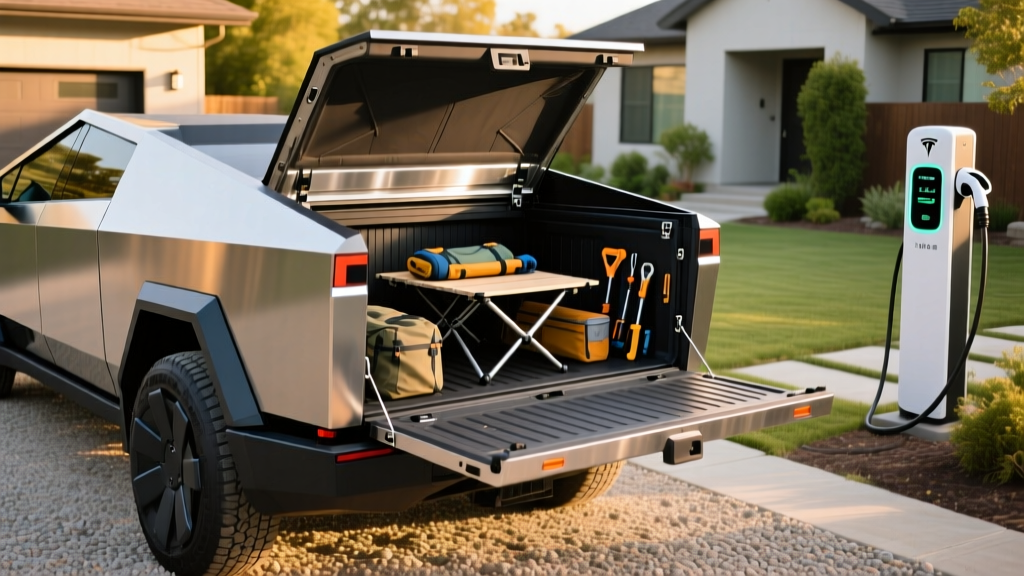
The Cybertruck's bed is officially 6 feet long with the powered tonneau cover deployed. Unlike a conventional truck tailgate that drops flat, Tesla uses a power-folding "vault"-style tonneau that retracts into the bed floor, and a tailgate that deploys with a built-in ramp. The bed width between the wheel wells is roughly 50 inches — just enough for a standard 4×8 sheet of plywood if you angle it, but it will not sit flat on the floor between the wells the way it does in a Ford F-150 or Rivian R1T.
Practical loading notes from real-world use:
- 4×8 plywood sheets: Fit on top of the wheel wells (with tailgate down and support), but not flat on the bed floor.
- Full-size pallets: Will not fit between the wheel wells. Forklift loading from the side is not practical.
- Dirt bikes / ATVs: Two dirt bikes fit with the ramp deployed; the powered tailgate handles the weight of a single rider rolling on.
- Cargo volume: ~67 cu ft with the tonneau closed; Tesla also markets ~70 cu ft of total lockable storage when you include the front trunk (frunk) and the "sail" compartments behind the rear doors.
- 120V/240V bed outlets: The bed includes two 120V outlets and one 240V outlet (NEMA 14-50-style), enabling power-tool use, campsite hookup, or up to 11.5 kW of vehicle-to-load (V2L) export — enough to run most home essentials during an outage.
The stainless-steel exoskeleton is dent-resistant but shows fingerprints aggressively, and the angular bed sides limit aftermarket rack compatibility. As of 2026, Yakima and Thule offer Cybertruck-specific crossbar systems, but the broader ecosystem of bed racks, camper shells, and ladder racks still lags the F-150 and Silverado by a wide margin.
Range and Efficiency: What the EPA Number Doesn't Tell You
Real-World Range vs. EPA Sticker
EPA Estimated: 340 miles (AWD) / 320 miles (Cyberbeast)
Expect in real-world highway driving (70-75 mph): ~260-285 miles
Cold-weather (below 32°F, highway): ~210-240 miles
While towing (5,000+ lb trailer, flat terrain): ~150-180 miles
The Cybertruck's slab-sided, angular profile is a drag coefficient liability at highway speeds. Despite Tesla's claims of aerodynamic optimization, independent testing consistently shows 20-25% range reduction at sustained 70+ mph speeds versus the EPA combined figure. The EPA's combined cycle weights city driving heavily, where regenerative braking recovers energy — the Cybertruck's 67 MPGe combined drops effectively into the low 50s MPGe-equivalent on a long interstate run.
The ~123 kWh usable NMC battery pack is one of the largest in any consumer EV, which provides a buffer for cold-weather degradation and towing, but it also means longer charge times at lower-power chargers. Plan your road-trip stops around high-power V3 or V4 Superchargers, not 50 kW CCS stations in rural areas.
Charging Speed: DC Fast, Home, and the Curve Reality
Charging Speeds Breakdown
| Level | Power (kW) | Miles Added per Hour | Typical Use Case |
|---|---|---|---|
| Level 1 (120V) | ~1.4 kW | ~3-4 mi/hr | Emergency / trickle |
| Level 2 (240V, 48A) | 11.5 kW | ~37 mi/hr | Home / workplace |
| DC Fast (V3 Supercharger) | 250 kW peak | ~200+ mi in 15 min (10-50%) | Road trips |
| DC Fast (V4 Supercharger) | Up to 325 kW (cable-cooled) | Similar — truck-side limited | Future network |
The Cybertruck peaks at 250 kW on V3 Superchargers, but — as with every EV — peak power is not sustained power. The charge curve tapers noticeably above 50% State of Charge (SoC), and more aggressively above 80%. A 10-80% charge takes roughly 30 minutes at a V3 station, but the final 20% (80-100%) can add another 35-45 minutes. For road trips, the practical strategy is short, frequent stops (10-60%) rather than waiting for a full battery.
At home on a 48-amp Level 2 wall connector (11.5 kW), expect a full charge from 10% in about 10-11 hours. If your home electrical panel only supports a 40-amp circuit (9.6 kW), add roughly an hour. Panel upgrades to 200A service may be necessary for older homes — budget $1,500-$3,500 for the electrician work on top of the $400-$600 Wall Connector unit.
Preconditioning matters. Enable navigation to a Supercharger before you arrive, and the Cybertruck will warm the battery pack to optimize charge acceptance. Skip this step in cold weather and your peak charge rate may drop to 120-150 kW for the first several minutes.
Performance and Driving Impressions
The dual-motor AWD Cybertruck hits 60 mph in 4.1 seconds with 600 hp — genuinely quick for a vehicle that weighs over 6,600 lbs. The tri-motor Cyberbeast's 2.6-second 0-60 time is supercar territory, though its practical value beyond stoplight theatrics is limited by the truck's mass and tire grip.
Where the Cybertruck distinguishes itself from the Rivian R1T and F-150 Lightning is in its steer-by-wire system and 48-volt electrical architecture. Steer-by-wire eliminates the mechanical connection between the yoke and wheels, enabling a variable steering ratio that makes the truck feel surprisingly nimble at low speeds (under 2 turns lock-to-lock) while remaining stable at highway speed. It takes roughly 20 minutes of driving to build muscle memory — some owners love it; others never adjust.
Ride quality benefits from the adaptive air suspension, which offers 12 inches of ground clearance in Extract Mode for off-road use and drops for highway efficiency. The stainless-steel body is exceptionally rigid, which helps handling but transmits more road texture into the cabin than an F-150 Lightning's body-on-frame design.
Tax Credits, Pricing, and Total Cost
2026 Pricing and Federal Tax Credit Eligibility
| Trim | Base MSRP | §30D Federal Credit | Effective Price (if eligible) |
|---|---|---|---|
| AWD (Dual-Motor) | $79,990 | $0 | $79,990 |
| Cyberbeast (Tri-Motor) | $99,990 | $0 | $99,990 |
Under IRS §30D rules, the Cybertruck does not qualify for the $7,500 federal new-vehicle tax credit. The credit's MSRP cap for trucks is $80,000 — the AWD trim technically squeaks under at $79,990, but any options, destination fees, or paint selections push it over. The Cyberbeast at $99,990 is well above the cap regardless. Additionally, buyer income limits ($150,000 single / $300,000 joint MAGI) and critical-mineral/battery-component sourcing rules further restrict eligibility even for borderline-priced EVs.
For buyers who can access the point-of-sale transfer mechanism (available on qualifying vehicles), the credit is applied as a down-payment reduction at the dealer — but since the Cybertruck does not currently qualify, this is a moot point. Some state-level incentives (California's CVRP, Colorado's state credit) may still apply; check your state energy office for current-year programs.
Who Should Buy the Cybertruck — and Who Shouldn't
Pros
- 250 kW Supercharger access + Tesla's unmatched charging network reliability
- 11,000-lb towing, 2,500-lb payload — competitive with full-size gas trucks
- V2L capability (11.5 kW export) for job sites and home backup
- Stainless exoskeleton resists dents and scratches
- 8 yr / 120,000 mi battery & drive unit warranty
- OTA updates continuously add features post-purchase
Cons
- Bed cannot fit 4×8 plywood flat on the floor between wheel wells
- No federal §30D tax credit due to MSRP and sourcing rules
- Highway range drops sharply (~260-285 mi real-world vs. 340 EPA)
- Steer-by-wire learning curve; not for every driver
- Limited aftermarket rack/camper/rack accessory ecosystem (2026)
- Premiums for insurance run 20-40% higher than comparable F-150 Lightning
Best for: Tech-forward truck buyers who prioritize acceleration, Tesla's Supercharger network, and V2L capability, and whose cargo needs fit within a 6-foot bed with narrower wheel-well clearance. Ideal as a daily-driver truck that occasionally hauls gear, bikes, or a modest trailer.
Look elsewhere if: You need flat-floor 4×8 sheet goods capability, a mature aftermarket accessory ecosystem, or federal tax-credit eligibility. The Ford F-150 Lightning (8-ft bed option, flat floor, qualifies for §30D on lower trims) and Rivian R1T (gear tunnel, 4.5-ft bed + tunnel storage, more refined ride) are the direct alternatives.
Tesla Cybertruck FAQ
Does the Tesla truck bed fit a sheet of plywood?
A 4×8 sheet of plywood fits on top of the wheel wells with the tailgate down and a bed support, but it will not sit flat on the bed floor between the wells due to the ~50-inch width constraint. If flat-floor loading is a daily need, the F-150 Lightning or Silverado are more practical.
What is the real-world range of the Cybertruck?
The EPA rates the AWD at 340 miles and Cyberbeast at 320 miles. Real-world highway driving at 70-75 mph yields ~260-285 miles. Cold weather (below freezing) reduces that further to ~210-240 miles. Towing a 5,000+ lb trailer cuts range roughly in half.
How fast does the Cybertruck charge?
On a Tesla V3 Supercharger, the Cybertruck peaks at 250 kW and charges 10-80% in approximately 30 minutes. At home on a 48-amp Level 2 charger (11.5 kW), it adds ~37 miles of range per hour, with a full charge taking 10-11 hours.
Does the Cybertruck qualify for the $7,500 federal EV tax credit?
No. Under current IRS §30D rules, the AWD trim's $79,990 MSRP is at the $80,000 truck cap, but any options push it over. The Cyberbeast at $99,990 far exceeds it. Battery-sourcing and buyer income limits further restrict eligibility. Check IRS.gov for the latest rules.
Is the Cybertruck worth it over the F-150 Lightning or Rivian R1T?
It depends on your priorities. The Cybertruck wins on Supercharger network access, V2L capability, and acceleration. The F-150 Lightning wins on bed practicality, tax-credit eligibility, and dealer service access. The Rivian R1T wins on ride refinement and creative storage (gear tunnel). For a truck that must do traditional truck work daily, the Lightning is the safer bet. For a tech-first daily driver with occasional utility, the Cybertruck delivers.
What is the Cybertruck's towing capacity and warranty?
Both trims are rated for 11,000 lbs of towing. The battery and drive unit warranty covers 8 years or 120,000 miles, whichever comes first, with a minimum 70% battery capacity retention threshold — consistent with Tesla's broader warranty structure and slightly better mileage coverage than the F-150 Lightning's 8 yr / 100,000 mi battery warranty.