Quick Verdict: Does Hardware 4 Justify the Model Y in 2026?
The Tesla Model Y remains the best-selling EV in the United States for good reason: a compelling mix of range, charging speed, cargo versatility, and software. The introduction of Hardware 4 (HW4) — Tesla's latest Autopilot computer and sensor suite — sharpens the vehicle's driver-assistance capabilities with higher-resolution cameras and a more powerful inference chip. But HW4 is not a reason alone to buy; it's the wrapper around an already strong electric crossover that now starts at $44,990 (Long Range RWD) before incentives.
After spending time with the refreshed Juniper-era Model Y equipped with HW4, the verdict is clear: this is the default choice for buyers who want a practical family EV with access to the Supercharger network and best-in-class efficiency. Its weaknesses — a firm ride, minimal physical controls, and FSD Supervised that remains a Level 2 system — are well-documented and unlikely to surprise informed shoppers.
Range, Battery, and Real-World Efficiency
The 2026 Model Y lineup offers three primary configurations, each with a distinct range profile. Tesla uses a mix of NMC (nickel manganese cobalt) chemistry in Long Range and Performance trims and LFP (lithium iron phosphate) in the base Standard Range model. NMC provides higher energy density for maximum range; LFP trades some range for lower cost, longer cycle life, and the ability to charge routinely to 100% without degradation concerns.
| Trim | Battery (usable kWh) | Chemistry | EPA Range | MPGe (combined) | kWh/100 mi |
|---|---|---|---|---|---|
| Long Range RWD | ~75 kWh | NMC | 320 mi | 123 MPGe | 27 |
| Long Range AWD | ~75 kWh | NMC | 300 mi | 117 MPGe | 29 |
| Performance AWD | ~75 kWh | NMC | 285 mi | 111 MPGe | 30 |
Efficiency remains a Tesla strong point. At 27 kWh/100 miles, the Long Range RWD converts more electrons into miles than nearly any competing midsize electric SUV, a product of low drag coefficient, aggressive regenerative braking, and sophisticated thermal management. For reference, the Hyundai Ioniq 5 AWD consumes roughly 31 kWh/100 mi in combined driving per fueleconomy.gov.
Charging Speed: Supercharger Advantage and Home Setup
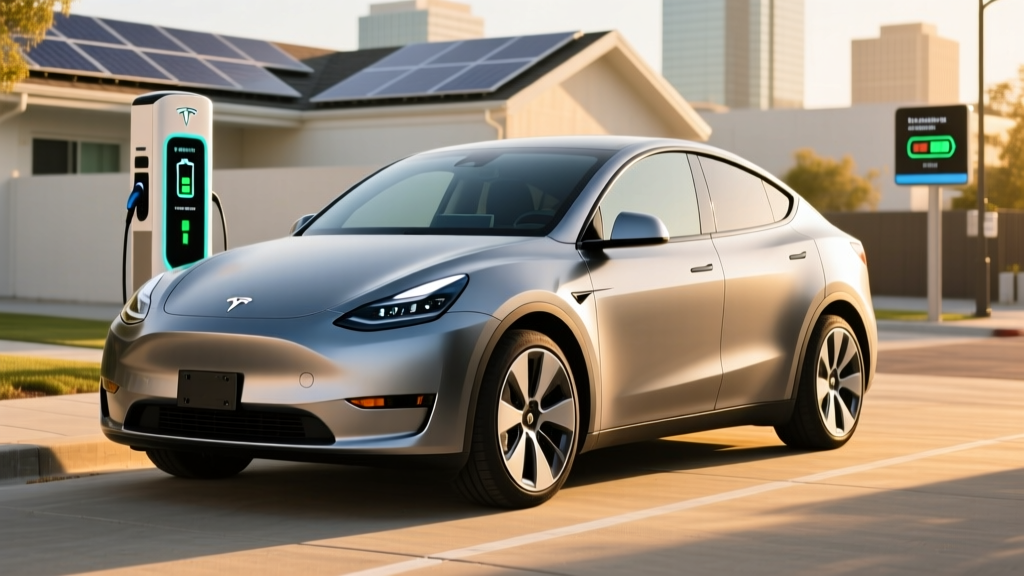
The Model Y Long Range and Performance trims support a peak DC fast-charge rate of 250 kW on V3 Superchargers (and compatible CCS/NACS stations). Tesla's charge curve is well-managed: the battery preconditioning system — activated automatically when a Supercharger is set as your navigation destination — warms the pack to optimal temperature, enabling sustained high-power charging in the critical 10–50% state-of-charge window.
| Charging Level | Power | Typical Speed | Best For |
|---|---|---|---|
| Level 1 (120V) | ~1.4 kW | ~3–4 mi/hr | Emergency / overnight trickle |
| Level 2 (240V, 48A) | 11.5 kW | ~37 mi/hr | Daily home charging |
| DC Fast (V3 Supercharger) | Peak 250 kW | 10–80% in ~25 min | Road trips |
| DC Fast (V4 Supercharger) | Peak 250 kW* | 10–80% in ~25 min | Newer stations |
*The Model Y's onboard architecture caps at ~250 kW even on higher-capacity V4 posts.
A critical nuance many buyers miss: peak kW is not sustained kW. The 250 kW figure applies roughly between 10–30% state of charge. Above 50%, the rate tapers significantly, and above 80%, charging slows dramatically to protect battery health. A typical 10–80% session takes about 25 minutes, but a 10–100% session can stretch past 50 minutes. Plan accordingly on long trips — charging to 80% and driving on is almost always faster than waiting for the last 20%.
At home on a Level 2 Wall Connector (48 amps, 240V), the Model Y adds roughly 37 miles of range per hour of charging. A full overnight session easily replenishes a day's driving for most commuters. Installation costs vary widely: expect $800–$2,500 for a straightforward install near your electrical panel, but homes requiring a panel upgrade (from 100A to 200A service) can see total costs of $3,000–$5,000. Always get a quote from a licensed electrician before committing.
Performance and Drivetrain
The Model Y continues to offer brisk acceleration across all trims, with dual-motor all-wheel drive available on Long Range AWD and standard on Performance.
| Trim | Drivetrain | Horsepower | 0–60 mph |
|---|---|---|---|
| Long Range RWD | Rear-Wheel Drive | ~346 hp | 5.8 sec |
| Long Range AWD | Dual-Motor AWD | ~384 hp | 4.8 sec |
| Performance AWD | Dual-Motor AWD | ~456 hp | 3.5 sec |
The Performance trim's 3.5-second 0–60 time puts it in sports-car territory, and the instant torque delivery makes even the Long Range AWD feel urgent in daily driving. The RWD model, while the slowest of the group, is still quicker than most gas-powered crossovers and offers the best efficiency and range of the lineup.
Hardware 4: What's New in Autopilot and Sensors
Hardware 4 (HW4) is Tesla's current-generation Autopilot computer and camera suite, succeeding the older HW3 system. The key upgrades include:
- Higher-resolution cameras — roughly double the pixel count of HW3, improving object detection at distance and in low light
- Wider field-of-view on the front-facing camera for better intersection and lane-change awareness
- More powerful inference chip — Tesla claims significantly faster neural-network processing, enabling more complex driving-scenario recognition
- Removal of ultrasonic sensors (USS) — Tesla now relies on Tesla Vision (camera-only) for parking proximity and obstacle detection, which remains a point of contention among owners who preferred the redundancy of physical sensors
In practice, HW4 improves Autopilot's lane-centering smoothness and its ability to read faded lane markings and complex merge scenarios. FSD Supervised — the optional $8,000 upgrade (or $99/month subscription as of early 2026) — handles more city-street scenarios than before, but still requires active supervision and can make unpredictable decisions in construction zones, unprotected left turns, and heavy rain. Buyer beware: FSD's value proposition remains debatable for most drivers, and it does not transform the Model Y into a robotaxi.
Interior, Cargo, and Tech
The Juniper refresh brought meaningful interior improvements: ventilated front seats, ambient lighting, rear-seat touchscreen, power-folding second row, and improved sound insulation. The minimalist cabin still centers on a single 15.4-inch touchscreen with no physical stalks (turn signals are now on the steering wheel rim — a love-it-or-hate-it design choice).
| Measurement | Value |
|---|---|
| Front legroom | 41.8 in |
| Rear legroom | 41.6 in |
| Cargo (rear seats up) | 30.2 cu ft |
| Cargo (rear seats folded) | 72.1 cu ft |
| Front trunk (frunk) | 4.1 cu ft |
Cargo volume remains best-in-class for the segment, easily swallowing strollers, groceries, and luggage for a family of four. The frunk is small but useful for charging cables. Rear-seat comfort has improved with the Juniper update, though taller passengers may still find the seat cushion slightly low to the floor.
Tech highlights include native Spotify/Apple Music integration, a built-in dashcam and Sentry Mode security system, over-the-air software updates that add features regularly, and the Tesla app for remote preconditioning, charging management, and vehicle location. Notable drawbacks: no Apple CarPlay or Android Auto (a dealbreaker for some buyers), no physical buttons for climate or volume, and reliance on the touchscreen for nearly every vehicle function.
Pricing, Tax Credits, and Ownership Cost
The 2026 Model Y lineup starts at $44,990 for the Long Range RWD, with AWD and Performance trims climbing from there. All trims fall below the IRS §30D MSRP cap of $80,000 for SUVs, making them potentially eligible for the federal tax credit — but eligibility is far from automatic.
| Trim | Base MSRP | As-Tested (typical) | §30D Credit Potential |
|---|---|---|---|
| Long Range RWD | $44,990 | $46,490 (w/ FSD sub) | Up to $7,500* |
| Long Range AWD | $47,990 | $50,490 | Up to $7,500* |
| Performance AWD | $51,490 | $54,990 | Up to $7,500* |
*Federal tax credit eligibility depends on multiple factors. See IRS §30D rules for current requirements.
- MSRP cap: Vehicle must be under $80,000 (all Model Y trims qualify)
- Buyer income cap: AGI ≤ $150,000 (single), $225,000 (head of household), $300,000 (joint)
- Battery sourcing: Critical minerals and battery components must meet escalating percentage thresholds from approved trade partners — Tesla's supply chain has adapted, but confirm with the dealer at purchase
- Point-of-sale transfer: Eligible buyers can apply the credit as a down-payment reduction at purchase rather than waiting for tax filing
- North American final assembly: Required — all US-market Model Y vehicles are assembled in Fremont, CA or Austin, TX ✓
Beyond the purchase price, ownership costs favor the Model Y. Electricity at $0.14/kWh (national average) yields a fuel cost of roughly $0.038/mile for the Long Range RWD — about one-third the per-mile cost of a comparable gas crossover at $3.50/gallon. Insurance, however, tends to run 15–25% higher than gas equivalents due to repair costs and Tesla's proprietary body structure. Depreciation has stabilized after steep 2023–2024 price cuts, and the Model Y retains value well relative to most EVs.
Warranty Coverage
| Coverage | Term |
|---|---|
| Basic vehicle | 4 years / 50,000 miles |
| Battery & drive unit | 8 years / 120,000 miles (Long Range/Performance) |
| Battery capacity retention | ≥70% over warranty period |
Tesla's battery warranty guarantees at least 70% capacity retention over 8 years or 120,000 miles (whichever comes first). Real-world data from high-mileage Tesla owners suggests NMC packs in the Model Y typically lose 8–12% capacity in the first 100,000 miles, with degradation slowing significantly after the initial break-in period. LFP packs (Standard Range) tend to degrade even more slowly but start with less total capacity.
Pros, Cons, and Who Should Buy
- Best-in-class efficiency (27 kWh/100 mi)
- Supercharger network access — still the most reliable DC fast-charging ecosystem
- Spacious cargo area (72.1 cu ft max) with practical frunk
- HW4 cameras improve Autopilot confidence in varied conditions
- Over-the-air updates continually add features
- Strong resale value relative to EV peers
- No Apple CarPlay or Android Auto
- Turn signals on steering wheel rim take adjustment
- FSD Supervised ($8,000) remains Level 2 — not self-driving
- Firm ride quality on rough pavement
- Ultrasonic sensor removal makes tight parking more stressful for some
- Insurance premiums above segment average
- Commuters: Excellent — efficient, comfortable enough for daily miles, easy home charging
- Families: Strong choice — spacious cargo, good safety ratings (NHTSA 5-star), rear-seat entertainment screen
- Road trippers: Best-in-segment thanks to Supercharger network and 250 kW charging
- Towing: Limited — 3,500 lb max tow rating, and towing cuts range by 40–50%
- Budget buyers: Consider — the $44,990 entry is competitive, but rivals like the Chevy Equinox EV undercut on price if range and Supercharger access aren't priorities
Frequently Asked Questions
What is the real-world range of the Tesla Model Y?
The EPA rates the Long Range RWD at 320 miles, but real-world highway driving at 70–75 mph typically yields 260–285 miles. In freezing weather, expect 220–250 miles. The AWD and Performance trims deliver 10–15% less due to the additional motor and stickier tires.
How fast does the Model Y charge at home and on the road?
On a Level 2 home charger (48A/240V), the Model Y adds about 37 miles of range per hour, fully replenishing overnight. On a V3 Supercharger at peak 250 kW, a 10–80% session takes approximately 25 minutes. Charging above 80% slows dramatically — plan to charge to 80% and drive on for the fastest road-trip experience.
How much does the Model Y cost after federal tax credits?
If you qualify for the full $7,500 §30D credit (meeting income, sourcing, and assembly requirements), the Long Range RWD drops to an effective $37,490. Use the point-of-sale transfer option to apply the credit as a down-payment reduction at purchase. Confirm eligibility with your tax professional before relying on the credit.
Does the Tesla Model Y qualify for the $7,500 federal EV tax credit?
All 2026 Model Y trims meet the MSRP cap ($80,000 for SUVs) and North American assembly requirement. Buyer income caps ($150K single / $300K joint) and battery-component sourcing rules apply. Tesla has worked to comply with critical-minerals sourcing thresholds, but rules tighten annually — verify current eligibility on IRS.gov before purchasing.
Is the Model Y worth buying over the Hyundai Ioniq 5 or Ford Mustang Mach-E?
The Model Y wins on efficiency, Supercharger access, and cargo space. The Ioniq 5 offers faster 800V charging (10–80% in ~18 min on 350 kW chargers), Apple CarPlay, and a more comfortable ride. The Mach-E provides a more traditional driving feel and available CarPlay. If Supercharger reliability and software ecosystem matter most, the Model Y remains the default. If ride comfort and phone integration are priorities, cross-shop the Ioniq 5.
Is Hardware 4 worth upgrading for?
If you're buying a new Model Y, HW4 comes standard — there's no choice to make. If you're considering a used HW3 vehicle versus a new HW4, the camera resolution and processing improvements are meaningful but not transformative. Autopilot remains Level 2 on both. The decision should rest more on battery health, mileage, and price than on the HW generation alone.