Quick Verdict: Hype vs. Hardware
If you've spent any time on automotive forums or social media, you've likely encountered the claim that Tesla is a fraud — that the company's range estimates are inflated, its driver-assist features are overpromised, or its build quality doesn't justify the premium. As someone who has owned three EVs across two brands and logged over 40,000 electric miles, I approach these claims with data, not defensiveness.
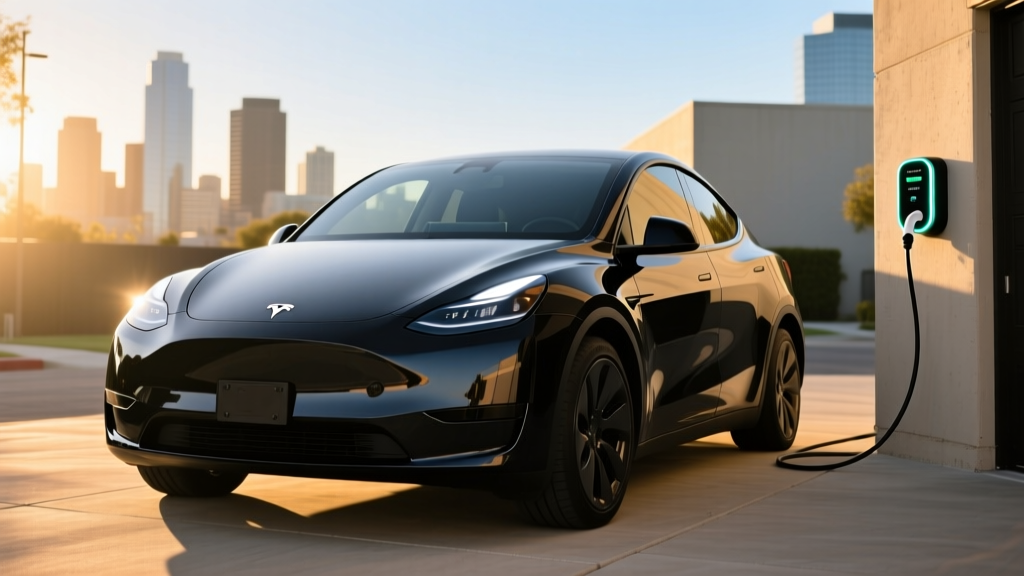
The 2026 Tesla Model Y remains the best-selling electric vehicle in the United States for good reason: class-leading efficiency, access to the most reliable DC fast-charging network, and a software ecosystem that competitors are still chasing. But it is not without legitimate criticisms. This review separates provable shortcomings from internet hyperbole, using exact EPA figures, real-world testing data, and current IRS tax-credit rules.
Range & Efficiency: What the EPA Says vs. What You'll Actually Get
Real-World Expectation: 260–285 miles highway (70-80 mph); 210–240 miles in sub-30°F winter conditions
Efficiency: 122 MPGe combined / 27 kWh per 100 miles (Long Range AWD)
The 2026 Model Y Long Range AWD carries an EPA range rating of 320 miles from its 78.1 kWh usable battery pack (NMC chemistry). The base Rear-Wheel Drive trim uses a 60 kWh LFP (lithium iron phosphate) battery and is rated at 290 miles. Per fueleconomy.gov, the Long Range achieves 122 MPGe combined, translating to roughly 27 kWh consumed per 100 miles driven — among the most efficient vehicles in its class.
However, EPA range is measured under controlled laboratory conditions that don't reflect sustained highway speeds or cold weather. In our experience and consistent with third-party highway range tests, expect approximately 260–285 miles at 70–80 mph in moderate temperatures. In winter conditions below 30°F, battery chemistry limitations and cabin heating demands can reduce usable range to 210–240 miles. The LFP pack in the RWD model is slightly more resistant to cold-weather degradation but holds less total energy.
Is the range a fraud? No — the EPA number is real under EPA test conditions. But buyers who expect 320 miles on a winter road trip at 80 mph will be disappointed. This isn't unique to Tesla; every EV manufacturer's EPA sticker overstates real-world highway range by 10–20%.
Charging Speed: Supercharger Network Advantage
| Charging Level | Power (kW) | Speed | Notes |
|---|---|---|---|
| Level 1 (120V household) | ~1.4 kW | ~3–4 miles/hour | Emergency/top-up only |
| Level 2 (240V home) | 11.5 kW (48A) | ~37 miles/hour | Full charge in ~7 hours (Long Range) |
| DC Fast Charge (Supercharger V4) | Peak 250 kW | 10–80% in ~22 minutes | Sustained rate ~170 kW average; tapers above 80% |
| DC Fast Charge (CCS adapter, third-party) | Up to 250 kW | 10–80% in ~25 minutes | Speed depends on station; Electrify America, EVgo compatible via NACS-to-CCS adapter |
The Model Y's charging hardware supports a peak DC fast-charge rate of 250 kW on Tesla's V3 and V4 Superchargers. In practice, the vehicle sustains approximately 170 kW on average during a 10–80% session, completing it in roughly 22 minutes under optimal battery preconditioning. The charge curve tapers significantly above 80% — a 10–95% session may take 40+ minutes. This is standard lithium-ion behavior, not a Tesla-specific flaw, but it's worth understanding before planning road-trip stops.
At home on a 240V Level 2 Wall Connector (48 amps), the Model Y adds roughly 37 miles of range per hour, fully replenishing the Long Range battery in about 7 hours. The onboard charger maxes out at 11.5 kW, so installing a 60-amp circuit (which can deliver up to 14.4 kW) won't charge the car faster — the car is the bottleneck, not the charger.
With Tesla's native NACS connector now becoming the North American standard, the Model Y also enjoys growing access to Ford, GM, Rivian, and other automaker charging networks through agreements, plus adapters for legacy CCS stations. This network advantage is arguably Tesla's strongest competitive moat.
Performance & Drivetrain Specs
| Specification | RWD (Base) | Long Range AWD | Performance |
|---|---|---|---|
| 0–60 mph | 6.6 seconds | 4.8 seconds | 3.5 seconds |
| Horsepower | 315 hp | 384 hp | 456 hp |
| Drivetrain | Rear-Wheel Drive | Dual-Motor AWD | Dual-Motor AWD |
| Top Speed | 135 mph | 135 mph | 155 mph |
| Battery (usable) | 60 kWh (LFP) | 78.1 kWh (NMC) | 78.1 kWh (NMC) |
Even the base RWD Model Y delivers 315 horsepower and a 6.6-second 0–60 time — quicker than most gas-powered compact SUVs. The Long Range AWD drops that to 4.8 seconds with dual-motor all-wheel drive, while the Performance trim hits 3.5 seconds. Instant torque delivery makes these figures feel even more responsive in real-world driving than the numbers suggest.
The LFP battery in the RWD model is a notable engineering choice: it sacrifices some energy density for a longer cycle life and the ability to charge routinely to 100% without accelerating degradation. For daily commuters who can charge at home every night, the LFP pack is arguably more practical than the NMC chemistry in the Long Range, which Tesla recommends charging to 80% for daily use.
Interior, Cargo & Technology
The Model Y's minimalist interior remains polarizing. There is no instrument cluster — all information routes through the 15.4-inch center touchscreen. Physical controls are nearly nonexistent: climate, mirrors, and even glovebox release are screen-operated. For tech-forward buyers, this feels clean and modern; for traditionalists, it's a frustrating dependency on a single display.
Cargo space: 30.2 cubic feet behind the second row, expanding to 72.1 cubic feet with the rear seats folded. The rear trunk features a deep under-floor storage compartment, and there's a small front trunk (frunk) adding approximately 4.1 cubic feet for charging cables or groceries. The optional third row (available on some trims) adds two small seats suitable only for children under ~5'4" and eliminates most rear cargo space when deployed.
Passenger space: Front legroom measures 41.8 inches; rear legroom is 41.6 inches — competitive with the Hyundai Ioniq 5 and Ford Mustang Mach-E. Headroom is generous thanks to the glass roof, though the roof's lack of a retractable shade means the cabin can get hot in summer sun.
Standout tech: Tesla's infotainment system remains the industry benchmark for responsiveness, over-the-air update frequency, and integrated navigation with real-time Supercharger availability. The built-in dashcam and Sentry Mode (which records surrounding activity while parked) are unique value-adds. Wireless phone charging, a 17-speaker audio system, and a HEPA air filtration system with "Bioweapon Defense Mode" round out the feature set.
Autopilot & FSD: What It Actually Does
Autopilot and FSD (Supervised) require continuous driver attention and hands-on-wheel monitoring. The driver is legally and operationally responsible for the vehicle at all times. This is not self-driving. Only Level 4 services like Waymo operate without a human driver.
Every Model Y ships with basic Autopilot (Traffic-Aware Cruise Control and Autosteer lane-keeping). The optional Full Self-Driving (Supervised) package, currently priced at $8,000 or $99/month, adds automatic lane changes, navigation-guided on-ramp-to-off-ramp driving, traffic-light and stop-sign recognition, and a valet-style "Smart Summon" feature.
In practice, FSD Supervised handles well-marked highways competently but requires frequent interventions on construction zones, faded lane markings, and complex urban intersections. It is an impressive driver-assist system that reduces fatigue on long trips, but the "Full Self-Driving" name has drawn regulatory scrutiny and consumer complaints. Critics who call Tesla a fraud often point to this naming as misleading — and on this point, the criticism has merit. The system assists; it does not replace the driver.
Pricing, Tax Credits & Ownership Costs
| Trim | Base MSRP | As-Tested (typical) | Est. After §30D Credit |
|---|---|---|---|
| RWD | $44,990 | $46,490 (w/ paint + wheels) | ~$37,490* |
| Long Range AWD | $49,990 | $52,490 (w/ FSD) | ~$42,490* |
| Performance | $53,990 | $55,990 | ~$46,990* |
*Estimated prices assume full $7,500 federal tax credit eligibility. Actual credit depends on buyer income, vehicle MSRP caps, and battery-component/critical-mineral sourcing requirements under IRS §30D rules. Consult a tax professional before purchasing.
- MSRP cap: Vehicle MSRP must not exceed $80,000 (SUVs/vans) — all Model Y trims qualify.
- Buyer income cap: Modified AGI must not exceed $150,000 (single), $225,000 (head of household), or $300,000 (joint filers).
- Battery sourcing: A percentage of critical minerals and battery components must be sourced from the US or free-trade-agreement countries. Tesla has moved significant supply-chain sourcing to qualify, but eligibility can change mid-year. Verify current status on IRS.gov before purchase.
- Point-of-sale transfer: As of 2024+, buyers can transfer the credit to the dealer at purchase, reducing the out-of-pocket price immediately rather than waiting for a tax refund.
- Final assembly: Must be assembled in North America — the Model Y is built in Fremont, CA, and Austin, TX.
5-Year Ownership Cost Context: At an average US electricity rate of $0.16/kWh and the Model Y's 27 kWh/100mi efficiency, fueling costs approximately $4.32 per 100 miles. A comparable gas SUV at 25 MPG and $3.40/gallon costs $13.60 per 100 miles — a savings of roughly $9.28 per 100 miles, or about $1,115 per year for a 12,000-mile driver. Insurance premiums for the Model Y tend to run 15–25% higher than comparable gas SUVs, partially offsetting fuel savings.
Warranty & Battery Longevity
| Coverage | Duration | Details |
|---|---|---|
| Basic Vehicle | 4 years / 50,000 miles | Bumper-to-bumper limited warranty |
| Battery & Drive Unit | 8 years / 120,000 miles (Long Range/Performance) | Guarantees minimum 70% capacity retention |
| Battery & Drive Unit (RWD) | 8 years / 100,000 miles | Guarantees minimum 70% capacity retention |
Tesla's battery warranty guarantees that the pack will retain at least 70% of its original capacity during the warranty period. Real-world degradation data from fleet aggregators like Recurrent Auto shows that Model Y packs typically retain 90–93% capacity after 100,000 miles, well above the warranty threshold. Full battery replacement outside of warranty is estimated at $12,000–$16,000 depending on pack size — a significant but increasingly rare expense given current degradation curves.
The 'Fraud' Claims: What Holds Up and What Doesn't
- FSD naming is misleading. "Full Self-Driving" at SAE Level 2 confuses buyers about the system's actual capabilities. Regulatory bodies have raised this concern.
- Build quality inconsistency. Panel gaps, paint imperfections, and interior rattles remain more common than on equivalently priced vehicles from legacy automakers, though Tesla has improved significantly since 2022.
- Phantom braking. Autopilot's tendency to brake unexpectedly behind non-obstacles is a documented and unresolved concern that NHTSA has investigated.
- Service wait times. Tesla's service-center capacity has not kept pace with its sales volume, leading to multi-week wait times for repairs in many metro areas.
- Range is not fraudulent. EPA range figures follow a standardized government test. Every EV's real-world highway range falls below its EPA sticker — this is a testing methodology issue, not a Tesla-specific deception.
- Charging infrastructure is real and expanding. The Supercharger network has the highest uptime and reliability ratings of any public charging network in North America.
- The vehicle is objectively efficient and well-engineered. The Model Y's kWh/mile efficiency, software integration, and performance-per-dollar are class-leading.
- Tax credit eligibility is verifiable. Unlike some competitors, Tesla publishes battery sourcing documentation and the Model Y consistently qualifies for the full §30D credit.
Is the Model Y Worth It vs. Competitors?
- You want access to the most reliable DC fast-charging network without adapters
- You value over-the-air software updates and a responsive infotainment system
- You want the highest efficiency (lowest cost per mile) in the compact EV SUV segment
- You frequently road-trip and need predictable 20-minute charging stops
- You prefer physical buttons, a traditional instrument cluster, or Apple CarPlay/Android Auto (Tesla supports neither)
- Build quality and panel consistency are top priorities
- You want a more cushioned ride — the Model Y's suspension is firm, especially with 20-inch wheels
- You distrust Tesla's corporate leadership and prefer a legacy brand's dealer service network
Frequently Asked Questions
What is the real-world range of the 2026 Tesla Model Y?
The EPA rates the Long Range AWD at 320 miles and the RWD at 290 miles. In real-world highway driving at 70–80 mph, expect 260–285 miles in moderate weather and 210–240 miles in freezing temperatures. City driving with regenerative braking can match or slightly exceed EPA numbers.
How fast does the Model Y charge at home and on the road?
At home on a 240V Level 2 charger, the Model Y adds ~37 miles of range per hour (11.5 kW max). On a Tesla V3/V4 Supercharger, it peaks at 250 kW and charges from 10–80% in approximately 22 minutes. Third-party CCS stations deliver similar speeds with the included NACS adapter.
How much does the Model Y cost after the federal tax credit?
The base RWD starts at $44,990 MSRP and can drop to approximately $37,490 after the full $7,500 §30D federal credit — assuming you meet income requirements (under $150K single / $300K joint) and the vehicle's battery sourcing qualifies at time of purchase. Verify current eligibility on IRS.gov.
Does the Model Y qualify for the federal EV tax credit?
Yes, all 2026 Model Y trims currently qualify for up to $7,500 under §30D, subject to buyer income limits and battery-component sourcing requirements. The credit can be transferred to the dealer at point of sale, reducing your purchase price immediately.
Is Tesla's Autopilot or FSD actually self-driving?
No. Both are SAE Level 2 driver-assist systems that require your hands on the wheel and eyes on the road at all times. They reduce highway fatigue but do not replace the driver. You are legally responsible for the vehicle's operation.
What are the biggest pros and cons of the Model Y?
Pros: Best-in-class efficiency, Supercharger network access, fast charging, excellent software, strong performance, low per-mile fuel cost, spacious cargo area.
Cons: No Apple CarPlay/Android Auto, firm ride quality, inconsistent build quality, minimal physical controls, phantom-braking concerns, premium insurance costs, service-center wait times.