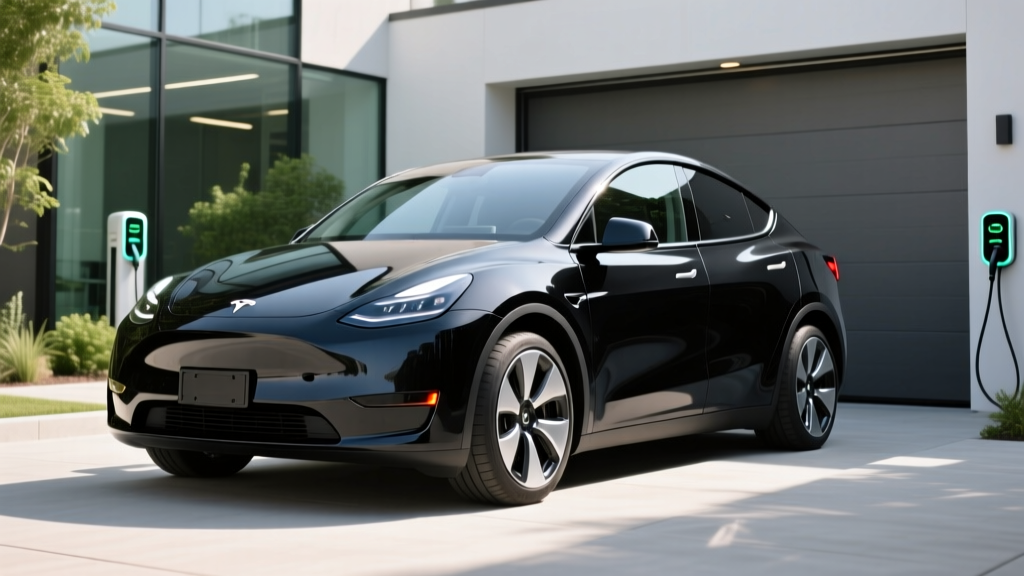
Tesla Model Y Dimensions and Exterior Profile
The Tesla Model Y remains the best-selling electric vehicle in the United States, and its physical footprint is a major reason why. It threads the needle between midsize crossover practicality and sedan-like efficiency. For buyers researching the Tesla Model Y dimensions, the numbers tell a story of packaging optimization that Tesla has refined across multiple model years.
| Measurement | Specification |
|---|---|
| Wheelbase | 113.8 in (2,890 mm) |
| Overall Length | 188.0 in (4,775 mm) |
| Overall Width (mirrors folded) | 75.6 in (1,920 mm) |
| Overall Width (mirrors extended) | 83.8 in (2,129 mm) |
| Overall Height | 63.9 in (1,623 mm) |
| Ground Clearance | 6.6 in (168 mm) |
| Curb Weight (Long Range AWD) | 4,398 lbs (1,995 kg) |
| Drag Coefficient (Cd) | 0.23 |
Compared to the Hyundai Ioniq 5 (191.1 in length, 117.6 in wheelbase), the Model Y is slightly shorter overall but sacrifices some wheelbase length. That translates to marginally less rear legroom, though the Model Y's sloping roofline and hatchback design preserve cargo utility in ways sedans cannot match. The 0.23 Cd drag coefficient is among the lowest in the crossover segment and directly contributes to the Model Y's class-leading efficiency figures.
Interior Space: Passenger Volume and Cargo Capacity
The Model Y's cabin accommodates five passengers standard, with an optional third-row seat (best suited for children). Interior dimensions reflect Tesla's minimalist packaging approach — no transmission tunnel, compact HVAC hardware, and a flat floor maximize usable space.
| Measurement | Front Row | Second Row | Third Row (Optional) |
|---|---|---|---|
| Headroom | 41.0 in | 37.7 in | 34.6 in |
| Legroom | 41.8 in | 38.4 in | 26.5 in |
| Shoulder Room | 58.4 in | 56.1 in | N/A |
| Hip Room | 53.8 in | 50.2 in | N/A |
Cargo volume is where the Model Y distinguishes itself. Behind the second row, you get 30.2 cubic feet of space. Fold the second row flat and that expands to 72.1 cubic feet. The front trunk (frunk) adds another 4.1 cubic feet — useful for charging cables, a small bag, or groceries you want separated from the main cargo area.
For context, the Ford Mustang Mach-E offers 29.7 cu ft behind its rear seats and 59.7 cu ft total, while the Ioniq 5 provides 27.2 cu ft and 59.3 cu ft respectively. The Model Y's hatchback opening is wide and low-lipped, making it easier to load bulky items than the Mach-E's liftback design.
Battery, Range, and Real-World Efficiency
The 2026 Model Y Long Range AWD uses a 75 kWh usable lithium-ion battery pack. Tesla has shifted its Long Range models to a nickel-manganese-cobalt (NMC) chemistry, which offers higher energy density than the lithium iron phosphate (LFP) cells used in the base rear-wheel-drive trim. The LFP pack in the RWD model is approximately 60 kWh usable and offers the advantage of being able to charge to 100% daily without long-term degradation concerns — a trade-off worth understanding if you commute long distances versus needing maximum single-charge range.
Long Range AWD: EPA-estimated 320 miles. In real-world highway driving at 70-75 mph, expect approximately 270-290 miles in mild weather (60-80°F). In cold conditions (below 32°F), range can drop to 220-250 miles due to battery resistance and cabin heating demands.
Rear-Wheel Drive (LFP): EPA-estimated 260 miles. Real-world highway: 220-240 miles mild; 180-210 miles cold.
Source: fueleconomy.gov
Efficiency is rated at 122 MPGe combined (28 kWh/100 mi) for the Long Range AWD, making it one of the most efficient electric crossovers available. The RWD model achieves a similar 123 MPGe combined. These figures matter for operating cost: at the national average electricity rate of $0.17/kWh, a full charge of the Long Range costs roughly $12.75 and delivers 270+ real-world miles — equivalent to about $0.047 per mile, compared to $0.12-$0.15/mile for a comparable gas crossover at $3.30/gallon.
Charging Speed: DC Fast Charge and Home Level 2
Charging capability is where Tesla's vertical integration continues to pay dividends, especially now that the Model Y ships with the NACS (North American Charging Standard) connector natively — no adapter required for Tesla Superchargers.
| Charging Level | Max Power | Speed / Time |
|---|---|---|
| Level 1 (120V household) | ~1.4 kW | ~3-4 miles per hour |
| Level 2 (240V home/Wall Connector) | 11.5 kW (48A) | ~44 miles per hour / ~7 hrs (0-100%) |
| DC Fast Charge (Supercharger V4) | 250 kW peak | 10-80% in ~25 minutes |
| DC Fast Charge (3rd-party CCS via adapter) | 150-175 kW typical | 10-80% in ~35-40 minutes |
A few nuances matter here. The 250 kW peak rate on Superchargers is not sustained across the entire charging session. The Model Y's charge curve peaks around 250 kW up to approximately 30-35% state of charge, then tapers progressively — dropping to around 100 kW by 60% and further to 40-50 kW above 80%. This is why Tesla (and all EV manufacturers) quote 10-80% times rather than 0-100%. Charging above 80% at a DC fast charger is painfully slow and should be avoided unless absolutely necessary.
For home charging, Tesla's Wall Connector on a 60-amp circuit delivers the full 11.5 kW (48 amps continuous, per NEC 80% derating rule). This means an overnight charge from 20% to 80% takes roughly 4 hours — more than adequate for daily replenishment. If your home electrical panel only supports a 40-amp circuit (32 amps continuous), you'll see approximately 7.7 kW and roughly 30 miles per hour of charging. A panel upgrade to 200A service may be required in older homes; budget $1,500-$3,500 for this if needed, on top of $500-$1,200 for the Wall Connector installation itself.
With the NACS connector now adopted by Ford, GM, Rivian, Volvo, and others, the Supercharger network is opening to non-Tesla vehicles. However, Tesla owners still benefit from the most seamless plug-and-charge experience — no app activation, no payment fumbling, and the most reliable uptime record among DC fast-charging networks.
Performance and Drivetrain
The 2026 Model Y lineup offers two primary configurations:
| Specification | Long Range AWD | Rear-Wheel Drive |
|---|---|---|
| Drivetrain | Dual-Motor AWD | Single-Motor RWD |
| Horsepower | 384 hp combined | 295 hp |
| Torque | 376 lb-ft | 310 lb-ft |
| 0-60 mph | 4.8 seconds | 6.6 seconds |
| Top Speed | 135 mph | 135 mph |
| Towing Capacity | 3,500 lbs | 3,500 lbs |
The Long Range AWD's dual-motor setup provides confident all-weather traction and brisk acceleration. The 4.8-second 0-60 time is quick enough to merge onto highways effortlessly, though it's not in sports-sedan territory. The RWD model's 6.6-second sprint is adequate for daily driving but noticeably more relaxed — if you live in a region with frequent snow or rain, the AWD traction advantage is worth the premium.
Regenerative braking is strong and adjustable. In "Hold" mode, the Model Y delivers near one-pedal driving capability, slowing the vehicle to a complete stop without touching the brake pedal in most scenarios. This reduces brake wear significantly — many Tesla owners report original brake pads lasting 80,000+ miles.
Pricing, Trims, and Federal Tax Credit Eligibility
The 2026 Model Y pricing structure is straightforward compared to legacy automakers, with no dealer markups on direct Tesla orders (though delivery fees apply).
| Trim | Base MSRP | Est. After §30D Credit* | Delivery Fee |
|---|---|---|---|
| Rear-Wheel Drive | $44,990 | $37,490 | $1,390 |
| Long Range AWD | $48,990 | $41,490 | $1,390 |
| Long Range AWD (w/ FSD) | $56,990 | $49,490 | $1,390 |
*Tax credit estimates assume full eligibility. Verify your personal eligibility at IRS.gov or with a tax professional.
- MSRP Cap: SUVs/crossovers must be under $80,000 MSRP — all Model Y trims qualify.
- Buyer Income Cap: Modified AGI must not exceed $150,000 (single), $225,000 (head of household), or $300,000 (joint filers).
- Battery Sourcing: Critical minerals and battery components must meet escalating domestic-sourcing thresholds. Tesla's US-built battery packs have generally satisfied these requirements, but supply-chain shifts can affect eligibility quarter to quarter.
- Point-of-Sale Transfer: As of 2024, the credit can be transferred to the dealer (Tesla) at purchase, reducing your out-of-pocket cost directly rather than waiting for a tax refund.
- One-Time Use: You can claim the new-vehicle credit once every three years.
The as-tested price for a Long Range AWD with common options (Midnight Cherry Red paint at $2,500, 19-inch wheels standard) lands around $52,880 before delivery and before any credit. Adding Full Self-Driving (Supervised) at $8,000 pushes the total above $60,000 — a significant premium that buyers should weigh carefully against the system's current capabilities (see Tech section below).
Technology, Driver Assistance, and Notable Drawbacks
The Model Y's 15.4-inch center touchscreen handles virtually every vehicle function — climate, navigation, media, vehicle settings, and even the glovebox release. There is no instrument cluster; speed and navigation info appear in the upper-left corner of the main screen. This minimalist approach polarizes buyers: some find it clean and intuitive, others miss physical controls and dedicated gauges.
Autopilot and Full Self-Driving (Supervised): Every Model Y ships with basic Autopilot (traffic-aware cruise control and lane centering). The optional FSD (Supervised) package adds automated lane changes, traffic light and stop sign recognition, and city-street navigation. However, it is critical to understand that FSD is an SAE Level 2 system — the driver must remain fully engaged, hands on or near the wheel, and eyes on the road at all times. This is not autonomous driving. Tesla's camera-only "Tesla Vision" approach lacks the LiDAR redundancy that Waymo and Cruise use in their Level 4 robotaxi fleets, and real-world performance varies significantly by weather, lighting, and road-marking quality.
Other Tech Highlights:
- Over-the-air (OTA) software updates that add features and refine performance post-purchase
- Sentry Mode dashcam recording with USB or glovebox SSD storage
- Dog Mode and Camp Mode for climate control while parked
- Tesla app with remote preconditioning, location tracking, and charging management
- HEPA air filtration with Bioweapon Defense Mode
Notable Drawbacks:
- No Apple CarPlay or Android Auto — Tesla's proprietary infotainment only
- Minimalist interior means no physical buttons for climate or volume (steering wheel scroll wheels handle some functions)
- Rear visibility is compromised by the sloping roofline and thick C-pillars; the backup camera is essential
- Ride quality is firm, especially on 21-inch wheels — road imperfections are transmitted noticeably to the cabin
- Panel gap consistency has improved but still draws occasional complaints versus luxury competitors
Warranty and Long-Term Ownership
Tesla's warranty coverage is competitive with the EV segment, though it trails Hyundai/Kia's industry-leading terms:
| Component | Coverage |
|---|---|
| Basic Vehicle (bumper-to-bumper) | 4 years / 50,000 miles |
| Battery & Drive Unit (Long Range AWD) | 8 years / 120,000 miles |
| Battery & Drive Unit (RWD) | 8 years / 100,000 miles |
| Battery Capacity Retention Guarantee | Minimum 70% over warranty period |
The 70% capacity retention threshold is the trigger for a warranty replacement. In practice, Tesla's NMC packs have shown degradation curves that plateau around 90-93% state of health after 50,000-80,000 miles, based on aggregated fleet data. LFP packs in the RWD model degrade even more slowly and tolerate frequent 100% charges, making them arguably better suited for high-mileage commuters who can charge at home nightly.
Insurance costs are a real ownership factor: the Model Y typically costs 15-25% more to insure than a comparable gas crossover due to repair costs and parts pricing. Budget $1,800-$2,400 annually depending on your state and driving record. Tesla offers its own insurance product in many states, which uses real-time driving behavior (Safety Score) to set premiums — some drivers save significantly, while others find it comparable to traditional carriers.
Who the Tesla Model Y Suits Best
Buy the Model Y If:
- You want the most efficient electric crossover with proven Supercharger network access
- You need 30+ cu ft of cargo space with a usable hatchback form factor
- Home Level 2 charging is available and you commute under 250 miles round-trip
- You value OTA updates and Tesla's app-integrated ownership experience
- You tow light loads (up to 3,500 lbs) with an EV
Look Elsewhere If:
- You need Apple CarPlay/Android Auto integration
- You prefer physical buttons and a traditional instrument cluster
- You regularly drive 300+ miles in cold weather between charging stops
- You want the longest battery warranty in the segment (Hyundai offers 10yr/100k)
- You prioritize plush ride quality over efficiency (consider the Genesis GV60 or BMW iX)
Frequently Asked Questions
What is the real-world range of the Tesla Model Y?
The Long Range AWD is EPA-rated at 320 miles, but expect 270-290 miles on the highway in mild weather and 220-250 miles in freezing temperatures. The RWD model delivers 260 EPA miles with real-world highway expectations of 220-240 miles (mild) and 180-210 miles (cold). Preconditioning the battery before fast charging and using seat heaters instead of cabin heat in winter can recover 10-15 miles of range.
How fast does the Model Y charge at home and on the road?
At home on a 240V/60A circuit with Tesla's Wall Connector, the Model Y charges at 11.5 kW, adding roughly 44 miles of range per hour — a full overnight session replenishes even a near-empty battery. On Tesla Superchargers, it peaks at 250 kW and charges from 10-80% in approximately 25 minutes. On third-party CCS chargers (via NACS-to-CCS adapter or at stations with NACS cables), expect 150-175 kW peak and 35-40 minutes for 10-80%.
How much does the Tesla Model Y cost after the federal tax credit?
The RWD starts at $44,990 and drops to approximately $37,490 with the full $7,500 §30D credit. The Long Range AWD starts at $48,990 ($41,490 after credit). Eligibility depends on your income (under $150K single / $300K joint), the vehicle's battery sourcing compliance, and MSRP under $80K. The credit can now be applied at point of sale, reducing your upfront payment directly. Always verify current eligibility on IRS.gov.
Is the Model Y worth buying versus the Ioniq 5, Mach-E, or Equinox EV?
The Model Y wins on efficiency (122 MPGe vs. 110-114 for competitors), Supercharger network reliability, and cargo volume. The Hyundai Ioniq 5 offers faster 800V charging (10-80% in ~18 min vs. 25 min), a more comfortable ride, and a 10-year battery warranty. The Ford Mach-E provides a more traditional interior with physical controls. The Chevrolet Equinox EV undercuts on price ($33,000 base) but offers less range and slower charging. If Supercharger access and efficiency are your priorities, the Model Y still leads. If charging speed and ride comfort matter more, the Ioniq 5 is the strongest alternative.
What are the biggest pros and cons of the Tesla Model Y?
Pros: Class-leading efficiency and real-world range, access to the Supercharger network with native NACS, best-in-class cargo volume for the segment, strong OTA update cadence, low operating cost per mile, robust regenerative braking that extends brake life.
Cons: No CarPlay/Android Auto, firm ride quality on larger wheels, camera-only driver assist lacks LiDAR redundancy, rear visibility is limited, insurance costs above segment average, minimalist interior polarizes buyers.
Does the Tesla Model Y qualify for the federal EV tax credit in 2026?
Yes, all Model Y trims fall under the $80,000 MSRP cap for SUVs/crossovers, and Tesla's US-manufactured battery packs have generally met the critical-minerals and component-sourcing requirements under §30D. However, your personal eligibility depends on income limits ($150K/$225K/$300K thresholds) and the once-every-three-years rule. Battery sourcing requirements tighten annually, so eligibility can shift. Confirm current status at fueleconomy.gov before placing your order.