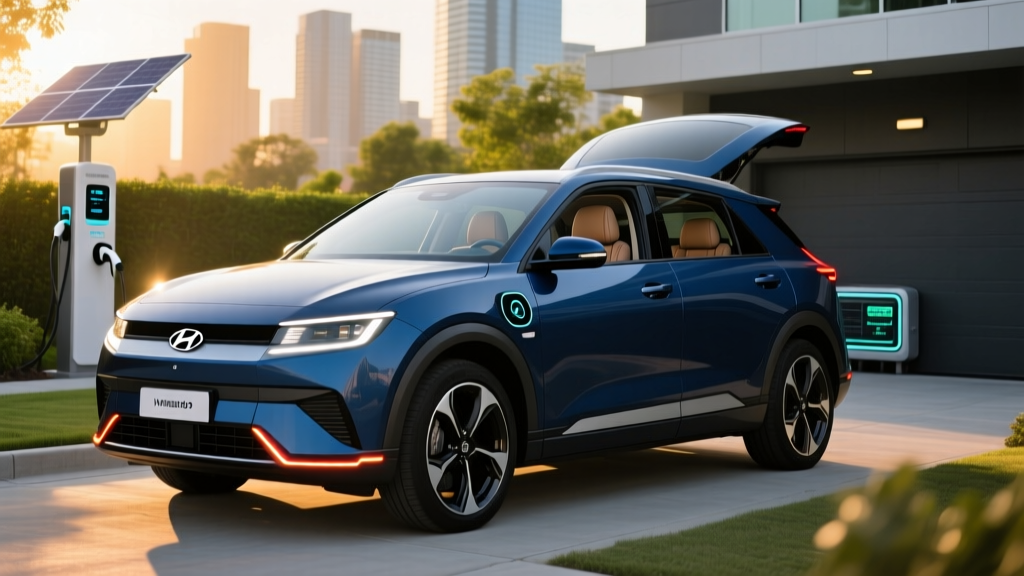
The Hyundai Ioniq 9 is the automaker's flagship three-row electric SUV, built on the E-GMP platform and designed to compete head-to-head with the Kia EV9, Tesla Model X, and Rivian R1S. For buyers researching garage fitment, parking practicality, and interior volume, the Ioniq 9's overall length is a defining specification — and one that shapes the entire ownership experience. This review covers the 2026 Hyundai Ioniq 9 with exact figures on dimensions, range, charging, pricing, and federal tax credit eligibility.
Hyundai Ioniq 9 Length and Exterior Dimensions
The 2026 Hyundai Ioniq 9 measures 199.8 inches (5,075 mm) in overall length, placing it squarely in full-size SUV territory. That length is roughly 8 inches longer than the midsize Ioniq 5 and about 2 inches shorter than the long-wheelbase Kia EV9. Here is how the key exterior dimensions break down:
| Dimension | Measurement |
|---|---|
| Overall Length | 199.8 in (5,075 mm) |
| Wheelbase | 125.2 in (3,180 mm) |
| Overall Width (excl. mirrors) | 78.0 in (1,981 mm) |
| Overall Height | 71.5 in (1,816 mm) |
| Ground Clearance | 7.5 in (190 mm) |
| Curb Weight (AWD Long Range) | ~5,700 lbs |
The 125.2-inch wheelbase is exceptionally long for the class, which directly benefits second- and third-row legroom while also contributing to stable highway ride quality. At 199.8 inches long, the Ioniq 9 will fit in most standard US residential garages (typically 20 feet deep), but with only inches to spare — measure carefully before committing if your garage is tight.
Range, Battery, and Real-World Efficiency
The Ioniq 9 is offered with a massive 110.3 kWh (usable) NMC lithium-ion battery across its Long Range trims. Hyundai's NMC chemistry choice prioritizes energy density — essential for a heavy three-row SUV — over the cycle-life advantages of LFP. This pack feeds either a single-motor RWD or dual-motor AWD drivetrain.
EPA Estimated Range: Up to 335 miles (RWD Long Range) / ~300 miles (AWD Long Range)
Real-World Expectation: Expect 270–295 miles on mixed highway driving at 70 mph in moderate temperatures. In sub-freezing winter conditions (below 32°F), anticipate a 20–30% reduction, dropping effective range to approximately 210–240 miles (AWD). City driving with regenerative braking can push closer to or slightly above the EPA sticker.
Efficiency for the RWD Long Range is estimated at 87 MPGe combined (approximately 38 kWh/100 mi), while the AWD variant drops to roughly 80 MPGe combined (~42 kWh/100 mi). These figures are competitive for a 5,700-lb vehicle but reflect the physics of moving a large, heavy SUV — don't expect Ioniq 5-level efficiency here.
| Trim / Drivetrain | Battery (kWh) | EPA Range (mi) | MPGe Combined | kWh/100 mi |
|---|---|---|---|---|
| SE Long Range RWD | 110.3 NMC | 335 | 87 | 38 |
| SEL / Limited AWD | 110.3 NMC | ~300 | 80 | 42 |
| Performance AWD | 110.3 NMC | ~280 | 76 | 44 |
Charging Speed: DC Fast Charge and Home Level 2
The Ioniq 9 retains Hyundai's 800V electrical architecture — one of the platform's strongest advantages. This enables DC fast-charging speeds that leave most competitors behind.
| Charging Level | Power / Rate | Speed / Time |
|---|---|---|
| DC Fast Charge (Peak) | Up to 350 kW (NACS port) | 10–80% in ~24 minutes |
| DC Fast Charge (Sustained avg.) | ~200 kW average to 80% | Charge curve tapers sharply above 80% |
| Level 2 Home (240V / 48A) | 11.5 kW | ~32 miles of range per hour; 0–100% in ~10 hours |
| Level 1 (120V / 12A) | 1.4 kW | ~4 miles per hour (emergency/trickle only) |
A critical ownership note: the 350 kW peak is only achievable on capable chargers (Electrify America 350 kW stations, Tesla Superchargers with NACS adapter or native NACS on 2026 models). On a typical 150 kW station, expect 10–80% in roughly 35–40 minutes. The 800V architecture also means the Ioniq 9 sustains higher charging power deeper into the session compared to 400V competitors — you'll spend less time at the charger even when peak rates aren't available.
For home charging, a 48-amp Level 2 wallbox on a 60-amp circuit is strongly recommended given the 110.3 kWh pack. A full charge from near-empty takes about 10 hours, making overnight charging practical. Budget $800–$2,200 for a quality Level 2 installation (equipment + licensed electrician + permit), with costs climbing if your panel needs a 200-amp upgrade. Always defer final electrical specifications to a licensed electrician.
Performance: 0-60, Horsepower, and Drivetrain
The Ioniq 9 offers three powertrain configurations for 2026:
- Long Range RWD: Single rear motor, 215 hp, 0–60 mph in ~7.8 seconds. Adequate for commuting and family hauling, optimized for maximum range.
- Long Range AWD: Dual-motor, 338 hp combined, 0–60 mph in ~5.5 seconds. The volume seller — strong passing power and all-weather confidence.
- Performance AWD: Dual-motor, 422 hp, 0–60 mph in ~4.8 seconds. Genuinely quick for a three-row SUV, though at a ~20-mile range penalty versus the standard AWD.
All trims feature adaptive cruise control with stop-and-go, Hyundai's Highway Driving Assist 2 (HDA2) — a SAE Level 2 driver-assistance system that requires the driver to remain engaged at all times. This is not autonomous driving; hands-on-wheel monitoring is enforced.
Pricing, Trims, and Federal Tax Credit Eligibility
The 2026 Ioniq 9 is positioned as a premium mainstream three-row EV, undercutting the Tesla Model X and Rivian R1S while competing directly with the Kia EV9 on price.
| Trim | Drivetrain | Base MSRP | Est. After §30D Credit* |
|---|---|---|---|
| SE Standard Range | RWD | ~$52,500 | ~$45,000 |
| SE Long Range | RWD | ~$57,000 | ~$49,500 |
| SEL Long Range | AWD | ~$62,500 | ~$55,000 |
| Limited | AWD | ~$70,500 | ~$63,000 |
| Performance (Calligraphy) | AWD | ~$74,000 | ~$66,500 |
*Federal tax credit estimates assume full §30D eligibility. See checklist below.
- MSRP Cap: SUVs/vans/pickups must be ≤ $80,000 MSRP. All Ioniq 9 trims currently clear this threshold.
- Buyer Income Cap: Modified AGI must not exceed $300,000 (married filing jointly), $225,000 (head of household), or $150,000 (single).
- Battery Sourcing: Critical minerals and battery components must meet phased-in domestic/free-trade sourcing requirements. Hyundai's US-built Ioniq 9 (Metaplant Georgia) is positioned for compliance, but verify at purchase — rules tighten annually. Check current IRS guidance.
- Point-of-Sale Transfer: Eligible buyers can transfer the credit to the dealer at purchase, reducing the purchase price upfront rather than waiting for a tax refund.
- Consult a tax professional to confirm your personal eligibility before relying on the credit in your budget.
Interior Space, Cargo, and Technology
The Ioniq 9's 125.2-inch wheelbase — enabled by its 199.8-inch overall length — translates to genuinely usable third-row space, which is the entire point of buying a three-row EV.
| Measurement | Dimension |
|---|---|
| First-Row Legroom | 41.7 in |
| Second-Row Legroom | 39.4 in |
| Third-Row Legroom | 30.1 in |
| Cargo (behind 3rd row) | 15.9 cu ft |
| Cargo (3rd row folded) | 45.7 cu ft |
| Cargo (all rear rows folded) | 88.5 cu ft |
| Front Trunk (Frunk) | ~2.0 cu ft (small, for charging cables) |
The third row accommodates children and shorter adults on trips under an hour. For taller passengers on longer drives, the second-row captain's chairs (available on SEL and above) with slide and recline are the premium seating position. The 15.9 cu ft behind the third row fits roughly four carry-on suitcases — adequate for a family grocery run but tight for airport trips with all six seats occupied.
Standout Tech:
- Dual 12.3-inch curved displays with wireless Apple CarPlay and Android Auto
- Hyundai Digital Key 2 (phone-as-key via NFC/UWB)
- Highway Driving Assist 2 (Level 2 lane-centering + adaptive cruise)
- Vehicle-to-Load (V2L) — power devices up to 3.6 kW from the vehicle's battery
- Available digital side mirrors (market-dependent)
- Over-the-air (OTA) software updates for powertrain and infotainment
Notable Drawbacks:
- Touch-capacitive climate controls replace physical buttons — frustrating while driving
- Third-row access requires folding the second row; no walk-through on captain's chair trims
- Frunk is tiny compared to the Ford F-150 Lightning or Rivian R1S
- No NACS native port on early-production 2025 models; 2026 models expected to ship with NACS natively (verify at purchase)
Pros and Cons at a Glance
- 800V architecture enables class-leading DC fast charging
- Genuine three-row usability with 30+ inches of 3rd-row legroom
- 110.3 kWh battery delivers 300+ mile real-world range (RWD)
- US-built (Georgia) — strong §30D credit eligibility outlook
- V2L capability for camping, tailgating, backup power
- Competitive MSRP undercuts Model X and R1S significantly
- 199.8-inch length is tight for standard garages
- Heavy curb weight (~5,700 lbs) hurts efficiency vs. smaller EVs
- AWD range drops to ~300 mi EPA; winter further reduces this
- Touch-only HVAC controls are a usability regression
- Frunk is nearly useless at ~2 cu ft
- Performance trim's range penalty may not justify the power
Who Should Buy the Hyundai Ioniq 9?
- You need three rows and want a mainstream-priced EV (not $80K+)
- You road-trip frequently and value 800V fast charging at 350 kW stations
- You want to maximize §30D credit eligibility with a US-built vehicle
- Your daily commute is under 100 miles round-trip (AWD), allowing comfortable range buffer
- Your garage is under 20 feet deep — the 199.8-inch length may not fit
- You need serious towing (Rivian R1S or F-150 Lightning are better suited)
- You prioritize maximum efficiency over passenger volume (Ioniq 5 or Tesla Model Y)
- You regularly need all six seats plus maximum cargo (consider a minivan PHEV like the Chrysler Pacifica Hybrid)
Warranty Coverage
Hyundai backs the Ioniq 9 with one of the strongest warranty packages in the segment:
- Battery: 10 years / 100,000 miles (capacity retention threshold: 70% of original capacity)
- Powertrain: 10 years / 100,000 miles
- New Vehicle (Bumper-to-Bumper): 5 years / 60,000 miles
- Roadside Assistance: 5 years / unlimited miles
The 10-year battery warranty is a meaningful advantage over Tesla (8 yr/120K mi for Model X) and most European competitors. Hyundai's 70% capacity retention threshold is standard for the industry — if your battery degrades below 70% within the warranty period, Hyundai will repair or replace it to meet that threshold.
Frequently Asked Questions
What is the exact length of the Hyundai Ioniq 9?
The 2026 Hyundai Ioniq 9 is 199.8 inches (5,075 mm) long overall, with a 125.2-inch wheelbase. This makes it one of the longest EVs in the mainstream three-row segment, which benefits interior volume but requires careful garage measurement.
What is the real-world range of the Ioniq 9?
The EPA rates the RWD Long Range at 335 miles and the AWD at approximately 300 miles. In real-world mixed highway driving at 70 mph, expect 270–295 miles (RWD) or 250–275 miles (AWD). In sub-freezing temperatures, subtract 20–30% from those figures. Preconditioning the battery while plugged in mitigates some cold-weather loss.
How fast does the Ioniq 9 charge?
On a 350 kW DC fast charger, the Ioniq 9 peaks at up to 350 kW and charges from 10–80% in approximately 24 minutes, thanks to its 800V architecture. On a 150 kW charger, expect 10–80% in roughly 35–40 minutes. At home on a 48-amp Level 2 charger (11.5 kW), a full charge takes about 10 hours.
Does the Ioniq 9 qualify for the $7,500 federal EV tax credit?
The Ioniq 9 is a strong candidate for the full §30D credit, as it is assembled in the US (Georgia) and all trims fall under the $80,000 SUV MSRP cap. However, eligibility depends on your income (≤$300K joint / ≤$150K single), battery critical-mineral sourcing compliance, and purchasing new from a dealer. Verify on IRS.gov and consult a tax professional before budgeting the credit.
Is the Ioniq 9 worth buying over the Kia EV9 or Tesla Model X?
Against the Kia EV9 (which shares the E-GMP platform), the Ioniq 9 is slightly more upscale inside with a longer wheelbase, but the EV9 is marginally more affordable and offers a similar driving experience — test-drive both. Against the Tesla Model X, the Ioniq 9 is $30K–$40K cheaper, has a more conventional (and practical) interior layout, and offers comparable range, though the Model X has faster acceleration and access to the Supercharger network natively. For most family-EV buyers, the Ioniq 9's price-to-space ratio makes it the more rational choice.
How does the Ioniq 9's length compare to its competitors?
At 199.8 inches, the Ioniq 9 is shorter than the Tesla Model X (202.0 in) and Rivian R1S (205.7 in with standard battery), but longer than the Kia EV9 (195.7 in). It occupies a middle ground that maximizes interior volume without pushing into full luxury-SUV footprint territory.
Sources: Hyundai Motor America Press, EPA Fuel Economy, IRS §30D Clean Vehicle Credits. All specifications reflect 2026 model-year data as published; verify final figures with your dealer at time of purchase.