Why Tesla's Cold Weather Tech Matters for Real-World Range
If you live where temperatures routinely drop below freezing, you already know EV range shrinks in winter. The question isn't whether it happens — it's how much you lose and what the car does to fight back. Tesla's cold weather feature set, anchored by a standard heat pump and sophisticated battery thermal management, is one of the most mature systems in the EV market. But marketing claims only go so far. Let's look at what the 2026 Tesla Model Y actually delivers when the thermometer drops, with exact numbers for range, charging, and efficiency that matter to buyers in cold climates.
EPA Estimated Range: 320 miles (Long Range AWD)
Real-World Expectation: ~270–290 miles in mild highway driving (65–70 mph, 50°F+). In sustained cold weather (below 25°F), expect 210–250 miles depending on cabin heat usage, speed, and whether the battery was preconditioned. Short trips in single-digit temps with a cold-soaked battery can push losses to 35–40%.
The 2026 Model Y Long Range AWD carries an 78.1 kWh usable battery using NMC (nickel manganese cobalt) chemistry. NMC offers higher energy density than LFP, which helps preserve range in a compact pack — but it also means Tesla recommends daily charging to 80% for longevity, with 100% reserved for trips. The rear-wheel-drive base Model Y uses an LFP pack (roughly 60 kWh usable) and can be charged to 100% daily, but its smaller capacity means less absolute winter buffer.
2026 Model Y Cold Weather Features: What's Actually Working
Tesla bundles several thermal management technologies under what owners experience as "cold weather features." Here's what's actively preserving your range and charging speed in winter:
- Heat Pump (Octovalve System): Standard on all Model Y trims. Unlike resistive cabin heaters that can draw 3–5 kW, the heat pump scavenges waste heat from the drive motors, battery, and ambient air, typically using 1–2 kW for cabin heating. In testing, this translates to roughly 10–15% less winter range loss compared to EVs with resistive heating.
- Battery Preconditioning: When you navigate to a Supercharger (or schedule departure), the car warms the battery pack to its optimal charging temperature (~95°F). Without preconditioning, DC fast charging in cold weather can be painfully slow — a cold NMC pack might accept only 30–50 kW until it warms. With preconditioning, you hit peak charge rates much faster.
- Scheduled Departure & Cabin Preheat: Plug in at home, set your departure time, and the car warms the cabin and battery using grid power — not battery energy. This is the single most impactful cold weather feature for daily commuters. You leave with a warm cabin and a warm battery, preserving range from mile one.
- Seat Heaters & Heated Steering Wheel: All five seats are heated in the 2026 Model Y (front ventilated as well). Using seat heaters instead of cranking cabin air temperature can save 0.5–1.5 kW of continuous draw, adding 5–10 miles of range on a cold commute.
- Regenerative Braking Blending: In cold weather, regen braking is automatically reduced when the battery is cold (it can't accept high charge rates when below ~50°F). The car blends in friction brakes seamlessly. This is a safety feature — unexpected regen loss on icy roads would be dangerous.
Specs That Matter: 2026 Model Y at a Glance
| Specification | Long Range AWD | RWD (Base) | Performance |
|---|---|---|---|
| EPA Range | 320 miles | 260 miles | 293 miles |
| Battery (Usable) | ~78.1 kWh (NMC) | ~60 kWh (LFP) | ~78.1 kWh (NMC) |
| MPGe (Combined) | 122 MPGe | 123 MPGe | 111 MPGe |
| Efficiency | 28 kWh/100mi | 27 kWh/100mi | 30 kWh/100mi |
| 0–60 mph | 4.8 sec | 6.6 sec | 3.5 sec |
| Horsepower | 384 hp | 295 hp | 510 hp |
| Drivetrain | Dual-Motor AWD | Single-Motor RWD | Dual-Motor AWD |
| Max DC Fast Charge | 250 kW (peak) | 170 kW (peak) | 250 kW (peak) |
| 10–80% DC Charge | ~25 min | ~30 min | ~25 min |
| Level 2 Home Charging | 11.5 kW (~44 mi/hr) | 7.6 kW (~30 mi/hr) | 11.5 kW (~44 mi/hr) |
| Base MSRP | $48,990 | $44,990 | $53,990 |
Source: fueleconomy.gov and Tesla's official order page. Specs subject to change by model year.
Winter Charging: How Cold Weather Affects Speed
Charging speed is where Tesla's cold weather features earn their keep. Here's the physics: lithium-ion cells resist accepting charge when cold. A Model Y battery at 32°F without preconditioning may only accept 40–60 kW at a Supercharger, even if the stall can deliver 250 kW. That turns a 25-minute charge into a 50-minute ordeal.
| Scenario | Peak kW Accepted | 10–80% Time | Notes |
|---|---|---|---|
| Warm battery (summer, preconditioned) | 250 kW | ~25 min | Peak sustained to ~50% SoC, then tapers |
| Cold battery (30°F, NO preconditioning) | 40–70 kW | 50–70 min | Slow ramp; battery heats itself via charge current |
| Cold battery (30°F, WITH preconditioning via nav to Supercharger) | 200–250 kW | ~28–32 min | Preconditioning uses ~15–20 min of driving energy |
The takeaway is non-negotiable: always navigate to a Supercharger in cold weather, even if you know the route by heart. This triggers battery preconditioning automatically. Without it, you'll sit at the charger watching single-digit kW numbers and wondering why your "fast charge" is slower than a Level 2 home charger.
For home charging, a Level 2 wall connector on a 60-amp circuit delivers up to 11.5 kW (44 miles of range per hour) to the Long Range and Performance trims. In winter, preconditioning your cabin while plugged in costs roughly $0.50–$1.50 in electricity instead of burning 5–15 miles of range on battery power. Over a winter, that's 500–1,000 miles of range preserved.
Pricing, Trims & Federal Tax Credit Eligibility
The 2026 Model Y lineup starts at $44,990 for the RWD base trim and tops out at $53,990 for the Performance. All trims fall under the IRS §30D MSRP cap of $80,000 for SUVs, so price isn't the barrier to the federal credit — other rules are.
| Trim | MSRP | Federal Credit (if eligible) | Effective Price |
|---|---|---|---|
| RWD (Base, LFP) | $44,990 | Up to $7,500 | ~$37,490 |
| Long Range AWD | $48,990 | Up to $7,500 | ~$41,490 |
| Performance AWD | $53,990 | Up to $7,500 | ~$46,490 |
But eligibility is not guaranteed. The §30D credit has three hurdles that trip up many Tesla buyers:
- Income caps: Modified AGI must not exceed $150,000 (single), $225,000 (head of household), or $300,000 (joint).
- Battery sourcing: A percentage of critical minerals and battery components must be sourced from the US or free-trade-agreement countries. These thresholds tighten annually. Tesla's LFP batteries (used in the RWD Model Y) have historically relied on Chinese-sourced materials, which can disqualify that trim from the full credit. The NMC Long Range and Performance trims have a stronger sourcing profile but must be verified per VIN at purchase.
- Point-of-sale transfer: As of 2024, buyers can transfer the credit to the dealer at purchase, reducing the sale price directly. Tesla's checkout flow supports this, but you must confirm eligibility at the time of delivery — rules can shift mid-year.
Always verify current eligibility on fueleconomy.gov and consult a tax professional. State incentives (Colorado, California, Massachusetts, and others) may stack on top but vary by jurisdiction.
Interior, Cargo & Daily Practicality
The refreshed Model Y (codenamed "Juniper") that entered production in 2025 carries into 2026 with a quieter cabin, ventilated front seats, a rear-seat touchscreen, and power-folding second-row seats. Dimensions remain practical for families:
- Cargo (behind 2nd row): 30.2 cu ft
- Cargo (2nd row folded): 72.1 cu ft
- Frunk: 4.1 cu ft (useful for charging cables, winter gear)
- Rear legroom: 41.6 inches
- Front headroom: 41.0 inches
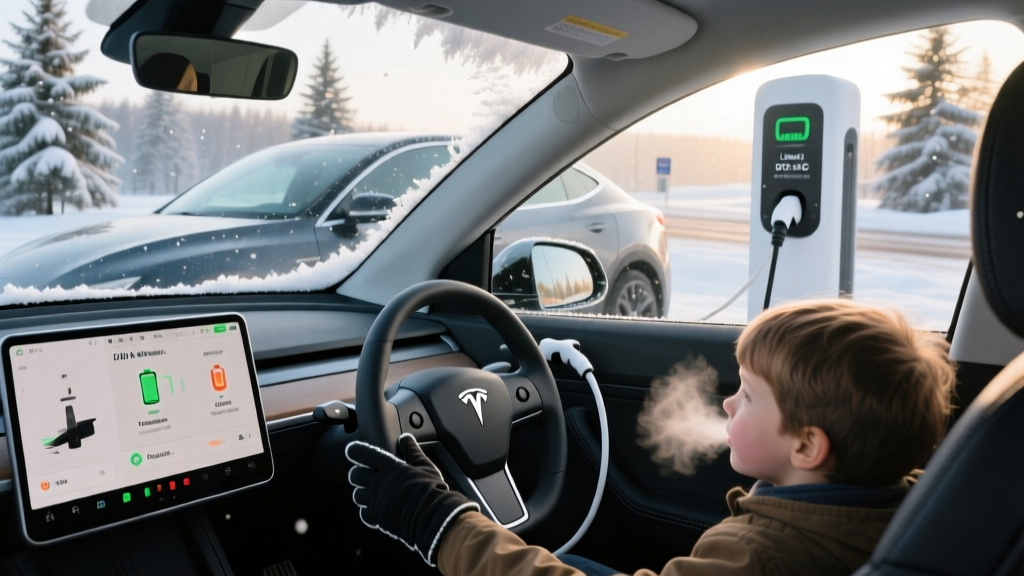
The 15.4-inch center touchscreen handles everything — there are no physical buttons for climate, which some drivers find frustrating when wearing winter gloves. However, the Tesla app's remote climate control and the scheduled departure feature largely eliminate the need to fiddle with the screen while bundled up.
Autopilot, FSD & Driver Assistance in Winter Conditions
All 2026 Model Y vehicles ship with Tesla's HW4 (AI4) vision system powering Basic Autopilot (traffic-aware cruise control, lane centering). Full Self-Driving (Supervised) is available as a $8,000 option or $99/month subscription.
Both Autopilot and FSD (Supervised) are SAE Level 2 driver-assistance systems. The driver must remain fully engaged — eyes on the road, hands available to steer — at all times. These are not self-driving systems. Tesla's cabin camera monitors driver attention and will issue escalating warnings if you look away.
Heavy snow, ice buildup on cameras, and obscured lane markings will degrade or disable Autopilot/FSD. Tesla's vision-only system (no radar or lidar) is more susceptible to camera obstruction than sensor-fused competitors. Keep cameras clear of ice and slush — the car will warn you when vision is impaired, but proactive cleaning is your responsibility. Expect reduced availability during active snowfall and on poorly plowed roads.
Model Y vs. Cold-Weather Competitors: Is It Worth It?
The Model Y's main rivals in cold climates include the Hyundai Ioniq 5, Ford Mustang Mach-E, and Volkswagen ID.4. Here's how they stack up on the metrics that matter when it's 10°F outside:
| Metric | Tesla Model Y LR AWD | Hyundai Ioniq 5 LR AWD | Ford Mach-E ER AWD | VW ID.4 AWD Pro S |
|---|---|---|---|---|
| EPA Range | 320 mi | 290 mi | 300 mi | 275 mi |
| Heat Pump | Standard | Standard | Optional (std on ER) | Standard |
| Max DC Charge | 250 kW | 240 kW | 150 kW | 175 kW |
| 10–80% (warm) | ~25 min | ~18 min | ~38 min | ~30 min |
| Charging Network | Supercharger (native NACS) | NACS adapter / Supercharger access | NACS adapter / Supercharger access | NACS adapter / Supercharger access |
| Battery Preconditioning (nav-triggered) | Yes, automatic | Manual toggle | Manual toggle | Yes, automatic |
The Ioniq 5 charges faster from 10–80% in warm weather thanks to its 800V architecture, but Tesla's Supercharger network reliability and automatic preconditioning give the Model Y a practical edge on winter road trips. The Mach-E's slower peak charge rate (150 kW) is a real disadvantage on long cold-weather drives where every minute at the charger feels longer. The ID.4 is competitive on comfort but trails on range and charging speed.
- Choose the Model Y if: You take regular winter road trips and value Supercharger network reliability, automatic battery preconditioning, and the best-in-class heat pump efficiency. The Long Range AWD trim offers the best cold-weather buffer.
- Choose the Ioniq 5 if: You prioritize the fastest possible DC charging in warm weather and prefer Hyundai's physical controls and 10-year/100,000-mile powertrain warranty.
- Choose the Mach-E if: You want a more traditional driving feel, Ford dealer service accessibility, and don't mind slower charging on road trips.
- Avoid the RWD Model Y in harsh winters: The base LFP pack has less range to lose, and RWD traction is less confidence-inspiring on snow than AWD. If cold weather is your reality 4+ months a year, invest in Long Range AWD.
Warranty & Battery Longevity in Cold Climates
Tesla covers the Model Y battery and drive unit for 8 years / 120,000 miles (Long Range and Performance) or 8 years / 100,000 miles (RWD), with a minimum 70% capacity retention threshold. The basic vehicle warranty is 4 years / 50,000 miles.
For cold-climate owners, there's good news: NMC batteries degrade primarily from high heat and sustained high SoC, not from cold. A Model Y in Minnesota that charges to 80% daily and rarely fast-charges to 100% will likely see less degradation than one in Arizona sitting at 100% in 110°F heat. Expect roughly 8–12% total degradation over 100,000 miles under normal use, based on fleet data from sources like Tesla's Impact Report.
LFP batteries (RWD trim) are even more resilient to degradation and tolerate 100% SoC storage, but their lower energy density means you start with fewer miles to lose in winter.
- Best-in-class heat pump minimizes winter range loss (10–15% less than resistive-heated EVs)
- Automatic battery preconditioning via navigation is seamless and highly effective
- Supercharger network remains the most reliable DC fast-charging option in rural/cold regions
- Scheduled departure preconditioning preserves battery range on daily commutes
- AWD traction with low center of gravity handles snow confidently
- OTA updates continuously improve thermal management algorithms
- Vision-only Autopilot/FSD degrades significantly in heavy snow and camera-obscuring conditions
- No physical buttons — glove-unfriendly touchscreen for climate adjustments
- Regen braking reduction on cold batteries can surprise new EV drivers (blended braking transition)
- LFP RWD trim has limited winter range buffer and may not qualify for full federal credit
- Fastest DC charging (250 kW peak) only sustains briefly; real average is ~130–150 kW across the curve
- Insurance premiums run 15–25% higher than comparable ICE SUVs in most states
Frequently Asked Questions
What is the real-world range of the 2026 Tesla Model Y in winter?
The Long Range AWD has a 320-mile EPA estimate. In real-world cold-weather driving (below 25°F, highway speeds, cabin heat on), expect 210–250 miles. City driving with preconditioning and seat heaters can push this to 260+. Short trips with a cold-soaked battery will yield the worst results — sometimes under 200 miles effective range.
How fast does the Model Y charge in cold weather?
With battery preconditioning enabled (by navigating to a Supercharger), the Long Range and Performance trims can peak at 250 kW and charge 10–80% in about 25–32 minutes even in freezing weather. Without preconditioning, expect 50–70 minutes for the same charge session as the cold battery limits power acceptance to 40–70 kW initially.
How much does the 2026 Model Y cost after the federal tax credit?
If you qualify for the full $7,500 §30D credit, the Long Range AWD drops from $48,990 to approximately $41,490. However, eligibility depends on your income (caps at $150K single / $300K joint), the vehicle's battery sourcing compliance, and MSRP limits. Verify your specific eligibility on fueleconomy.gov and with a tax professional before relying on the credit.
Is the Model Y worth buying over the Ioniq 5 or Mach-E for cold climates?
For winter road trips and daily cold-weather commuting, the Model Y Long Range AWD has a practical edge thanks to its automatic preconditioning, Supercharger network access, and efficient heat pump. The Ioniq 5 charges faster in warm weather and has a longer warranty. The Mach-E offers a more traditional driving experience but charges more slowly. If you regularly drive in sub-freezing conditions, the Model Y's integrated thermal management is the most mature in the segment.
Does the Tesla Model Y qualify for the federal EV tax credit in 2026?
The Model Y qualifies on MSRP grounds (under the $80,000 SUV cap). However, the full $7,500 credit depends on battery critical-mineral and component sourcing requirements that tighten annually, plus buyer income caps. The Long Range AWD (NMC) has historically had stronger sourcing compliance than the RWD (LFP). Check the latest eligibility on the IRS website and fueleconomy.gov before purchasing, as rules can change.
Do I need winter tires on the Model Y?
Tesla ships the Model Y with all-season tires that are adequate for light snow. For sustained winter conditions (consistent snow, ice, temperatures below 40°F), dedicated winter tires on a separate wheel set significantly improve braking distance and traction. The AWD system helps you accelerate but does not help you stop — winter tires are the single best safety upgrade for cold-climate Model Y owners.
How do I maximize Model Y range in winter?
Use scheduled departure to precondition while plugged in. Rely on seat and steering wheel heaters instead of high cabin air temperature. Keep highway speeds at or below 65 mph (aerodynamic drag compounds cold-weather losses). Always navigate to Superchargers to trigger battery preconditioning. Charge to 80% daily and only go to 100% when departing on a trip. These habits can recover 30–50 miles of otherwise-lost winter range.