The 2023 Subaru Solterra Premium arrived as Subaru's first ground-up battery-electric vehicle, co-developed with Toyota on the e-TNGA platform shared with the bZ4X. For a brand synonymous with all-wheel drive and outdoor capability, the Solterra makes a deliberate statement: standard dual-motor AWD across every trim, 8.3 inches of ground clearance, and the X-MODE traction system borrowed from Subaru's ICE lineup. But the Premium trim — the entry point at launch — also exposed real compromises in range and charging speed that buyers need to weigh carefully before signing a lease or purchase agreement.
This review breaks down the 2023 Subaru Solterra Premium with exact figures from EPA testing, real-world driving data, and current ownership economics. If you're evaluating a used or certified pre-owned 2023 model, or comparing it against newer Solterra model years that addressed some of these shortcomings, the numbers below will tell you exactly what you're getting.
Range and Efficiency: The Numbers Behind 228 EPA Miles
Real-World Expectation: ~190–210 miles in mixed driving; ~160–175 miles sustained highway at 70+ mph; ~140–160 miles in freezing temperatures with cabin heat
The 2023 Solterra Premium carries a 71.4 kWh lithium-ion battery pack (NMC chemistry — nickel manganese cobalt) with approximately 64 kWh of usable capacity. Subaru and Toyota engineered a conservative top-and-bottom buffer to protect long-term battery health, but that buffer directly limits the range figure you see on the window sticker.
According to fueleconomy.gov, the 2023 Solterra achieves 114 MPGe combined (111 city / 117 highway), translating to roughly 29 kWh per 100 miles. That efficiency figure places it behind competitors like the Hyundai Ioniq 5 (114 MPGe combined but with a larger battery yielding over 300 miles) and the Ford Mustang Mach-E Select RWD (101 MPGe combined, ~250 miles on a smaller battery thanks to lower weight and RWD efficiency).
The AWD system's constant dual-motor engagement is the primary range penalty. Unlike competitors that decouple a secondary motor during light-load cruising, the Solterra's e-AWD system keeps both motors active. In real-world testing, highway driving at 75 mph in mild conditions yields roughly 2.8–3.0 miles per kWh, giving you about 180–195 miles before the low-battery warning. In winter conditions below freezing, expect a 25–35% range reduction — a reality for all EVs, but more painful when your starting point is 228 miles.
| Specification | Value |
|---|---|
| EPA Range | 228 miles |
| Battery (Total / Usable) | 71.4 kWh / ~64 kWh |
| Battery Chemistry | NMC (Nickel Manganese Cobalt) |
| Drivetrain | Dual-motor e-AWD (standard) |
| Horsepower | 215 hp combined |
| Torque | 248 lb-ft |
| 0–60 mph | ~6.5 seconds |
| MPGe (City / Hwy / Combined) | 111 / 117 / 114 |
| Energy Consumption | 29 kWh / 100 mi |
| Ground Clearance | 8.3 inches |
| Cargo Volume (rear seats up / down) | 23.8 / 56.9 cu ft |
| Rear Legroom | 35.7 inches |
| Curb Weight | ~4,365 lbs |
Charging Speed: DC Fast Charging and Home Level 2 Reality
Charging is where the 2023 Solterra Premium requires the most careful expectation-setting. Subaru rated the DC fast-charging capability at a peak of 100 kW, but real-world charging curves tell a more nuanced story.
| Charging Level | Power / Rate | Time / Range Added |
|---|---|---|
| Level 1 (120V household) | ~1.2 kW | ~3–4 miles per hour |
| Level 2 (240V, 32A) | ~7.2 kW | ~22–25 miles per hour; 0–100% in ~9.5 hours |
| DC Fast Charge (CCS) | Peak ~100 kW (sustained ~55–65 kW avg) | 10–80% in ~56 minutes (Subaru est.) |
The critical detail here is the charge curve. While the Solterra can briefly peak near 100 kW at a low state of charge, the rate tapers significantly after 50% SoC. Independent testing by EV reviewers has shown that a 10–80% session on a 150 kW+ CCS charger typically takes 50–60 minutes — substantially slower than the Hyundai Ioniq 5's 18-minute 10–80% time on an 800V architecture or the Tesla Model Y's ~25-minute session on a V3 Supercharger.
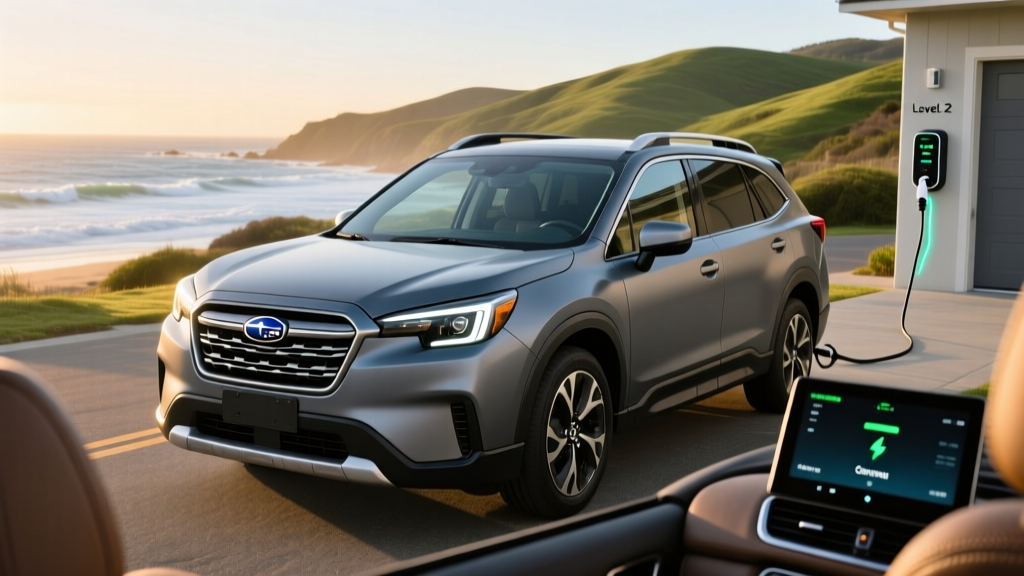
For home charging, the onboard charger is rated at 7.2 kW on Level 2 (240V). A full charge from empty takes approximately 9.5 hours, which is manageable for overnight charging. Most owners will plug in at 20–30% remaining and wake up to a full battery in 6–7 hours. A standard NEMA 14-50 outlet installation or a hardwired Level 2 wall connector (such as the ChargePoint Home Flex or Emporia Vue) is the practical baseline for Solterra ownership.
One important note for used buyers: Subaru issued a recall and software update in late 2023 related to DC fast charging that reduced maximum charge rates to protect battery longevity. If you're evaluating a 2023 model, verify whether the recall update (Recall WRG-23) was applied, as it affects the charging behavior you'll experience.
Performance and Driving Dynamics
The 2023 Solterra Premium delivers 215 horsepower and 248 lb-ft of torque from its dual-motor setup — 107 hp from the front motor and 108 hp from the rear. The 0–60 mph time of approximately 6.5 seconds is adequate for merging and passing but trails sportier competitors (the Mach-E GT hits 60 in ~3.5 seconds, and even the Ioniq 5 AWD manages ~5.0 seconds).
Where the Solterra earns its keep is off-pavement and in adverse conditions. The X-MODE system, carried over from Subaru's ICE vehicles, provides selectable traction modes for snow, dirt, and deep snow/mud. Combined with 8.3 inches of ground clearance and a 2,000-pound towing capacity, this is the most trail-capable compact electric crossover in its class — a genuine differentiator if your use case involves ski trips, forest service roads, or camping.
The ride quality is compliant, with well-tuned damping that absorbs rough pavement without excessive body roll. Steering is light and numb by enthusiast standards, but predictable and confidence-inspiring in daily driving. Regenerative braking is modest — the Solterra does not offer true one-pedal driving in the way a Nissan Leaf or Chevrolet Bolt does. You'll still use the friction brakes for complete stops, though paddle shifters behind the steering wheel let you adjust regen intensity across multiple levels.
Interior, Technology, and Cargo
The Premium trim's interior blends hard plastics with soft-touch surfaces in a layout that prioritizes function over flash. A 12.3-inch touchscreen dominates the center stack (upgraded from the base model's 8-inch unit on higher trims, though the Premium launched with the 8-inch unit standard — verify trim specifics on the exact vehicle you're evaluating). Wireless Apple CarPlay and Android Auto are standard, along with a 6-speaker audio system, heated front seats, and a heated steering wheel.
Subaru's EyeSight driver-assistance suite is standard and includes adaptive cruise control with lane centering, pre-collision braking, lane departure warning, and lead vehicle start alert. This is a SAE Level 2 driver-assist system — it does not drive the vehicle autonomously and requires continuous driver attention and hands on the wheel.
Cargo capacity is 23.8 cubic feet behind the rear seats and 56.9 cubic feet with the rear seats folded — competitive with the RAV4 Prime and slightly less than the Ioniq 5 (27.2 / 59.3 cu ft). There is no front trunk (frunk); the space under the hood is occupied by power electronics. Rear-seat legroom at 35.7 inches is adequate for adults on shorter trips but tighter than the Mach-E's 38.9 inches.
Pricing, Trims, and Federal Tax Credit Eligibility
At launch, the 2023 Subaru Solterra Premium carried a base MSRP of approximately $44,995 (including destination). The Limited trim started around $48,495, and the Touring trim topped out near $51,995. By late 2023 and into 2024, Subaru reduced pricing significantly — the 2024 Solterra received a price cut of roughly $6,000 across trims, and used 2023 models now trade well below original MSRP.
| Trim | Base MSRP | Est. Used/CPO Price (2026) |
|---|---|---|
| Premium | $44,995 | $22,000–$28,000 |
| Limited | $48,495 | $25,000–$31,000 |
| Touring | $51,995 | $28,000–$34,000 |
Federal Tax Credit (§30D): The 2023 Solterra's eligibility for the full $7,500 federal tax credit depends on several factors governed by IRS rules under §30D. Key requirements include:
- MSRP Cap: The vehicle must have an MSRP at or below $80,000 for SUVs — the Solterra qualifies.
- Buyer Income Cap: Modified AGI must not exceed $150,000 (single), $225,000 (head of household), or $300,000 (joint).
- Battery Sourcing: Critical minerals and battery component requirements phase in by year. For 2023 purchases, partial credit ($3,750) may apply depending on sourcing compliance. The Solterra's battery sourcing from Panasonic (Japan) created ambiguity for full credit eligibility in 2023.
- Assembly: Final assembly must occur in North America. The 2023 Solterra was assembled in Japan, which disqualified it from the §30D new-vehicle credit for purchases placed after the North American assembly requirement took effect.
This is a critical point: because the 2023 Solterra was built in Japan, it did not qualify for the $7,500 new clean vehicle credit under §30D after the Inflation Reduction Act's assembly requirement became effective. Some buyers in early 2023 may have qualified under the pre-IRA transition rule if they had a binding purchase contract before the requirement took effect. For current used buyers, the Used Clean Vehicle Credit (§25E) may apply — up to $4,000 or 30% of the sale price (whichever is less) for a used EV purchased from a dealer for $25,000 or less, subject to income caps. Consult a tax professional and review current IRS §25E guidance before relying on credit eligibility.
Battery Warranty and Long-Term Ownership
Subaru provides a 8-year / 100,000-mile warranty on the battery pack and electric powertrain components. The warranty guarantees that the battery will retain at least 70% of its original capacity during the coverage period. This is industry-standard and matches the coverage offered by Toyota, Hyundai, and Ford.
For a 2023 model purchased used in 2026, approximately 5 years and tens of thousands of miles of warranty coverage remain — a meaningful safety net. NMC batteries in vehicles with conservative buffer management (like the Solterra's ~7 kWh top-and-bottom buffer) tend to degrade more slowly than those operated closer to their electrochemical limits. Expect approximately 5–8% capacity loss over the first 5 years under normal use patterns, based on industry-wide NMC degradation data.
Maintenance costs are low, as with all BEVs: no oil changes, no spark plugs, no transmission fluid. Brake pad life is extended by regenerative braking. The primary ongoing cost is tire replacement — the Solterra's weight (4,365 lbs) and instant torque accelerate tire wear relative to lighter vehicles.
Pros and Cons: An Honest Assessment
- Standard dual-motor AWD with genuine off-road capability (X-MODE, 8.3" clearance)
- Competitive ground clearance and 2,000-lb towing for the EV compact crossover class
- Comfortable, compliant ride quality for daily driving
- Strong safety ratings (IIHS Top Safety Pick+ for 2023)
- 8-year/100,000-mile battery warranty with 70% capacity retention guarantee
- Heated seats and steering wheel standard on Premium
- Significant depreciation makes used examples a value play in 2026
- 228-mile EPA range is below class average (Ioniq 5: 303 mi, Mach-E: 250+ mi)
- DC fast charging is slow — ~56 min for 10–80%, far behind 800V competitors
- No front trunk (frunk) for additional cargo
- Did not qualify for $7,500 federal credit (Japan assembly)
- Rear-seat legroom is tight for taller passengers
- Modest regenerative braking — no true one-pedal driving mode
- Infotainment system feels dated compared to Tesla, Hyundai, and GM interfaces
Who Should Buy the 2023 Solterra Premium?
Choose the Solterra Premium if: You need standard AWD for snow, dirt roads, or mountain driving; you value Subaru's safety reputation and EyeSight suite; your daily commute is under 150 miles round-trip with home charging; you're buying used and can leverage the steep depreciation.
Look elsewhere if: You regularly drive 250+ miles between charges; you need fast DC charging for road trips; you want the latest infotainment and one-pedal driving; you're buying new and need maximum range per dollar.
The ideal Solterra Premium owner is an outdoors-oriented driver with reliable home Level 2 charging who prioritizes all-weather capability over maximum range. If your lifestyle includes weekend ski trips, forest service road access to trailheads, or rural commuting in snow, the Solterra's AWD system and ground clearance solve problems that no other EV in this price range addresses as effectively. If your priority is efficiency, range, and road-trip charging speed, the Hyundai Ioniq 5, Tesla Model Y, or Ford Mustang Mach-E are more rational choices.
Frequently Asked Questions
What is the real-world range of the 2023 Subaru Solterra Premium?
The EPA rates it at 228 miles, but expect roughly 190–210 miles in mixed driving, 160–175 miles on sustained highway trips, and as low as 140–160 miles in freezing weather with cabin heating. The conservative battery buffer and constant AWD engagement reduce usable range below the sticker figure.
How fast does the 2023 Solterra charge at home and on DC fast chargers?
On a Level 2 home charger (240V, 7.2 kW), a full charge takes about 9.5 hours. On a DC fast charger, the peak rate is around 100 kW, but the average rate is closer to 55–65 kW, resulting in a 10–80% charge time of approximately 50–60 minutes — significantly slower than competitors with 800V architectures.
Does the 2023 Subaru Solterra qualify for the federal EV tax credit?
For new purchases after the IRA's North American assembly requirement took effect, the 2023 Solterra did not qualify for the §30D credit because it was assembled in Japan. However, used buyers in 2026 may qualify for the §25E Used Clean Vehicle Credit (up to $4,000) if the purchase price is $25,000 or less and income limits are met. Consult a tax professional for your specific situation.
Is the 2023 Solterra worth buying vs. the Hyundai Ioniq 5 or Tesla Model Y?
It depends on your priorities. If AWD capability, ground clearance, and off-road confidence are essential, the Solterra has no direct rival in its class. If range, charging speed, and technology are your top criteria, the Ioniq 5 (303 mi EPA, 18-min fast charge) or Model Y (310+ mi, Supercharger network) are stronger EVs. The Solterra's steep depreciation makes used examples compelling value buys for the right use case.
What is the battery warranty on the 2023 Solterra?
Subaru covers the battery and electric powertrain for 8 years or 100,000 miles, whichever comes first. The warranty guarantees at least 70% of original battery capacity retention during the coverage period.
Can the 2023 Solterra tow?
Yes. The 2023 Solterra is rated to tow up to 2,000 pounds when properly equipped — sufficient for a small utility trailer, bike rack, or lightweight pop-up camper. Towing will significantly reduce range, typically by 30–50% depending on trailer weight and aerodynamics.
Does the Solterra have a frunk (front trunk)?
No. The space under the hood is occupied by power electronics and the front motor. All cargo must go in the rear cargo area (23.8 cu ft behind rear seats, 56.9 cu ft with seats folded).