Why Tesla Model Y Camping Mode Matters for Overlanders
If you've ever searched for camping mode tesla hoping to turn your EV into a backcountry basecamp, the 2026 Tesla Model Y Long Range AWD is the strongest factory option Tesla currently sells for the job. Camping Mode is a dedicated software feature that keeps the HVAC system, interior lighting presets, and 12V accessory outlets running while the vehicle is parked and locked — without the drive motor engaging or the car waking into a ready-to-drive state. It's essentially a climate-controlled, silent, zero-emission tent that happens to have 76 cubic feet of cargo volume behind the front seats.
But Camping Mode is only as useful as the battery supporting it. Below, we break down the 2026 Model Y's real-world range, overnight energy consumption in Camping Mode, charging logistics at remote trailheads, and whether the math works compared to a rooftop-tent SUV or a competing EV like the Hyundai Ioniq 5.
2026 Tesla Model Y Long Range AWD: Core Specifications
| Spec | Value |
|---|---|
| EPA Range | 320 miles |
| Real-World Highway (70 mph, 65°F) | ~275–290 miles |
| Cold-Weather Highway (30°F) | ~230–250 miles |
| Usable Battery Capacity | ~75 kWh (NMC chemistry) |
| Drivetrain | Dual-Motor AWD |
| Horsepower | 384 hp (combined) |
| 0–60 mph | 4.8 seconds |
| MPGe (combined) | 111 MPGe |
| Efficiency | 28 kWh / 100 mi |
| Max DC Fast Charge | 250 kW (peak) |
| 10–80% DC Charge Time | ~27 minutes |
| Level 2 Home Charge (11.5 kW) | ~37 miles/hr |
| Cargo Volume (rear seats folded) | 76.2 cu ft |
| Cargo Volume (seats up) | 30.2 cu ft |
| Rear Legroom | 41.6 in |
| Battery Warranty | 8 years / 120,000 miles |
| Base MSRP (Long Range AWD) | $48,990 |
| As-Tested (w/ FSD + Red Paint) | ~$58,490 |
Source: fueleconomy.gov and Tesla.com.
Real-World Range: What the EPA Sticker Doesn't Tell You
Expect in Practice: 275–290 miles on a warm highway cruise at 70 mph; 230–250 miles in freezing temps with cabin heat; 300+ miles in stop-and-go city driving thanks to regenerative braking.
Camping Mode Overnight Draw: ~1–2% SoC per hour depending on outside temperature (roughly 0.75–1.5 kWh/hr for climate maintenance).
The 2026 Model Y Long Range uses an NMC (nickel manganese cobalt) pack, which offers higher energy density than the LFP batteries found in the RWD Standard Range trim. That density is what lets Tesla squeeze 320 EPA miles into a relatively compact crossover footprint — critical when you're trying to reach dispersed campsites far from the last Supercharger.
For a typical two-night car-camping trip, plan on consuming 3–5% of total SoC overnight (8 hours × ~1.25 kWh/hr ≈ 10 kWh, or ~13% of the 75-kWh usable pack in cold weather with the heat pump running harder). That leaves you roughly 270+ miles of driving range the next morning — more than enough to reach the nearest DC fast charger in most of the lower 48.
Charging Speed and Trailhead Logistics
| Charging Level | Power | Miles Added | Notes |
|---|---|---|---|
| Level 1 (120V household) | ~1.4 kW | ~3–4 mi/hr | Emergency only; 3-day full charge |
| Level 2 (240V, 48A Wall Connector) | 11.5 kW | ~37 mi/hr | Full overnight charge in ~7 hours |
| DC Fast (Tesla Supercharger V3) | 250 kW peak | ~160 mi in 15 min | 10–80% in ~27 min; tapers above 80% |
| DC Fast (CCS adapter, EA/Ionity) | Up to 150 kW | ~100 mi in 15 min | Requires $175 CCS adapter; speed varies by station |
A crucial nuance for campers: the 250-kW peak only holds from roughly 10–30% SoC on a preconditioned battery. Above 50%, the curve tapers to ~100 kW, and above 80% it drops further to ~40 kW. If you're topping off at a Supercharger near a trailhead before settling in for the night, a 15-minute stop at low SoC is dramatically more efficient than trying to push from 70% to 100%.
Tesla's onboard route planner will automatically precondition the battery when you navigate to a Supercharger — always use this feature in cold weather, or your first 10 minutes of charging will crawl at half-speed.
Camping Mode: How It Actually Works
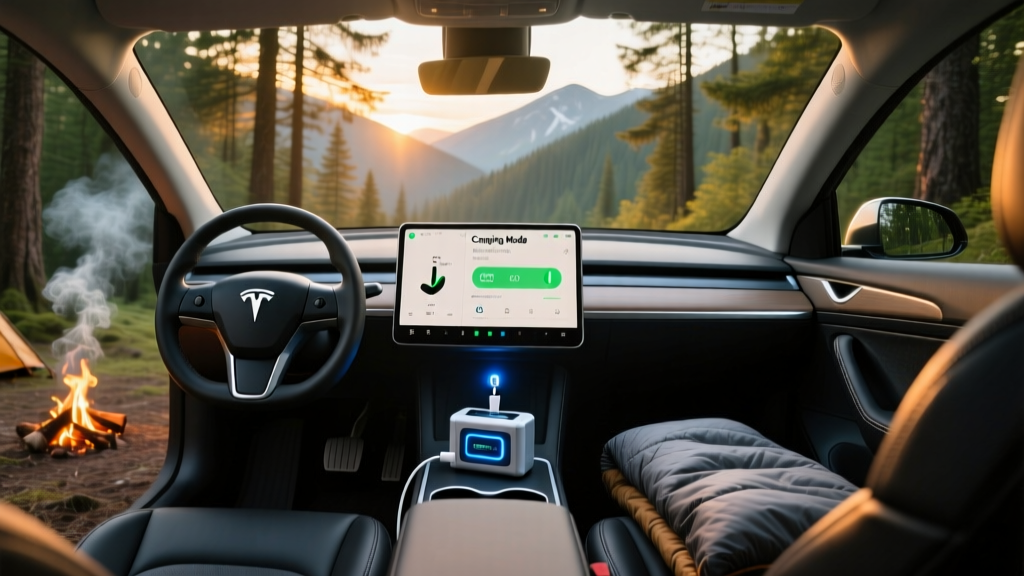
Activating Camping Mode on the 2026 Model Y is straightforward: pull down the climate menu on the 15.4-inch touchscreen, tap "Camping," and the car locks into a sustained-climate state. Here's what stays on and what shuts down:
- Active: HVAC (heat pump + A/C), USB-C ports (up to 65W on front ports), 12V outlet (150W max), interior ambient lighting presets, touchscreen media playback, Bluetooth audio.
- Disabled: Drive motor engagement, walk-away auto-lock (doors remain manually lockable), Sentry Mode (optional — enabling it adds ~0.5 kWh/hr draw), exterior lights unless manually toggled.
The 65W USB-C ports are enough to charge a laptop or power a small CPAP machine overnight. For higher-draw devices (portable fridge, electric blanket), you'll need a 12V-to-AC inverter plugged into the 150W outlet in the rear cargo area — but stay under 150W or the fuse will trip.
Compared to a gas SUV idling for heat, Camping Mode is silent (no engine drone), produces no carbon monoxide (safe in enclosed spaces like truck canopies), and costs roughly $1.50–$3.00 per night in electricity-equivalent, depending on your local rate.
Pricing, Tax Credits, and Total Cost
| Trim | MSRP | Federal Credit (est.) | Effective Price |
|---|---|---|---|
| Long Range AWD | $48,990 | $7,500 (if eligible) | ~$41,490 |
| Performance AWD | $53,990 | $7,500 (if eligible) | ~$46,490 |
Under IRS §30D rules, the full $7,500 credit requires meeting three hurdles simultaneously:
- MSRP cap: SUVs must be ≤$80,000 (Model Y qualifies at all trims).
- Buyer income cap: AGI ≤$150,000 single / ≤$300,000 joint.
- Battery sourcing: Critical minerals and battery components must meet escalating domestic/free-trade-agreement thresholds — Tesla's Austin-built Model Y currently qualifies for the full amount, but this is subject to annual tightening. Confirm on the IRS clean-vehicle portal before purchase.
As of 2026, the credit can be transferred to the dealer at point of sale, reducing your out-of-pocket price on delivery day rather than waiting for a tax refund.
Who the Model Y Camping Mode Setup Suits Best
This configuration is ideal for:
- Weekend car-campers who want a flat sleeping platform (with a mattress topper, the folded-rear-seat area measures roughly 72" long × 50" wide — enough for two adults).
- Solo overlanders reaching dispersed BLM/Forest Service sites within 150 miles of a Supercharger corridor.
- Digital nomads needing reliable 65W USB-C power and a climate-controlled workspace between hikes.
It's less suited for:
- Extended off-grid boondocking beyond 2–3 nights without access to Level 2 or DC charging — the 75-kWh pack is finite, and solar trickle-charging an EV traction battery is not practical.
- Heavy towing to remote sites — the Model Y's 3,500-lb tow rating is adequate for a light teardrop trailer but not a full camper.
Pros and Cons: Model Y as a Camping Platform
Pros
- Silent, zero-emission overnight climate control (no CO risk)
- 76.2 cu ft cargo space with flat load floor — fits a queen-size mattress topper
- 65W USB-C ports + 150W 12V outlet handle most camping electronics
- 250-kW Supercharger network access for fast trailhead top-offs
- Heat pump standard — efficient cold-weather HVAC draw
- NMC battery energy density maximizes range-to-weight ratio
Cons
- No native V2L (vehicle-to-load) AC outlet above 150W — limits appliance use
- 150W 12V outlet is below competitors (Hyundai Ioniq 5 offers V2L at 3.6 kW)
- Ground clearance of 6.6" limits rough fire-road access vs. a lifted SUV
- No spare tire — Tesla provides only a tire-repair kit
- Camping Mode disables Sentry Mode by default (can be re-enabled, but adds drain)
- NMC chemistry degrades faster than LFP if regularly held at 100% SoC
Model Y vs. Competitors for Camping Use
The closest EV alternative for camping is the Hyundai Ioniq 5 Long Range AWD (318 mi EPA, 77.4 kWh, ~$52,000). The Ioniq 5's V2L adapter can output 3.6 kW of 120V AC — enough to run a portable induction cooktop, electric cooler, or even a small space heater externally. That's a decisive advantage for basecamp cooking. However, the Ioniq 5 lacks a dedicated Camping Mode software state; you'd need to leave the car "on" in utility mode, which is less elegant and can trigger auto-shutoff timers.
The Ford Mustang Mach-E (312 mi EPA, 91 kWh usable, ~$48,000) offers more battery capacity but a less refined thermal management system, meaning higher overnight HVAC draw in extreme cold.
Frequently Asked Questions
How much battery does Tesla Camping Mode use per night?
Expect 10–15 kWh over 8 hours in moderate (50–70°F) conditions, or 13–20% of the Model Y Long Range's 75-kWh usable pack. In sub-freezing temps, plan for up to 15–20 kWh (20–27%) as the heat pump works harder.
Can I run Camping Mode while plugged into a Level 2 charger?
Yes. If you're camping at a site with EV hookups (increasingly common at KOA and some state parks), the car will draw from the grid first and only tap the battery if demand exceeds the charger's output — effectively giving you unlimited overnight climate control.
Does the 2026 Model Y qualify for the $7,500 federal tax credit?
Currently yes, for buyers under the AGI cap ($150K single / $300K joint) purchasing a new Model Y at or below the $80K SUV MSRP ceiling. Battery sourcing requirements are met for Austin-built units as of early 2026, but always verify on the IRS clean-vehicle portal before signing.
Is Camping Mode safe in terms of carbon monoxide?
Yes — unlike a gas vehicle idling for heat, an EV in Camping Mode produces zero tailpipe emissions. There is no CO risk, making it safe for enclosed spaces like truck-bed tents or canopy setups. This is one of the most underrated advantages of EV car-camping.
Can I sleep in the Model Y with the frunk open for ventilation?
You can, but it's unnecessary. Camping Mode runs the HVAC continuously, providing filtered, temperature-controlled air. The HEPA filter (standard on Long Range) handles smoke and dust — a genuine advantage during wildfire season in the West.