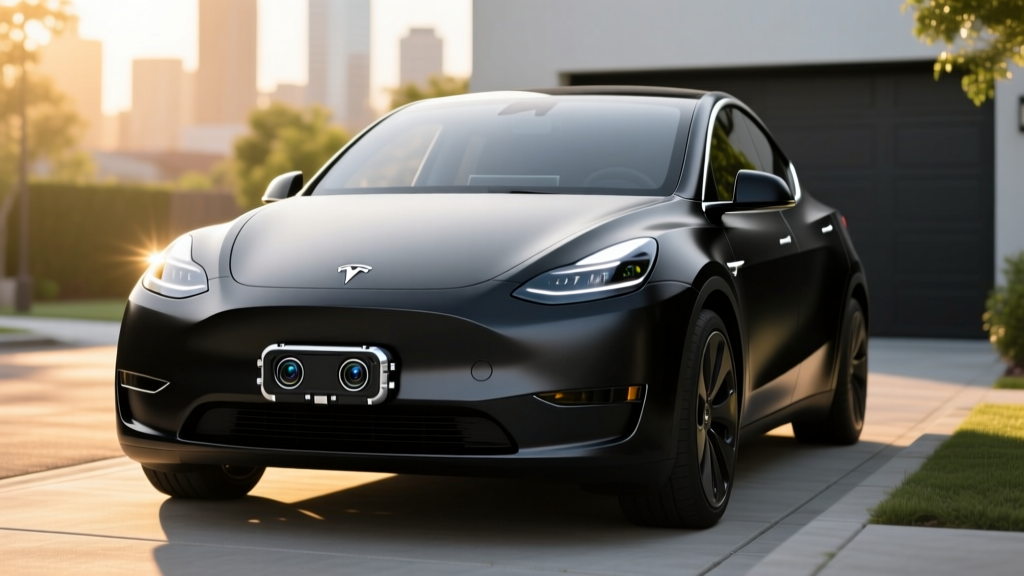
The Tesla Model Y remains the benchmark compact electric SUV in 2026, and much of its identity is tied to a hardware suite that ditches radar and lidar in favor of cameras alone. Tesla's vision-only approach — branded as Tesla Vision — relies on a network of high-resolution cameras to power everything from basic Autopilot lane-keeping to the Full Self-Driving (Supervised) neural network. But for buyers, the real question isn't just about the Tesla camera hardware: it's whether the whole package — range, charging speed, cargo space, and price — still holds up against an increasingly crowded field.
We've spent extensive time with the 2026 Model Y Long Range AWD and Performance trims to answer that question with hard numbers, not marketing copy. Here's everything you need to know before you configure one.
2026 Tesla Model Y: Core Specs at a Glance
| Spec | Long Range AWD | Performance |
|---|---|---|
| EPA Range | 320 miles | 295 miles |
| Battery (usable) | ~75 kWh (NMC) | ~75 kWh (NMC) |
| Drivetrain | Dual-motor AWD | Dual-motor AWD |
| Horsepower | 384 hp | 456 hp |
| 0–60 mph | 4.8 seconds | 3.5 seconds |
| Peak DC Fast Charge | 250 kW | 250 kW |
| 10–80% DC Charge | ~25 minutes | ~25 minutes |
| Level 2 Charge Rate | 11.5 kW (~44 mi/hr) | 11.5 kW (~44 mi/hr) |
| MPGe (combined) | 122 MPGe | 111 MPGe |
| Efficiency | 28 kWh/100 mi | 30 kWh/100 mi |
| Cargo (rear seats up) | 30.2 cu ft | 30.2 cu ft |
| Cargo (rear seats folded) | 72.1 cu ft | 72.1 cu ft |
| Rear Legroom | 38.4 inches | 38.4 inches |
| Base MSRP | $47,990 | $52,490 |
| Battery Warranty | 8 yr / 120,000 mi | 8 yr / 120,000 mi |
Source: EPA / fueleconomy.gov and Tesla Model Y official specs.
Real-World Range: What the EPA Number Doesn't Tell You
Real-World Expectation: ~270–290 miles in mixed driving; ~250–265 miles sustained highway at 75 mph; ~220–240 miles in freezing weather with cabin heat.
The 320-mile EPA estimate for the Long Range AWD is competitive, but EPA testing uses a specific drive-cycle blend that doesn't fully capture highway-speed energy consumption or cold-weather losses. In our experience, the Model Y's 75 kWh usable NMC pack delivers roughly 270–290 miles in mixed suburban-and-highway driving at moderate temperatures (60–80°F).
Push sustained highway speeds above 70 mph and you'll see consumption climb to around 30–32 kWh/100 mi, pulling effective range down to about 250 miles. In sub-freezing conditions, expect a 15–25% reduction depending on whether you use the heat pump effectively and precondition the battery. Tesla's heat pump is standard and does help mitigate cold-weather losses compared to resistive heating systems, but physics still wins: a 320-mile sticker becomes roughly 240 miles at 20°F with the cabin set to 72°F.
For context, the RWD base model (not currently offered in the U.S. for 2026) historically carried an LFP battery with slightly lower energy density and a 260-mile EPA rating. U.S. buyers in 2026 are choosing between the Long Range and Performance, both with NMC chemistry.
Charging Speed: DC Fast, Level 2, and the Charge Curve Reality
| Charging Level | Power | Miles Added per Hour | Notes |
|---|---|---|---|
| Level 1 (120V household) | ~1.4 kW | ~4–5 mi/hr | Emergency/trickle only |
| Level 2 (240V home) | 11.5 kW | ~44 mi/hr | Full charge in ~7 hours |
| DC Fast (Tesla Supercharger V3/V4) | Peak 250 kW | ~1,000+ mi/hr (peak) | 10–80% in ~25 min |
| DC Fast (CCS adapter, non-Tesla) | Peak 250 kW | Varies by station | Requires NACS-to-CCS adapter |
The Model Y peaks at 250 kW on V3 and V4 Superchargers, but — and this is critical for trip planning — that peak rate only holds from roughly 10% to 30% State of Charge. The charge curve tapers progressively: you'll see about 170–190 kW through the 40–60% range, dropping to under 100 kW past 70%, and crawling below 50 kW above 85%. This is normal for NMC lithium-ion cells, but it means the advertised "250 kW" is a peak, not a sustained rate.
A 10–80% session takes roughly 25 minutes at a V3 Supercharger under ideal conditions (battery preconditioned via navigation routing to the charger). Without preconditioning — for example, if you pull into a charger after the car has been sitting cold — add 5–10 minutes as the battery warms up. Always route to a Supercharger using the built-in navigation to trigger automatic preconditioning.
At home on a 48-amp Level 2 circuit (the Tesla Wall Connector or equivalent), the onboard charger accepts up to 11.5 kW, adding about 44 miles of range per hour. A full 10–100% charge takes roughly 7 hours, making overnight charging straightforward. Installation costs for a 240V/60A circuit typically range from $800–$2,000 depending on panel proximity and local permitting — hire a licensed electrician for the final spec.
The Tesla Camera System: Autopilot, FSD, and What the Hardware Actually Does
The phrase "Tesla camera" encompasses the vehicle's entire perception suite. The 2026 Model Y uses Tesla's Hardware 4.0 (HW4) architecture, which includes:
- 8 external cameras — front-facing narrow and wide-angle, left/right front repeaters, left/right rear, and a rear-view camera — providing up to 360° visibility at ranges up to 250 meters (front narrow)
- HW4 computer with Tesla's custom inference chip, processing camera feeds through the neural network in real time
- No radar, no lidar — Tesla removed ultrasonic sensors (USS) in late 2022 and radar earlier, relying entirely on vision for object detection, distance estimation, and parking
Autopilot and Full Self-Driving (Supervised) are Level 2 driver-assistance systems. The driver must remain fully attentive, hands on or near the wheel, and eyes on the road at all times. The vehicle does not handle all driving scenarios autonomously. Only Level 4 services like Waymo operate without a human driver in defined geofenced areas.
Autopilot (standard, included): Traffic-Aware Cruise Control and Autosteer provide adaptive cruise and lane-centering on highways. It's competent for highway commuting but requires active supervision. Lane changes require manual activation via turn signal.
Full Self-Driving (Supervised) — $8,000 option or $99/month: Adds automatic lane changes, navigation-guided on/off-ramp transitions, traffic-light and stop-sign recognition, and city-street autosteer. In 2026, FSD (Supervised) has improved substantially in urban environments, but it still makes errors — phantom braking, missed construction zones, and occasional erratic lane positioning remain documented issues. The "Supervised" branding is deliberate: you are the fallback.
- Drive you to a destination without supervision — you must monitor at all times
- Handle all weather conditions — heavy rain, fog, and snow degrade camera performance
- Replace an attentive driver — NHTSA has investigated multiple Tesla Autopilot/FSD incidents involving stationary emergency vehicles
- Qualify as "self-driving" — this is SAE Level 2, not Level 4
The camera-only approach has real trade-offs. Cameras can struggle with depth perception in low-contrast scenarios (white truck trailer against a bright sky, for instance), and the removal of ultrasonic sensors means parking proximity alerts rely on vision-derived estimates that occasionally misjudge tight obstacles. Tesla's "Park Assist" visualization is visually impressive but not as consistently accurate as ultrasonic-based systems from competitors.
Performance and Driving Dynamics
The Long Range AWD's 384 hp and 4.8-second 0–60 time make it genuinely quick for a family SUV. The dual-motor setup provides confident all-weather traction, and regenerative braking (adjustable between Standard and Low modes) enables near-one-pedal driving in daily commuting.
The Performance trim bumps output to 456 hp and drops the 0–60 to 3.5 seconds — sports-car territory in an SUV that seats five. Track Mode (Performance exclusive) adjusts stability control and cooling for closed-course use, though this is a niche feature.
Ride quality is firm but controlled. The 2026 Model Y received acoustic improvements (laminated glass, additional sound deadening) that noticeably reduce road noise compared to pre-2025 models. The adaptive damping on Performance trims adds compliance without sacrificing the planted feel.
Pricing, Trims, and Federal Tax Credit Eligibility
| Trim | Base MSRP | Federal Credit (potential) | Effective Price (if eligible) |
|---|---|---|---|
| Long Range AWD | $47,990 | Up to $7,500 (§30D) | ~$40,490 |
| Performance | $52,490 | Up to $7,500 (§30D) | ~$44,990 |
The Model Y's pricing falls under the IRS §30D Clean Vehicle Credit rules. Here's the critical eligibility framework for 2026:
- MSRP cap: SUVs must be priced at or below $80,000 — the Model Y clears this easily
- Buyer income limits: Modified AGI ≤ $300,000 (joint), $225,000 (head of household), $150,000 (single)
- Battery sourcing requirements: The $7,500 credit splits into two halves — $3,750 for critical minerals sourcing and $3,750 for battery component manufacturing. Tesla's U.S.-built battery packs (from the Nevada Gigafactory and Texas suppliers) have generally qualified for the full $7,500, but sourcing rules tighten annually. Confirm current eligibility at the point of sale.
- Point-of-sale transfer: As of 2024, you can transfer the credit to the dealer (Tesla) at purchase, reducing your out-of-pocket cost immediately rather than waiting for a tax refund
- Tax liability: The credit is non-refundable — you must have sufficient federal tax liability to benefit (the point-of-sale transfer sidesteps this for most buyers)
Important: Tax credit rules change frequently and depend on battery mineral sourcing declarations that can shift model year to model year. Always verify current eligibility on the IRS Clean Vehicle Credit page and consult a tax professional before relying on the credit in your purchase decision.
Interior, Cargo, and Daily Practicality
The Model Y's cabin follows Tesla's minimalist philosophy: a single 15.4-inch center touchscreen handles infotainment, climate, vehicle settings, and the camera-based instrument cluster. There's no traditional gauge cluster behind the wheel — speed and navigation info appears on the left portion of the main screen.
Practical dimensions:
- Cargo (rear seats up): 30.2 cu ft — enough for a week's groceries or two large suitcases
- Cargo (rear seats folded): 72.1 cu ft — competitive with midsize SUVs, useful for flat-pack furniture
- Frunk (front trunk): 4.1 cu ft — good for charging cables and a small bag
- Rear legroom: 38.4 inches — adequate for adults, though not class-leading
- Seating: Standard 5-passenger; optional 7-seat configuration available (third row is child-sized only)
The 15-speaker audio system is impressive for the price point. Ventilated front seats, a panoramic glass roof (with a power sunshade in the 2026 refresh), and power-folding mirrors are standard on Long Range. The glass roof does contribute to cabin heat in summer — Tesla added a tinted/reduced-transmission glass panel for 2026, but an aftermarket sunshade is still a common owner accessory in hot climates.
Pros and Cons
- Access to the Tesla Supercharger network — the most reliable and widespread DC fast-charging infrastructure in the U.S.
- Strong real-world efficiency (28 kWh/100 mi) keeps per-mile charging costs low
- Over-the-air updates continuously add features and improve FSD performance
- 320-mile EPA range covers most road-trip legs without excessive stops
- Excellent cargo capacity (72.1 cu ft) for the segment
- 250 kW peak charging with effective battery preconditioning
- Camera-only perception (no radar/lidar/USS) has documented edge-case failures in low-contrast and adverse weather
- FSD (Supervised) costs $8,000 and remains Level 2 — not autonomous driving
- Minimalist interior lacks physical controls — climate and mirror adjustments are all touchscreen
- Ride quality, while improved, is still firmer than competitors like the Hyundai Ioniq 5
- Build quality variability — panel gaps and paint imperfections still reported by some owners
- No Apple CarPlay or Android Auto — Tesla's proprietary infotainment only
Who Should Buy the 2026 Tesla Model Y?
- You want the best public DC charging network access (Supercharger reliability is a real ownership advantage)
- You road-trip frequently and value 250 kW charging with route-based preconditioning
- You want strong efficiency (low cost per mile) in a practical crossover form factor
- You're comfortable with a touchscreen-first interface and camera-based driver assist
- You prefer physical buttons, Apple CarPlay, or a more traditional interior layout
- You want radar-backed adaptive cruise and ultrasonic parking sensors for redundancy
- You prioritize ride comfort over sporty handling
- You need more rear-seat legroom for tall adult passengers
Frequently Asked Questions
What is the real-world range of the 2026 Tesla Model Y?
The EPA rates the Long Range AWD at 320 miles. In mixed real-world driving, expect 270–290 miles. Sustained highway driving at 75 mph drops that to roughly 250–265 miles, and freezing temperatures can reduce it to 220–240 miles with cabin heating. Always plan road trips around ~250 miles of usable range to maintain a safety buffer.
How fast does the Tesla Model Y charge at home and on the road?
On a 240V Level 2 home charger (48A), the Model Y charges at 11.5 kW, adding about 44 miles per hour — a full charge takes roughly 7 hours. On a Tesla V3/V4 Supercharger, it peaks at 250 kW and charges from 10–80% in approximately 25 minutes with battery preconditioning active.
Does the 2026 Tesla Model Y qualify for the $7,500 federal EV tax credit?
It can, but eligibility depends on several factors under IRS §30D: the buyer's modified AGI must fall below income caps ($300K joint, $150K single), the MSRP must be under $80,000 (the Model Y qualifies), and the battery must meet critical-mineral and component-sourcing thresholds. Tesla has generally met the full $7,500 requirement for U.S.-built Model Ys, but rules tighten annually. Verify at point of sale and consult a tax professional.
Is the Tesla camera system safe without radar or ultrasonic sensors?
Tesla Vision (camera-only) performs well in normal conditions but has documented limitations. NHTSA has investigated incidents involving Autopilot and stationary emergency vehicles. The lack of radar means reduced redundancy in depth estimation, and the absence of ultrasonic sensors makes parking proximity less reliable than radar/USS-equipped competitors. Tesla's HW4 cameras have improved resolution and low-light performance, but camera-only remains a deliberate engineering trade-off, not an unqualified advantage.
Is the Model Y worth buying vs. the Hyundai Ioniq 5 or Ford Mustang Mach-E?
The Model Y wins on charging network access (Supercharger reliability), efficiency (28 kWh/100 mi), and over-the-air feature updates. The Ioniq 5 offers faster 800V charging architecture (up to 350 kW on compatible chargers), physical buttons, and a more comfortable ride. The Mach-E provides a more conventional SUV feel with Apple CarPlay. If Supercharger access matters most to you, the Model Y is still the strongest choice. If interior quality and ride comfort rank higher, test-drive the Ioniq 5 before committing.
What is the battery warranty on the 2026 Model Y?
Tesla covers the Model Y's battery and drive unit for 8 years or 120,000 miles, whichever comes first, with a minimum 70% capacity retention threshold. If the battery degrades below 70% of its original capacity within the warranty period, Tesla will repair or replace it at no cost. This is competitive with the industry standard (most manufacturers offer 8 years/100,000 miles), and Tesla's 120,000-mile limit is slightly more generous than some rivals.