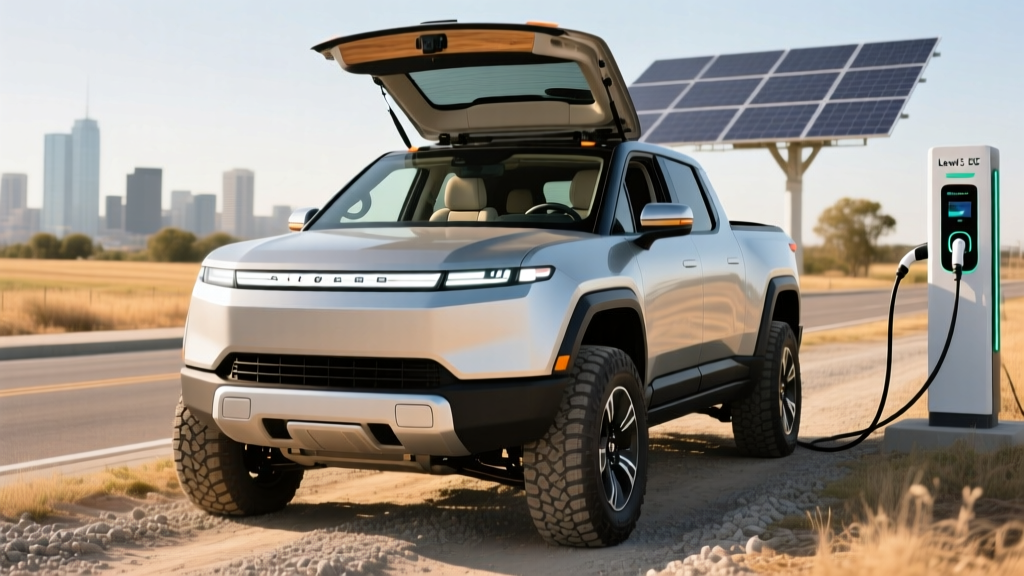
The 2026 Rivian R1T Quad Motor sits at the top of the electric truck hierarchy — a four-motor, 1,025-horsepower pickup that attempts to be a luxury daily driver, a serious tow rig, and a backcountry explorer all at once. Rivian's second-generation (Gen 2) platform brought meaningful upgrades to the R1T starting with the 2025 model year: a new electrical architecture, zonal wiring that cut roughly 44 pounds of harness weight, enhanced thermal management, and revised software that unlocked faster DC charging on the Max Pack battery. For 2026, the R1T Quad Motor with the Max Pack remains the most powerful and most capable version in the lineup, but it also commands a premium price that pushes it firmly into luxury-truck territory.
This review breaks down everything a prospective buyer needs — from real-world range reconciliation and charging-curve behavior to tax-credit eligibility and total cost of ownership — based on EPA data, Rivian's published specs, and accumulated owner experience.
2026 Rivian R1T Quad Motor: Core Specifications at a Glance
| Spec | Value |
|---|---|
| EPA Range (Max Pack) | 352 miles |
| Battery Capacity (usable) | ~149 kWh (Max Pack, NMC lithium-ion) |
| Powertrain | Quad Motor AWD (independent motor per wheel) |
| Horsepower | 1,025 HP |
| Torque | 1,198 lb-ft |
| 0–60 mph | ~3.0 seconds |
| Max DC Fast Charge Rate | ~220 kW peak |
| 10–80% DC Charge Time | ~21 minutes (Max Pack, preconditioned) |
| Level 2 Home Charge Rate | 11.5 kW (~25 miles of range per hour) |
| EPA Efficiency | 69 MPGe combined (est.); ~48 kWh/100 mi |
| Max Towing Capacity | 11,000 lbs |
| Payload Capacity | ~1,760 lbs |
| Bed Length | 4'6" (54 in) with gate up; ~82 in with gate down |
| Gear Tunnel Cargo Volume | 11 cu ft |
| Base MSRP (Quad Motor Max Pack) | $99,900 (incl. destination) |
| Battery/Powertrain Warranty | 8 years / 175,000 miles |
Real-World Range: What to Expect Beyond the EPA Sticker
EPA sticker: 352 miles (Max Pack, Quad Motor, 20-inch all-season tires)
Real-world highway (70–75 mph, mild weather): ~280–310 miles
Real-world highway (cold weather, <30°F): ~230–260 miles
Mixed city/suburban driving: ~310–340 miles
Towing (5,000–7,000 lb trailer): ~160–200 miles
The R1T Quad Motor Max Pack carries an enormous ~149 kWh usable battery — one of the largest packs in any production passenger vehicle. That raw capacity gives it a 352-mile EPA rating even with the efficiency penalty of four motors and a 7,000+ lb curb weight. But physics is unforgiving: the R1T's tall, flat-fronted profile and 6,800-lb-plus base weight mean highway efficiency drops significantly at speed.
On a flat, 70-mph highway loop in 65–75°F conditions, owners and testers consistently report consumption between 44 and 50 kWh/100 miles, which nets roughly 280 to 310 miles of real range. That's a meaningful 12–20% reduction from the EPA combined number, which blends in lower-speed city driving where regenerative braking recovers energy.
Cold weather compounds the loss. Below 30°F, battery internal resistance increases and cabin heating draws significant power (the R1T uses a heat pump, which helps, but it's still a major load at extreme temperatures). Expect 230 to 260 miles on a cold-weather highway run. If you're towing a 6,000-lb travel trailer, range collapses further to roughly 160–200 miles depending on terrain and speed — a reality shared by every electric truck on the market, including the Ford F-150 Lightning and Chevrolet Silverado EV.
The Standard Pack (106 kWh usable, ~270 miles EPA) and Large Pack (128 kWh usable, ~330 miles EPA) are also available on lower Quad Motor configurations, but most Quad Motor buyers opt for the Max Pack for the range buffer it provides on road trips and tow days.
Charging Speed: DC Fast Charging and Home Level 2
Rivian's Gen 2 platform upgraded the R1T's electrical architecture to support faster DC charging, though it doesn't match the 800V architectures of vehicles like the Hyundai Ioniq 5 or Porsche Taycan. The R1T Quad Motor Max Pack runs on a ~400V system, and its charging curve reflects that engineering choice.
| Charging Level | Power / Rate | Time or Range Added |
|---|---|---|
| Level 1 (120V / 12A) | ~1.4 kW | ~3 miles of range per hour |
| Level 2 (240V / 48A) | 11.5 kW | ~25 miles of range per hour; full charge in ~13 hours (Max Pack) |
| DC Fast Charge (peak) | ~220 kW peak | 10–80% in ~21 minutes (preconditioned) |
| DC Fast Charge (sustained avg) | ~140–160 kW avg (10–80%) | ~170–190 miles added in 20 min |
| Rivian Adventure Network | Up to 200+ kW (select stalls) | Exclusive to Rivian owners; NACS connector |
The peak 220 kW rate is just that — a peak. The charging curve tapers noticeably once the battery passes roughly 50% state of charge (SoC), and above 80% the rate drops steeply to protect the NMC cells. A preconditioned 10–80% session takes about 21 minutes at a capable 350 kW charger, but your average power delivery across that session is closer to 140–160 kW. This is typical for 400V-architecture EVs with large batteries; the sheer pack size means even moderate C-rates deliver substantial miles.
For home charging, the R1T's onboard charger accepts up to 11.5 kW on a Level 2 circuit (48 amps on a 60-amp breaker). That adds roughly 25 miles of range per hour, which means a full 0–100% replenishment of the Max Pack takes approximately 13 hours. Most owners who plug in nightly never need a full charge — a typical 50-mile daily commute uses roughly 22–25 kWh, which replenishes in about two hours on Level 2.
The R1T uses the NACS (North American Charging Standard) connector, giving it native access to the Rivian Adventure Network and, as of 2025, full access to Tesla Supercharger stations via Rivian's adapter program. This is a significant practical advantage over CCS-only vehicles as the Supercharger network remains the most reliable public DC charging infrastructure in the U.S.
Performance: 1,025 HP and a 3.0-Second 0–60
The Quad Motor powertrain assigns one permanent-magnet motor to each wheel, enabling true torque vectoring — the truck can send more torque to the wheels with grip, which is transformative off-road and useful in rain and snow. The combined output of 1,025 horsepower and 1,198 lb-ft of torque gives the R1T a 0–60 mph time of approximately 3.0 seconds, making it one of the quickest production pickups ever built.
But the R1T Quad Motor isn't just a straight-line performer. The independent motors allow for features like Tank Turns (low-speed counter-rotation for tight off-road maneuvers) and a highly responsive electronic limited-slip function. Ground clearance reaches 14.9 inches in Max mode on the adjustable air suspension, with approach/departure/breakover angles that rival dedicated off-road vehicles. Water fording depth is rated at over 36 inches.
On pavement, the Quad Motor's 7,000+ lb curb weight is felt in corners and during hard braking, though Rivian's chassis tuning and the low center of gravity from the floor-mounted battery keep it composed for a vehicle of its size. The air suspension does excellent work soaking up rough pavement and adapting ride height for highway efficiency or off-road clearance.
Pricing, Trims, and Federal Tax Credit Eligibility
The 2026 R1T Quad Motor is available across three battery pack configurations, with pricing that places it in the luxury truck segment:
| Configuration | Base MSRP (incl. destination) | Estimated After Federal Credit* |
|---|---|---|
| Quad Motor — Large Pack (~330 mi EPA) | $89,900 | $82,400 |
| Quad Motor — Max Pack (~352 mi EPA) | $99,900 | $92,400 |
| Quad Motor — Max Pack (fully optioned, as-tested) | $105,000–$110,000+ | $97,500–$102,500+ |
*Federal tax credit estimates assume buyer eligibility. See details below.
- Credit amount: Up to $7,500 for new qualifying EVs
- Truck MSRP cap: Vehicle MSRP must not exceed $80,000 (the R1T Quad Motor MSRP exceeds this cap — it does NOT qualify for the new-vehicle §30D credit)
- Buyer income caps: Modified AGI ≤ $300,000 (MFJ), $225,000 (HoH), $150,000 (single)
- Battery sourcing: Critical minerals and battery component requirements phase in annually; must meet current-year thresholds
- Point-of-sale transfer: Eligible buyers can transfer the credit to the dealer at purchase for an immediate price reduction
This is a critical point that many buyers overlook: the R1T Quad Motor, at $89,900+ MSRP, exceeds the $80,000 MSRP cap for trucks, vans, and SUVs under the federal §30D new clean vehicle credit. It does not qualify for the $7,500 federal credit. The R1T Dual Motor with the Standard Pack, however, may fall under the cap depending on configuration and current pricing — buyers should verify the exact window sticker MSRP (before options) against the current IRS threshold.
Some buyers may qualify for state-level rebates (California's CVRP, Colorado's innovative motor vehicle credit, etc.), and utility companies occasionally offer residential charging incentives. These vary by jurisdiction and change frequently, so check official state and utility sources.
Interior, Cargo, and Technology
The R1T's cabin seats five adults comfortably, with rear legroom of approximately 37.3 inches — adequate for long trips but not class-leading compared to full-size crew cabs. Front seats are well-bolstered and heated/ventilated across all trims, and the driving position is commanding thanks to the truck's tall stance.
Cargo versatility is where the R1T distinguishes itself from conventional pickups:
- Bed: 4'6" (54 in) with tailgate up — short by traditional truck standards, but the powered tonneau cover and integrated tie-downs make it practical for gear
- Gear Tunnel: 11 cu ft of lockable, pass-through storage between the cab and bed — ideal for skis, camping gear, or groceries. Rivian offers a slide-out kitchen accessory for this space
- Frunk (front trunk): ~11 cu ft, drainable and lockable — large enough for charging cables, a weekend bag, or wet gear
- Towing: 11,000 lbs max (properly equipped), with integrated trailer brake controller and Rivian's trailer-assist camera system
On the tech front, the R1T runs Rivian's in-house infotainment system on a 15.6-inch center touchscreen. The Gen 2 update brought a faster processor and improved responsiveness. Wireless Apple CarPlay and Android Auto are standard. The digital instrument cluster is 12.3 inches, and a head-up display is available.
Driver assistance comes via Rivian's Highway Assist and Adaptive Cruise Control suite — this is an SAE Level 2 system, meaning the driver must remain fully engaged with hands on the wheel and eyes on the road. It is not autonomous driving. Features include lane-centering, automatic emergency braking, blind-spot monitoring, and rear cross-traffic alert. Rivian has been developing more advanced driver-assist features, but as of the 2026 model year, the system remains a competent Level 2 competitor to Ford BlueCruise and GM Super Cruise in capability, though it lacks the hands-free operation those systems offer on mapped highways.
Efficiency and Ownership Costs
The R1T Quad Motor Max Pack returns an EPA-estimated 69 MPGe combined, which translates to roughly 48 kWh per 100 miles. This is reasonable for a 7,000-lb, 1,025-HP truck, but it's not efficient in absolute terms — the lighter Dual Motor R1T achieves approximately 73–76 MPGe depending on configuration.
Charging costs vary dramatically by method:
- Home Level 2 (national avg $0.16/kWh): ~$0.077 per mile, or ~$23.50 for a full 300-mile recharge
- DC fast charging (avg $0.35–$0.48/kWh): ~$0.17–$0.23 per mile, or ~$51–$69 for a 300-mile session
- Compared to gas (30 MPG truck at $3.50/gal): ~$0.117 per mile
Home charging delivers clear cost savings over gasoline, but frequent DC fast charging can narrow or even eliminate that advantage on a per-mile basis. Owners who can charge primarily at home or at workplace chargers will see the strongest economics.
Rivian's battery warranty covers 8 years or 175,000 miles (whichever comes first), with a capacity retention threshold of 70% — meaning Rivian warrants that the battery will retain at least 70% of its original usable capacity during the warranty period. This is competitive with the industry standard (most manufacturers offer 8 yr/100,000 mi, with Rivian's mileage limit being notably more generous). The basic vehicle warranty is 5 years / 60,000 miles.
Pros, Cons, and Who Should Buy the R1T Quad Motor
- 1,025 HP with true torque-vectoring AWD — exceptional on- and off-road
- 352-mile EPA range (Max Pack) — among the longest of any EV truck
- NACS connector + Supercharger access — best-in-class charging network
- Gear Tunnel and frunk add cargo versatility no conventional truck matches
- 11,000-lb towing capacity with integrated trailer tech
- Over-the-air updates continuously improve the vehicle
- 175,000-mile battery warranty exceeds most competitors
- $89,900+ MSRP — exceeds $80K federal tax credit cap
- Heavy: 7,000+ lbs hurts highway efficiency and tire wear
- Short 4'6" bed limits utility for construction/lumber-type cargo
- Level 2 driver assist only — no hands-free highway driving (vs BlueCruise/Super Cruise)
- 400V architecture limits peak DC charging speed vs 800V competitors
- Insurance premiums run 20–35% higher than comparable gas trucks
- Service center network still expanding — rural owners may face long tow distances
- Adventure-oriented buyers who want serious off-road capability without sacrificing daily-driver refinement
- Tech-forward families who need a pickup for weekend towing (boats, campers, horse trailers) and value the gear tunnel and frunk
- Home-charging-capable owners who can install a Level 2 charger and will do 80%+ of their charging at home
- Buyers who prioritize performance — the Quad Motor's 3.0-second 0–60 and torque vectoring are in a class of their own
- Budget-conscious buyers: The R1T Dual Motor or Ford F-150 Lightning offer strong value at lower price points and may qualify for the federal credit
- Heavy commercial users: The short bed and limited upfit options make the R1T less suited for fleet/commercial work than the F-150 Lightning or Silverado EV
- Frequent road-trippers in charging deserts: While the Supercharger network helps, rural routes in the Mountain West and Great Plains still have sparse DC charging
Frequently Asked Questions
What is the real-world range of the 2026 Rivian R1T Quad Motor?
The EPA rates the R1T Quad Motor Max Pack at 352 miles combined. In real-world highway driving at 70–75 mph in mild weather, expect 280–310 miles. Cold weather (below 30°F) reduces that to roughly 230–260 miles. Towing a mid-weight trailer drops range to approximately 160–200 miles. The Standard Pack and Large Pack deliver proportionally less real-world range.
How fast does the R1T Quad Motor charge at home and on the road?
On a Level 2 home charger (240V, 48A), the R1T charges at 11.5 kW, adding about 25 miles of range per hour. A full Max Pack charge from empty takes roughly 13 hours. On DC fast chargers, it peaks at approximately 220 kW and can go from 10–80% in about 21 minutes when the battery is preconditioned. Average power during a 10–80% session is closer to 140–160 kW due to the charge-curve taper.
Does the 2026 Rivian R1T Quad Motor qualify for the federal EV tax credit?
No — the R1T Quad Motor's MSRP exceeds the $80,000 cap for trucks under the IRS §30D new clean vehicle credit rules. It does not qualify for the $7,500 federal credit. Lower-priced R1T configurations (such as the Dual Motor Standard Pack, if priced under $80,000 MSRP) may qualify, subject to buyer income limits and battery-sourcing requirements. Always verify current rules at IRS.gov and consult a tax professional.
Is the R1T Quad Motor worth it vs the Ford F-150 Lightning or Chevy Silverado EV?
It depends on your priorities. The R1T Quad Motor offers more power (1,025 HP vs ~563 HP for the Lightning), more range (352 vs ~320 mi for the Lightning Extended Range), and superior off-road capability with torque vectoring and air suspension. However, it costs significantly more, has a shorter bed, and doesn't qualify for the federal credit. The F-150 Lightning is a better value for work-oriented and budget-conscious buyers. The Silverado EV offers a longer bed and competitive range. The R1T wins on performance, adventure capability, and charging network access.
How much does it cost to insure the R1T Quad Motor?
Insurance premiums for the R1T typically run 20–35% higher than comparable gas-powered trucks due to higher repair costs, parts pricing, and the vehicle's MSRP. National averages for full-coverage insurance on the R1T range from approximately $2,400 to $3,600 per year depending on driver profile, location, and coverage levels. Get quotes from multiple insurers before purchasing.
What is the battery warranty on the 2026 Rivian R1T?
Rivian covers the R1T's battery pack for 8 years or 175,000 miles (whichever comes first), warranting that it will retain at least 70% of its original usable capacity. The powertrain is also covered for 8 years / 175,000 miles. The basic vehicle warranty is 5 years / 60,000 miles. Rivian's mileage limit on the battery warranty is notably more generous than the industry-standard 100,000 miles.