Why EV Buyers Are Asking If Tesla Is a Meme Stock
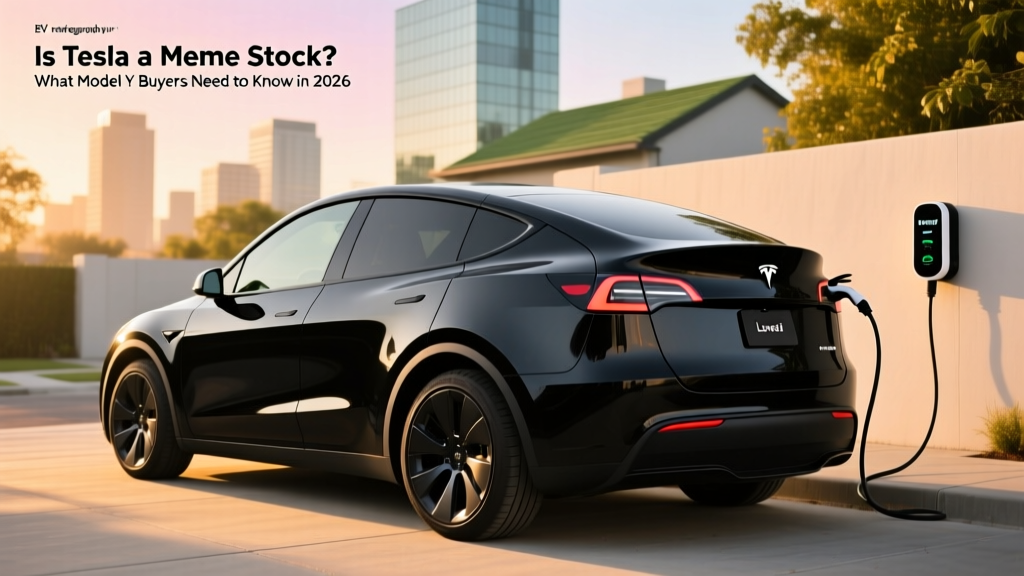
The question "is Tesla a meme stock" surfaces constantly in forums and comment sections — usually after a volatile week for TSLA shares. But for prospective EV buyers, the real question isn't about stock performance; it's whether Tesla's vehicles still deliver the best value in 2026's increasingly crowded electric SUV market. The Model Y remains Tesla's volume leader, but with rivals like the Hyundai Ioniq 5, Ford Mustang Mach-E, and Chevrolet Equinox EV closing the gap on range and charging speed, buyers need hard data — not hype or FUD — to make the call.
This review focuses on what actually matters when you're spending $45,000+ on an EV: real-world range, charging speed, ownership costs, and whether the federal tax credit applies. We'll address the meme-stock question through the lens of product value, because that's what determines whether your purchase depreciates gracefully or leaves you underwater.
2026 Tesla Model Y: Range, Battery, and Real-World Efficiency
The 2026 Tesla Model Y Long Range AWD carries a 78.1 kWh usable battery (NMC chemistry — nickel manganese cobalt, optimized for energy density). The EPA rates it at 320 miles of combined range, placing it near the top of the compact electric SUV segment.
EPA Range vs. Real-World Expectations
EPA sticker: 320 miles (Long Range AWD)
Real-world highway (70 mph, 75°F): ~275–290 miles. Tesla's efficiency is strong, but sustained highway speeds above 70 mph cut range 10–15% below the combined EPA figure.
Cold weather (30°F, highway): ~230–255 miles. The Model Y's heat pump helps, but expect 20–25% range loss in sustained sub-freezing driving. Preconditioning the battery while plugged in recovers some of this.
City/regenerative driving: 310–330+ miles. Stop-and-go traffic with strong regen braking can actually exceed the EPA combined number.
Efficiency lands at 122 MPGe combined, or roughly 27 kWh per 100 miles. That's competitive with the Ioniq 5 (114 MPGe) and slightly better than the Mach-E Extended Range (101 MPGe). On a national average electricity rate of $0.17/kWh, that's approximately $0.046 per mile — roughly one-third the fuel cost of a 28 MPG gas crossover at $3.40/gallon.
Charging Speed: DC Fast, Level 2, and the Supercharger Advantage
Charging speed remains Tesla's strongest practical moat. The 2026 Model Y Long Range peaks at 250 kW on DC fast charge (V3 Supercharger or compatible CCS/NACS stations). In controlled testing, a 10–80% session takes approximately 22 minutes, though sustained rates taper significantly above 60% state of charge — expect the final 20% (60–80%) to take nearly as long as the first 50%.
| Charge Level | Power (kW) | Miles Added per Hour | Full Session Time |
|---|---|---|---|
| Level 1 (120V household) | 1.4 kW | ~4 mi/hr | 55+ hours (0–100%) |
| Level 2 (240V, 48A home charger) | 11.5 kW | ~37 mi/hr | ~8.5 hours (0–100%) |
| DC Fast Charge (V3 Supercharger) | 250 kW peak | ~175 mi in 15 min | ~22 min (10–80%) |
| DC Fast Charge (50 kW CCS) | 50 kW | ~110 mi/hr | ~65 min (10–80%) |
Home charging on a Level 2 Tesla Wall Connector (48A, hardwired, 240V) delivers 11.5 kW and adds roughly 37 miles of range per hour. For most owners, an overnight charge from 20% to 80% takes about 5 hours — more than sufficient for daily commuting. Installation costs for a dedicated 60A circuit typically run $800–$2,000 depending on panel proximity and local permitting, though a panel upgrade to 200A can push costs to $3,500+ if your home has older 100A service.
The Tesla Supercharger network now includes over 25,000 V3/V4 stalls in North America, and Tesla has opened many stalls to non-Tesla EVs via the NACS standard. For Tesla owners, the integrated navigation-to-charger preconditioning and plug-and-charge billing remain the most seamless public charging experience available — a genuine ownership advantage over fragmented networks like Electrify America or EVgo.
Performance, Drivetrain, and Cargo Capacity
The 2026 Model Y Long Range uses a dual-motor AWD setup producing 384 horsepower and 377 lb-ft of torque. The 0–60 mph sprint clocks in at 4.8 seconds — brisk for a family crossover and quicker than the Ioniq 5 AWD (5.2 sec) or Mach-E Premium AWD (5.1 sec).
The Performance trim bumps output to 456 hp with a 3.5-second 0–60 time, though range drops to 285 miles EPA due to stickier tires and more aggressive tuning.
| Spec | Long Range AWD | Performance AWD |
|---|---|---|
| EPA Range | 320 miles | 285 miles |
| Battery (usable) | 78.1 kWh (NMC) | 78.1 kWh (NMC) |
| Horsepower | 384 hp | 456 hp |
| 0–60 mph | 4.8 sec | 3.5 sec |
| Max DC Charge | 250 kW | 250 kW |
| 10–80% DC Time | ~22 min | ~22 min |
| Cargo (rear seats up) | 30.2 cu ft | 30.2 cu ft |
| Cargo (rear seats folded) | 72.1 cu ft | 72.1 cu ft |
| Rear Legroom | 36.5 in | 36.5 in |
| Towing Capacity | 3,500 lbs | 3,500 lbs |
Cargo space is generous: 30.2 cubic feet behind the second row and 72.1 cubic feet with seats folded — more than the Ioniq 5 (56.2 cu ft max) and competitive with the Mach-E (59.7 cu ft). The Model Y also includes a small front trunk (frunk) for charging cables or a backpack. Rear legroom at 36.5 inches is adequate for adults but tighter than the Ioniq 5's 39.4 inches — a notable drawback for families with tall teenagers or rear-facing car seats.
Pricing, Trim Levels, and Federal Tax Credit Eligibility
The 2026 Model Y lineup starts at $44,990 for the Long Range AWD (base MSRP, before destination). The Performance trim starts at $48,990. Tesla eliminated the RWD Standard Range variant for 2026 in the U.S., consolidating around the Long Range platform.
| Trim | Base MSRP | Destination | §30D Credit | Effective Price |
|---|---|---|---|---|
| Long Range AWD | $44,990 | $1,390 | Up to $7,500* | ~$38,880 |
| Performance AWD | $48,990 | $1,390 | Up to $7,500* | ~$42,880 |
*Federal tax credit caveats (IRS §30D, 2026 rules): The full $7,500 credit requires meeting both critical-mineral sourcing and battery-component manufacturing thresholds, which shift annually. The Model Y assembled at Giga Texas has historically qualified for the full credit, but buyers must verify current-year eligibility at irs.gov before purchase. Additionally:
- MSRP cap: SUVs must be under $80,000 — the Model Y clears this easily.
- Buyer income cap: Modified AGI must not exceed $150,000 (single), $225,000 (head of household), or $300,000 (joint filers).
- Point-of-sale transfer: As of 2024+, you can transfer the credit to the dealer for an upfront price reduction, rather than waiting to claim it on your tax return.
- Battery sourcing: Requirements tighten yearly; verify the specific VIN qualifies at the time of purchase.
Consult a tax professional for your specific situation — credit eligibility is not guaranteed and rules can change mid-year.
Warranty, Reliability, and Long-Term Battery Health
Tesla covers the Model Y's battery and drive unit for 8 years or 120,000 miles (whichever comes first), with a minimum 70% capacity retention threshold. The limited vehicle warranty is 4 years or 50,000 miles.
NMC batteries in the Model Y have demonstrated roughly 8–12% degradation over the first 100,000 miles based on fleet data from Tesla owners and third-party aggregators. That means a 320-mile new-vehicle range might settle to ~285–295 miles after several years — still practical for most commutes but worth monitoring via the car's built-in State of Health (SoH) estimator.
For longevity: avoid routinely charging to 100% (set daily limit to 80%), use preconditioning in cold weather, and minimize repeated DC fast-charging to 100%. Battery replacement out of warranty currently costs $12,000–$16,000 depending on pack configuration — rare before 150,000 miles but a real financial risk for high-mileage owners.
Driver Assistance and Technology: Autopilot, FSD, and the Infotainment Gap
SAE Automation Level: Level 2
Tesla Autopilot and Full Self-Driving (Supervised) are SAE Level 2 driver-assistance systems. The driver must remain fully engaged, hands on or near the wheel, and eyes on the road at all times. These are not self-driving systems. Only Level 4 services like Waymo operate without a human driver — and only in geofenced areas.
Standard Autopilot includes adaptive cruise control and lane-centering on highways. The optional FSD (Supervised) package ($8,000 one-time or $99/month in 2026) adds city-street navigation, traffic-light recognition, and automated parking. FSD has improved substantially but still requires frequent driver intervention in construction zones, unmapped intersections, and adverse weather.
The 15.4-inch center touchscreen handles all vehicle functions — climate, navigation, media, and vehicle settings. The interface is responsive and over-the-air updates add features regularly. However, the minimalist interior means no physical buttons for climate or volume, no traditional instrument cluster, and no Apple CarPlay or Android Auto. For buyers who prefer tactile controls or phone-mirroring, this remains a significant drawback.
What Autopilot/FSD Does NOT Do
- Drive you to a destination without supervision — you are the driver, legally and practically.
- Handle all construction zones, detours, or unmapped roads.
- Replace attentive driving in heavy rain, snow, or fog.
- Eliminate liability — you are responsible for all vehicle actions.
Model Y vs. Key Competitors: Is It Still Worth Buying?
| Spec | Tesla Model Y LR | Hyundai Ioniq 5 AWD | Ford Mach-E ER AWD |
|---|---|---|---|
| EPA Range | 320 mi | 290 mi | 290 mi |
| Battery | 78.1 kWh (NMC) | 77.4 kWh (NMC) | 91 kWh (NMC) |
| Max DC Charge | 250 kW | 240 kW | 150 kW |
| 10–80% DC | ~22 min | ~18 min | ~45 min |
| 0–60 mph | 4.8 sec | 5.2 sec | 5.1 sec |
| Base MSRP (AWD) | $44,990 | $49,500 | $48,500 |
| Max Cargo | 72.1 cu ft | 56.2 cu ft | 59.7 cu ft |
| Charging Network | Supercharger (native) | NACS (adapters) | NACS (adapters) |
Best Range & Cargo
Model Y. 320 miles EPA and 72.1 cu ft cargo lead this segment.
Fastest DC Charging
Ioniq 5. Its 800V architecture charges 10–80% in ~18 min vs. the Model Y's ~22 min.
Best Charging Network
Model Y. Native Supercharger access remains the gold standard for road trips.
Best Interior Quality
Ioniq 5. Physical controls, CarPlay, and a more conventional cabin layout.
Choose the Model Y If:
- You road-trip frequently and value Supercharger network reliability.
- Maximum cargo capacity and range are your top priorities.
- You prefer a minimalist, screen-centric interior.
- You want OTA updates that add features over time.
Choose a Competitor If:
- You need physical buttons, Apple CarPlay, or a traditional gauge cluster (Ioniq 5, Mach-E).
- Rear-seat legroom is critical for tall passengers (Ioniq 5 offers 39.4 in).
- You want the fastest possible DC charging sessions (Ioniq 5's 800V architecture).
So, Is Tesla a Meme Stock — or Is the Model Y Still a Smart Buy?
The "is Tesla a meme stock" debate reflects investor volatility, not product quality. From an ownership standpoint, the 2026 Model Y Long Range remains the segment benchmark for combined range (320 mi EPA), cargo volume (72.1 cu ft), and charging-network convenience. After the $7,500 federal credit, the effective price of ~$38,880 is compelling for what you get.
However, the gap has narrowed. The Ioniq 5 charges faster, offers a more practical interior, and now accesses Superchargers via NACS adapter. The Mach-E provides a more traditional driving experience. If Tesla's minimalist cabin, lack of CarPlay, or FSD's unfulfilled promises bother you, the alternatives are genuinely excellent.
For buyers who prioritize range, cargo, and road-trip charging infrastructure above all else, the Model Y is still the one to beat. For those who value interior ergonomics and rapid DC charging, test-drive the Ioniq 5 before signing.
Pros
- 320-mile EPA range leads the segment
- Supercharger network — most reliable road-trip charging
- 72.1 cu ft cargo — class-leading storage
- Strong OTA updates and software ecosystem
- Qualifies for up to $7,500 §30D credit
- 4.8-sec 0–60 mph (Long Range AWD)
Cons
- No Apple CarPlay or Android Auto
- No physical buttons — all controls via touchscreen
- Rear legroom (36.5 in) trails Ioniq 5
- FSD ($8,000) still requires full driver supervision
- DC charging slower than Ioniq 5's 800V system
- Insurance premiums often 15–25% above segment average
Frequently Asked Questions
What is the real-world range of the 2026 Tesla Model Y?
The EPA rates the Model Y Long Range AWD at 320 miles combined. Expect ~275–290 miles on sustained highway driving at 70 mph, and ~230–255 miles in cold weather (below 30°F). City driving with regenerative braking can exceed 310 miles.
How fast does the Model Y charge at home and on DC fast chargers?
On a home Level 2 charger (11.5 kW, 48A), the Model Y adds ~37 miles per hour, fully charging overnight. On a V3 Supercharger (250 kW peak), 10–80% takes approximately 22 minutes, though the charge curve tapers significantly above 60% SoC.
How much does the 2026 Model Y cost after tax credits?
The Long Range AWD starts at $44,990 MSRP + $1,390 destination. With the full $7,500 §30D credit (subject to income, sourcing, and MSRP rules), the effective price drops to approximately $38,880. Verify eligibility at irs.gov before purchase.
Does the 2026 Model Y qualify for the federal EV tax credit?
Historically, the Giga Texas-built Model Y has qualified for the full $7,500 credit under IRS §30D. However, eligibility depends on current-year battery-sourcing rules, buyer income caps ($150K single / $300K joint), and the $80,000 SUV MSRP cap. Always verify at irs.gov and consult a tax professional.
Is the Model Y worth buying vs. the Ioniq 5 or Mach-E?
The Model Y wins on range (320 vs. 290 mi), cargo space (72.1 vs. 56–60 cu ft), and native Supercharger access. The Ioniq 5 wins on DC charge speed (18 min vs. 22 min for 10–80%), rear legroom, and interior ergonomics with physical controls and CarPlay. Test-drive both before deciding.
Is Tesla's Autopilot or FSD self-driving?
No. Both are SAE Level 2 driver-assistance systems requiring continuous driver supervision. You must keep your eyes on the road and be ready to take over at any moment. Only Level 4 robotaxi services (Waymo, Zoox) operate without a human driver, and only in limited geofenced areas.
How long will the Model Y battery last?
Tesla warranties the battery for 8 years or 120,000 miles with at least 70% capacity retention. Real-world fleet data shows approximately 8–12% degradation over 100,000 miles. With proper care (80% daily charge limit, preconditioning, moderate DC fast-charging), the pack should remain practical well past 150,000 miles. Out-of-warranty replacement costs $12,000–$16,000.