Rumors about the Tesla Model X's future surface almost every year, and the question keeps landing in our inbox: Is Model X discontinued? As of early 2026, the answer is no — the Model X remains in Tesla's active lineup, still built at the Fremont, California factory alongside the Model S and Model 3/Y. But with Tesla's history of abrupt production changes and a shifting luxury EV SUV market, buyers deserve a clear-eyed look at what you're actually getting, what it costs, and whether this flagship SUV still makes sense against newer rivals.
This review covers the current 2026 Tesla Model X with exact specs — range, charging, pricing, tax-credit status, and real-world ownership data — so you can decide if it's worth your garage space or if a competitor better fits your needs.
Current Status: Is the Tesla Model X Discontinued?
The Model X is not discontinued as of the 2026 model year. Tesla continues to list it on its website, accept orders, and produce it at Fremont. However, context matters. Tesla has significantly reduced its emphasis on the Model X and Model S in recent earnings calls, shifting production capacity toward the higher-volume Model Y, Cybertruck, and its next-generation platform. Order wait times have fluctuated, and Tesla has trimmed the configurator to just two trims.
The Model X occupies a narrow niche: a three-row, all-electric luxury SUV with falcon-wing rear doors and genuine 3500-lb towing capability. Sales volume has always been modest compared to the Model Y, and Tesla has not announced a direct next-generation successor. If you're shopping for one, it's available — but understand you're buying what may be the final iteration of this platform.
2026 Tesla Model X Specifications at a Glance
| Spec | Model X (Dual Motor) | Model X Plaid |
|---|---|---|
| EPA Range | 335 miles | 326 miles |
| Battery (usable) | ~95 kWh (NMC) | ~95 kWh (NMC) |
| Drivetrain | Dual Motor AWD | Tri-Motor AWD |
| Horsepower | 670 hp | 1,020 hp |
| 0–60 mph | 3.8 sec | 2.5 sec |
| Top Speed | 155 mph | 163 mph |
| Max DC Fast Charge | 250 kW | 250 kW |
| 10–80% DCFC Time | ~32 min | ~32 min |
| Level 2 Home Charge | 11.5 kW (~34 mi/hr) | 11.5 kW (~34 mi/hr) |
| EPA Efficiency | 101 MPGe (33 kWh/100mi) | 98 MPGe (34 kWh/100mi) |
| Towing Capacity | 3,500 lbs | 3,500 lbs |
| Base MSRP | $79,990 | $94,990 |
| Federal Tax Credit (§30D) | Up to $7,500* | Up to $7,500* |
*Tax credit eligibility depends on buyer income, battery sourcing, and MSRP caps. See the tax credit section below for full details. Source: fueleconomy.gov, Tesla.com.
Real-World Range: What to Actually Expect
EPA Sticker: 335 miles (Dual Motor) / 326 miles (Plaid)
Real-World Highway (70 mph, moderate weather): ~260–285 miles
Cold Weather (below 32°F, highway): ~210–245 miles
Mixed Commute (city/suburban with regen): ~290–320 miles
The Model X uses a ~95 kWh usable battery with NMC (nickel manganese cobalt) chemistry. NMC offers higher energy density than LFP, which is necessary in a heavy three-row SUV, but it's more sensitive to sustained high states of charge — Tesla recommends daily charging to 80–90% and only charging to 100% for longer trips.
The EPA's 335-mile rating assumes a mix of city and highway driving. In practice, the Model X's large frontal area and weight (~5,185 lbs for the Dual Motor) hit efficiency hard at sustained highway speeds. On a 300-mile road trip at 75 mph in 65°F weather, expect to arrive with roughly 10–15% state of charge remaining, meaning you'll want a Supercharger stop around the 250-mile mark. In freezing temperatures, range drops 25–35% due to battery heating demands and cabin climate load — the heat pump helps, but physics is physics.
City and suburban driving with frequent regenerative braking opportunities gets you closest to the EPA number. Owners who primarily commute short distances and charge at home rarely notice the gap.
Charging Speed: DC Fast, Level 2, and the Curve Reality
| Charging Level | Max Power | Rate | Notes |
|---|---|---|---|
| Level 1 (120V household) | ~1.4 kW | ~3–4 mi/hr | Emergency/trickle only |
| Level 2 (240V home) | 11.5 kW | ~34 mi/hr | Full charge in ~10 hrs |
| DC Fast Charge (Supercharger V3/V4) | 250 kW peak | ~175 mi in 15 min | 10–80% in ~32 min |
The Model X peaks at 250 kW on Tesla's V3 and V4 Superchargers using its native NACS connector. However, as with all EVs, peak rate is not sustained rate. The charging curve is aggressive in the 10–40% SoC window (where you'll see 220–250 kW), then tapers progressively through 60%, 80%, and beyond. The 10–80% time of approximately 32 minutes reflects this taper.
For home charging, the onboard charger accepts up to 11.5 kW on a 48-amp Level 2 circuit (requires a 60-amp breaker). A typical overnight session from 20% to 80% takes about 5–6 hours, which covers most daily needs. If your home electrical panel is older or maxed out, a panel upgrade could add $1,500–$3,000 to your installation cost — get a load calculation from a licensed electrician before committing.
The Model X comes with a NACS (Tesla) connector natively. With Tesla now opening Superchargers to other brands via NACS adoption, you benefit from the largest and most reliable DC fast-charging network in North America — a significant ownership advantage over CCS-equipped competitors still reliant on Electrify America or EVgo.
Performance, Drivetrain, and Efficiency
The standard Dual Motor Model X pairs front and rear electric motors for all-wheel drive, producing 670 combined horsepower and a 3.8-second 0–60 time. That's genuinely quick for a 5,185-lb SUV with three rows of seats.
The Plaid variant adds a third rear motor for 1,020 hp and a 2.5-second 0–60 — numbers that border on absurd in a family hauler, but the instant torque delivery makes it feel effortless in merging and passing situations. The tri-motor setup also enables torque vectoring across the rear axle, improving cornering composure.
Efficiency sits at 101 MPGe combined (33 kWh per 100 miles) for the Dual Motor and 98 MPGe (34 kWh/100mi) for the Plaid, per fueleconomy.gov. At the national average electricity rate of ~$0.16/kWh, that translates to roughly $5.28 per 100 miles driven — compared to $12–15 per 100 miles in a comparable gas SUV getting 20 mpg at $3.20/gallon.
Pricing, Trims, and Federal Tax Credit Eligibility
| Trim | Base MSRP | Destination | Est. As-Tested* | §30D Credit Eligibility |
|---|---|---|---|---|
| Model X (Dual Motor) | $79,990 | $1,995 | $82,000–$90,000 | Eligible (up to $7,500) |
| Model X Plaid | $94,990 | $1,995 | $97,000–$105,000 | Eligible (up to $7,500) |
*As-tested prices vary with options (wheels, paint, interior, FSD).
The Model X qualifies for the IRS §30D Clean Vehicle Credit, but with important caveats that determine whether you actually receive the full $7,500:
- MSRP Cap: SUVs must have an MSRP at or below $80,000. The base Dual Motor Model X at $79,990 clears this threshold — but adding premium paint, larger wheels, or six-seat config can push the sticker above $80,000 and disqualify the credit. The Plaid at $94,990 exceeds the cap and does NOT qualify unless Tesla adjusts pricing.
- Buyer Income Cap: Modified adjusted gross income must not exceed $300,000 (joint filers), $225,000 (head of household), or $150,000 (single). Check IRS.gov for current-year thresholds.
- Battery Sourcing: The $7,500 credit splits into two halves — $3,750 for critical minerals and $3,750 for battery components — each with escalating domestic/free-trade sourcing requirements. Tesla has worked to localize supply chains, but the exact credit amount ($3,750 or $7,500) can shift. Confirm the current eligibility on the IRS qualified vehicles list before purchasing.
- Point-of-Sale Transfer: As of 2024, you can transfer the credit to the dealer at purchase, reducing your out-of-pocket cost immediately rather than waiting to claim it on your tax return.
Bottom line: The base Model X Dual Motor can qualify for up to $7,500, bringing effective pricing to roughly $72,500 before options. The Plaid generally does not qualify due to the $80,000 SUV MSRP cap. Always verify with a tax professional before relying on credit eligibility.
Interior, Cargo, and Tech
The Model X seats up to seven in a 2-3-2 configuration, though the optional second-row captain's chairs reduce capacity to six and eliminate the middle-row bench. Third-row space is tight — 32.7 inches of legroom — suitable for children or short trips but not comfortable for adults on long drives.
Cargo volume is a strong point:
- Behind third row: 37.1 cu ft
- Behind second row (third row folded): 74.1 cu ft
- Maximum (all rear seats folded): 85.1 cu ft
- Front trunk (frunk): 6.6 cu ft
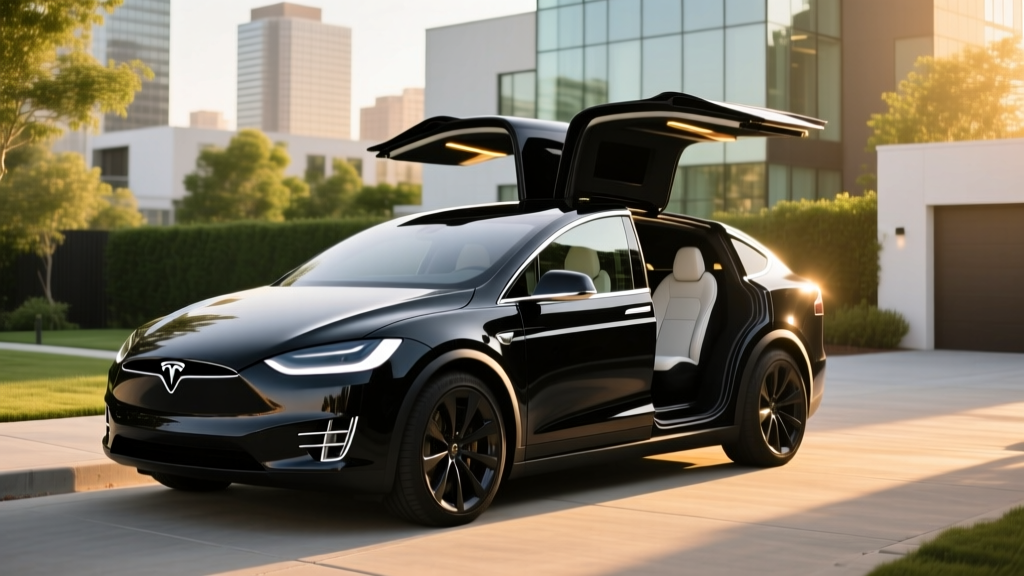
The falcon-wing rear doors remain the Model X's signature feature. They articulate upward with dual hinges, making child-seat loading dramatically easier than in any conventional SUV. However, they require overhead clearance (roughly 12 inches above the roofline to fully open) and can be slow in tight parking structures. They're also a long-term maintenance concern — more motors, sensors, and seals than a conventional door.
The 17-inch center touchscreen runs Tesla's proprietary infotainment system, which is responsive and feature-rich but lacks Apple CarPlay and Android Auto. A rear-seat 8-inch touchscreen handles climate and entertainment for second-row passengers. The yoke steering wheel is standard (a conventional round wheel is available as a no-cost option on request).
Driver Assistance: Autopilot and FSD
Tesla Autopilot and Full Self-Driving (Supervised) are Level 2 driver-assistance systems. The driver must remain fully attentive, keep hands on the wheel (or demonstrate engagement via the cabin camera), and be prepared to take over at any moment. These systems do NOT make the Model X a self-driving vehicle. Only Level 4 services like Waymo operate without a human driver in defined zones.
Standard Autopilot includes Traffic-Aware Cruise Control and Autosteer (lane centering on divided highways). The optional FSD (Supervised) package, currently priced at $8,000 or $99/month, adds automatic lane changes, navigation-guided on/off-ramp handling, traffic light and stop sign recognition, and city-street autosteer.
FSD has improved substantially, but it still makes errors — phantom braking, misread construction zones, and occasional hesitation at complex intersections. It's a convenience feature for long highway stretches, not a replacement for an attentive driver. Insurance implications vary by state, and some insurers charge higher premiums for vehicles with FSD enabled.
Warranty Coverage
| Component | Coverage |
|---|---|
| Basic Vehicle | 4 years / 50,000 miles |
| Battery & Drive Unit | 8 years / 150,000 miles |
| Battery Capacity Retention | Minimum 70% over warranty period |
Tesla's 8-year/150,000-mile battery and drive unit warranty is competitive with the industry standard (most automakers offer 8 years/100,000 miles). The 70% capacity retention threshold means Tesla will repair or replace the battery if it degrades below 70% of original capacity within the warranty window. Real-world data from long-term Tesla owners suggests NMC batteries in the Model X typically retain 85–90% capacity at 100,000 miles when charged responsibly (avoiding daily 100% charges and frequent DC fast charging to full).
Pros and Cons
- 335-mile EPA range — longest in its class
- Access to Tesla Supercharger network (NACS native)
- Falcon-wing doors ease child-seat loading
- Up to 7 seats + 3,500-lb towing
- Strong real-world efficiency (101 MPGe)
- Over-the-air updates keep software current
- Plaid trim exceeds $80K MSRP cap — no tax credit
- Falcon-wing doors: slow, need overhead clearance, maintenance risk
- No Apple CarPlay or Android Auto
- Third row tight for adults
- 250 kW peak DCFC trails some 350 kW-capable rivals
- Panel gap and interior finish not on par with BMW/Mercedes at this price
- Future platform uncertain — potential depreciation risk
Competitors: Is the Model X Worth It vs. Rivals?
The Model X competes in the luxury electric SUV segment, but the field has grown considerably since it launched. Here's how it stacks up:
- BMW iX xDrive50: Starting ~$87,250, EPA 324 miles, 516 hp. More refined interior, better ride quality, but only two rows of seats and no tax credit (MSRP over cap). Better for buyers prioritizing luxury over utility.
- Mercedes EQS SUV 450 4MATIC: Starting ~$105,550, EPA 305 miles. Three rows available, superior interior materials, but heavier, less efficient, and significantly more expensive.
- Rivian R1S (Dual Motor): Starting ~$75,900, EPA 352 miles (Max Pack). Three rows, genuine off-road capability, 7,700-lb towing. Strongest direct competitor for families who tow or adventure. Tax credit eligibility varies by battery pack.
- Kia EV9 (GT-Line AWD): Starting ~$64,900, EPA 270 miles. Three rows, qualifies for $7,500 credit, much more affordable. Less range and performance but dramatically better value for budget-conscious families.
Choose the Model X if: You need three rows + 300+ miles of range + Supercharger access, regularly load child seats (falcon wings), and the Dual Motor base MSRP stays under $80K for the tax credit.
Choose a competitor if: You need genuine off-road/towing capability (Rivian R1S), prioritize interior luxury over tech (BMW iX, Mercedes EQS SUV), or want a more affordable three-row EV and can accept less range (Kia EV9).
Who Should Buy the 2026 Tesla Model X?
The Model X is best suited for:
- Tech-forward families who value the Supercharger network for road trips and need three rows primarily for children.
- Commuters with home charging who want a long-range AWD SUV that costs ~$5 per 100 miles to fuel.
- Parents of young children who will genuinely use the falcon-wing doors for car-seat access daily.
It's less ideal for:
- Buyers who regularly carry adults in the third row.
- Heavy towers (3,500-lb capacity trails the Rivian R1S and F-150 Lightning).
- Those who prioritize traditional luxury build quality and dealership service experiences.
Frequently Asked Questions
Is the Tesla Model X being discontinued?
No. As of the 2026 model year, the Model X is actively produced and available for order. However, Tesla has not announced a next-generation successor, and production volume is low compared to Model Y. It's available now, but its long-term future beyond the current generation is uncertain.
What is the real-world range of the Model X?
The EPA rates the Dual Motor at 335 miles and the Plaid at 326 miles. In real-world highway driving at 70 mph, expect 260–285 miles. In cold weather (below freezing), range can drop to 210–245 miles. City driving with regenerative braking gets closest to the EPA sticker.
How fast does the Model X charge?
On a Tesla V3/V4 Supercharger, the Model X peaks at 250 kW and charges from 10–80% in approximately 32 minutes. At home on a 48-amp Level 2 charger (11.5 kW), it adds about 34 miles per hour of charging, with a full charge taking roughly 10 hours.
Does the Model X qualify for the $7,500 federal EV tax credit?
The base Model X Dual Motor at $79,990 MSRP qualifies, as it's under the $80,000 SUV cap. However, options that push the sticker above $80,000 will disqualify it. The Plaid trim at $94,990 does not qualify. Buyer income limits ($300K joint / $150K single) and battery sourcing requirements also apply. Verify on IRS.gov before purchasing.
Is the Model X worth buying over competitors?
It depends on your priorities. The Model X wins on range, Supercharger access, and falcon-wing utility for child seats. It loses on interior luxury (BMW iX, Mercedes EQS SUV), towing/off-road capability (Rivian R1S), and value (Kia EV9). If the Supercharger network and 335-mile range are your top needs in a three-row EV, it remains the strongest option.
What's the biggest risk of buying a Model X now?
Platform longevity. Tesla has not committed to a next-generation Model X, and if the model is eventually discontinued, parts availability, software support, and resale value could be affected over a 10+ year ownership horizon. If you plan to keep the vehicle 5 years or fewer, this risk is manageable. For long-term keepers, it's worth considering.