Quick Verdict: Tesla's Dual-Motor AWD Excels in Snow — With Caveats
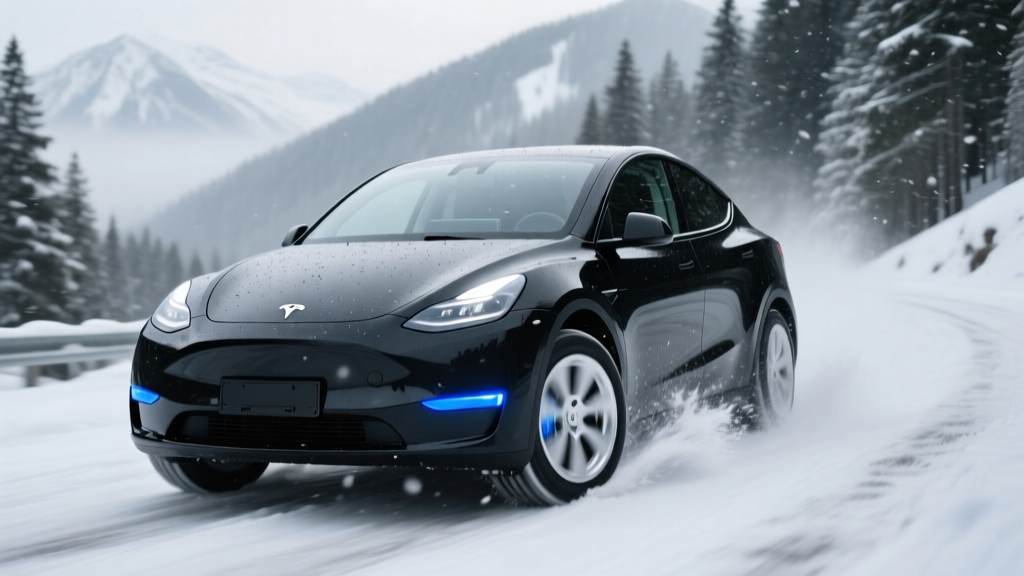
The short answer to "are Teslas good in snow" is yes — but not because of the brand. It's because Tesla's dual-motor all-wheel-drive system delivers instant, independent torque to each axle with millisecond traction-control response that outperforms most mechanical AWD setups. The 2026 Tesla Model Y Long Range AWD pairs this with a standard heat pump, low center of gravity, and predictable weight distribution that make it one of the most capable EVs in winter conditions.
However, every EV loses range in cold weather, and the Model Y is no exception. Expect a 20-30% reduction in below-freezing temperatures, slower DC fast charging until the battery warms, and the same tire limitations every vehicle faces on ice. This review breaks down exactly what the 2026 Model Y Long Range AWD delivers in snow, ice, and sub-zero commutes — with hard numbers, not marketing claims.
2026 Tesla Model Y Long Range AWD: Full Specifications
| Specification | Value |
|---|---|
| EPA Estimated Range | 320 miles |
| Battery Capacity (Usable) | ~75 kWh, NMC chemistry |
| Drivetrain | Dual-Motor AWD |
| Horsepower | 384 hp combined |
| 0-60 mph | 4.8 seconds |
| Top Speed | 125 mph |
| Max DC Fast Charge | 250 kW (peak) |
| 10-80% DC Fast Charge Time | ~25 minutes (preconditioned) |
| Level 2 Home Charging | 11.5 kW / ~37 miles per hour |
| EPA Efficiency | 117 MPGe combined (29 kWh/100 mi) |
| Cargo Volume (rear seats up) | 30.2 cu ft |
| Cargo Volume (rear seats folded) | 72.1 cu ft |
| Rear Legroom | 39.0 inches |
| Front Trunk (Frunk) | 4.1 cu ft |
| Curb Weight | 4,398 lbs |
| Battery Warranty | 8 years / 120,000 miles |
| Basic Vehicle Warranty | 4 years / 50,000 miles |
| Base MSRP | $48,990 |
Sources: EPA / fueleconomy.gov, Tesla Model Y specifications
Real-World Winter Range: What the EPA Sticker Doesn't Tell You
Real-World Highway (70°F): ~270-290 miles
Real-World Highway (20°F, no preconditioning): ~210-240 miles
Real-World Highway (0°F, short trips): ~180-210 miles
The Model Y's 320-mile EPA rating assumes mild conditions and mixed driving. In practice, highway speeds alone reduce range to roughly 270-290 miles in temperate weather. Add freezing temperatures, and the physics of battery chemistry and cabin heating take a significant toll.
Lithium-ion NMC batteries experience increased internal resistance in cold weather, reducing the energy available for propulsion. Simultaneously, heating the cabin draws power directly from the traction battery. The Model Y's standard heat pump (introduced in the 2021 refresh and standard on all current models) significantly mitigates this — a heat pump moves heat rather than generating it resistively, using roughly 3-4x less energy than a traditional PTC heater in temperatures above 10°F.
However, in extreme cold (below 0°F), even the heat pump's efficiency drops, and the vehicle may supplement with resistive heating. Owners in northern climates should budget a 25-35% range loss during deep winter. For a 320-mile rated Model Y, that means planning for roughly 210-240 miles of real range on a cold highway drive — still adequate for most commutes and manageable on road trips with strategic Supercharger stops.
Critical winter tip: Always precondition the battery while plugged in before a cold-weather drive. This warms the battery using grid power rather than battery power, preserving range and enabling faster regenerative braking from the start of your trip.
How Teslas Handle Snow: Dual-Motor Traction Explained
The reason Teslas earn strong reputations in snow comes down to the dual-motor AWD system. Unlike traditional mechanical AWD, which uses a driveshaft and center differential to split torque between axles, Tesla's system uses two independent electric motors — one on each axle — controlled by software that adjusts torque distribution thousands of times per second.
This delivers several snow-driving advantages:
- Instant torque vectoring: If the front wheels slip, the system redirects power to the rear (or vice versa) in milliseconds — far faster than any mechanical clutch-based AWD system.
- Low center of gravity: The battery pack sits beneath the floor, giving the Model Y a lower CG than most crossovers. This reduces body roll and improves stability on icy curves.
- Weight distribution: At roughly 50/50 front-to-rear weight balance, neither axle is significantly unloaded, improving traction at all four contact patches.
- Regenerative braking modulation: One-pedal driving can be a liability on ice (sudden regen can break traction), but Tesla's "Chill" acceleration mode and adjustable regen settings let drivers soften the deceleration for slippery conditions.
Important limitation: No AWD system overcomes the laws of physics on ice. The Model Y ships with all-season tires that provide adequate snow traction but mediocre ice grip. Owners in regions with sustained icy conditions should invest in a dedicated set of winter tires on separate wheels — this single modification transforms the car's cold-weather capability more than any drivetrain upgrade could.
Winter Charging: Cold Weather Impacts on Speed and Strategy
| Charging Method | Power (kW) | Miles Added/Hour | Winter Notes |
|---|---|---|---|
| Level 1 (120V outlet) | 1.4 kW | ~3-4 mi/hr | Trickle only; battery may not warm |
| Level 2 (240V, 48A) | 11.5 kW | ~37 mi/hr | Full overnight charge; warms battery slowly |
| DC Fast (Tesla Supercharger V3) | 250 kW peak | Up to ~1,000 mi/hr (peak) | Requires preconditioning; cold battery limits to ~80-120 kW initially |
| DC Fast (CCS adapter, non-Tesla) | Up to 150-250 kW | Varies by station | Same preconditioning requirement |
Cold batteries charge slowly. This is a chemistry reality, not a Tesla flaw. When you arrive at a Supercharger with a cold-soaked battery (say, after sitting outside at 10°F for hours), the vehicle's battery management system (BMS) limits charge rate to protect the cells. You may see only 50-80 kW initially, tapering up as the battery warms.
The fix is preconditioning. When you navigate to a Supercharger using the in-car navigation, the Model Y automatically begins warming the battery en route — typically 10-20 minutes before arrival. This can bring peak charge rates close to the 250 kW maximum even in freezing weather. Without preconditioning, a 10-80% charge that normally takes ~25 minutes could stretch to 40+ minutes in deep cold.
For daily winter driving, Level 2 home charging is the ideal setup. A Wall Connector or equivalent 48-amp charger adds roughly 37 miles of range per hour, meaning a full overnight charge from 20% to 100% takes about 8-9 hours. Charging at home while plugged in also allows preconditioning to draw from grid power, not the battery.
Tech Features That Matter in Winter Conditions
Beyond the drivetrain, several Model Y features specifically improve the winter ownership experience:
- Heat pump HVAC: Standard on all current Model Y vehicles. Cuts cabin-heating energy consumption by up to 70% compared to resistive heaters in moderate cold (15-40°F).
- Heated seats and steering wheel: All positions heated standard. Uses far less energy than heating the entire cabin air — a smart strategy for maximizing range on short winter trips.
- Heated side mirrors and rear window defrost: Standard. Critical for visibility in freezing rain and snow.
- Sentry Mode and cabin overheat/cool protection: While not winter-specific, the ability to remotely precondition the cabin via the Tesla app means you can warm the car while still plugged in at home.
- Autopilot (Level 2 driver-assist): Adaptive cruise and lane-keeping can reduce driver fatigue on long, monotonous winter highway drives. However, lane markings obscured by snow render lane-keeping unreliable — the driver must remain fully engaged and ready to take over at all times. This is SAE Level 2 automation, not self-driving.
- Traction control and stability software: Tesla's traction control is among the fastest-reacting in the industry, leveraging the instant-response electric motors to cut power to slipping wheels in milliseconds.
Pricing, Trims, and Federal Tax Credit Eligibility
| Trim | MSRP | Est. Price After §30D Credit | Notes |
|---|---|---|---|
| Long Range AWD | $48,990 | ~$41,490 (if eligible) | Qualifies for up to $7,500 under current rules |
| Performance AWD | $52,990 | ~$45,490 (if eligible) | Qualifies for up to $7,500 under current rules |
The 2026 Model Y Long Range AWD starts at $48,990 (including destination). The Performance trim, which drops the 0-60 time to 3.5 seconds with 510 hp, starts at $52,990. Both fall under the IRS §30D MSRP cap of $80,000 for SUVs/trucks.
Federal tax credit eligibility is not guaranteed for every buyer. Under current IRS §30D rules, the $7,500 credit requires:
- Income caps: Modified AGI ≤ $150,000 (single), $225,000 (head of household), or $300,000 (joint).
- MSRP cap: Vehicle MSRP must not exceed $80,000 (SUVs/trucks) — both Model Y trims qualify.
- Battery sourcing requirements: A percentage of critical minerals and battery components must be sourced from the U.S. or free-trade-agreement countries. Tesla's evolving supply chain means eligibility can shift — always verify on the IRS qualified vehicles list before purchasing.
- Point-of-sale transfer: Buyers can transfer the credit to the dealer at purchase, reducing the purchase price directly rather than waiting for a tax refund.
Consult a tax professional for your specific eligibility. State and local incentives vary by jurisdiction — check AFDC state incentive lookup for your area.
Pros and Cons: Tesla Model Y AWD as a Winter Vehicle
- Dual-motor AWD with millisecond traction response outperforms most mechanical AWD systems
- Standard heat pump significantly reduces winter range loss vs. EVs with resistive heaters
- Low center of gravity improves stability on icy roads
- Excellent Supercharger network reliability for winter road trips
- Remote preconditioning via app while plugged in preserves battery range
- Heated seats, steering wheel, and mirrors standard on all trims
- Spacious cargo area (72.1 cu ft folded) for winter gear, skis, and supplies
- OTA updates continuously improve thermal management and efficiency
- 20-30% range loss in freezing weather is still a planning factor on long trips
- All-season stock tires are mediocre on ice — winter tires strongly recommended
- DC fast charging slows significantly without battery preconditioning in cold
- Camera-dependent Autopilot degrades in heavy snow and slush spray
- No physical buttons — glove operation of the touchscreen is awkward in winter
- Frameless windows can freeze to seals in ice storms
- Insurance premiums tend to run higher than comparable AWD crossovers
Who Should Buy the Model Y AWD for Snow — And Who Shouldn't
- You live in a region with moderate to heavy snow but have access to home Level 2 charging
- Your daily winter commute is under 100 miles round-trip (well within cold-adjusted range)
- You value the Supercharger network for winter ski trips and holiday road trips
- You want instant AWD traction without the maintenance of a gas-powered AWD system
- You qualify for the §30D tax credit and want to reduce the effective purchase price
- You regularly drive 300+ miles in sub-zero conditions between charging stations (the charging-desert risk is real in rural northern areas)
- You cannot install a Level 2 charger at home (relying solely on public DC charging in winter is frustrating and expensive)
- You need serious off-road or deep-snow capability beyond packed-snow roads (ground clearance is 6.6 inches — adequate, not exceptional)
- You prefer physical buttons and knobs for gloved winter operation
Frequently Asked Questions
Are Teslas good in snow compared to gas-powered AWD vehicles?
Yes, in most conditions. Tesla's dual-motor AWD system reacts to traction loss faster than mechanical AWD, and the low center of gravity improves stability. However, winter tires matter more than the drivetrain on ice — a gas AWD SUV with winter tires may outperform a Tesla on all-seasons in pure ice grip.
How much range does a Tesla Model Y lose in winter?
Expect a 20-30% reduction in below-freezing temperatures. The 320-mile EPA rating drops to roughly 210-240 real-world highway miles at 20°F, and potentially 180-210 miles at 0°F. The standard heat pump significantly reduces this loss compared to EVs without one.
Do Teslas have a snow mode?
Tesla does not offer a dedicated "snow mode" button. Instead, drivers can select "Chill" acceleration mode for gentler torque delivery, reduce regenerative braking to prevent sudden deceleration on ice, and enable traction control (always on by default). These adjustments together provide effective snow-driving behavior.
Should I get winter tires for my Tesla Model Y?
If you drive in sustained freezing temperatures, ice, or packed snow, winter tires are strongly recommended. The stock all-season tires provide adequate light-snow traction but significantly less ice grip. A dedicated winter tire on separate wheels (typically $800-$1,400 for a set) is the single most impactful winter upgrade you can make.
Can I charge my Tesla at a Supercharger in extreme cold?
Yes, but always navigate to the Supercharger using the car's built-in navigation to trigger battery preconditioning. Without preconditioning, a cold battery will charge at reduced rates (potentially 50-80 kW instead of the 250 kW peak), adding 15-20 minutes to a 10-80% session.
Does the Tesla Model Y qualify for the federal EV tax credit in 2026?
The Model Y Long Range AWD and Performance currently qualify for up to $7,500 under IRS §30D, subject to buyer income caps ($150K/$225K/$300K MAGI), MSRP limits (under $80K for SUVs), and battery-sourcing requirements. Eligibility can change as supply chains shift — verify on the IRS qualified vehicle list at the time of purchase.
Is the Model Y's Autopilot safe to use in snow?
Autopilot is a Level 2 driver-assist system that requires full driver engagement. In snow, camera visibility degrades due to slush spray, snowfall, and lens icing. The system may disengage unexpectedly. Use it as a convenience aid in clear conditions, but be prepared to take full control in winter weather at all times.