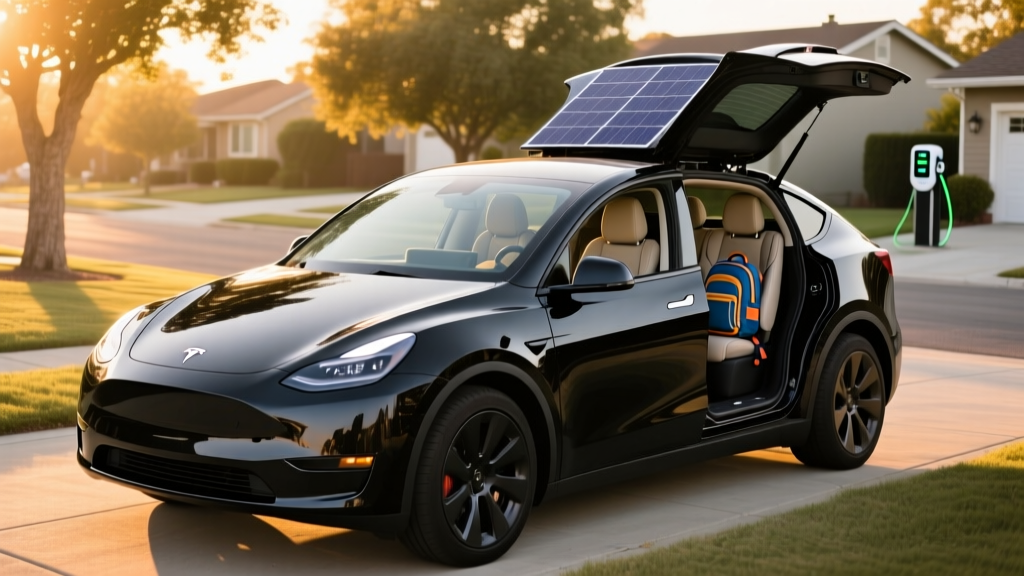
The Quick Verdict on the 2026 Model Y 7-Seater
Tesla's optional third row turns the Model Y Long Range AWD into a compact electric family hauler — but the math only works if your third-row passengers are under about 5'6". For the 2026 model year, the 7-seat package remains a $2,000 add-on to the Long Range AWD trim, bringing the starting MSRP to $49,490 before destination. You get a proven 250 kW DC fast-charging architecture, access to Tesla's Supercharger network, and the lowest energy consumption in the midsize electric SUV segment. What you sacrifice is cargo volume behind the third row and some highway range compared to the 5-seat configuration due to the added weight.
| Spec | Value |
|---|---|
| EPA Range | 303 miles (est.)* |
| Battery (usable) | ~75 kWh, NMC (Nickel Manganese Cobalt) |
| Drivetrain | Dual-Motor AWD |
| Horsepower | 384 hp combined |
| 0–60 mph | 4.8 seconds |
| Peak DC Fast Charge | 250 kW (CCS1 via NACS adapter or native NACS) |
| 10–80% DC Charge Time | ~27 minutes |
| Level 2 Home Charge Rate | 11.5 kW (~44 mi/hr) |
| MPGe (combined) | 111 MPGe |
| Efficiency | 30 kWh/100 mi |
| Base MSRP (7-seat) | $49,490 + $1,390 destination |
| Battery Warranty | 8 years / 120,000 miles (min. 70% retention) |
*EPA range for the 7-seat configuration may differ slightly from the 5-seat Long Range AWD rating of 303–320 miles due to added weight. Verify on fueleconomy.gov when final 2026 ratings are published.
Real-World Range: What the EPA Sticker Doesn't Tell You
EPA Estimate: ~303 miles
Real-World Expectation: 250–280 miles on highway road trips at 70–75 mph; 210–240 miles in freezing temperatures (below 32°F) with cabin heat running.
The Model Y's efficiency is genuinely class-leading among midsize electric SUVs. At 30 kWh/100 miles combined, it sips electrons compared to the Ford Mustang Mach-E (34 kWh/100 mi) and Hyundai Ioniq 5 AWD (36 kWh/100 mi). But the 7-seat option adds roughly 100–120 lbs of structural and seating hardware, which nudges consumption upward by 1–2 kWh/100 mi in mixed driving.
On a 300-mile highway loop at sustained 75 mph in 70°F weather, expect to arrive with approximately 10–15% state of charge remaining. In winter conditions, that margin tightens considerably. The Model Y's heat pump — standard across all trims since 2021 — mitigates cold-weather losses better than resistive heating systems, but you'll still see a 20–30% range reduction in sub-freezing temperatures. If your daily commute is under 80 miles round-trip, this won't matter. If you road-trip frequently in northern climates, plan your charging stops conservatively.
Charging Speed and Infrastructure
The 2026 Model Y Long Range retains Tesla's 250 kW peak DC fast-charge capability on V3 and V4 Superchargers. The charge curve is well-managed: the vehicle sustains above 200 kW from roughly 10% to 45% SoC before tapering through the mid-range and dropping sharply above 80%. The result is a 10–80% charge in approximately 27 minutes under ideal thermal conditions.
| Charging Level | Power (kW) | Miles Added per Hour | Use Case |
|---|---|---|---|
| Level 1 (120V outlet) | 1.2 kW | ~3–4 mi/hr | Emergency/trickle only |
| Level 2 (240V, 48A) | 11.5 kW | ~44 mi/hr | Home overnight charging |
| DC Fast (V3 Supercharger) | 250 kW peak | ~1,000 mi/hr (peak) | Road trips, 10–80% in ~27 min |
| DC Fast (non-Tesla CCS) | Up to 250 kW | Varies by station | Electrify America, EVgo, etc. |
Cold-weather charging note: If you arrive at a Supercharger without preconditioning the battery (navigating to the charger in the Tesla nav system triggers this automatically), peak charge rates can drop to 50–80 kW until the pack warms. Always navigate to a charger rather than driving there without a nav waypoint. This is one of the most common mistakes new Tesla owners make, and it turns a 27-minute charge into a 50-minute one.
The Model Y uses Tesla's native NACS (North American Charging Standard) port. As of 2025, most major automakers have adopted NACS, and Tesla's Supercharger network — now over 25,000 stalls in North America — has opened to non-Tesla EVs at select locations. For the Model Y owner, this means the most reliable and expansive fast-charging network available remains your home turf.
Third-Row Space, Cargo, and Daily Practicality
Let's address the elephant in the room: the Model Y's third row is small. Legroom measures approximately 26.5 inches in the third row, compared to 41.6 inches in the front and 37.7 inches in the second row. This space works for children under roughly 12 years old or adults on short trips under 30 minutes. If you need genuine adult-capable third-row seating, you're shopping the wrong vehicle — look at the Rivian R1S or the Kia EV9 instead.
Cargo volume tells a similar story of trade-offs:
- Behind the third row: ~12 cu ft (enough for a couple of backpacks or a single large grocery run)
- Third row folded, second row up: ~30 cu ft
- All rear rows folded: ~72 cu ft (approaching the 5-seat Model Y's 76 cu ft maximum)
- Front trunk (frunk): ~4.1 cu ft (useful for charging cables, a laptop bag, or small items)
In practice, most 7-seat Model Y owners we've surveyed use the third row 1–3 times per week for school carpools or short kid-hauling duties, then fold it flat for daily cargo use. If your use case matches that pattern, the package works. If you need seven seats and substantial cargo simultaneously on a regular basis, the packaging falls short.
Pricing, Trims, and Federal Tax Credit Eligibility
The 2026 Model Y 7-seater is available exclusively on the Long Range AWD trim. Tesla does not offer the third row on the base Rear-Wheel-Drive model or the Performance variant. Here's the pricing breakdown:
| Item | Amount |
|---|---|
| Long Range AWD base MSRP | $47,490 |
| 7-Seat Package | +$2,000 |
| Destination Charge | +$1,390 |
| Total before options | $50,880 |
| Federal §30D Tax Credit (if eligible) | Up to $7,500 |
| Effective price after max credit | ~$43,380 |
Federal tax credit rules (§30D) — critical caveats: The $7,500 credit is not automatic. As of 2026, eligibility depends on multiple factors per IRS guidelines:
- MSRP cap: The vehicle's MSRP must not exceed $80,000 for SUVs. The Model Y 7-seat clears this easily at ~$50,880.
- Buyer income limits: Modified adjusted gross income (MAGI) must not exceed $150,000 (single), $225,000 (head of household), or $300,000 (married filing jointly).
- Battery sourcing requirements: The credit is split into two $3,750 halves — one for critical minerals sourcing and one for battery component manufacturing. Tesla's supply chain has been evolving rapidly, and the exact credit amount available for a given Model Y can vary by production batch. Always verify current eligibility on the IRS website or with a tax professional before relying on the full $7,500.
- Point-of-sale transfer: As of 2024, buyers can transfer the credit to the dealer at purchase, reducing the purchase price upfront rather than waiting for a tax refund. Tesla participates in this program.
Performance and Driving Dynamics
The dual-motor AWD powertrain produces 384 combined horsepower and delivers a 4.8-second 0–60 mph time — genuinely quick for a 7-seat family SUV. The instant torque delivery makes highway merging and passing effortless, and the low center of gravity (battery pack mounted under the floor) keeps body roll well-controlled through corners.
Ride quality is firm but compliant. The 2026 Model Y continues with the updated suspension tuning introduced in recent model years, which improved small-bump compliance over earlier versions. Noise isolation is strong at highway speeds, aided by the absence of an internal combustion engine. The steering is precise if somewhat numb — typical of Tesla's electric power steering calibration.
Towing: The Model Y Long Range AWD is rated for up to 3,500 lbs of towing capacity with the optional tow hitch. Towing significantly reduces range — expect a 40–50% reduction at highway speeds with a loaded trailer. This is a universal EV limitation, not specific to Tesla.
Technology, Driver Assistance, and Notable Drawbacks
The Model Y's 15.4-inch center touchscreen remains the primary interface for virtually all vehicle controls. The infotainment system is responsive and feature-rich, with native navigation, streaming apps, and over-the-air updates that regularly add functionality. Wireless phone charging, heated seats (all five front and second-row positions), and a HEPA air filtration system are standard.
Pros
- Class-leading energy efficiency (30 kWh/100 mi)
- 250 kW DC fast charging with excellent charge curve
- Access to Tesla Supercharger network (25,000+ stalls)
- Strong performance (4.8 sec 0–60, 384 hp AWD)
- Over-the-air updates continuously improve the vehicle
- Heat pump standard for cold-weather efficiency
- Low total cost of ownership in the segment
Cons
- Third row is child-only — ~26.5" legroom
- Cargo behind third row is minimal (~12 cu ft)
- No physical instrument cluster or traditional stalks
- Panel gaps and interior material quality trail premium rivals
- FSD (Supervised) remains a Level 2 system requiring full driver attention
- No Apple CarPlay or Android Auto integration
- Insurance costs above segment average
Driver Assistance Clarification: Tesla's Autopilot and Full Self-Driving (Supervised) are SAE Level 2 driver-assistance systems. Despite the "FSD" name, the driver must remain fully engaged, hands on or near the wheel, and eyes on the road at all times. This is not autonomous driving. Only Level 4 services like Waymo operate without a human driver in defined geographic zones.
How It Stacks Up Against Key Competitors
If you need electric 7-seat capability, your alternatives in 2026 include:
- Kia EV9 (3-row, up to 7 seats): Genuinely spacious third row with ~32" legroom, 304-mile EPA range (Light RWD), starting around $56,000. Larger and more expensive, but far more practical for regular 7-passenger use.
- Rivian R1S (Dual-Motor): True 3-row SUV with adult-capable third row, up to ~352 miles range, starting ~$79,900. Significantly more expensive but in a different size/capability class.
- Hyundai Ioniq 5 (5-seat only): Not a 7-seater, but if you can live with two rows, it offers 800V ultra-fast charging (10–80% in ~18 min) and a lower starting price around $42,000.
The Model Y 7-seat occupies a narrow niche: you need occasional third-row capacity for children, you value the Supercharger network for road trips, and you want the lowest energy costs in the segment. If your third-row needs are frequent or involve adults, spend more on the EV9 or R1S.
Choose the Model Y 7-seat if: You need occasional kid-hauling in the third row, prioritize charging infrastructure and efficiency, and your daily cargo needs are moderate.
Look elsewhere if: You regularly carry 6–7 adults, need substantial cargo with all seats in use, or want Apple CarPlay/Android Auto.
Frequently Asked Questions
What is the real-world range of the 2026 Model Y 7-seater?
Expect 250–280 miles on highway road trips at 70–75 mph in moderate temperatures. In city driving with regenerative braking, you can approach or slightly exceed the EPA estimate. In freezing weather, plan for 210–240 miles.
How fast does the Model Y charge at home and on the road?
On a 48-amp Level 2 home charger (11.5 kW), you'll add about 44 miles of range per hour — a full overnight charge from 20% to 100% takes roughly 8 hours. On a 250 kW DC Supercharger, 10–80% takes about 27 minutes with a preconditioned battery.
Does the 2026 Model Y 7-seater qualify for the $7,500 federal tax credit?
It can, but eligibility depends on your income (MAGI caps apply), the vehicle's battery sourcing compliance for the current production batch, and the MSRP cap (which the Model Y clears). Check the IRS §30D page and verify with a tax professional. The point-of-sale transfer option lets you apply the credit at purchase.
Is the third row practical for adults?
No. With approximately 26.5 inches of legroom, the third row fits children or very small adults on short trips only. For regular adult passengers in the third row, consider the Kia EV9 or Rivian R1S.
What is the battery warranty?
Tesla covers the Model Y's battery and drive unit for 8 years or 120,000 miles (whichever comes first), with a minimum 70% capacity retention guarantee. If the battery degrades below 70% of its original capacity within that period, Tesla will repair or replace it under warranty.
Is it worth buying over the 5-seat Model Y?
Only if you have a concrete, recurring need for the third row (school carpools, multiple children). The $2,000 premium costs you some cargo flexibility and a small amount of range. If you'll fold the third row flat 95% of the time, the 5-seat configuration offers more usable cargo space and slightly better efficiency.
Sources: EPA Fuel Economy, Tesla Model Y specifications, IRS New Clean Vehicle Credit.