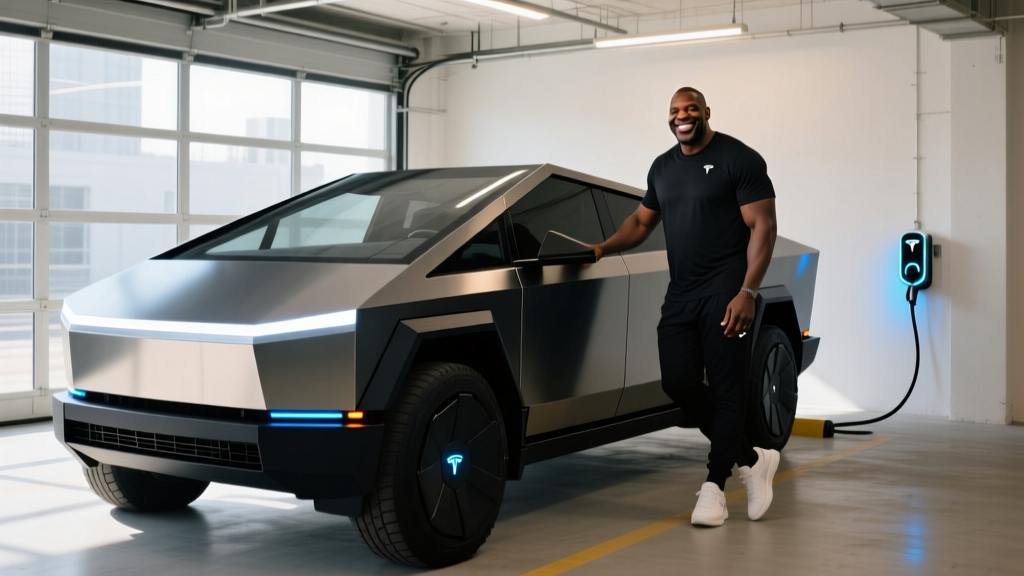
When Shaquille O'Neal posted about his Tesla Cybertruck — and comedian/actor David Alan Goldin (known online as "Goldin") jumped on the celebrity EV bandwagon — search interest in the Shaq Cybertruck Goldin connection spiked. But beyond the Instagram reels and YouTube cameos, the Cybertruck itself remains one of the most polarizing electric vehicles on the road. This review strips away the celebrity hype and delivers a data-driven, owner-relevant breakdown of the 2026 Tesla Cybertruck: real-world range, charging reality, pricing after tax credits, and whether it actually makes sense as a daily driver or truck.
Quick Verdict: Is the Cybertruck More Than a Celebrity Status Symbol?
The Cybertruck is a capable, fast, and technologically advanced electric pickup — but it is not the most practical truck in its class. Its stainless-steel exoskeleton and angular design turn heads (ask Shaq), but the bed is smaller than a Ford F-150 Lightning's, rear visibility is compromised, and the steer-by-wire system demands an adjustment period. If you want an electric truck for towing and hauling, the Rivian R1T or F-150 Lightning serve most buyers better. If you want a conversation piece with genuine performance credentials and access to Tesla's Supercharger network, the Cybertruck delivers — just know the trade-offs before signing the order.
Range, Battery, and Efficiency: What the EPA Says vs. Reality
Real-World Expectation: Expect 250–280 miles on highway road trips at 70+ mph. In cold weather (below 32°F), range drops 20–30%, meaning a Cyberbeast could see as little as 230 miles before needing a charge. City driving with regen braking gets you closest to the EPA sticker.
The Cybertruck AWD uses an estimated ~123 kWh battery pack (usable capacity; Tesla does not publish official kWh figures, but third-party teardowns and EPA test data point to this range). The chemistry is NMC (nickel manganese cobalt), which offers higher energy density than LFP but is more sensitive to sustained 100% state-of-charge storage. For daily driving, Tesla recommends charging to 80–90% to maximize long-term battery health.
Efficiency lands at approximately 2 MPGe (miles per gallon equivalent) or roughly 50–55 kWh per 100 miles combined — on the higher consumption side for an EV, which tracks given the truck's 6,600+ lb curb weight and brick-like aerodynamics. For comparison, the Rivian R1T Dual-Motor achieves around 48 kWh/100 mi, and the F-150 Lightning Extended Range sits near 49 kWh/100 mi.
| Spec | AWD Dual-Motor | Cyberbeast (Tri-Motor) |
|---|---|---|
| EPA Range | 320 mi | 340 mi |
| Battery (est. usable) | ~123 kWh NMC | ~123 kWh NMC |
| 0–60 mph | 3.9 sec | 2.6 sec |
| Horsepower | 600 hp | 845 hp |
| Drivetrain | Dual-Motor AWD | Tri-Motor AWD |
| Towing Capacity | 11,000 lbs | 11,000 lbs |
| Payload | 2,500 lbs | 2,500 lbs |
| Bed Length | 6 ft (72 in) | 6 ft (72 in) |
| MPGe (combined) | ~67 MPGe | ~64 MPGe |
Charging Speed: DC Fast Charging and Home Level 2 Reality
The Cybertruck supports Tesla's NACS connector natively (no adapter needed) and is built on an 800V architecture, which enables impressive DC fast-charging speeds.
| Charging Level | Max Rate | Speed / Notes |
|---|---|---|
| Level 1 (120V) | ~1.4 kW | ~3–4 miles per hour (emergency/trickle only) |
| Level 2 (240V, 48A) | 11.5 kW | ~30–34 miles per hour; full charge in ~10–12 hours |
| Level 2 (240V, 80A Wall Connector) | 19.2 kW | ~50–55 miles per hour; full charge in ~6–7 hours |
| DC Fast Charge (Supercharger V4) | Peak ~350 kW | 10–80% in approximately 15–17 minutes |
Charging curve reality check: The Cybertruck peaks near 350 kW only at low state-of-charge (roughly 10–25% SoC). Above 50%, the rate tapers significantly — by 80% SoC, you're pulling closer to 80–100 kW. This is normal for large NMC packs but means the "15-minute" 10–80% claim only holds if you arrive at the charger with a nearly depleted battery and preconditioned pack. Always use the Tesla app to precondition before arriving at a Supercharger; skipping this step in cold weather can add 10+ minutes to your charge session.
At home, most Cybertruck owners install a Tesla Wall Connector on a 60A circuit (delivering 48A continuous). Budget $500–$1,500 for the electrician and permit if your panel has capacity. A 200A panel upgrade — common in older homes — can add $1,500–$3,000. (Tesla Home Charging)
Performance and Drivetrain: The Cyberbeast Is Absurdly Quick
The tri-motor Cyberbeast produces 845 horsepower and hits 0–60 mph in 2.6 seconds — faster than a Porsche 911 Turbo S. The dual-motor AWD variant still manages 3.9 seconds, which is sports-car territory from a 6,600-pound truck. Both models use Tesla's steer-by-wire system, which eliminates the mechanical connection between the steering wheel and the wheels. The result is a yoke-style wheel that requires only about 340 degrees of lock (less than one full turn, lock-to-lock), making parking lots feel twitchy until you adapt.
Ride quality is firm — the adaptive air suspension offers multiple height settings, but the stainless-steel body and heavy battery pack mean you feel sharp bumps more than in an F-150 Lightning or Rivian R1T. Off-road, the Cybertruck's approach and departure angles are respectable, but ground clearance tops out around 16 inches in Extract mode, which is adequate for fire roads but not serious rock crawling.
Pricing, Tax Credits, and Total Cost
| Trim | Base MSRP | §30D Credit Eligibility | Effective Price (if eligible) |
|---|---|---|---|
| AWD Dual-Motor | $79,990 | Eligible for up to $7,500 (subject to income, sourcing rules) | ~$72,490 |
| Cyberbeast (Tri-Motor) | $99,990 | Eligible for up to $7,500 (subject to income, sourcing rules) | ~$92,490 |
Federal tax credit caveats (IRS §30D): The Cybertruck qualifies as a light truck under the MSRP cap ($80,000 for trucks/vans/SUVs). However, the AWD Dual-Motor at $79,990 sits right at the cap line, while the Cyberbeast at $99,990 exceeds the truck MSRP cap and is not eligible for the federal credit. Buyer income limits also apply: $300,000 joint / $225,000 head of household / $150,000 individual (modified AGI). Additionally, battery component and critical mineral sourcing requirements must be met — Tesla's supply chain has largely complied, but verify current-year rules at IRS.gov §30D page. The credit can be transferred at point-of-sale to reduce the purchase price directly.
Cargo, Passenger Space, and Daily Practicality
The Cybertruck's 6-foot bed is shorter than the F-150 Lightning's 5.5-foot bed with the tailgate up but comparable in usable volume thanks to the Cybertruck's wider bed floor. The motorized tonneau cover is standard and locks securely, but it limits vertical cargo (you can't stack above the bed rails easily). The vault-style frunk (front trunk) offers approximately 7 cu ft of lockable storage — useful for charging cables or a small cooler.
Inside, rear-seat legroom measures approximately 38.5 inches, which is adequate for adults but tighter than the F-150 Lightning's rear row. Headroom is generous thanks to the tall roofline. The 18.5-inch center touchscreen controls nearly everything — there are no physical buttons for climate, mirrors, or glovebox. This minimalist approach frustrates some owners and delights others. Rear passengers get their own 9.4-inch touchscreen for climate and entertainment.
Tech, Driver Assistance, and Notable Drawbacks
The Cybertruck ships with Tesla's latest Hardware 4 (HW4) computer and camera suite. Autopilot (included) handles adaptive cruise control and lane centering on highways competently. Full Self-Driving (Supervised), a $8,000 add-on or $99/month subscription, adds city-street navigation, stop-sign/light recognition, and lane changes — but still requires constant supervision and occasionally makes puzzling routing decisions.
Standout tech features:
- Steer-by-wire with variable ratio (fewer turns lock-to-lock at low speed)
- Adaptive air suspension with adjustable ride height
- Powered frunk and locking tonneau bed cover
- 120V/240V bed outlet (Powershare) for tools or camping
- Over-the-air updates that add features post-purchase
- Bioweapon Defense Mode (HEPA air filtration)
Notable drawbacks:
- Stainless-steel body panels show fingerprints and are difficult to repair after dents
- Rear visibility is poor — the small rear window and sloped bed cover force heavy reliance on the backup camera
- Steer-by-wire yoke takes significant adaptation; not ideal for low-speed maneuvers or three-point turns
- No Apple CarPlay or Android Auto — Tesla's proprietary infotainment only
- Insurance premiums run 25–40% higher than comparable trucks due to repair costs
Pros, Cons, and Who Should Buy the Cybertruck
Pros
- Blistering acceleration (2.6 sec 0–60 Cyberbeast)
- Access to Tesla Supercharger network (17,000+ stalls in North America)
- 800V architecture enables ~350 kW peak DC charging
- 11,000-lb towing capacity is competitive
- Stainless-steel body resists dents and corrosion
- Powershare 240V outlet enables job-site and camping use
Cons
- Cyberbeast exceeds $80K MSRP cap — no federal tax credit
- Smaller bed and less rear-seat room than F-150 Lightning
- Steer-by-wire yoke is polarizing and slow to master
- High insurance and repair costs
- Real-world highway range ~250–280 mi, well below EPA sticker
- No CarPlay/Android Auto
Best for: Tech-forward buyers who prioritize performance, want Supercharger network access, and don't need maximum bed space or traditional truck ergonomics. The Cybertruck works as a commuter and weekend warrior but is less ideal for commercial fleet use or buyers who regularly haul 4x8 sheets of plywood.
Choose the F-150 Lightning or Rivian R1T if: You need a full-size bed, better rear-seat comfort, physical buttons, CarPlay, and a lower entry price. The Lightning Pro starts around $55,000 and is eligible for the full $7,500 credit.
Warranty Coverage
Tesla provides an 8-year / 120,000-mile battery and drive unit warranty, with a minimum 70% capacity retention threshold over that period. The limited vehicle warranty covers 4 years / 50,000 miles. This is competitive with Rivian (8yr/175,000 mi on battery for R1T) but slightly less generous on mileage than Ford's 8yr/100,000 mi battery warranty for the Lightning. (Tesla Warranty Info)
Frequently Asked Questions
What is the real-world range of the Cybertruck?
The EPA rates the AWD at 320 miles and the Cyberbeast at 340 miles. In real-world highway driving at 70+ mph, expect 250–280 miles. Cold weather (below freezing) can reduce range by 20–30%, bringing effective range down to 220–250 miles. Towing at highway speeds cuts range roughly in half — plan for 150–170 miles between charges when pulling a trailer.
How fast does the Cybertruck charge?
On a V4 Supercharger, the Cybertruck peaks near 350 kW and charges from 10–80% in approximately 15–17 minutes with a preconditioned battery. At home on a 48A Level 2 charger, you'll add about 30–34 miles per hour, with a full charge taking 10–12 hours. An 80A Wall Connector cuts that to roughly 6–7 hours.
Does the Cybertruck qualify for the federal EV tax credit?
The AWD Dual-Motor at $79,990 MSRP falls under the $80,000 truck cap and may qualify for up to $7,500 — provided you meet income limits ($150K individual / $300K joint) and the battery sourcing requirements are satisfied for the current tax year. The Cyberbeast at $99,990 exceeds the MSRP cap and is NOT eligible for the §30D credit. Always verify current rules at IRS.gov and consult a tax professional.
Is the Cybertruck worth buying vs. the F-150 Lightning or Rivian R1T?
It depends on your priorities. The Cybertruck wins on raw performance (2.6 sec 0–60), Supercharger access, and 800V charging speed. The F-150 Lightning wins on bed size, rear-seat comfort, lower pricing, CarPlay support, and broader tax credit eligibility. The Rivian R1T wins on off-road capability, build quality, and adventure-oriented design. If celebrity appeal (the Shaq Cybertruck factor) and cutting-edge tech matter most, the Cybertruck has no equal. If practicality and value lead your decision, look elsewhere.
What's the biggest complaint from actual Cybertruck owners?
Based on owner forums and reviews, the top complaints are: the yoke-style steering wheel in parking lots, panel gap inconsistencies on early builds, poor rear visibility, and the fingerprint-prone stainless-steel finish. Some owners also report software glitches with the powered tonneau cover and frunk latch on 2024–2025 models, though OTA updates have addressed many of these.
Can the Cybertruck tow a boat or camper?
Yes — the 11,000-lb towing capacity handles most boat trailers, utility trailers, and smaller travel campers. However, towing at highway speeds dramatically reduces range (expect roughly 150–170 miles between charges). Plan your route around Supercharger locations and expect 30–45 minute charge stops every 2–2.5 hours when towing.
Note: The "Shaq Cybertruck Goldin" search trend reflects celebrity EV adoption buzz. This review evaluates the Tesla Cybertruck on its own merits as a 2026 electric pickup, independent of any celebrity endorsement or social media content.