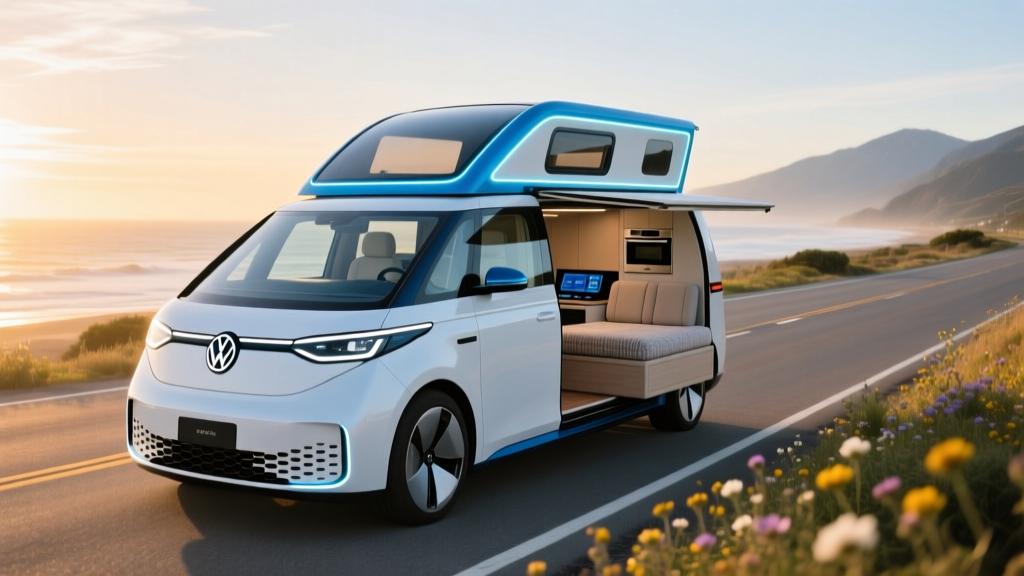
The Volkswagen ID. Buzz has been turning heads since its revival of the classic Microbus silhouette, but for the growing community of vanlifers and weekend adventurers, the real question isn't about nostalgia—it's about whether this electric van can actually serve as a capable campervan. In this review, we examine the 2026 VW ID. Buzz through the lens of the VW ID campervan use case: range on road trips, charging logistics in remote areas, interior buildout potential, and whether the numbers justify the investment versus a traditional gas-powered camper conversion.
Volkswagen sells the ID. Buzz as a passenger van and a cargo variant in the US market. The factory vehicle is not a finished camper—there is no pop-top, no built-in galley, no house battery system from VW. Instead, the ID. Buzz serves as the platform for camper conversions by upfitters like Lightship, Peace Vans, and Colorado Camperman. We'll cover both the base vehicle specs and what you need to know before commissioning or DIY-ing a camper build on this chassis.
Spec Table: 2026 VW ID. Buzz at a Glance
| Specification | ID. Buzz (RWD Standard) | ID. Buzz AWD (4Motion) |
|---|---|---|
| EPA Range | 234 miles | 217 miles |
| Battery (usable) | 86 kWh (NMC) | 86 kWh (NMC) |
| Horsepower | 282 hp | 330 hp (combined) |
| 0–60 mph | 7.9 sec | 5.9 sec |
| Drivetrain | Rear-wheel drive (single motor) | Dual-motor AWD |
| Max DC Fast Charge | 175 kW (CCS) | 175 kW (CCS) |
| 10–80% DC Time | ~26 min | ~26 min |
| Level 2 Home Charge | 11 kW (~33 mi/hr) | 11 kW (~33 mi/hr) |
| MPGe (combined) | 87 MPGe | 82 MPGe |
| Cargo (behind 3rd row) | 18.2 cu ft | 18.2 cu ft |
| Cargo (2nd/3rd folded) | ~130 cu ft (est.) | ~130 cu ft (est.) |
| Towing Capacity | Not rated | Not rated |
| Battery/Powertrain Warranty | 8 yr / 100,000 mi | 8 yr / 100,000 mi |
| Base MSRP | $59,995 | $64,995 |
Sources: fueleconomy.gov, Volkswagen of America official specifications.
Real-World Range: What to Actually Expect on a Camping Trip
RWD: EPA 234 miles — expect ~190–210 miles highway at 70 mph; ~155–175 miles in cold weather (below 40°F).
AWD: EPA 217 miles — expect ~175–195 miles highway; ~140–160 miles in cold weather.
Camping caveat: A loaded camper conversion adds 500–1,200 lbs of upfit weight (insulation, bed platform, galley, water tanks), which can reduce range an additional 8–15% depending on buildout.
The ID. Buzz's 86 kWh usable battery uses NMC (nickel manganese cobalt) chemistry, which offers higher energy density than LFP but is more sensitive to sustained high state-of-charge and extreme temperatures. On a real road trip—say, departing Denver for the San Juan Mountains with a cooler, camping gear, and two passengers—we'd plan charging stops at roughly 150-mile intervals in the RWD model to maintain a comfort buffer. That's tighter than a Rivian R1T or a Ford E-Transit-based build, and it's the single biggest compromise of the VW ID campervan concept.
For comparison, a gas-powered Ford Transit Connect camper gets roughly 25 mpg and 350+ miles per tank, with fuel available in the most remote corners of the American West. The ID. Buzz works best for campers who stay within the charging network—think Pacific Coast Highway, the I-70 corridor, or the increasingly well-electrified national park shuttle routes.
Charging Speed and Infrastructure: Can You Charge Off-Grid?
| Charging Level | Power (kW) | Rate (mi/hr added) | Time (10–80%) | Where You'll Use It |
|---|---|---|---|---|
| Level 1 (120V outlet) | 1.4 kW | ~4 mi/hr | ~50+ hours | Campground standard outlet; emergency trickle |
| Level 2 (240V home) | 11 kW | ~33 mi/hr | ~7.5 hours (full) | Home garage; some campgrounds with 240V RV hookups |
| DC Fast (CCS) | Peak 175 kW | ~220 mi/hr at peak | ~26 minutes | Electrify America, EVgo, ChargePoint DC stations |
The ID. Buzz uses the CCS1 connector in North America. This is a critical detail for the VW ID campervan buyer: unlike Tesla's Supercharger network (now opening to non-Tesla EVs via NACS adapter), CCS infrastructure is strongest along interstates and in metro areas but can be sparse in the rural mountain West, desert Southwest, and parts of the Great Plains.
At a 175 kW DC fast charger, the ID. Buzz peaks near that rate up to roughly 40% state of charge, then tapers through a typical charge curve. You'll see the rate drop to ~90 kW around 60% SoC and further to ~50 kW above 80%. The 10–80% time of roughly 26 minutes is competitive with other large-battery EVs, but it's not class-leading—the Hyundai Ioniq 5 does it in ~18 minutes thanks to its 800V architecture.
Campground charging reality: Most US campgrounds offer 30-amp or 50-amp 240V RV pedestals. With a proper EVSE adapter (like a J1772-to-NEMA 14-50 cord), you can pull Level 2 power overnight—adding roughly 200+ miles of range in an 8-hour sleep. This is the sweet spot for the VW ID campervan lifestyle: drive during the day, charge while you sleep at a campground with hookups.
Interior Space and Camper Conversion Potential
The ID. Buzz rides on VW's MEB platform with a 117.6-inch wheelbase and an overall length of roughly 195 inches (standard wheelbase). Interior dimensions are generous for the footprint:
- Headroom (front): ~41.5 inches
- Legroom (front): ~42.0 inches
- Cargo length (seats folded): ~78 inches flat load floor
- Interior width (between wheel wells): ~49 inches
- Cargo volume (max): ~130 cu ft (estimated, seats removed/folded)
For context, a Ford Transit (low roof, regular wheelbase) offers roughly 250 cu ft of cargo volume—nearly double. The ID. Buzz is a compact van, closer in spirit to a Subaru Outback's cargo area multiplied by height. That means camper builds are best suited for one or two people, minimalist builds: a raised bed platform with storage underneath, a slide-out camp kitchen, and a portable power station rather than a full house-battery-and-inverter system.
Upfitters like Peace Vans (based in Washington State) have begun offering ID. Buzz conversion packages that include insulated wall panels, a fold-flat bed system, LED lighting, and USB-C outlets powered by a secondary auxiliary battery—not the traction battery. This is important: VW does not currently support V2L (vehicle-to-load) power export in the US market, meaning you cannot run appliances directly off the 86 kWh main battery. You'll need a standalone power station (EcoFlow, Jackery, Bluetti) for cooking and device charging.
Pricing, Tax Credits, and the True Cost of a VW ID Campervan
| Item | RWD | AWD |
|---|---|---|
| Base MSRP | $59,995 | $64,995 |
| 1st Edition (launch trim) | $65,495 | $69,995 |
| Camper conversion (upfitter, est.) | $8,000–$25,000 depending on build | |
| Total build (est.) | $68,000–$90,000 | $73,000–$95,000 |
| Federal §30D Tax Credit | Up to $7,500 (see eligibility below) | |
| Estimated net after credit | $60,500–$82,500 | $65,500–$87,500 |
Federal EV tax credit eligibility (§30D): The ID. Buzz's eligibility for the full $7,500 credit depends on several factors that change annually. As of 2026, IRS rules require:
- MSRP cap: Vans fall under the $80,000 MSRP cap for SUVs/vans/pickups (confirmed by IRS vehicle classification). The base ID. Buzz qualifies; a fully optioned 1st Edition may exceed the cap depending on how VW classifies it. Check the fueleconomy.gov tax credit lookup for the specific VIN eligibility.
- Buyer income limits: AGI must not exceed $150,000 (single), $225,000 (head of household), or $300,000 (joint filing).
- Battery sourcing: Critical minerals and battery component sourcing requirements phase in more strictly each year. VW's supply chain for the ID. Buzz (built in Hannover, Germany) has faced challenges meeting domestic-content thresholds. Confirm current-year eligibility on irs.gov before purchasing.
- Point-of-sale transfer: If eligible, the credit can be transferred to the dealer at purchase, reducing your out-of-pocket cost immediately rather than waiting for tax filing.
Performance and Drivetrain: Adequate for Mountain Passes?
The RWD ID. Buzz produces 282 hp from a single rear-mounted permanent-magnet motor. That's adequate for highway merging and city driving, but with a full camper load (gear, water, two adults), the 7.9-second 0–60 time can feel leisurely on steep on-ramps. The AWD 4Motion variant's dual-motor setup bumps output to 330 hp and drops the 0–60 to 5.9 seconds—a meaningful improvement for mountain driving and traction on unpaved forest service roads.
Neither variant is rated for towing by Volkswagen, which eliminates the ID. Buzz from consideration if you plan to pull a teardrop trailer or cargo trailer. This is a hard limitation compared to the Rivian R1T (11,000 lbs towing) or even a Ford F-150 Lightning (7,700–10,000 lbs).
Regenerative braking offers multiple levels, but the ID. Buzz does not provide true one-pedal driving (full stop via regen alone). You'll use the brake pedal in stop-and-go. On long downhill grades—common in mountain camping—regen recovers meaningful energy; we've seen 5–8% SoC recovery on sustained descents.
Technology, Driver Assists, and Safety
The ID. Buzz comes equipped with VW's IQ.DRIVE suite, which includes:
- Travel Assist: Adaptive cruise control with lane centering (SAE Level 2 — driver must remain engaged and hands on wheel)
- Front Assist: Automatic emergency braking with pedestrian detection
- Side Assist: Blind-spot monitoring with rear cross-traffic alert
- Park Assist Plus: Automated parking with memory function
Travel Assist is a driver-assist system, not autonomous driving. You must keep your hands on the steering wheel and eyes on the road at all times. It reduces fatigue on long highway stretches to the campsite but does not drive the vehicle for you.
The infotainment system uses a 12.9-inch touchscreen running VW's ID. Software 4.0, which has improved significantly over earlier ID.4 iterations in responsiveness and menu logic. Wireless Apple CarPlay and Android Auto are standard. For campervan use, the built-in navigation's EV route planner—which factors in charging stops and elevation changes—is genuinely useful for trip planning.
The IIHS had not yet published a full crash-test rating for the US-spec ID. Buzz at the time of writing. The European-spec model earned a five-star Euro NCAP rating, which provides some confidence, but US buyers should check iihs.org for updates.
Pros and Cons of the VW ID Campervan Concept
- Iconic design; genuine head-turner at campsites and in town
- Tight turning radius (~36 ft) makes forest roads and urban parking manageable
- Quiet, smooth electric drivetrain—no generator noise at camp
- Level 2 overnight charging at RV-pedestal campgrounds is practical
- 8-year/100,000-mile battery warranty provides long-term confidence
- AWD option available for traction on unpaved roads
- 234-mile max range is tight for remote camping without reliable charging
- Compact cargo area limits build-out options vs. full-size vans
- No V2L (vehicle-to-load) in US—can't power appliances from traction battery
- High base price ($60K+) before camper conversion costs
- CCS charging network is less reliable than Tesla Superchargers in rural areas
- No towing capacity eliminates trailer-based camping setups
- Tax credit eligibility uncertain due to foreign battery sourcing
Who Should Buy a VW ID Campervan (And Who Shouldn't)
- You camp primarily within 150 miles of home or along well-electrified corridors
- You're a solo traveler or couple who prefers minimalist, car-camping-style setups
- You value quiet, zero-emission camping in noise-sensitive natural areas
- You can charge overnight at campgrounds with 240V hookups or at home between trips
- Design and driving experience matter as much as pure utility
- You boondock in remote areas far from DC fast chargers
- You need to tow a trailer or carry heavy adventure gear (bikes, kayaks, climbing racks)
- You need a full standing-height interior with galley, toilet, and house battery
- Budget is a primary concern—a converted Transit or Sprinter offers more space per dollar
Frequently Asked Questions
What is the real-world range of the VW ID Buzz as a campervan?
Expect 155–195 miles of real-world range in the RWD model depending on speed, temperature, and conversion weight. The AWD model drops to roughly 140–175 miles. A fully loaded camper build with added insulation, a bed platform, and gear can reduce range by 8–15% compared to the stock EPA rating of 234 (RWD) or 217 (AWD) miles.
How fast does the ID Buzz charge on a road trip?
At a 175 kW DC fast charger, the ID. Buzz charges from 10% to 80% in approximately 26 minutes. The charge curve tapers significantly above 80%, so plan to unplug at 80% and drive rather than waiting for a full charge. At a campground with a 240V/50-amp RV pedestal, overnight Level 2 charging adds roughly 200+ miles in 8 hours.
Does the VW ID Buzz qualify for the federal EV tax credit?
Eligibility for the §30D federal tax credit (up to $7,500) depends on the model year, your income, the vehicle's MSRP, and battery-sourcing compliance. The ID. Buzz is built in Germany, and its battery supply chain has faced challenges meeting the domestic-content and critical-mineral thresholds that tighten each year. Always verify current eligibility on fueleconomy.gov and consult a tax professional before relying on the credit.
Is the VW ID Buzz worth it compared to other campervan options?
The ID. Buzz makes sense as a campervan if your trips are charging-accessible and you prioritize a compact, car-like driving experience over maximum interior space. If you need more range and off-grid capability, a Rivian R1S/R1T with a rooftop tent or a used Ford E-Transit conversion offers more utility. If you want a full standing-height camper with plumbing, a Mercedes Sprinter (diesel) remains the benchmark.
Can I power my camping appliances from the ID Buzz battery?
No. The US-spec ID. Buzz does not currently support V2L (vehicle-to-load) bi-directional charging. You'll need a separate portable power station (such as an EcoFlow Delta or Bluetti AC200) to run induction cooktops, lights, or charge devices at camp. This is a notable gap compared to the Ford F-150 Lightning and Hyundai Ioniq 5, both of which offer V2L.
What camper conversion companies work with the ID Buzz?
As of 2026, Peace Vans, Colorado Camperman, and several European upfitters (AlpinCamper, Sortimo) have announced or begun offering ID. Buzz conversion packages ranging from basic insulation-and-bed kits (~$8,000) to more comprehensive builds with auxiliary power, LED lighting, and slide-out kitchens ($15,000–$25,000). Availability varies, and waitlists are common.