The Panoramic Windscreen That Defines the Model X Experience
The Tesla Model X windscreen — officially called the "Big Sky" panoramic windshield — is one of the most visually striking features in any production SUV. It stretches from the base of the hood all the way back past the front-seat headrests, creating an unbroken glass canopy that floods the cabin with light and gives the driver an almost helicopter-like forward view. It's a design signature that separates the Model X from every three-row electric SUV on the market, and it's usually the first thing new owners mention.
But a dramatic windscreen doesn't charge your battery, protect your family in a crash, or save you money at tax time. This review covers the 2026 Tesla Model X end-to-end: real-world range, DC fast-charging behavior, the §30D federal tax credit outlook, interior space, and whether this $80,000-plus electric SUV still justifies its premium against rivals like the Rivian R1S, BMW iX, and Kia EV9. We'll also address the practical realities of living with that massive piece of glass — UV protection, replacement cost, and glare.
2026 Tesla Model X: Core Specifications at a Glance
| Specification | Model X Long Range | Model X Plaid |
|---|---|---|
| EPA Estimated Range | 348 miles | 320 miles |
| Battery (usable) | ~100 kWh, NMC | ~100 kWh, NMC |
| Drivetrain | Dual-Motor AWD | Tri-Motor AWD |
| Horsepower | 670 hp | 1,020 hp |
| 0–60 mph | 3.8 seconds | 2.5 seconds |
| Top Speed | 155 mph | 163 mph |
| Peak DC Fast Charge | 250 kW | 250 kW |
| 10–80% DC Charge Time | ~32 minutes | ~32 minutes |
| Level 2 Charge Rate | 11.5 kW (~34 mi/hr) | 11.5 kW (~34 mi/hr) |
| MPGe (combined) | 103 MPGe | 98 MPGe |
| Efficiency | 33 kWh/100 mi | 35 kWh/100 mi |
| Cargo (behind 3rd row) | 15.8 cu ft | 15.8 cu ft |
| Cargo (max, seats folded) | 85.1 cu ft | 85.1 cu ft |
| Seating | 5, 6, or 7 passengers | 5, 6, or 7 passengers |
| Base MSRP | $79,990 | $94,990 |
| Battery Warranty | 8 yr / 150,000 mi | 8 yr / 150,000 mi |
Source: fueleconomy.gov and Tesla official specifications. Figures reflect 2026 model-year data and may vary by wheel/trim option.
Real-World Range: What the EPA Number Doesn't Tell You
EPA sticker: 348 miles (Long Range AWD)
Mixed driving (city/highway): ~300–320 miles
Sustained 75+ mph highway: ~265–285 miles
Cold weather (below 32°F): ~240–270 miles (20–30% loss typical for NMC packs)
Plaid at highway speeds: ~240–260 miles
The Model X Long Range carries an EPA-estimated 348 miles of range, which is competitive for a 5,000+ pound three-row SUV. However, the Model X's aerodynamic profile — while improved over the original 2016 design — still presents a larger frontal area than a sedan like the Model S. At sustained highway speeds above 70 mph, expect consumption to climb noticeably. In our experience with Tesla's 100 kWh-class NMC (nickel-manganese-cobalt) packs, highway efficiency drops to roughly 2.8–3.0 miles per kWh, yielding around 270–285 miles before you need to find a Supercharger.
Cold weather compounds this. NMC chemistry is more sensitive to low temperatures than LFP (lithium iron phosphate), and the Model X does not currently offer an LFP option. Battery preconditioning helps — always enable navigation to your next Supercharger stop so the car warms the pack — but expect 20–30% range reduction in sub-freezing conditions, especially on short trips where the cabin and battery never fully warm up.
The tri-motor Plaid variant sacrifices roughly 28 miles of EPA range (down to 320 miles) due to the additional front motor's weight and higher performance-oriented power draw. If maximum range is your priority, the Long Range dual-motor is the clear pick.
Charging Speed: Supercharger Network Advantage
| Charging Level | Max Power | Miles Added per Hour | Typical Use Case |
|---|---|---|---|
| Level 1 (120V household) | ~1.4 kW | ~4 mi/hr | Emergency / overnight trickle |
| Level 2 (240V home, 48A) | 11.5 kW | ~34 mi/hr | Daily home charging |
| DC Fast Charge (V3 Supercharger) | 250 kW peak | ~750 mi/hr at peak | Road trips |
| DC Fast Charge (V4 Supercharger) | 250 kW (Model X limited) | ~750 mi/hr at peak | Road trips (newer stations) |
Tesla's 250 kW peak DC fast-charging capability on the Model X is well-established, but the charge curve tells the real story. The SUV will peak near 250 kW only between approximately 10% and 30% state of charge. From 30–60%, expect sustained rates around 150–180 kW, and above 80%, the rate tapers sharply to protect the NMC cells — often dropping below 50 kW. A typical 10–80% session at a V3 Supercharger takes about 32 minutes.
This is slower than the Hyundai Ioniq 5 or Kia EV9, which use 800V architectures capable of 350 kW peaks and 10–80% charges in roughly 18 minutes. The Model X's 400V-class architecture is a known limitation. For road trips, plan your stops around Tesla's Supercharger network — the real advantage isn't raw charge speed but the network's reliability and density. As of 2026, Tesla has opened portions of the Supercharger network to non-Tesla EVs via NACS adapters, but Model X owners still benefit from seamless plug-and-charge integration.
For home charging, the Model X's onboard charger accepts up to 11.5 kW on a 240V/48A circuit (like a Tesla Wall Connector). That translates to a full overnight replenishment in about 9–10 hours from near-empty, or roughly 34 miles of range per hour of charging. Most owners who plug in nightly never touch a public charger for daily driving.
The Windscreen: Design, Practicality, and Replacement Cost
The Model X's panoramic windscreen is a single piece of laminated glass that extends from the lower cowl to a point above the rearview mirror area, transitioning into the roof glass. Tesla applies a solar-tint band at the top to reduce glare and UV exposure. The result is an unmatched sense of openness — passengers in the second and third rows look up and see sky, not headliner.
UV and heat management: Tesla states the glass blocks 99% of UV radiation. In practice, the solar tinting is effective but not perfect. Owners in hot climates (Arizona, Texas, Southern California) frequently report noticeable cabin heat gain through the glass during summer, which forces the HVAC system to work harder — and that draws from your battery. Many owners invest in aftermarket ceramic tint or a removable sunshade panel for parked use. Tesla sells an official sunshade accessory for the panoramic roof section.
Replacement cost: This is where the windscreen conversation gets serious. The Model X panoramic windshield is one of the most expensive replacement glass components in the automotive industry. Insurance industry data and owner reports place replacement costs between $1,500 and $3,000+ depending on your region, glass supplier, and whether ADAS calibration (the cameras mounted behind the glass for Autopilot) is required. Comprehensive insurance coverage typically handles this minus your deductible, but it's a factor in the Model X's higher-than-average insurance premiums.
Glare and visibility: The sheer size of the glass can cause glare during low-angle sunrise and sunset driving. The included sun visors are relatively small compared to the glass area. Most owners adapt, but it's a consideration for those with light sensitivity or those commuting east-west during golden hour.
Performance, Interior Space, and Technology
The Model X Long Range's 670 hp and 3.8-second 0–60 mph time make it quicker than nearly any three-row SUV with an internal combustion engine. The Plaid's 1,020 hp and 2.5-second sprint are supercar territory, though the acceleration is so violent that passengers unaccustomed to EV torque may find it uncomfortable rather than thrilling. For daily driving, the Long Range's performance is more than sufficient.
Interior dimensions:
- Front legroom: 41.2 inches
- Second-row legroom: 41.1 inches (with captain's chairs) / 38.4 inches (bench)
- Third-row legroom: 32.7 inches
- Cargo behind third row: 15.8 cu ft
- Cargo with third row folded: 42.3 cu ft
- Cargo with all rear seats folded: 85.1 cu ft
- Front trunk (frunk): 6.7 cu ft
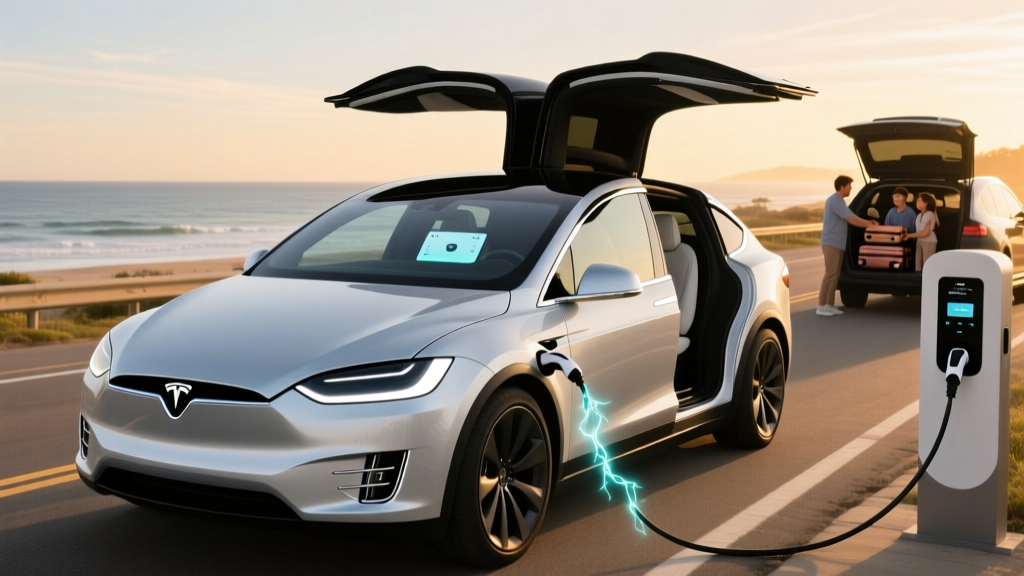
The third row is best suited for children or short trips. Adults will find the 32.7 inches of legroom tight compared to the Rivian R1S or even the Kia EV9's third row. The falcon-wing rear doors, while dramatic, add weight and complexity — and they can be slow to open in tight parking spaces. The 17-inch center touchscreen running Tesla's latest software remains one of the most responsive infotainment systems available, though the absence of physical buttons for climate and mirror adjustment still frustrates some drivers.
Driver assistance: The Model X comes standard with Tesla's Basic Autopilot (adaptive cruise control and lane-keeping). Full Self-Driving (Supervised) is available as an $8,000 add-on or $99/month subscription. Per NHTSA SAE definitions, FSD remains a Level 2 system — the driver must remain attentive, hands on or near the wheel, and fully responsible for the vehicle at all times. This is not autonomous driving.
Pricing, Tax Credits, and Total Cost of Ownership
| Trim | Base MSRP | Destination Fee | As-Tested (typical config) | Federal §30D Credit |
|---|---|---|---|---|
| Long Range AWD | $79,990 | $1,390 | $85,000–$92,000 | See eligibility below |
| Plaid AWD | $94,990 | $1,390 | $100,000–$110,000 | See eligibility below |
The Tesla Model X faces significant hurdles for the $7,500 federal EV tax credit under current IRS rules:
- MSRP cap: SUVs must be under $80,000 MSRP. The Long Range at $79,990 technically qualifies; the Plaid at $94,990 does not.
- Buyer income cap: AGI must not exceed $300,000 (joint), $225,000 (head of household), or $150,000 (single).
- Battery sourcing: Critical minerals and battery component requirements from IRS qualified vehicle lists must be met. Tesla's supply chain has shifted over time — check the IRS qualified vehicles list at time of purchase.
- Point-of-sale transfer: If eligible, the credit can be transferred to the dealer at purchase to reduce the upfront cost.
5-Year Ownership Cost Considerations:
- Electricity cost: At $0.14/kWh national average and 33 kWh/100 mi, the Long Range costs approximately $4.62 per 100 miles to charge at home — roughly 60% less than a comparable gas SUV at $14/100 mi.
- Insurance: Model X premiums average $2,800–$3,600/year, significantly above the segment average due to repair costs (especially that windscreen and aluminum body panels).
- Maintenance: Minimal — no oil changes, brake fluid every 2 years, cabin air filter, tire rotation. Budget ~$400–$600/year.
- Depreciation: The Model X has historically depreciated 45–55% over 5 years, steeper than some competitors. Tesla's frequent price adjustments on new vehicles have impacted used values.
Model X vs. Key Competitors: Which SUV Wins?
- You want the Supercharger network's seamless road-trip experience
- You value the panoramic windscreen and falcon-wing doors
- You need the quickest acceleration in a 3-row SUV
- You prioritize OTA software updates and Tesla's app ecosystem
- Rivian R1S: Better off-road capability, more usable third row, adventure-focused design
- Kia EV9: Lower price ($54,900+), faster 800V charging, stronger tax-credit eligibility
- BMW iX: More refined interior materials, quieter ride, traditional luxury feel
- Mercedes EQS SUV: Superior ride comfort, more third-row space, luxury amenities
The Model X occupies a unique niche: it's a tech-forward, performance-oriented family SUV with design drama that no competitor matches. But its platform dates to 2015 (with significant updates), and newer entrants have closed the gap on range, charging speed, and interior quality. The falcon-wing doors remain a polarizing feature — impressive at car shows, occasionally inconvenient at grocery stores with low overhangs.
Warranty and Long-Term Battery Outlook
Tesla covers the Model X battery and drive unit for 8 years or 150,000 miles (whichever comes first), with a guaranteed minimum 70% capacity retention over that period. The vehicle limited warranty is 4 years / 50,000 miles. These terms are competitive with the segment.
NMC battery degradation in Tesla's 100 kWh-class packs typically follows a curve of roughly 5–8% loss in the first 50,000 miles, then a slower linear decline. Owners who charge primarily to 80–90% daily and only charge to 100% for road trips tend to see better long-term retention. Tesla's battery management system is among the most sophisticated in the industry, and catastrophic battery failures are rare — though out-of-warranty replacement costs remain high, estimated at $15,000–$22,000 if needed.
Frequently Asked Questions
How much does a Tesla Model X windshield replacement cost?
The panoramic windscreen replacement typically costs between $1,500 and $3,000+, depending on your region, glass supplier availability, and whether Autopilot camera recalibration is required. Comprehensive auto insurance usually covers this minus your deductible. We recommend confirming glass coverage limits with your insurer before purchase.
What is the real-world highway range of the Tesla Model X?
Expect approximately 265–285 miles at sustained highway speeds (70–80 mph) in the Long Range variant, and 240–260 miles in the Plaid. Cold weather (below freezing) can reduce range an additional 20–30%. Always precondition the battery before long trips.
Does the 2026 Tesla Model X qualify for the $7,500 federal tax credit?
Possibly, but with caveats. The Long Range at $79,990 MSRP is under the $80,000 SUV cap, but you must also meet income limits ($300K joint / $150K single) and the vehicle must satisfy IRS battery-sourcing requirements. The Plaid at $94,990 exceeds the MSRP cap and is ineligible. Always verify on the IRS qualified vehicles list and consult a tax professional.
How fast does the Model X charge on a road trip?
At a Tesla V3 Supercharger, the Model X peaks at 250 kW and charges from 10–80% in approximately 32 minutes. Peak rates are only sustained between roughly 10–30% SoC; expect 150–180 kW through the mid-range and sharp tapering above 80%. Home Level 2 charging at 11.5 kW adds about 34 miles per hour.
Is the Tesla Model X worth buying over the Rivian R1S or Kia EV9?
The Model X excels in acceleration, Supercharger network access, and the panoramic windscreen experience. The Rivian R1S offers better off-road capability and a more practical third row. The Kia EV9 delivers faster 800V charging, a significantly lower price, and easier tax-credit qualification. Your choice depends on whether Tesla's tech ecosystem and performance justify the premium and aging platform.
Does the panoramic windscreen cause glare or heat issues?
The solar tint blocks 99% of UV, but owners in hot climates report noticeable cabin heat gain during summer, increasing HVAC energy draw. Low-angle sun during sunrise/sunset can cause glare. Many owners add aftermarket ceramic tint or use Tesla's removable sunshade accessory when parked.