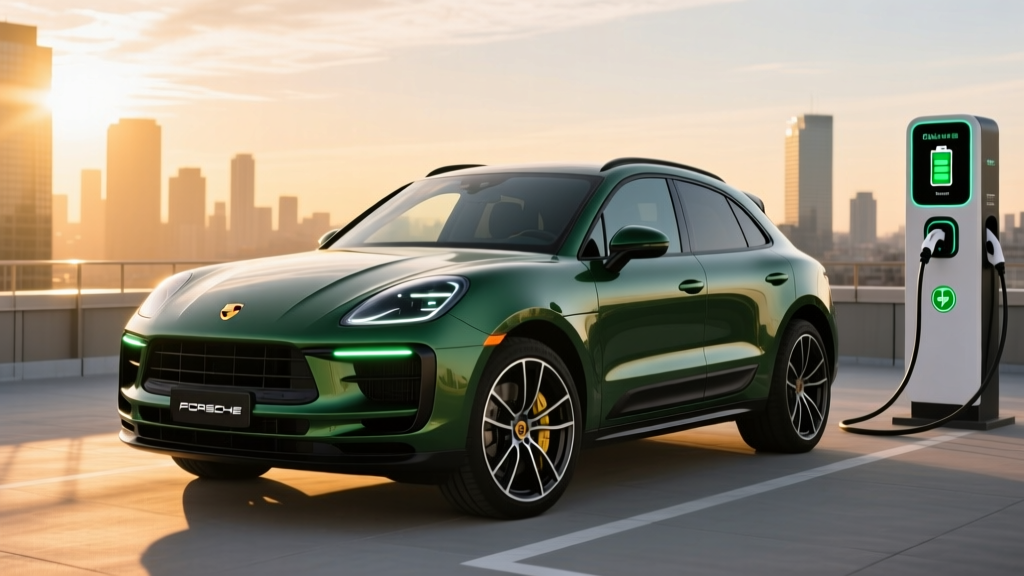
Quick Verdict: Is the Macan Turbo Electric Worth It?
The 2025/2026 Porsche Macan Turbo Electric delivers 630 hp, a 5.0-second 0-60, and an EPA-estimated 318 miles of range from its 100 kWh (95 kWh usable) NMC battery. Starting around $95,000 before options, it is not eligible for the federal §30D new EV tax credit (MSRP cap for SUVs is $80,000). It charges at up to 270 kW DC, reaching 10-80% in roughly 21 minutes. Real-world highway range sits closer to 260-280 miles, and cold-weather driving can drop that to 220-240 miles. If you want Porsche performance in a daily-driver SUV and can charge at home, it is one of the best in its class. If you need tax-credit pricing or regularly drive in charging deserts, consider alternatives.
Range & Battery: EPA vs. Real World
The Macan Turbo Electric uses a 100 kWh gross (approximately 95 kWh net usable) lithium-ion NMC battery pack mounted low in the skateboard platform shared with the Audi Q6 e-tron (PPE architecture). Porsche quotes an EPA range of 318 miles for the Turbo trim with its standard 21-inch wheels. Opt for smaller 20-inch wheels and you may see 2-3% more range; larger performance rubber reduces it.
EPA Sticker: 318 miles
Real-World Highway (70-80 mph): ~260-280 miles
Cold Weather (below 30°F): ~220-240 miles
Mixed Commute (55-65 mph, mild weather): ~290-310 miles
The Macan Turbo Electric's efficiency lands around 87 MPGe combined per fueleconomy.gov. In practice, expect 2.8-3.2 miles per kWh in mixed driving. Porsche's thermal management system with heat pump is standard, which helps limit cold-weather losses compared to older EVs, but physics still wins: a 20°F morning commute will cost you roughly 15-25% range versus a 70°F day.
The battery chemistry is NMC (nickel manganese cobalt), which offers higher energy density than LFP but has a more conservative long-term degradation profile. Porsche warranties the battery for 8 years or 100,000 miles, guaranteeing at least 70% state of health (SoH) retention — a standard luxury-EV benchmark.
Charging Speed & Infrastructure
The Macan Turbo Electric supports up to 270 kW peak DC fast charging on 800-volt architecture. Porsche states a 10-80% charge in approximately 21 minutes under ideal conditions. In real-world testing at 350 kW Electrify America or Tesla Supercharger (with NACS adapter) stations, you will typically see peak rates of 250-270 kW that taper progressively above 60% SoC, with the 50-80% segment averaging closer to 120-150 kW. This taper is normal and protects battery longevity.
| Charging Level | Power (kW) | Miles Added per Hour | Typical Use Case |
|---|---|---|---|
| Level 1 (120V) | ~1.4 kW | ~4 mi/hr | Emergency / trickle only |
| Level 2 (240V, 48A) | ~11.5 kW | ~33 mi/hr | Home overnight charging |
| DC Fast (peak) | Up to 270 kW | ~650+ mi/hr (peak) | Road trips, 10-80% in ~21 min |
Level 2 home charging is essential for daily Macan Turbo Electric ownership. A full 0-100% charge at 11.5 kW takes roughly 8.5-9 hours. Plan for a dedicated 60A circuit with a hardwired wall connector — budget $800-$2,500 for installation depending on your panel capacity and run length. If your home has a 200A panel with spare capacity, you are likely fine. Older 100A panels may require a $2,000-$4,000 upgrade.
For road trips, Porsche includes three years of complimentary 30-minute charging sessions at Electrify America. The Macan Electric uses the NACS connector natively on 2025+ North American models, granting direct access to Tesla Superchargers. CCS adapters are available for legacy networks.
Performance & Driving Dynamics
The Turbo badge is not ornamental. Dual electric motors produce 630 hp (with Launch Control) and 833 lb-ft of torque. The 0-60 mph time is 5.0 seconds — quick by any measure, and instantaneous in the way only an EV delivers. Top speed is electronically limited to 161 mph.
| Specification | Macan Turbo Electric |
|---|---|
| Battery (usable) | ~95 kWh NMC |
| EPA Range | 318 miles |
| Power (Launch Control) | 630 hp / 833 lb-ft |
| 0-60 mph | 5.0 seconds |
| Top Speed | 161 mph |
| DC Fast Charge (peak) | 270 kW |
| 10-80% DC Time | ~21 minutes |
| Level 2 Charge Rate | 11.5 kW |
| Drivetrain | AWD (dual motor) |
| Cargo (rear seats up) | ~23 cu ft + 3 cu ft frunk |
| Base MSRP | ~$95,000 |
| Battery Warranty | 8 yr / 100,000 mi (70% SoH) |
Porsche's adaptive air suspension with PASM damping is standard on the Turbo, and rear-axle steering is available. The result is a ride that absorbs highway expansion joints while staying flat through canyon sweepers. Regenerative braking offers up to 290 kW of recuperation, enabling near one-pedal driving in most scenarios, though Porsche stops short of a full stop-hold without brake pedal input.
Macan Turbo Electric vs. Gas Macan GTS: Cost Comparison
Many cross-shoppers are deciding between the electric Macan Turbo and a gasoline Macan GTS. Here is how the numbers stack up over five years of ownership at 12,000 miles per year.
| Cost Factor | Macan Turbo Electric | Macan GTS (Gas) |
|---|---|---|
| Base MSRP | ~$95,000 | ~$89,000 |
| Federal Tax Credit (§30D) | $0 (exceeds $80K SUV cap) | $0 |
| Fuel/Energy (5 yr) | ~$4,200 (home L2, $0.14/kWh avg) | ~$14,500 (premium $4.50/gal, 19 MPG) |
| Maintenance (5 yr) | ~$2,200 (no oil, fewer fluids) | ~$5,500 (oil, brakes, filters) |
| Insurance (5 yr est.) | ~$16,000 | ~$14,000 |
| Estimated Depreciation (5 yr) | ~$42,000 | ~$38,000 |
| 5-Year Total Cost | ~$159,400 | ~$161,000 |
The electric Macan Turbo roughly breaks even with the gas GTS over five years when you factor in energy savings against higher insurance premiums and steeper EV depreciation. Your local electricity rate is the swing variable: at $0.10/kWh (cheap utility rate or solar), the EV pulls ahead by $2,000-$3,000. At $0.30/kWh (California peak or public DC charging only), the gap narrows or reverses. According to IRS §30D rules, the Macan Turbo Electric's MSRP exceeds the $80,000 SUV cap, so the $7,500 federal credit is unavailable regardless of income or battery sourcing.
Common Misconceptions — Myth vs. Fact
| Myth | Fact |
|---|---|
| "318 miles means I can drive 318 miles on the highway." | EPA range includes city/regen driving. Sustained 75-80 mph highway driving yields ~260-280 miles. Cold weather reduces this further. |
| "270 kW charging means a full charge in 22 minutes." | Peak 270 kW is available only at low SoC. The charge curve tapers significantly above 60%. Expect 10-80% in ~21 min; 10-100% takes 40+ minutes. |
| "I don't need home charging; public chargers are everywhere." | Public DC charging costs 2-4x more per kWh than home L2. Relying exclusively on public charging adds $3,000-$5,000 in energy costs over 5 years and introduces reliability risk. |
| "The battery will need replacing in 5-8 years." | NMC batteries with active thermal management typically retain 85-90% SoH at 100,000 miles. Porsche warranties 70% at 8 years/100K. Full replacement (rare) costs $15,000-$25,000. |
| "It qualifies for the $7,500 tax credit." | IRS §30D caps SUVs at $80,000 MSRP. The Macan Turbo Electric starts at ~$95,000. No federal new-vehicle credit applies. |
Ownership Realities: What First-Time EV Buyers Should Know
Home charging is non-negotiable for daily satisfaction. If you cannot install a Level 2 charger at home or at your workplace, the Macan Turbo Electric's premium will feel like a burden. Public-only charging means paying $0.35-$0.55/kWh at DC stations (versus $0.10-$0.18/kWh at home) and spending 20-30 minutes per session, two to three times a week.
Insurance costs 10-20% more than a comparable gas Macan. EV-specific collision repair costs and battery replacement risk drive higher premiums. Get a quote before ordering — we have seen $250-$350/month from major carriers for well-qualified drivers.
Tire wear accelerates. The Macan Turbo Electric weighs approximately 5,300 lbs and delivers instant torque. Expect to replace tires every 20,000-30,000 miles instead of 40,000+. Budget $1,200-$2,000 per set for the OEM Pirelli P Zero EV-specific rubber.
Preconditioning matters. Use the Porsche app to precondition the battery before arriving at a DC fast charger. This warms the pack to optimal temperature and can shave 5-8 minutes off your 10-80% charge time, especially in cold weather. The Macan supports route-based preconditioning when a charger is set as your navigation destination.
Depreciation is steeper than gas Porsches — for now. Early EV adoption means faster depreciation as battery tech evolves. The Macan Electric may lose 45-55% of value in five years versus 35-45% for a gas Macan. This is improving as EV adoption matures, but it is a current reality.
Decision Framework: Should You Buy the Macan Turbo Electric?
Choose the Macan Turbo Electric if:
- You can install a Level 2 home charger (240V, 60A circuit)
- Your daily driving is under 200 miles round-trip
- You value instant torque, silent acceleration, and a low center of gravity
- You take 2-4 road trips per year under 400 miles each (manageable with one charge stop)
- You accept ~$95,000+ pricing without a federal tax credit
- You live in a region with reliable Electrify America or Tesla Supercharger coverage
Choose the gas Macan GTS (or a different EV) if:
- You cannot charge at home or at work reliably
- You regularly drive 300+ miles in remote areas with sparse charging
- You want to keep the vehicle 10+ years (battery replacement risk increases post-warranty)
- You need the $7,500 federal tax credit to make the math work (look at EVs under $80,000 MSRP)
- You live in extreme cold (-10°F or below regularly) and cannot garage the vehicle
- You tow frequently — the Macan Electric's 4,400-lb tow rating drops effective range by 30-40%
Frequently Asked Questions
Does the Porsche Macan Turbo Electric qualify for any tax credits?
Not the federal §30D new clean vehicle credit. The IRS caps SUV MSRP at $80,000, and the Macan Turbo Electric starts at approximately $95,000. Some states offer their own rebates or HOV lane access — check your state's energy office or DMV for current programs. A used Macan Electric (2+ years old, under $25,000) could qualify for the $4,000 used EV credit if income limits apply.
How long does it take to charge the Macan Turbo Electric at home?
On a 240V Level 2 charger at 48 amps (11.5 kW), a full 0-100% charge takes approximately 8.5-9 hours. Most owners plug in nightly and wake to a full battery. A typical daily commute of 40 miles requires only about 1.5-2 hours of Level 2 charging to replenish.
Is the Macan Electric a real Porsche or just a rebadged Audi?
The Macan Electric shares the PPE (Premium Platform Electric) architecture with the Audi Q6 e-tron, but Porsche tunes the suspension, steering, motor mapping, and software independently. The driving dynamics, interior, and performance calibration are distinctly Porsche. Think of it as siblings sharing DNA, not clones.
What happens if the battery degrades significantly?
Porsche's 8-year/100,000-mile battery warranty guarantees at least 70% state of health. If the battery falls below that threshold within the warranty period, Porsche will repair or replace modules to bring it back above 70%. Real-world data from similar PPE and J1-platform Porsches (Taycan) shows 8-12% degradation at 100,000 miles under normal use — well within warranty limits.
Can I use Tesla Superchargers with the Macan Turbo Electric?
Yes. The 2025+ Macan Electric for North America comes with the NACS (North American Charging Standard) connector natively, giving you direct access to Tesla's Supercharger network — over 25,000 stalls nationwide. No adapter required. You can also use Electrify America, EVgo, and other CCS networks with a NACS-to-CCS adapter.
How does the Macan Turbo Electric handle towing?
The Macan Electric is rated to tow up to 4,400 lbs. However, towing a 3,000-lb trailer at highway speeds will reduce effective range by approximately 30-40%. A 318-mile EPA range becomes roughly 190-220 miles while towing. Plan charge stops accordingly and expect longer DC sessions due to the higher energy demand.
Sources: EPA fueleconomy.gov, Porsche USA Macan Electric, IRS §30D Clean Vehicle Credits.