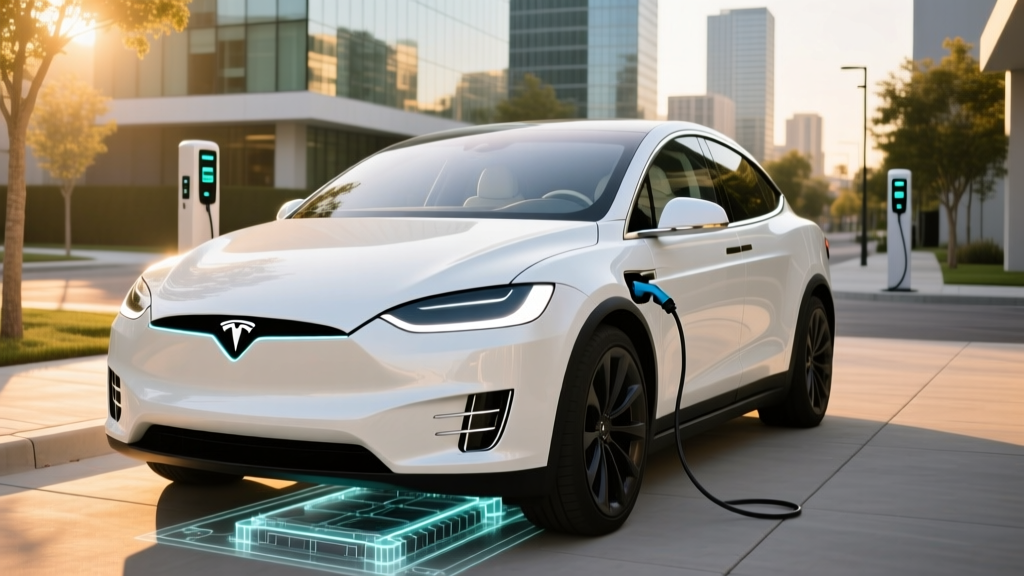
The Tesla Model X has been a fixture of the premium electric SUV segment since its debut, and for 2026 it continues to offer falcon-wing doors, tri-motor performance, and access to the Supercharger network — all wrapped in a lineup that now starts under $80,000. If you've been searching for a Tesla Model X white — Tesla's popular Pearl White Multi-Coat finish — you're looking at one of the most recognizable luxury electric SUVs on the road. But does the 2026 Model X still make sense against newer rivals like the Rivian R1S, BMW iX, and Mercedes EQS SUV?
This review breaks down every number that matters: real-world range, charging curves, battery chemistry, federal tax credit eligibility under current IRS §30D rules, and the ownership realities that spec sheets don't tell you.
2026 Tesla Model X Quick Specs at a Glance
| Spec | Long Range AWD | Plaid (Tri-Motor AWD) |
|---|---|---|
| EPA Range | 348 miles | 311 miles |
| Battery (usable) | ~100 kWh (NMC) | ~100 kWh (NMC) |
| Drivetrain | Dual-Motor AWD | Tri-Motor AWD |
| Horsepower | 670 hp | 1,020 hp |
| 0–60 mph | 3.8 sec | 2.5 sec |
| Peak DC Fast Charge | 250 kW | 250 kW |
| 10–80% DC Time | ~30 min | ~30 min |
| Level 2 (11.5 kW AC) | ~34 mi/hr | ~34 mi/hr |
| MPGe (combined) | 102 MPGe | 98 MPGe |
| Energy Consumption | 33 kWh/100 mi | 34 kWh/100 mi |
| Seating | 5, 6, or 7 passengers | 5, 6, or 7 passengers |
| Cargo (behind 2nd row) | 44.1 cu ft | 44.1 cu ft |
| Cargo (max, all rows folded) | 85.1 cu ft | 85.1 cu ft |
| Towing Capacity | 5,000 lbs | 5,000 lbs |
| Base MSRP | $79,990 | $94,990 |
| Battery Warranty | 8 yr / 150,000 mi | 8 yr / 150,000 mi |
Sources: EPA Fuel Economy, Tesla Model X Design Studio. Specs reflect current 2026 model year. Pear White Multi-Coat is a $0-cost standard paint option on the Model X.
Real-World Range: What the EPA Sticker Doesn't Tell You
Long Range AWD: EPA 348 miles — expect approximately 280–310 miles in mixed highway driving at 70–75 mph; 230–260 miles in sustained cold weather (below 32°F) with cabin heating.
Plaid: EPA 311 miles — expect approximately 250–275 miles highway; 200–230 miles in cold conditions.
The Model X Long Range's 348-mile EPA figure is among the highest of any three-row electric SUV. But EPA range is measured on a specific dynamometer cycle that doesn't fully replicate sustained highway speeds or cold-weather battery behavior. The Model X's large frontal area and aerodynamic drag — amplified by those heavy falcon-wing doors — means highway efficiency drops more noticeably than in a sedan like the Model S.
In real-world highway testing at 70 mph in moderate temperatures (65–75°F), the Long Range AWD typically delivers between 280 and 310 miles before needing a charge stop. Push speeds to 80+ mph or encounter headwinds on open interstates, and you may see the lower end of that range. In winter conditions below freezing, lithium-ion chemistry slows, cabin heating draws significant energy, and range can drop 25–35%. Tesla's heat pump — standard on all 2026 Model X trims — mitigates some of this loss compared to older resistive-heating EVs, but physics still wins.
The Plaid's 311-mile EPA rating reflects the energy demands of its tri-motor setup. Three motors, higher weight, and a performance-oriented drive calibration mean you'll charge more frequently on road trips — roughly every 200–250 miles at highway speeds in moderate weather.
Battery Chemistry, Capacity, and Long-Term Degradation
The 2026 Model X uses an NMC (nickel-manganese-cobalt) lithium-ion battery pack with approximately 100 kWh of usable capacity. Unlike the Model 3 and Model Y rear-wheel-drive trims, which have shifted to LFP (lithium iron phosphate) chemistry for cost savings and cycle-life durability, the Model X retains NMC for its higher energy density — essential for fitting 300+ miles of range into a heavy, large-format SUV.
| Factor | NMC (Model X) | LFP (Model 3 RWD) |
|---|---|---|
| Energy Density | Higher — more range per kg | Lower — requires larger/heavier pack |
| Cycle Life | ~1,500–2,000 cycles to 80% SoH | ~3,000+ cycles to 80% SoH |
| Recommended Daily SoC | 80% for daily use | 100% okay for daily use |
| Cold-Weather Performance | Better at low temps | More range loss in cold |
| Cost | Higher (cobalt/nickel) | Lower (iron/phosphate) |
Tesla's battery warranty covers 8 years or 150,000 miles (whichever comes first) with a minimum 70% capacity retention guarantee. Real-world data from Tesla's fleet and third-party tracking suggests Model X packs typically lose 8–12% capacity over the first 100,000 miles, with degradation flattening after the initial break-in period. If you plan to keep the vehicle beyond 150,000 miles, budgeting for a potential battery replacement — estimated between $15,000 and $22,000 out of warranty — is prudent.
Charging Speeds: DC Fast Charging and Home Level 2
The 2026 Model X supports a peak DC fast-charge rate of 250 kW via Tesla's V3 Superchargers and compatible CCS-equipped public stations (using Tesla's Magic Dock adapter or a third-party CCS-to-NACS adapter). The vehicle uses the NACS (North American Charging Standard) connector natively.
| Charging Level | Power (kW) | Speed (miles/hr) | Time Estimate |
|---|---|---|---|
| Level 1 (120V, 12A) | ~1.4 kW | ~4 mi/hr | ~85 hrs (0–100%) |
| Level 2 (240V, 48A) | 11.5 kW | ~34 mi/hr | ~10 hrs (0–100%) |
| DC Fast (V3 Supercharger) | Peak 250 kW | ~500 mi/hr (peak) | ~30 min (10–80%) |
| DC Fast (above 80%) | Tapers to ~40 kW | ~120 mi/hr | +15–20 min (80–100%) |
The 10–80% time of approximately 30 minutes is competitive but not class-leading. The Hyundai Ioniq 9 and Rivian R1S Gen 2 can achieve 10–80% in roughly 20–22 minutes on capable chargers thanks to higher sustained charge rates. The Model X's charge curve peaks at 250 kW up to roughly 30% state of charge, then tapers progressively. By 60% SoC, you're typically seeing 120–150 kW, and above 80%, the rate drops sharply to protect battery health.
For home charging, the onboard 11.5 kW AC charger means a full charge from empty takes about 10 hours on a 48-amp Level 2 circuit (requiring a 60-amp breaker). Most owners who plug in nightly never deplete below 20%, so a typical daily top-up of 40–60% takes just 3–5 hours — easily accomplished overnight. If your home electrical panel is maxed out, a 32-amp Level 2 circuit (7.7 kW, ~23 mi/hr) is a common fallback that still covers daily needs.
One practical note: Tesla's navigation system automatically preconditions the battery when you route to a Supercharger, warming the pack to optimize charge speed upon arrival. Skipping preconditioning in cold weather can cut your peak charge rate by 40–50%, adding significant time to your stop.
Performance: Dual-Motor Long Range vs. Tri-Motor Plaid
The Model X Long Range delivers 670 horsepower from its dual-motor all-wheel-drive powertrain, achieving 0–60 mph in 3.8 seconds. For a three-row, 5,185-pound SUV, that figure remains remarkable — it's quicker to 60 than most sports sedans from a decade ago.
The Plaid trim adds a third rear motor for 1,020 horsepower and a 2.5-second 0–60 time. The Plaid is an engineering showcase, but the real-world utility of that extra acceleration is minimal outside of on-ramp merges and the occasional drag strip visit. The Long Range's 3.8-second sprint already handles any real-world passing or merging scenario with authority.
Both trims feature adaptive air suspension with automatic ride-height adjustment, torque-vectoring AWD, and regenerative braking with a one-pedal driving experience. The air suspension provides approximately 2 inches of height adjustment — useful for clearing obstacles on unpaved roads or lowering for highway efficiency.
Pricing, Trims, and Federal Tax Credit Eligibility
The 2026 Model X lineup is straightforward: two trims, with Pearl White Multi-Coat included as a standard (no-cost) paint option. Upgrading to colors like Ultra Red, Deep Blue Metallic, or Solid Black adds $2,000 to $2,500.
| Trim | Base MSRP | Typical As-Tested* | Est. §30D Credit | Effective Price |
|---|---|---|---|---|
| Long Range AWD | $79,990 | $83,490 (w/ FSD, 6-seat) | Up to $7,500 | ~$75,990 |
| Plaid AWD | $94,990 | $98,490 (w/ FSD, 6-seat) | Up to $7,500 | ~$90,990 |
*As-tested includes common options: Full Self-Driving (Supervised) at $8,000 and six-seat interior. Prices exclude destination/delivery.
- MSRP Cap: SUVs/vans/pickups must be ≤ $80,000 MSRP. The Long Range qualifies; the Plaid ($94,990) exceeds the cap and does NOT qualify.
- Buyer Income Cap: Modified AGI must not exceed $150,000 (single), $225,000 (head of household), or $300,000 (joint filers).
- Battery Sourcing: A percentage of critical minerals and battery components must be sourced from the U.S. or FTA-partner countries. These thresholds increase annually. Check current-year requirements at IRS.gov §30D page.
- Point-of-Sale Transfer: The credit can be transferred to the dealer at purchase, reducing your out-of-pocket cost immediately rather than waiting for tax filing.
- One Vehicle Per VIN: The credit applies once per vehicle; used Model X purchases fall under the separate §25E used-vehicle credit (up to $4,000).
The critical takeaway: only the Long Range AWD qualifies for the full §30D credit. The Plaid's $94,990 MSRP exceeds the $80,000 SUV cap, making it ineligible regardless of your income or battery sourcing. If the $7,500 credit is essential to your budget, the Long Range is your Model X.
Interior Space, Technology, and the Falcon-Wing Reality
The Model X offers three seating configurations: 5-seat (two rows), 6-seat (captain's chairs in the second row with a center aisle), and 7-seat (bench second row with a third-row bench). The 6-seat layout is the most popular for families, providing comfortable captain's chairs and easier third-row access.
Cargo space is generous: 44.1 cubic feet behind the second row and 85.1 cubic feet with all rear seats folded. The front trunk (frunk) adds approximately 6.5 cubic feet — enough for a carry-on bag or charging cables. Total interior passenger volume is approximately 132 cubic feet.
Legroom measures 41.2 inches in the front, 38.4 inches in the second row, and 32.7 inches in the third row. The third row is viable for children or shorter adults on trips under an hour; taller passengers will find it cramped on longer journeys.
The 17-inch landscape touchscreen remains the command center for virtually all vehicle functions, running Tesla's latest software. A secondary 8-inch rear touchscreen allows second-row passengers to control climate and entertainment. The yoke steering wheel is standard, though a round wheel is available as a no-cost option. Wireless phone charging, HEPA air filtration (with Bioweapon Defense Mode), and a 22-speaker audio system are standard across all trims.
The falcon-wing rear doors are the Model X's signature feature. They open upward on double hinges, requiring less side clearance than conventional doors in tight parking spots. However, they are slower to open and close than standard doors, can be problematic in heavy rain (water drips from the door seams into the cabin opening), and add weight and mechanical complexity that has historically been a reliability pain point.
Autopilot, FSD (Supervised), and Driver Assistance
Tesla's Autopilot and Full Self-Driving (Supervised) are SAE Level 2 driver-assistance systems. The driver must remain engaged, monitor the road, and keep hands on the steering wheel at all times. These systems do NOT make the Model X a self-driving vehicle. Only Level 4 services like Waymo operate without driver supervision, and only in geofenced areas.
Standard Autopilot includes Traffic-Aware Cruise Control and Autosteer (lane-centering on highways). The optional Full Self-Driving (Supervised) package — currently priced at $8,000 — adds automatic lane changes, Navigate on Autopilot (highway on/off-ramp routing), Smart Summon (parking lot navigation), and traffic-light/stop-sign recognition.
FSD (Supervised) has improved significantly in city-street performance, but it remains a supervised system. Expect occasional disengagements, phantom braking events, and situations requiring driver takeover. For highway commuting, Autopilot alone (included standard) handles the vast majority of scenarios comfortably. Whether FSD is worth $8,000 depends on your tolerance for beta-level city driving behavior and your daily route complexity.
- Operate without driver supervision or attention
- Handle all weather conditions (heavy rain, snow, fog can impair cameras)
- Replace the need for a licensed, attentive driver
- Guarantee collision-free operation — NHTSA has investigated multiple incidents involving Autopilot/FSD
How the Model X Stacks Up Against Key Competitors
| Spec | Tesla Model X LR | Rivian R1S (Dual) | BMW iX xDrive50 | Kia EV9 GT-Line AWD |
|---|---|---|---|---|
| EPA Range | 348 mi | 352 mi | 309 mi | 270 mi |
| Base MSRP | $79,990 | $79,900 | $91,300 | $73,900 |
| 0–60 mph | 3.8 sec | 4.5 sec | 4.4 sec | 4.9 sec |
| Peak DC Charge | 250 kW | 220 kW | 195 kW | 236 kW |
| 10–80% DC Time | ~30 min | ~30 min | ~34 min | ~24 min |
| 3rd Row | Yes (tight) | Yes (moderate) | No | Yes (usable) |
| Towing | 5,000 lbs | 7,700 lbs | 3,500 lbs | 5,000 lbs |
| Supercharger Access | Native | NACS (2025+) | Adapter needed | Adapter needed |
The Model X's edge remains the Supercharger network — the most reliable and extensive DC fast-charging infrastructure in North America. While Rivian now has native NACS access and other brands are gaining adapter compatibility, Tesla owners still enjoy the most seamless plug-and-charge experience on road trips.
The Rivian R1S is the strongest competitor for adventure-oriented buyers: superior off-road capability, better towing (7,700 lbs), and a more usable third row. The BMW iX offers a quieter, more refined cabin but lacks a third row entirely. The Kia EV9 undercuts all three on price and offers the fastest 10–80% charge time, but with significantly less range.
Pros and Cons: The Honest Verdict
- Class-leading EPA range (348 mi Long Range)
- Native Supercharger access — best road-trip charging experience
- Quick 0–60 even in Long Range trim (3.8 sec)
- Generous cargo space (85.1 cu ft max)
- Over-the-air updates keep software current
- Heat pump standard for better winter efficiency
- Pearl White Multi-Coat is a no-cost option
- Falcon-wing doors: slow, rain-prone, reliability concerns
- Third-row legroom is tight (32.7 in) for adults
- 250 kW peak charge rate lags newer 350 kW-capable rivals
- Plaid trim ineligible for §30D tax credit (over $80K cap)
- Yoke steering is polarizing; round wheel should be default
- Interior materials don't match BMW/Mercedes at this price point
- FSD (Supervised) at $8,000 remains a Level 2 system
Who Should Buy the Tesla Model X in 2026?
- You need 300+ miles of range for frequent road trips and want the Supercharger advantage
- You want a three-row EV with strong performance and are willing to accept a tight third row
- The $7,500 federal tax credit is important to your purchase math
- You value OTA updates and Tesla's software ecosystem
- You want 1,020 hp and 2.5-second 0–60 performance in a family SUV — and don't need the tax credit
- Track days and straight-line acceleration are genuine priorities
- You need a genuinely comfortable third row for adults (consider the Rivian R1S or Kia EV9)
- You tow heavy loads regularly (Rivian R1S offers 7,700 lbs)
- You prioritize cabin luxury and quietness over performance (BMW iX, Mercedes EQS SUV)
- You want the fastest DC charging available (Ioniq 9 or EV9 charge faster)
The Model X in Pearl White Multi-Coat remains one of the most visible and recognizable luxury EVs on the road. Its combination of range, performance, and charging infrastructure access is still compelling in 2026 — but the competition has narrowed the gap significantly. Test-drive the Model X alongside the R1S and EV9 before committing, and pay close attention to whether the Long Range's tax credit eligibility matters for your budget.
Frequently Asked Questions
What is the real-world range of the Tesla Model X?
The EPA rates the Long Range at 348 miles and the Plaid at 311 miles. In real-world highway driving at 70–75 mph in moderate temperatures, expect approximately 280–310 miles (Long Range) and 250–275 miles (Plaid). Cold weather below 32°F can reduce range by 25–35%, bringing the Long Range down to approximately 230–260 miles.
How fast does the Tesla Model X charge at home and on the road?
On a 48-amp Level 2 home charger (11.5 kW), the Model X gains about 34 miles of range per hour, with a full charge taking roughly 10 hours. On a V3 Supercharger (250 kW peak), a 10–80% charge takes about 30 minutes. Above 80%, charging slows significantly to protect the battery — add another 15–20 minutes if you need a full charge.
How much does the Tesla Model X cost after the federal tax credit?
The Long Range AWD starts at $79,990 MSRP and may qualify for up to $7,500 under IRS §30D — bringing the effective price to approximately $72,490 before state incentives. The Plaid at $94,990 exceeds the $80,000 SUV MSRP cap and does not qualify for the federal credit. Eligibility also depends on buyer income limits and battery-sourcing requirements. Consult IRS.gov and a tax professional for your specific situation.
Does the Tesla Model X qualify for the federal EV tax credit?
Only the Long Range AWD qualifies, as its $79,990 MSRP falls under the $80,000 SUV cap. The Plaid does not qualify. Additionally, the buyer must meet income caps ($300,000 joint / $150,000 single) and the vehicle must satisfy battery critical-mineral and component sourcing thresholds that tighten each year. The credit can be applied at the point of sale.
Is the Tesla Model X worth buying over the Rivian R1S or Kia EV9?
It depends on your priorities. The Model X wins on range (348 mi), Supercharger convenience, and performance. The Rivian R1S wins on towing (7,700 lbs), off-road capability, and third-row comfort. The Kia EV9 wins on price ($73,900) and DC charging speed (~24 min 10–80%). Test-drive all three to determine which trade-offs matter most for your use case.
Is Pearl White Multi-Coat a premium paint option?
No. Pearl White Multi-Coat is included as a standard, no-cost paint option on the 2026 Model X. It's a popular choice because it's a multi-coat finish with a subtle pearlescent shimmer that looks premium despite the zero upcharge. Upgrading to Ultra Red or Deep Blue Metallic adds $2,000–$2,500.
What is the battery warranty on the 2026 Model X?
Tesla covers the Model X battery and drive unit for 8 years or 150,000 miles (whichever comes first) with a minimum 70% capacity retention guarantee. If the battery degrades below 70% state of health within that period, Tesla will repair or replace it to meet the threshold.
Can the Model X tow, and how does towing affect range?
The Model X is rated to tow up to 5,000 lbs across all trims. Expect range to drop by 30–50% when towing near maximum capacity, depending on trailer aerodynamics, weight, terrain, and speed. For frequent heavy towing, the Rivian R1S (7,700 lbs) is the stronger choice.