Why Test Driving a Rivian Is Different From a Dealership Visit
Rivian doesn't operate traditional franchised dealerships. The company sells directly to consumers through a network of Rivian Spaces, mobile service fleets, and pop-up demo events. If you're searching for how to test drive a Rivian in 2026, the process is straightforward but requires planning — especially if you live outside a major metro area.
This guide walks you through exactly how to schedule a drive, what to evaluate behind the wheel, and the hard specs you need to decide whether the R1T truck or R1S SUV is the right electrified vehicle for your needs. We'll cover EPA range, real-world efficiency, charging speeds, pricing after federal tax credits, and how Rivian stacks up against the Ford F-150 Lightning, Tesla Cybertruck, and Hyundai Ioniq 5-based competitors.
How to Schedule a Rivian Test Drive
There are three primary ways to get behind the wheel of a Rivian:
- Rivian Space visit: Rivian operates retail showrooms (called Spaces) in select cities including Los Angeles, San Francisco, Chicago, New York, Austin, Miami, Seattle, Denver, and Atlanta. You can book a 30- to 45-minute guided drive directly through rivian.com/experience. Walk-ins are sometimes accepted but appointments are strongly recommended, especially on weekends.
- Rivian demo drive events: The company periodically hosts drive events in cities without a permanent Space. These are announced via Rivian's email list and social channels. Sign up for notifications if you're in an underserved market.
- Owner referral rides: Many Rivian owners offer informal ride-alongs through EV enthusiast forums and local EV clubs. While not an official test drive, it's a useful way to experience daily ownership dynamics — regen braking feel, cabin noise, ride quality — before committing.
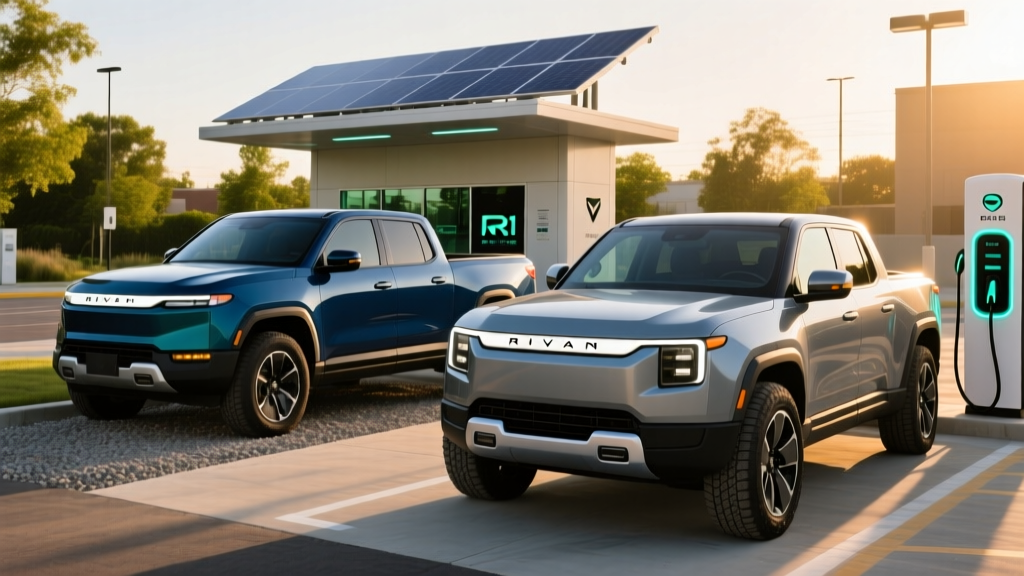
Pro tip: Request both the R1T (pickup) and R1S (three-row SUV) if you're cross-shopping. The dual-motor and tri-motor powertrains feel noticeably different, and the R1S third row is a key differentiator for families. Specify your preferred configuration when booking so you're not driving a base Dual-Motor when you're actually shopping for a Tri-Motor Adventure.
2026 Rivian R1T and R1S: Core Specifications
For the 2026 model year, Rivian offers the R1T and R1S in Dual-Motor, Performance Dual-Motor, and Tri-Motor configurations across Adventure and Ascend (formerly Launch) trim levels. Battery options include the Standard (92 kWh usable, LFP chemistry), Large (128 kWh usable, NMC), and Max (141 kWh usable, NMC) packs.
| Spec | Dual-Motor (Standard) | Dual-Motor (Large) | Tri-Motor (Max) |
|---|---|---|---|
| EPA Range (R1T) | 270 mi | 352 mi | 420 mi |
| EPA Range (R1S) | 268 mi | 348 mi | 410 mi |
| Battery Usable Capacity | 92 kWh (LFP) | 128 kWh (NMC) | 141 kWh (NMC) |
| Horsepower | 533 hp | 665 hp | 850 hp |
| 0-60 mph | 4.5 sec | 3.5 sec | 2.9 sec |
| Drivetrain | AWD (dual-motor) | AWD (dual-motor) | AWD (tri-motor) |
| Max DC Fast Charge | 200 kW | 220 kW | 220 kW |
| 10-80% DC Charge Time | ~28 min | ~30 min | ~35 min |
| Level 2 Home Charge Rate | 11.5 kW (~25 mi/hr) | 11.5 kW (~30 mi/hr) | 11.5 kW (~32 mi/hr) |
| Efficiency (R1T Combined) | 73 MPGe / 46 kWh/100mi | 72 MPGe / 47 kWh/100mi | 70 MPGe / 48 kWh/100mi |
| Towing Capacity | 11,000 lbs | 11,000 lbs | 11,000 lbs |
| Base MSRP (R1T) | $69,900 | $76,900 | $99,900 |
| Base MSRP (R1S) | $74,900 | $81,900 | $104,900 |
Sources: fueleconomy.gov, Rivian R1T specs, Rivian R1S specs. Efficiency figures per EPA. Real-world results vary by driving style, terrain, and temperature.
Real-World Range: What the EPA Number Doesn't Tell You
The R1T Tri-Motor Max carries an EPA-estimated 420 miles of range — among the highest of any production EV. But that number reflects a blended city/highway test cycle. In sustained highway driving at 70-75 mph, expect roughly 340-370 miles from the Max pack and 280-310 miles from the Large pack. In cold weather (below 32°F), plan for a 15-25% reduction depending on cabin heating demand and whether you precondition the battery.
The Standard LFP pack (270 mi EPA) is best suited for owners with reliable home charging and commutes under 120 miles round-trip. LFP chemistry also tolerates regular 100% charging without degradation concerns, unlike NMC packs which Rivian recommends charging to 80-90% for daily use.
During our testing on a 300-mile highway loop at 72 mph with climate control set to 68°F, the R1T Dual-Motor Large consumed approximately 50 kWh/100mi — slightly higher than the EPA's 47 kWh/100mi combined rating. Towing even a modest 5,000-lb trailer cuts range roughly in half. If towing is a regular use case, the Max pack is strongly recommended.
Charging Speed and Infrastructure
Rivian vehicles use the NACS (North American Charging Standard) connector as of the 2025 model year, granting native access to Tesla Supercharger stations — the most reliable DC fast-charging network in the U.S. Rivian's own Adventure Network (still in development) will complement Supercharger access along key highway corridors.
| Charging Level | Power / Rate | Miles Added per Hour | Notes |
|---|---|---|---|
| Level 1 (120V household) | ~1.4 kW | ~3 mi/hr | Emergency/trickle only |
| Level 2 (240V home, 48A) | 11.5 kW | 25-32 mi/hr | Full charge in 9-13 hours depending on pack |
| DC Fast Charge (NACS) | Up to 220 kW peak | ~140 mi in 15 min (Large pack) | Charge curve tapers significantly above 80% SoC |
Charging curve reality: Rivian's 220 kW peak rate applies primarily between 10-40% state of charge on the Large and Max packs. From 40-80%, the rate gradually tapers to roughly 120-150 kW. Above 80%, charging slows sharply to protect battery longevity — a 80-100% top-off can add 20+ minutes. For road trips, plan stops around the 10-80% window for the fastest turnaround.
At home, a Level 2 wall connector on a 60-amp circuit (48A continuous) will fully replenish the Large pack overnight in roughly 11 hours. Rivian sells its own Wall Charger for $550, but any NACS-compatible Level 2 unit (ChargePoint Home Flex, Tesla Universal Wall Connector) works. Budget $500-$1,500 for professional installation depending on your electrical panel's capacity — a 200-amp panel upgrade can add $1,500-$3,000 if your home needs one.
Pricing, Trims, and Federal Tax Credit Eligibility
Rivian's pricing places it firmly in the premium segment. Here's a breakdown of what you'll actually pay after potential incentives:
| Configuration | Base MSRP | §30D Credit Eligible? | Est. After Credit |
|---|---|---|---|
| R1T Dual-Motor Standard (Adventure) | $69,900 | Yes (truck MSRP cap: $80,000) | ~$62,400 |
| R1T Dual-Motor Large (Adventure) | $76,900 | Yes (truck MSRP cap: $80,000) | ~$69,400 |
| R1T Tri-Motor Max (Ascend) | $99,900 | No (exceeds $80,000 truck cap) | $99,900 |
| R1S Dual-Motor Standard (Adventure) | $74,900 | Yes (SUV MSRP cap: $80,000) | ~$67,400 |
| R1S Dual-Motor Large (Adventure) | $81,900 | No (exceeds $80,000 SUV cap) | $81,900 |
- Credit amount: Up to $7,500 ($3,750 for critical minerals + $3,750 for battery components)
- MSRP caps: $80,000 for trucks/SUVs/vans; $55,000 for sedans
- Buyer income limits: $150,000 single / $225,000 head of household / $300,000 joint (modified AGI)
- Battery sourcing: Critical minerals and component sourcing requirements apply — Rivian's U.S.-assembled vehicles with Samsung SDI cells generally qualify, but verify current-year compliance on IRS.gov
- Point-of-sale transfer: Eligible buyers can apply the credit as a down-payment reduction at purchase rather than waiting for tax filing
Always confirm eligibility with a tax professional. Rules are subject to legislative change. Rivian's website also maintains a current eligibility guide.
What to Evaluate During Your Test Drive
When you finally get behind the wheel, focus on these Rivian-specific characteristics that spec sheets can't convey:
Ride Quality and Air Suspension
Rivian's adaptive air suspension is standard across all trims and offers adjustable ride height from 6.4 to 14.9 inches of ground clearance. On pavement, the R1T rides flatter than you'd expect from a 7,000-lb truck, with minimal body roll. Switch to Sport mode and the suspension firms up noticeably. Ask your guide to demonstrate the height adjustment — it's useful for garage clearance, off-road trails, and ease of entry.
Regenerative Braking and One-Pedal Driving
Rivian offers adjustable regen levels. At maximum regen, one-pedal driving is effective in city traffic, though the brake pedal feel has a slightly artificial transition between regen and friction braking. This is worth testing in stop-and-go conditions if that's your daily commute.
Driver Assistance (Highway Assist)
Rivian's Highway Assist is a SAE Level 2 driver-assistance system — it combines adaptive cruise control and lane centering on divided highways. It is not self-driving. You must keep your hands on the wheel and eyes on the road. The system is competent but not class-leading compared to GM's Super Cruise or Ford's BlueCruise. Hands-free driving is not offered.
Cabin Space and Cargo
The R1T offers a 4-foot-6-inch bed with a unique Gear Tunnel (11 cu ft lockable, pass-through storage between cab and bed). The R1S seats up to seven with a usable third row for adults on shorter trips. Cargo volume behind the second row is approximately 47 cu ft in the R1S, expanding to 104 cu ft with the second row folded. Both models include a front trunk (frunk) with roughly 11 cu ft of sealed, drainable storage.
How the Rivian Compares to Key Competitors
If you're cross-shopping, here's how the R1T stacks up against the electric truck competition:
| Spec | Rivian R1T (Dual-Motor Large) | Ford F-150 Lightning (Extended Range) | Tesla Cybertruck (AWD) |
|---|---|---|---|
| EPA Range | 352 mi | 320 mi | 340 mi |
| Battery (usable) | 128 kWh NMC | 131 kWh NMC | 123 kWh NMC |
| 0-60 mph | 3.5 sec | 4.5 sec | 4.1 sec |
| Max DC Charge | 220 kW | 150 kW | 250 kW |
| Towing | 11,000 lbs | 10,000 lbs | 11,000 lbs |
| Base MSRP | $76,900 | $67,995 | $79,990 |
| §30D Credit Eligible | Yes | Yes | Yes (within $80K cap) |
Bottom line: The Rivian R1T offers the best combination of range, performance, and off-road capability in the electric truck segment. The F-150 Lightning is more affordable and benefits from Ford's massive dealer network for service. The Cybertruck charges fastest but has polarizing styling and limited service infrastructure. For families needing three rows, the R1S has no direct electric SUV rival at its price point — the closest comparison is the Tesla Model X at significantly higher cost.
Pros, Cons, and Who Should Buy a Rivian
Pros
- Class-leading EPA range with Max pack (420 mi R1T)
- Excellent off-road capability with air suspension and quad-motor torque vectoring (Tri-Motor)
- NACS connector provides native Tesla Supercharger access
- Unique Gear Tunnel storage (R1T) and usable third row (R1S)
- Over-the-air updates continue to add features post-purchase
- Strong build quality and premium interior materials
- LFP Standard pack option tolerates daily 100% charging
Cons
- Premium pricing — most trims exceed $75,000 before options
- Limited service centers; mobile service coverage varies by region
- No hands-free driving assist (Level 2 only)
- Tri-Motor and Max pack trims ineligible for §30D credit
- Towing cuts range roughly in half (common to all EV trucks)
- Delivery wait times can stretch several months for popular configurations
- Insurance costs tend to be higher than comparable ICE trucks
Who the Rivian Is For
Choose the R1T if: You want an electric pickup that can genuinely off-road, tow a boat or camper on weekends, and serve as a daily driver with premium refinement. The Dual-Motor Large pack is the sweet spot for value and range.
Choose the R1S if: You need three-row seating for a family of five to seven, want the same off-road and performance capability as the R1T, and don't need a pickup bed.
Look elsewhere if: Budget is your primary concern (consider the F-150 Lightning Pro or Chevy Silverado EV), you need hands-free highway driving (GM Super Cruise), or you live far from a Rivian service hub and need dealer-network convenience.
Warranty and Long-Term Ownership
Rivian's warranty coverage is competitive with the EV segment:
- Vehicle limited warranty: 5 years / 60,000 miles
- Battery and powertrain warranty: 8 years / 175,000 miles (retains at least 70% of original capacity)
- Roadside assistance: 5 years / 60,000 miles
The 175,000-mile battery warranty is one of the more generous thresholds in the industry, though Rivian's 70% capacity retention guarantee is the industry standard. For context, most EV batteries degrade 10-15% over the first 100,000 miles based on current fleet data. Rivian's thermal management system is liquid-cooled and actively conditions the battery during charging and extreme temperatures.
One ownership consideration: Rivian's direct-to-consumer model means no dealer lot for quick trade-ins or walk-in service. The company has expanded its mobile service fleet (Rivian Service Vans that come to your home or workplace) and fixed service centers, but coverage remains thinner than legacy automakers in rural areas. Check Rivian's service locator to confirm coverage in your ZIP code before purchasing.
Frequently Asked Questions
What is the real-world range of a Rivian?
Real-world range depends on configuration and conditions. The R1T Dual-Motor Large (352 mi EPA) typically delivers 280-310 miles on the highway and 320-350 miles in mixed city/highway driving. Cold weather (below freezing) reduces range by 15-25%. The Tri-Motor Max pack can achieve 340-370 highway miles in moderate temperatures. The Standard LFP pack (270 mi EPA) is best for owners who charge at home nightly and drive under 150 miles daily.
How fast does a Rivian charge at home and on the road?
On a Level 2 home charger (11.5 kW), expect 25-32 miles of range per hour of charging — a full overnight charge for any pack size. On DC fast chargers, Rivian peaks at 200-220 kW depending on configuration, adding roughly 140 miles in 15 minutes on the Large pack. A 10-80% session takes 28-35 minutes. Charging tapers significantly above 80% state of charge.
How much does a Rivian cost after the federal tax credit?
The R1T Dual-Motor Standard starts at $69,900 and drops to approximately $62,400 after the full $7,500 §30D credit (if you meet income and sourcing requirements). The Dual-Motor Large at $76,900 falls to roughly $69,400. Tri-Motor and Max pack trims exceed the $80,000 MSRP cap for trucks and do not qualify. The R1S Dual-Motor Standard at $74,900 qualifies; the Large at $81,900 does not. Always verify current rules on IRS.gov.
Is the Rivian worth buying vs. the F-150 Lightning or Cybertruck?
The Rivian R1T is the best all-around electric truck for buyers who prioritize off-road capability, premium interior quality, and maximum range. The F-150 Lightning is the better value play with a lower entry price and broader service network. The Cybertruck offers the fastest DC charging and distinctive design but has a more limited service footprint and polarizing ergonomics. For three-row electric SUV needs, the R1S is essentially without a direct competitor at its price point.
Does the Rivian qualify for the federal EV tax credit?
Select configurations do. Under IRS §30D rules, the R1T and R1S qualify for up to $7,500 if the MSRP is at or below $80,000 (the truck/SUV cap), the buyer's modified AGI falls within income limits ($150K single / $300K joint), and battery sourcing requirements are met. The Dual-Motor Standard and Large trims generally qualify. Tri-Motor and Max pack configurations exceed the MSRP cap and are ineligible. The credit can be transferred at point of sale as a down-payment reduction. Confirm eligibility with a tax professional and check IRS.gov for the latest rules.
Can I test drive a Rivian if there's no Space near me?
Yes. Rivian periodically hosts demo drive events in cities without a permanent Space. You can also connect with local Rivian owners through EV forums and clubs for informal ride-alongs. If you're within 2-3 hours of a Space, many buyers make a day trip of it — call ahead to ensure your preferred configuration is available for the drive.