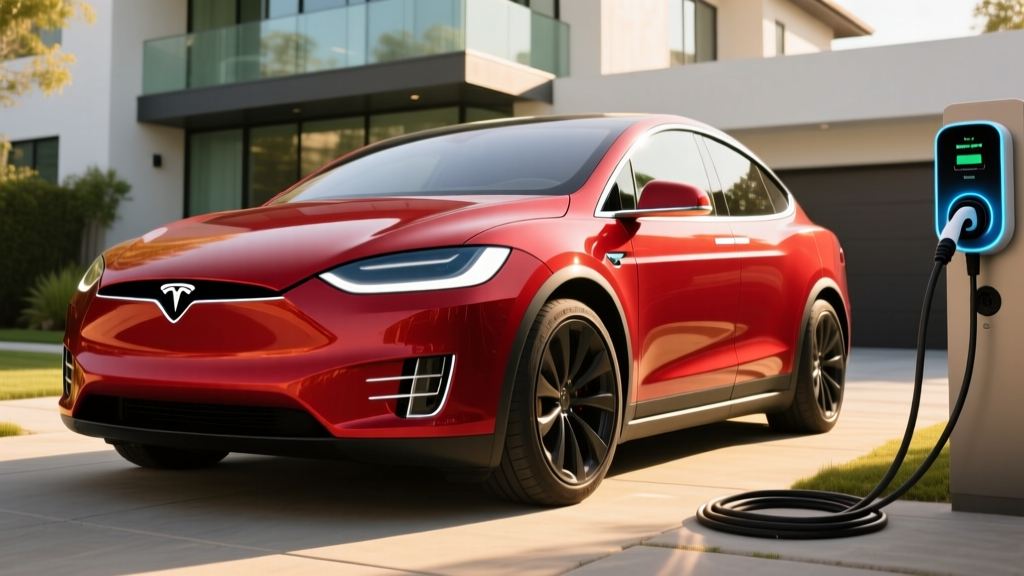
The Tesla Model X remains one of the most recognizable electric SUVs on the road, and in its current generation it continues to push the boundaries of what a three-row family hauler can do on electrons alone. For buyers searching for a Tesla X Red — specifically the Ultra Red or legacy Red Multi-Coat finish — the appeal goes beyond aesthetics. This is a 5,000-plus-pound electric SUV that hits 60 mph in under four seconds, tows up to 5,000 pounds, and offers falcon-wing rear doors that make car-seat loading genuinely easier. But with a starting price well above $70,000 and a competitive landscape that now includes the Rivian R1S, BMW iX, and Mercedes EQS SUV, does the Model X still earn its premium? We break down every spec that matters.
2026 Tesla Model X: Core Specifications at a Glance
| Spec | Long Range (Dual Motor AWD) | Plaid (Tri-Motor AWD) |
|---|---|---|
| EPA Range | 311 miles | 285 miles |
| Battery (usable) | ~100 kWh (NMC) | ~100 kWh (NMC) |
| Horsepower | 670 hp | 1,020 hp |
| 0–60 mph | 3.8 seconds | 2.5 seconds |
| Top Speed | 155 mph | 163 mph |
| Drivetrain | Dual-Motor AWD | Tri-Motor AWD |
| Max DC Fast Charge | 250 kW | 250 kW |
| 10–80% DC Charge | ~32 minutes | ~32 minutes |
| Level 2 Charge Rate | 11.5 kW (~34 mi/hr) | 11.5 kW (~34 mi/hr) |
| MPGe (combined) | 102 MPGe | 98 MPGe |
| Efficiency | 33 kWh/100 mi | 34 kWh/100 mi |
| Towing Capacity | 5,000 lbs | 5,000 lbs |
| Cargo (behind 3rd row) | 15.0 cu ft | 15.0 cu ft |
| Cargo (all rows folded) | 81.5 cu ft | 81.5 cu ft |
| Seating | 5, 6, or 7 passengers | 5, 6, or 7 passengers |
| Battery Warranty | 8 yr / 150,000 mi | 8 yr / 150,000 mi |
| Base MSRP | $74,990 | $89,990 |
Sources: EPA / fueleconomy.gov, Tesla Model X Design Studio. Prices reflect 2026 model year before destination or options.
Range Reality: EPA Sticker vs. What You'll Actually Get
Real-World Expectation: On a 75-mph highway drive in mild weather (65–75°F), expect approximately 265–280 miles from the Long Range model. In winter conditions (below 32°F), range can drop to 220–245 miles due to battery resistive heating and cabin climate demands. City driving with frequent regenerative braking can push closer to or slightly above the EPA number.
The Model X Long Range carries roughly 100 kWh of usable battery capacity using nickel-manganese-cobalt (NMC) chemistry. NMC provides higher energy density than LFP (lithium iron phosphate), which is why Tesla reserves it for the Long Range and Plaid variants where maximizing range and power matters more than cycle-life longevity. The trade-off: Tesla recommends daily charging to 80–90% for NMC batteries, reserving 100% for road trips. This means your practical daily range is closer to 250–280 miles before you even factor in driving conditions.
The Plaid trim sacrifices 26 miles of EPA range due to its tri-motor configuration and higher curb weight, landing at 285 miles. In our experience, highway efficiency in the Plaid is noticeably worse if you exploit its 1,020 horsepower — aggressive acceleration pushes consumption well above 34 kWh/100 mi.
Charging Speed: DC Fast Charging and Home Level 2
| Charging Method | Power (kW) | Speed (mi/hr added) | Typical Use Case |
|---|---|---|---|
| Level 1 (120V outlet) | ~1.4 kW | ~3–4 mi/hr | Emergency / overnight trickle |
| Level 2 (240V, 48A) | 11.5 kW | ~34 mi/hr | Home daily charging |
| DC Fast (Tesla Supercharger V3) | Up to 250 kW peak | ~175 mi in 15 min | Road trips |
| DC Fast (CCS adapter, 3rd-party) | Up to ~150–250 kW | Varies by station | Non-Tesla networks |
The Model X peaks at 250 kW on Tesla V3 Superchargers, but that peak is not sustained. The charge curve tapers significantly above 50% state of charge (SoC). A 10–80% session takes approximately 32 minutes, which is respectable for a 100 kWh pack but noticeably slower than newer 800V-architecture rivals like the Hyundai Ioniq 5 (which does 10–80% in ~18 minutes at 350 kW chargers).
For home charging, the onboard charger accepts up to 11.5 kW on a 240V/48A circuit. A full charge from 10% to 90% takes roughly 8–9 hours, which is adequate for overnight replenishment. If you're installing a Tesla Wall Connector, expect to budget $500–$800 for the unit plus $800–$2,500 for electrician labor depending on panel proximity and whether your home needs a service upgrade from 100A to 200A.
Tesla now includes a NACS (North American Charging Standard) port natively, so no adapter is needed at Superchargers. For Electrify America, EVgo, or other CCS networks, you'll use the CCS adapter Tesla provides or purchase a third-party NACS-to-CCS adapter.
Performance: Supercar Acceleration in a Family SUV
The dual-motor Long Range delivers 670 horsepower and a 3.8-second 0–60 mph time — quick enough to embarrass most sports cars from a stoplight. The Plaid's tri-motor setup produces 1,020 hp and hits 60 mph in 2.5 seconds, a figure that remains staggering in a vehicle with third-row seating and 81.5 cubic feet of cargo space.
Both trims use all-wheel drive with independent front and rear motors (the Plaid adds a second rear motor). Torque vectoring is handled electronically, and traction in rain and light snow is excellent thanks to the low center of gravity from the floor-mounted battery pack. The adaptive air suspension adjusts ride height automatically — it lowers at highway speeds for efficiency and raises for rough roads or loading.
One performance note: the Model X's ~5,100-pound curb weight is noticeable in corners. While acceleration is beyond reproach, the steering feel remains somewhat numb compared to the BMW iX or even Tesla's own Model S sedan. This is a straight-line performer and a comfortable cruiser, not a canyon carver.
Red Paint Options and Pricing Breakdown
Tesla's current Ultra Red paint (introduced to replace the older Red Multi-Coat) is a $2,000 premium option on both Long Range and Plaid trims. It's a deep, multi-layer metallic with a color-shift quality that reads darker in shade and vibrant in direct sunlight. For buyers specifically searching for a Tesla X in red, this is the only red currently offered from the factory.
| Item | Long Range | Plaid |
|---|---|---|
| Base MSRP | $74,990 | $89,990 |
| Ultra Red Paint | +$2,000 | +$2,000 |
| Destination Fee | +$1,390 | +$1,390 |
| 6-Seat Interior (optional) | +$6,500 | +$6,500 |
| FSD (Supervised) License | +$8,000 | +$8,000 |
| Typical As-Tested (6-seat, red) | ~$84,880 | ~$99,880 |
| Federal Tax Credit (§30D) | See eligibility below | See eligibility below |
Federal EV Tax Credit Eligibility (IRS §30D)
The Tesla Model X qualifies for up to $7,500 under the §30D Clean Vehicle Credit, but eligibility depends on several factors that buyers must verify:
- MSRP Cap: SUVs must have an MSRP at or below $80,000. The Long Range at ~$76,380 (base + destination) qualifies. A heavily optioned Plaid pushing past $80,000 MSRP may be ineligible — check your exact build configuration.
- Buyer Income Cap: Adjusted gross income must not exceed $300,000 (joint filers), $225,000 (head of household), or $150,000 (individual).
- Battery Sourcing: The credit is split into two halves ($3,750 each) based on critical-mineral sourcing and battery-component manufacturing requirements. Current-year rules require increasing percentages of battery components manufactured in North America and critical minerals sourced from the U.S. or free-trade-agreement partners. Tesla's supply chain has largely met these thresholds, but verify at IRS.gov for the exact model year and build date.
- Point-of-Sale Transfer: As of 2024, you can transfer the credit to the dealer at purchase, reducing your out-of-pocket cost immediately rather than waiting for a tax refund.
Tax rules change frequently. Consult a tax professional and check fueleconomy.gov before purchasing.
Interior, Cargo, and Technology
The Model X interior is dominated by a 17-inch center touchscreen (now tilted toward the driver in recent refreshes) and a 12.3-inch instrument cluster. A rear-seat 8-inch screen handles climate and entertainment for second-row passengers. The yoke steering wheel remains standard, though a conventional round wheel is available at no extra charge — most buyers opt for the round wheel for daily usability.
Cargo dimensions: Behind the third row, you get 15.0 cubic feet — enough for a couple of carry-ons or a week of groceries. Fold the third row and you unlock 41.1 cubic feet. Fold everything flat and the Model X swallows 81.5 cubic feet, rivaling midsize SUVs. The front trunk (frunk) adds roughly 6.5 cubic feet of enclosed storage, useful for charging cables or a small bag.
Legroom: Front-row legroom is generous at 41.2 inches. Second-row passengers get 38.4 inches (in the five-seat bench configuration), while the third row is best reserved for children at 32.7 inches of legroom.
The falcon-wing rear doors remain the Model X's signature feature. They open upward with dual hinges, allowing you to stand nearly upright while loading children into car seats — a genuine practical advantage in tight parking spots. However, the doors rely on sensors to avoid overhead obstacles, and in heavy rain, water can drip into the cabin during the opening sequence. They also add mechanical complexity; warranty claims on the hinge and sensor systems are not uncommon based on owner forums.
Driver Assistance: Tesla's Basic Autopilot is standard, providing lane-centering and adaptive cruise control. Full Self-Driving (Supervised), an $8,000 option, adds automatic lane changes, traffic-light recognition, and city-street navigation. It is critical to understand that FSD is a SAE Level 2 driver-assistance system — you must keep your hands on the wheel and eyes on the road at all times. It is not autonomous driving.
Pros, Cons, and the Competition
- Class-leading acceleration (especially Plaid)
- Access to Tesla Supercharger network (35,000+ stalls globally)
- Falcon-wing doors genuinely ease car-seat loading
- Over-the-air updates continuously add features
- Strong towing capacity (5,000 lbs) for an EV SUV
- Excellent regenerative braking and one-pedal driving
- High starting price; Plaid easily exceeds $80K MSRP cap
- 250 kW peak charging is slower than 800V rivals
- Third row is tight for adults
- Build quality inconsistencies still reported by owners
- Falcon-wing doors can be slow and drip water in rain
- No Apple CarPlay or Android Auto
- Insurance premiums run 20–35% above comparable gas SUVs
Key Competitors Compared
| Vehicle | EPA Range | Starting Price | Max DC Charge | 0–60 mph |
|---|---|---|---|---|
| Tesla Model X LR | 311 mi | $74,990 | 250 kW | 3.8s |
| Rivian R1S (Dual Max) | ~352 mi | $75,900 | ~200 kW | 4.5s |
| BMW iX xDrive50 | 324 mi | $87,250 | 200 kW | 4.4s |
| Mercedes EQS 580 SUV | 305 mi | $104,400 | 200 kW | 4.3s |
The Rivian R1S is the closest rival in spirit: it offers more range with the Max battery, genuine off-road capability, and a more traditional SUV design. The BMW iX has a superior interior and better ride quality but only two rows of seats. The Mercedes EQS SUV is more luxurious but considerably more expensive and less efficient. The Model X wins on raw performance, Supercharger network access, and the practicality of its falcon-wing doors for families.
Who Should Buy the Tesla Model X in Red?
- Families with young children who value the falcon-wing doors for car-seat access and need three rows of seating.
- Performance-oriented buyers who want supercar acceleration without sacrificing daily utility.
- Road-trip enthusiasts who benefit from the Supercharger network's reliability and coverage across the U.S.
- Buyers who tow — 5,000-lb capacity handles small boats and utility trailers.
- You want the longest possible range per dollar (consider the Rivian R1S Max or a Model Y Long Range).
- You prioritize luxury interior materials (the BMW iX or Mercedes EQS SUV are more refined).
- You need a comfortable adult-friendly third row for long trips (the Rivian or a three-row PHEV like the Kia EV9 may suit better).
Frequently Asked Questions
What is the real-world range of the Tesla Model X?
The EPA rates the Long Range at 311 miles and the Plaid at 285 miles. In real-world highway driving at 70–75 mph in moderate temperatures, expect 265–280 miles from the Long Range. In cold weather (below freezing), plan for 220–245 miles. Always charge to 100% before long trips on NMC batteries; for daily use, Tesla recommends 80–90%.
How fast does the Model X charge at home and on the road?
On a home Level 2 charger (240V, 48A), the Model X charges at 11.5 kW, adding roughly 34 miles of range per hour — a full overnight session replenishes the battery. On a Tesla V3 Supercharger, it peaks at 250 kW and charges from 10–80% in about 32 minutes. Charging slows substantially above 80% SoC to protect the battery.
Does the Tesla Model X qualify for the $7,500 federal tax credit?
The Long Range trim at its base MSRP of ~$76,380 (including destination) falls under the $80,000 SUV cap and is generally eligible, provided you meet income requirements ($300K joint / $150K individual) and the battery sourcing requirements are met for your build date. A fully optioned Plaid may exceed the $80,000 MSRP cap and become ineligible. Always verify at IRS.gov before purchase.
Is the Tesla Model X worth buying over the Rivian R1S or BMW iX?
The Model X wins on acceleration, Supercharger access, and falcon-wing door practicality for families. The Rivian R1S offers more range, better off-road capability, and a more rugged design. The BMW iX delivers a more luxurious interior and smoother ride but lacks a third row. If Supercharger network reliability and raw performance are your priorities, the Model X remains compelling. If interior quality or maximum range matter more, test-drive the competition.
What is the battery warranty on the Model X?
Tesla covers the Model X battery and drive unit for 8 years or 150,000 miles (whichever comes first), with a guaranteed minimum of 70% capacity retention over that period. NMC batteries in the Model X have demonstrated relatively low degradation in fleet data — most owners report 90%+ capacity after 50,000 miles, tapering gradually. Full battery replacement outside warranty currently costs approximately $15,000–$22,000 depending on the pack.
Is Ultra Red the same as the old Red Multi-Coat?
No. Tesla phased out Red Multi-Coat and replaced it with Ultra Red, which uses a different pigment formulation with a deeper, more saturated tone and less orange undertone in direct light. If you're comparing used Model X listings in Red Multi-Coat against new Ultra Red builds, they are visually similar but distinct colors.