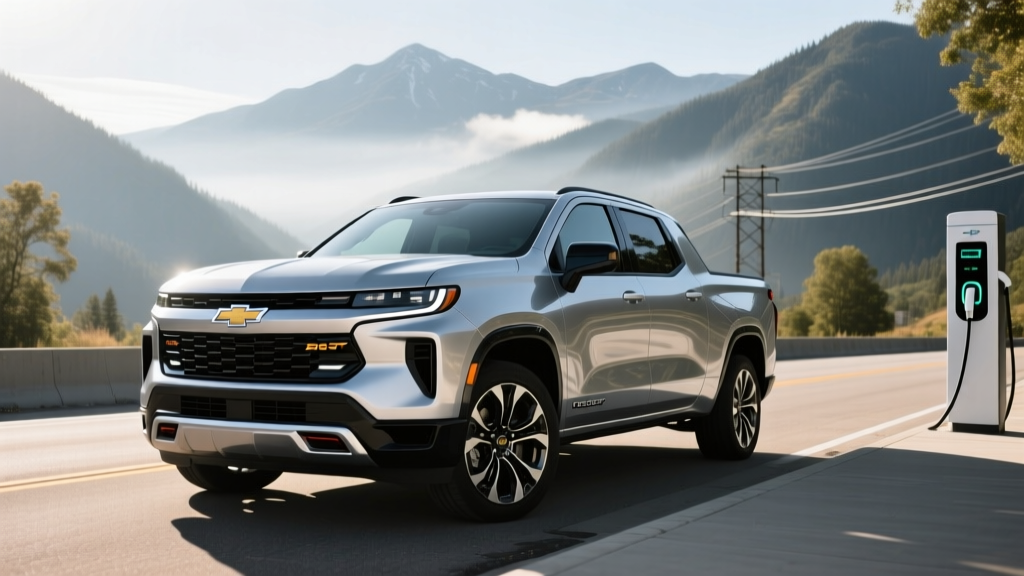
The Chevrolet Silverado EV has been one of the most anticipated electric pickups since its announcement, and the RST (Rally Sport Truck) trim sits near the top of the lineup as Chevy's flagship consumer model. With an EPA-estimated range that tops nearly every rival, serious towing capability, and GM's Ultium platform underpinning it all, the Silverado EV RST makes a compelling case for full-size truck buyers ready to electrify. But does a 200-plus-kWh battery and a price tag north of $87,000 make sense for your driveway? We break down every spec that matters.
2026 Silverado EV RST: Key Specs at a Glance
| Specification | 2026 Silverado EV RST |
|---|---|
| EPA Range | 440 miles (Max Range battery) |
| Usable Battery Capacity | ~200 kWh (Max Range), NMC chemistry |
| Peak DC Fast Charge | 350 kW |
| 10–80% DC Charge Time | ~42 minutes (estimated) |
| Level 2 Home Charging | 19.2 kW (up to 52 mi/hr) |
| Horsepower | 664 hp (e4WD dual-motor) |
| Torque | 780 lb-ft |
| 0–60 mph | ~4.5 seconds |
| Max Towing Capacity | 10,000 lbs (standard); 12,000 lbs with Max Trailering pkg |
| Bed Length | 5 ft 11 in (with Multi-Flex Midgate open: up to 9 ft) |
| Base MSRP | $87,300 (RST, Standard Range) |
| As-Tested Price (Max Range) | ~$105,000+ |
| Battery/Powertrain Warranty | 8 years / 100,000 miles |
| Efficiency | ~61 MPGe combined (est.) |
Range and Efficiency: What the EPA Says vs. Reality
The headline number for the Silverado EV RST is its available Max Range battery pack, which Chevy rates at an EPA-estimated 440 miles. That figure places the Silverado EV among the longest-range EVs of any body style — rivaling the Lucid Air sedan and surpassing every other electric pickup on the market. The Standard Range variant drops to approximately 290 miles EPA.
EPA 440 miles (Max Range) / 290 miles (Standard Range). In practice, expect the Max Range model to deliver 340–380 miles on the highway at 70–75 mph, and potentially 280–320 miles in cold weather (below freezing) without preconditioning. The Standard Range model will realistically net 220–250 highway miles. These are among the best figures in the electric truck segment, but no EV achieves its full EPA sticker at sustained highway speeds or in deep cold.
Efficiency for a truck this heavy — curb weight approaches 9,000 lbs — is inherently compromised compared to a sedan or crossover. Expect consumption in the neighborhood of 48–55 kWh/100 miles in mixed driving, which translates to roughly 61 MPGe combined. That's par for the course in the electric pickup class, where aerodynamics and mass work against you. Around town, regenerative braking helps recover energy and push efficiency higher.
Charging Speed: 350 kW Peak, But Mind the Curve
The Silverado EV RST is built on GM's Ultium platform with an 800-volt electrical architecture, enabling DC fast-charging at up to 350 kW — provided you're plugged into a compatible 350 kW station (such as Electrify America's latest hardware or select EVgo locations). At that rate, Chevy estimates a 10–80% charge in approximately 42 minutes for the Max Range pack.
| Charging Method | Power / Rate | Estimated Speed |
|---|---|---|
| DC Fast Charge (350 kW station) | Peak 350 kW | 10–80% in ~42 min (Max Range) |
| DC Fast Charge (150 kW station) | Peak ~150 kW | 10–80% in ~70 min (Max Range) |
| Level 2 Home (19.2 kW / 80A) | 19.2 kW | ~52 miles of range per hour |
| Level 2 Home (11.5 kW / 48A) | 11.5 kW | ~31 miles of range per hour |
| Level 1 (120V / 12A) | ~1.4 kW | ~4 miles of range per hour |
A critical caveat: peak kW is not sustained kW. The 350 kW rate applies only in the lower portion of the state-of-charge window (roughly 10–40% SoC). As the battery fills past 50%, the charge rate tapers significantly — a physics-driven reality for all lithium-ion packs to protect cell longevity. On a 150 kW station, which is still far more common across the U.S., expect the full 10–80% session to take closer to 70 minutes.
For home charging, the Silverado EV RST supports up to 19.2 kW on a hardwired Level 2 charger (requiring a 100-amp circuit). That's among the fastest AC rates available in any production EV and can replenish roughly 52 miles of range per hour — enough to fully recharge the Max Range pack overnight in about 10–11 hours. Most buyers will opt for a more common 48-amp / 11.5 kW installation (requiring a 60-amp breaker), which adds about 31 miles per hour. Either way, Chevy's official charging guide recommends consulting a licensed electrician to evaluate your panel capacity before installation.
Performance and Capability: 664 HP Meets a Truck Bed
The Silverado EV RST uses a dual-motor e4WD configuration producing 664 horsepower and 780 lb-ft of torque. That's enough to hustle this 9,000-lb truck to 60 mph in approximately 4.5 seconds — quick enough to surprise most sports sedan drivers at a stoplight. Power delivery is immediate and linear, as expected from electric motors, and the low center of gravity (battery pack under the floor) keeps body roll surprisingly composed for a full-size pickup.
Towing is a core mission for any truck buyer, and the RST delivers: 10,000 lbs standard, rising to 12,000 lbs with the optional Max Trailering package. However, towing at or near max capacity will slash range by 40–50%, a reality that applies to every electric pickup. Plan on 200–250 miles of range when pulling a heavy trailer — and plan your charging stops accordingly.
The Silverado EV's Multi-Flex Midgate is a standout feature: the partition between the cab and bed can fold down, extending the effective load floor from 5 ft 11 in to over 9 feet with the tailgate closed (or over 10 feet with the tailgate down). This is a genuinely useful innovation for hauling lumber, kayaks, or ladders without resorting to a roof rack or an open tailgate.
Interior, Tech, and Driver Assistance
Inside, the RST trim gets Chevy's largest infotainment setup: a 17.7-inch diagonal touchscreen paired with an 11-inch digital driver display. The system runs GM's latest software with wireless Apple CarPlay and Android Auto, Google built-in (Maps, Assistant, Play Store), and over-the-air update capability. A head-up display is standard on RST.
On the driver-assistance front, the Silverado EV RST comes equipped with Super Cruise — GM's hands-free highway driving system. Super Cruise operates on over 750,000 miles of compatible divided highways in the U.S. and Canada, using a combination of LiDAR-mapped road data, cameras, and radar. It is a SAE Level 2 system: the driver must remain attentive and eyes on the road (monitored by a driver-facing camera), but hands can come off the wheel on approved routes.
Super Cruise is an SAE Level 2 driver-assistance system — it is NOT autonomous or self-driving. You must remain alert, keep your eyes on the road, and be ready to take over at any time. It works only on pre-mapped divided highways and does not handle construction zones, unmapped surface streets, or severe weather autonomously.
Additional tech highlights include ProPower Onboard-style vehicle power output (up to 10.2 kW of exportable power via outlets in the bed and cabin — enough to run power tools, tailgate equipment, or serve as backup home power during outages), a digital rearview camera mirror, and an available trailering camera system with up to four views.
Pricing, Trims, and Federal Tax Credit Eligibility
| Trim / Config | MSRP | Est. Federal Credit | Effective Price |
|---|---|---|---|
| Silverado EV RST (Standard Range) | $87,300 | Up to $7,500* | ~$79,800 |
| Silverado EV RST (Max Range) | ~$99,400 | Up to $7,500* | ~$91,900 |
| RST Max Range + Max Trailering pkg | ~$105,000+ | Up to $7,500* | ~$97,500+ |
*Federal tax credit eligibility under IRS §30D is subject to multiple requirements:
- MSRP Cap: Pickup trucks must have an MSRP at or below $80,000 to qualify. The RST Standard Range at $87,300 exceeds this cap — meaning it likely does NOT qualify for the full $7,500 federal credit. (The lower-trim WT fleet model at a lower MSRP may qualify.)
- Buyer Income Cap: Modified adjusted gross income must not exceed $150,000 (single), $225,000 (head of household), or $300,000 (joint filers).
- Battery Sourcing: Critical minerals and battery components must meet escalating domestic-sourcing thresholds that tighten each year through 2032.
- Point-of-Sale Transfer: Eligible buyers can transfer the credit to the dealer at purchase, reducing the purchase price upfront rather than waiting for a tax refund.
The MSRP cap is the key issue for the RST. At $87,300 base, the Silverado EV RST likely falls outside the $80,000 truck cap for the §30D new-vehicle credit. Buyers should verify eligibility with a tax professional and check the latest fueleconomy.gov credit listings before assuming the full credit applies. State and local incentives may partially offset the cost — check your state's energy office for details.
Who Should Buy the Silverado EV RST?
- You need a full-size truck bed and genuine 10,000+ lb towing but want to eliminate fuel costs for daily driving
- Maximum EV range is a priority — the 440-mile Max Range pack is unmatched among electric trucks
- You want hands-free highway driving (Super Cruise) for long commutes or road trips
- Vehicle-to-load power (10.2 kW) matters for job-site or tailgate use
- You have reliable home Level 2 charging and a 200-amp or upgraded electrical panel
- Budget is under $80,000 — the RST starts above that, and the tax credit likely won't apply
- You rarely need a truck bed — a large SUV EV like the Rivian R1S or Cadillac Escalade IQ may suit you better
- You tow heavy trailers over 300+ miles frequently — range loss while towing makes this impractical without frequent charging stops
- You lack home charging access — a 200 kWh battery on public Level 2 chargers alone is an exercise in patience
Pros and Cons
- Class-leading 440-mile EPA range (Max Range battery)
- 350 kW peak DC charging on 800V architecture
- Multi-Flex Midgate extends bed to over 9 feet
- 664 hp / 780 lb-ft delivers genuine performance
- Super Cruise hands-free driving on 750k+ miles of highway
- 10.2 kW onboard power export for tools or home backup
- 19.2 kW AC home charging support (fastest in class)
- RST pricing starts at $87,300 — likely exceeds §30D MSRP cap
- ~9,000-lb curb weight hurts efficiency vs. lighter EVs
- Towing at max capacity cuts range by 40–50%
- Large footprint (233+ inches long) challenges tight garages and parking
- Max Range pack adds ~$12,000 and significant weight
- Real-world highway range falls well short of 440-mile sticker
Frequently Asked Questions
What is the real-world range of the Chevrolet Silverado EV RST?
The Max Range variant is EPA-rated at 440 miles, but expect 340–380 miles in real-world highway driving at 70–75 mph, and 280–320 miles in freezing temperatures. The Standard Range model (EPA ~290 miles) delivers roughly 220–250 real-world highway miles.
How fast does the Silverado EV RST charge?
On a 350 kW DC fast charger, the Max Range pack charges from 10–80% in approximately 42 minutes. On more common 150 kW chargers, expect around 70 minutes. At home on a 19.2 kW Level 2 charger, a full charge takes roughly 10–11 hours.
Does the Silverado EV RST qualify for the federal EV tax credit?
Likely not in full. The §30D credit caps truck MSRPs at $80,000, and the RST starts at $87,300. Buyer income limits and battery-sourcing rules add further restrictions. Verify current eligibility on IRS.gov and with a tax professional.
Is the Silverado EV RST worth buying vs. the Ford F-150 Lightning or Rivian R1T?
If maximum range is your top priority, the Silverado EV RST's 440-mile Max Range pack has no rival among electric trucks. The Ford F-150 Lightning (EPA up to 320 miles) is more affordable and widely available, while the Rivian R1T offers superior off-road capability and a more premium interior at a similar price point. The Silverado EV wins on range and bed versatility (Midgate) but costs more than a Lightning and lacks the R1T's quad-motor performance option.
How much does it cost to charge the Silverado EV RST at home?
With a ~200 kWh usable battery and a national average electricity rate of $0.16/kWh, a full charge costs roughly $32. That provides 340–380 real-world miles — equivalent to about $0.08–0.09 per mile, compared to $0.18–0.22/mile for a gas Silverado at $3.50/gallon and 18 MPG.
What is the battery warranty?
Chevrolet covers the Ultium battery pack and electric powertrain for 8 years or 100,000 miles, whichever comes first. The warranty guarantees the battery will retain a minimum level of capacity (typically 70% state of health) over that period.