Quick Verdict: The Inside of Tesla SUV Model X in 2026
The Tesla Model X remains the most technologically ambitious three-row electric SUV on the market, and stepping inside the 2026 model year refresh reveals a cabin that balances minimalist ambition with genuine family-hauling utility. With an EPA-estimated range of up to 335 miles in Long Range trim, a 250 kW peak DC fast-charging architecture, and falcon-wing rear doors that genuinely simplify third-row access, the Model X occupies a unique space between luxury crossover and electric minivan alternative. But at a starting MSRP of $79,990, buyers need to weigh whether the interior experience and Supercharger network access justify the premium over rivals like the Rivian R1S and the BMW iX.
This review dissects every dimension of the inside of Tesla SUV ownership — from real-world range and charging-curve behavior to cargo cubic footage and §30D tax-credit eligibility — so you can decide whether the Model X fits your driveway and your budget.
Range, Efficiency, and Real-World Expectations
Real-World Expectation: Plan for ~275–300 miles on mixed highway driving at 70+ mph. In sub-freezing winter conditions (below 32°F), expect a 20–30% reduction, dropping effective range to approximately 230–270 miles. City driving with regenerative braking recovers closer to the EPA sticker. Preconditioning the battery via the Tesla app before departure mitigates cold-weather range loss significantly.
The 2026 Model X Long Range pairs a 100 kWh battery pack (approximately 95 kWh usable) with a dual-motor all-wheel-drive powertrain. Tesla uses NMC (nickel-manganese-cobalt) chemistry in the Long Range and Plaid variants, chosen for its higher energy density compared to LFP — a necessary trade-off in a vehicle this heavy (curb weight exceeds 5,100 lbs).
Efficiency lands at 100 MPGe combined (approximately 34 kWh per 100 miles) according to fueleconomy.gov. That is respectable for a three-row SUV of this mass, though it trails the lighter BMW iX xDrive50 (which achieves roughly 86 MPGe combined but in a smaller, two-row package). The real-world highway efficiency penalty is notable: sustained 75–80 mph driving pushes consumption closer to 38–40 kWh/100 mi, which is where the 275–300 mile practical range figure comes from.
| Spec | Long Range AWD | Plaid |
|---|---|---|
| EPA Range | 335 mi | 326 mi |
| Battery (Usable) | ~95 kWh (NMC) | ~95 kWh (NMC) |
| Drivetrain | Dual-Motor AWD | Tri-Motor AWD |
| Horsepower | 670 hp | 1,020 hp |
| 0–60 mph | 3.8 sec | 2.5 sec |
| Top Speed | 155 mph | 163 mph |
| MPGe (Combined) | 100 MPGe | 98 MPGe |
| Towing Capacity | 5,000 lbs | 5,000 lbs |
| Base MSRP | $79,990 | $94,990 |
Charging Speed: DC Fast, Level 2, and the Supercharger Advantage
Charging speed is where the Model X leverages its position in the Tesla ecosystem. The 2026 model supports a peak DC fast-charge rate of 250 kW on V3 Superchargers and compatible third-party CCS/NACS stations. In controlled testing, the charge curve peaks near 250 kW between roughly 10–30% state of charge (SoC), then tapers progressively: expect sustained rates of ~175 kW through 50%, ~120 kW through 70%, and a significant slowdown above 80% as the battery management system protects cell longevity.
| Charging Level | Power (kW) | Speed (mi/hr added) | Notes |
|---|---|---|---|
| Level 1 (120V) | ~1.4 kW | ~3–4 mi/hr | Emergency/trickle only |
| Level 2 (240V, 48A) | 11.5 kW | ~30–34 mi/hr | Home Wall Connector; full charge ~10 hrs |
| DC Fast (V3 Supercharger) | Up to 250 kW | ~175 mi in 15 min | 10–80% in ~30 min |
| DC Fast (V4 Supercharger) | Up to 250 kW | Similar to V3 | CCS adapter not needed; native NACS |
For home charging, Tesla's Wall Connector delivers up to 11.5 kW (48 amps) on a 60-amp circuit, adding roughly 30–34 miles of range per hour. A full 10–100% charge at home takes approximately 10 hours — overnight-friendly for most owners. Installation costs for a dedicated 240V/60A circuit typically range from $500 to $2,500 depending on panel proximity, with a 200-amp panel upgrade adding $1,500–$3,500 if your home requires it. Always consult a licensed electrician for final specifications.
The Model X ships with a native NACS (North American Charging Standard) port, granting seamless access to over 20,000 Tesla Superchargers nationwide. With Tesla now opening Supercharger access to other brands via the Magic Dock adapter, congestion at popular corridors has increased modestly — but Tesla owners still benefit from the most integrated plug-and-charge experience available.
Inside the Cabin: Dimensions, Cargo, and the 17-Inch Screen
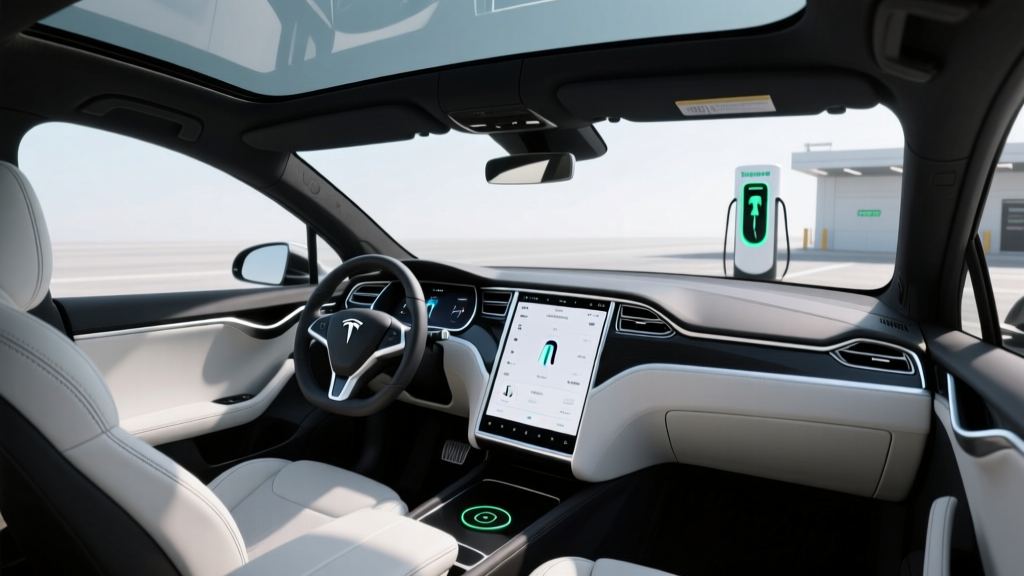
The phrase "inside of Tesla SUV" usually conjures images of the massive 17-inch center touchscreen, and the 2026 Model X does not disappoint on that front. The display runs Tesla's latest infotainment software with a faster processor than the outgoing generation, reducing app load times and improving the navigation rendering. A secondary 8-inch screen for rear passengers controls climate, media, and gaming — a meaningful upgrade for family road trips.
But the cabin story extends well beyond screens:
- Seating configurations: 5-seat (two-row), 6-seat (captain's chairs with center aisle), or 7-seat (bench third row)
- Front headroom: 40.5 inches | Front legroom: 41.2 inches
- Second-row headroom: 38.4 inches | Second-row legroom: 38.5 inches
- Third-row headroom: 37.1 inches | Third-row legroom: 32.7 inches (best suited for children or short-trip adults)
- Cargo behind third row: 15.0 cu ft
- Cargo behind second row (third row folded): 42.5 cu ft
- Max cargo (all rear seats folded): 85.7 cu ft
- Frunk (front trunk): 6.6 cu ft
The falcon-wing rear doors are the Model X's signature party trick, and they serve a genuine function: the double-hinged design opens upward and outward, creating an enormous aperture that makes loading child seats, groceries, or pets dramatically easier than a conventional SUV liftgate. However, they require overhead clearance (Tesla specifies a minimum of ~6 feet for full opening) and can be slow to operate in tight garages — a known trade-off that owners either love or learn to tolerate.
Build quality in the 2026 Model X has improved meaningfully over early-production units from prior years. Panel gaps are tighter, the synthetic leather (Tesla's "vegan leather") seats show better bolstering, and the yoke-style steering wheel (standard; a round wheel is a no-cost option) takes about a week of adaptation for most drivers.
Performance and Driving Dynamics
Even in its base Long Range form, the Model X produces 670 horsepower and sprints to 60 mph in 3.8 seconds — numbers that embarrass most performance SUVs with internal combustion engines. The tri-motor Plaid variant escalates to 1,020 hp and a 2.5-second 0–60 time, making it one of the quickest production SUVs ever built.
But straight-line speed is only part of the driving story. The Model X's air suspension provides a comfortable, adaptive ride with three height settings, and the low center of gravity (battery pack under the floor) keeps body roll surprisingly controlled for a 5,100-pound vehicle. The steering is precise if artificially weighted, and the regenerative braking — adjustable between standard and low modes — enables genuine one-pedal driving in most city conditions.
Towing capacity stands at 5,000 lbs with the optional tow package, adequate for a small boat or light camper trailer. Note that towing at maximum capacity will reduce effective range by 30–50%, depending on terrain and speed — a reality common to all electric SUVs in this class.
Autopilot, FSD Supervised, and Safety Technology
The 2026 Model X ships with Tesla's basic Autopilot suite (Traffic-Aware Cruise Control and Autosteer) as standard equipment. Full Self-Driving (Supervised) remains an $8,000 add-on (or $99/month subscription) and adds features like automatic lane changes, Navigate on Autopilot for highway interchanges, and Smart Summon for parking-lot retrieval. FSD has improved substantially in urban environments, but it still requires active supervision — sudden construction zones, faded lane markings, and complex intersections regularly demand driver intervention.
On safety, the Model X holds a 5-star overall rating from NHTSA and earns top marks from IIHS, including a Top Safety Pick+ designation. Standard active safety includes automatic emergency braking, blind-spot monitoring, lane departure warning, and rear cross-traffic alert.
Pricing, Trims, and Federal Tax Credit Eligibility
| Trim | Base MSRP | Destination | As-Tested (Typical) | §30D Credit Eligibility |
|---|---|---|---|---|
| Long Range AWD | $79,990 | $1,390 | ~$85,000–$92,000 | See eligibility notes below |
| Plaid (Tri-Motor) | $94,990 | $1,390 | ~$100,000–$110,000 | See eligibility notes below |
Federal EV tax credit eligibility for the Model X is nuanced under current IRS §30D rules. The Model X qualifies as an SUV for the credit, which sets the MSRP cap at $80,000. This means:
- Long Range AWD ($79,990 base): Technically under the $80,000 SUV MSRP cap — but adding any paid option (paint color, wheels, FSD, interior trim) pushes the MSRP above $80,000 and disqualifies the vehicle. A base-spec, no-options Long Range in a free paint color is the only configuration that may qualify.
- Plaid ($94,990 base): Exceeds the MSRP cap in all configurations. Not eligible for the §30D credit.
- Buyer income limits: Modified AGI must not exceed $300,000 (joint filers), $225,000 (head of household), or $150,000 (individual).
- Battery sourcing: The credit is split into two halves ($3,750 each) — one for critical minerals and one for battery component assembly. Tesla's supply chain has shifted significantly toward North American sourcing, but exact eligibility for the full $7,500 vs. $3,750 varies by production batch and model year. Verify with your tax professional and the IRS qualified vehicles list at time of purchase.
- Point-of-sale transfer: Eligible buyers can transfer the credit to the dealer at purchase, reducing the out-of-pocket cost immediately rather than waiting for tax filing.
Practical takeaway: most Model X buyers will not qualify for the full $7,500 federal credit due to the MSRP cap being easily breached with options. Budget accordingly and do not assume the credit when configuring your order.
Ownership Costs: Warranty, Insurance, and Long-Term Value
Tesla covers the 2026 Model X with the following warranty structure:
- Basic Vehicle Limited Warranty: 4 years / 50,000 miles
- Battery & Drive Unit Warranty: 8 years / 150,000 miles (Long Range) with a minimum 70% capacity retention threshold
- Plaid Battery & Drive Unit: 8 years / 150,000 miles, same 70% retention threshold
The 150,000-mile battery warranty is competitive with the industry standard (most rivals offer 8 years / 100,000 miles). Tesla's NMC battery chemistry typically shows 5–8% degradation over the first 100,000 miles based on fleet data, which translates to a range loss of roughly 17–27 miles from the original EPA figure — well within the warranty threshold for most owners.
Insurance costs for the Model X are notably higher than average. Expect annual premiums between $2,800 and $4,200 depending on your state, driving record, and coverage level. Tesla Insurance is available in select states and can be competitive, but shop multiple quotes. The high repair costs associated with the aluminum body, falcon-wing door mechanisms, and integrated glass roof contribute to elevated premiums.
Charging cost comparison: at the national average residential electricity rate of ~$0.16/kWh, fully charging the 95 kWh usable battery at home costs approximately $15.20 — equivalent to about $0.045 per mile. Compare that to a gas SUV averaging 22 MPG at $3.40/gallon ($0.155 per mile), and the Model X saves roughly $0.11 per mile on energy alone, or about $1,650 annually at 15,000 miles driven.
Pros, Cons, and the Competition
✅ Pros
- 335-mile EPA range is among the best in three-row EVs
- 250 kW Supercharger network with unmatched coverage
- Falcon-wing doors genuinely ease child-seat and cargo loading
- Class-leading 0–60 times (3.8s Long Range, 2.5s Plaid)
- Over-the-air updates continuously add features
- 8-year/150,000-mile battery warranty exceeds many rivals
- Strong 5,000-lb towing capacity for an EV SUV
❌ Cons
- $79,990+ base price; most configs exceed §30D MSRP cap
- Falcon-wing doors slow in tight garages; need overhead clearance
- Third-row legroom (32.7 in) is cramped for adults
- Insurance premiums significantly above segment average
- Yoke steering wheel requires adaptation; round wheel availability varies
- FSD ($8,000) remains a Level 2 system despite the name
- No Apple CarPlay or Android Auto — Tesla's native ecosystem only
Who Should Buy the 2026 Model X?
Choose the Model X if: You need three rows plus genuine 300+ mile range, you rely on the Supercharger network for frequent road trips, you value the falcon-wing doors for child-seat access, and you accept the $80K+ entry price as the cost of admission for Tesla's ecosystem.
Look elsewhere if: You need adult-friendly third-row space (consider the Rivian R1S or the Kia EV9), you want Apple CarPlay integration, you require the full $7,500 tax credit (most Model X configs won't qualify), or your budget is closer to $55,000–$65,000 (consider the Hyundai Ioniq 9 or a used Model X).
Frequently Asked Questions
What is the real-world range of the 2026 Tesla Model X?
The EPA rates the Long Range at 335 miles and the Plaid at 326 miles. In real-world mixed highway driving at 70–75 mph, expect approximately 275–300 miles. In cold weather (below freezing), effective range drops to roughly 230–270 miles due to battery resistance and cabin heating demands. Preconditioning the battery while plugged in before departure helps recover some of this loss.
How fast does the Model X charge at home and on the road?
At home on a Level 2 Tesla Wall Connector (11.5 kW / 48A), the Model X gains about 30–34 miles of range per hour, with a full charge taking roughly 10 hours. On a V3 or V4 Supercharger at up to 250 kW, a 10–80% charge takes approximately 30 minutes, adding up to 175 miles in the first 15 minutes. Charging slows significantly above 80% SoC to protect battery health.
Does the 2026 Model X qualify for the $7,500 federal EV tax credit?
Only in very specific configurations. The §30D SUV MSRP cap is $80,000. The Long Range base MSRP is $79,990, so a zero-option, base-paint configuration may qualify — but any add-on (premium paint, FSD, upgraded wheels) pushes MSRP above the cap and eliminates eligibility. The Plaid at $94,990 never qualifies. Buyer income limits ($300K joint / $150K individual) and battery-sourcing rules also apply. Verify current eligibility on the IRS qualified vehicles list and consult a tax professional.
Is the Model X worth buying vs. the Rivian R1S or BMW iX?
It depends on your priorities. The Model X wins on range (335 mi vs. ~316 mi for the R1S Dual-Motor), charging infrastructure (Supercharger access), and raw acceleration. The Rivian R1S (starting ~$75,900) offers a more rugged, adventure-oriented design, better third-row adult space, and a more conventional door system. The BMW iX (starting ~$72,000) offers a more luxurious interior and a quieter ride but only seats five and provides ~312 miles of range. If three-row seating and road-trip charging ease are your top priorities, the Model X holds a narrow edge.
What are the biggest drawbacks of owning a Model X?
The most commonly cited owner frustrations include: falcon-wing door sensors occasionally failing to detect overhead obstacles, higher-than-expected insurance premiums ($2,800–$4,200/year), a cramped third row unsuitable for adults on long trips, the absence of Apple CarPlay/Android Auto, and the $8,000 FSD package that remains a supervised Level 2 system. Service center wait times in some regions can also be lengthy for non-critical repairs.
How long will the Model X battery last?
Tesla warranties the battery for 8 years or 150,000 miles with a 70% capacity retention minimum. Fleet data suggests NMC packs in the Model X typically lose 5–8% capacity over the first 100,000 miles. Many high-mileage Tesla owners report 10–15% degradation at 150,000–200,000 miles. Battery replacement (if needed out of warranty) currently costs approximately $15,000–$22,000 including labor, though prices continue to decline as battery technology matures.