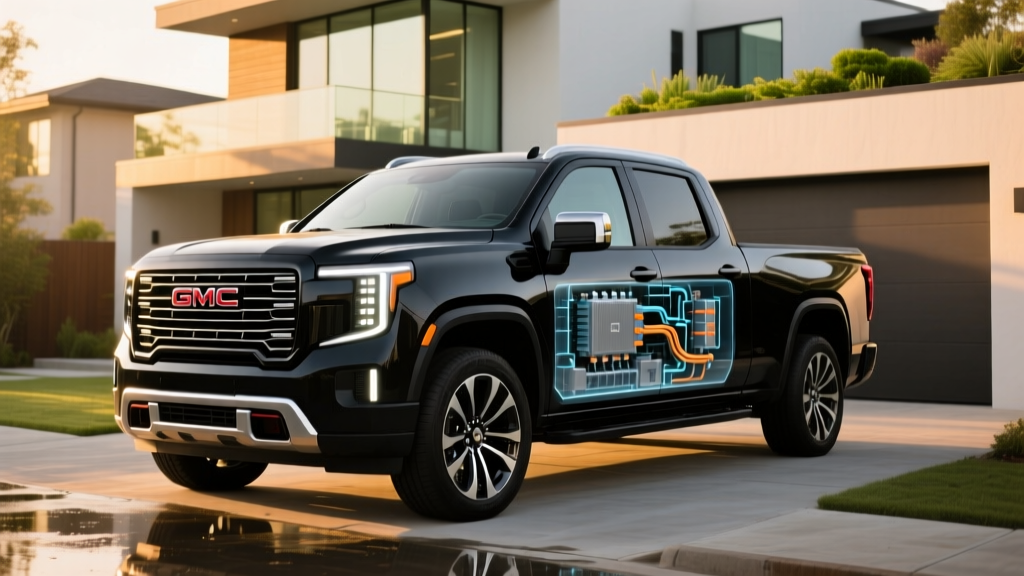
The 2026 GMC Sierra EV Denali: Quick Verdict
The 2026 GMC Sierra EV Denali truck is a premium electric full-size pickup that pairs luxury trim with serious capability. It offers an EPA-estimated 390 miles of range from its ~200 kWh Ultium battery pack, 754 horsepower (in Denali Edition 1 / top trims), and a peak DC fast-charge rate of 350 kW on 800V architecture — though sustained rates and real-world charging curves tell a more nuanced story. Starting MSRP for the Denali trim sits around $99,495 (before destination), placing it firmly in luxury-truck territory. It qualifies for the $7,500 federal tax credit under IRS §30D if you meet income caps and the vehicle meets battery-sourcing requirements — check current-year eligibility on irs.gov before committing.
Bottom line: If you need a full-size truck with premium features, can charge at home, and drive under 300 miles daily, the Sierra EV Denali is a compelling (if expensive) proposition. If you regularly tow heavy loads long-distance or lack home charging access, proceed with realistic expectations.
Range, Battery, and Real-World Expectations
The Sierra EV Denali rides on GM's Ultium platform with a massive battery pack rated at approximately 200 kWh usable capacity (NMC lithium-ion chemistry). The EPA rates the Denali Edition 1 at 390 miles of combined range, one of the highest figures in any production pickup. But EPA stickers don't tell the full story.
Real-World Range Reality Check
EPA Estimate: 390 miles (combined)
Highway driving (70-80 mph): Expect ~310-340 miles. Full-size trucks suffer aerodynamic drag penalties at speed.
Cold weather (below 30°F): Plan for 25-35% reduction, yielding ~250-290 miles. The Sierra EV includes a heat pump to mitigate cabin-heating losses, but battery chemistry still loses efficiency in cold.
Max towing (9,500 lb rated): Range can drop 40-50%, potentially to ~195-235 miles. This is physics, not a defect — all EVs lose range under heavy tow loads.
| Spec | Value |
|---|---|
| EPA Range (combined) | 390 miles |
| Battery Capacity (usable) | ~200 kWh (NMC) |
| Horsepower | 754 hp (Denali Edition 1) |
| Torque | 785 lb-ft |
| 0-60 mph | ~4.5 seconds |
| Max Towing Capacity | 9,500 lb (properly equipped) |
| Max Payload | ~1,800 lb |
| DC Fast Charge Peak | 350 kW (800V architecture) |
| 10-80% DC Charge Time | ~27 minutes (est. at optimal conditions) |
| Level 2 Home Charging | 19.2 kW (AC) |
| Base MSRP (Denali) | ~$99,495 |
| Battery/Powertrain Warranty | 8 years / 100,000 miles |
Charging: Home and on the Road
The Sierra EV Denali's 800V architecture enables peak DC fast-charging speeds up to 350 kW — but understanding the charge curve is essential. Peak rates apply only at low state-of-charge (typically 10-30% SoC) and taper significantly above 60-70%. Expect a 10-80% session to take roughly 27 minutes at a compatible 350 kW station (like Electrify America's newest stalls), but a full 10-100% session will take closer to 55-65 minutes because of tapering above 80%.
| Level | Power (kW) | Miles Added per Hour | Typical Use Case |
|---|---|---|---|
| Level 1 (120V) | ~1.4 kW | ~3 mi/hr | Emergency / trickle only |
| Level 2 (240V, 48A) | ~11.5 kW | ~24 mi/hr | Standard home charging |
| Level 2 (240V, 80A) | 19.2 kW | ~40 mi/hr | Upgraded home / depot |
| DC Fast (peak) | 350 kW | ~700+ mi/hr (at peak) | Road trips, 10-80% in ~27 min |
Home charging reality: With a ~200 kWh battery, a standard 48-amp Level 2 home charger (11.5 kW) needs approximately 17-18 hours for a full 0-100% charge. Most owners won't drain the battery fully, so a typical 60-80% overnight top-up takes 10-12 hours — achievable with nightly plug-in habits. If you drive 80 miles daily, you'll replenish that in about 7 hours on a 48A circuit. Upgrading to an 80A hardwired charger cuts this significantly but requires a 100-amp dedicated circuit — budget $1,500-$3,500 for professional installation including potential panel upgrades. Always get a quote from a licensed electrician before assuming your panel has capacity.
EV vs. Gas Sierra: Cost and Capability Compared
How does the Sierra EV Denali stack up against its gas-powered counterpart, the Sierra 1500 Denali with the 6.2L V8? The comparison reveals where EV ownership wins — and where it doesn't.
| Metric | Sierra EV Denali | Gas Sierra 1500 Denali (6.2L V8) |
|---|---|---|
| Base MSRP | ~$99,495 | ~$72,000 |
| Fed. Tax Credit (§30D) | Up to $7,500 | $0 |
| Effective Starting Price | ~$91,995 | ~$72,000 |
| Energy/Fuel Economy | ~63 MPGe / 54 kWh/100mi | ~16 MPG combined |
| Cost per Mile (fuel/energy) | ~$0.06-0.08 (home charging) | ~$0.22-0.28 ($3.70/gal gas) |
| Horsepower | 754 hp | 420 hp |
| 0-60 mph | ~4.5 sec | ~5.6 sec |
| Max Towing | 9,500 lb | ~13,000 lb (diesel/Max Tow) |
| Annual Maintenance (est.) | ~$300-500 | ~$800-1,200 |
| Range (full tank/battery) | 390 mi (EPA) | ~420 mi (26-gal tank) |
The EV Denali commands a $20,000-$27,000 premium over the gas version even after the tax credit. Where it wins: dramatically lower per-mile energy costs (saving roughly $2,000-$2,800 per year at 15,000 miles/year with home charging), reduced maintenance (no oil changes, fewer brake replacements due to regenerative braking), and vastly superior acceleration. Where it loses: maximum towing capacity falls short of the gas/diesel Sierra, upfront cost is significantly higher, and long-distance towing range is severely limited.
Total Cost of Ownership: 5-Year Breakdown
| Category | Sierra EV Denali | Gas Sierra 1500 Denali |
|---|---|---|
| Purchase Price (after credit) | $91,995 | $72,000 |
| Energy/Fuel | $4,500 (home charging avg.) | $16,800 (15 MPG avg., $3.70/gal) |
| Maintenance | $2,000 | $5,500 |
| Insurance (est. avg.) | $14,000 ($2,800/yr) | $10,500 ($2,100/yr) |
| Estimated Depreciation | $38,000 (est. 41%) | $32,000 (est. 44%) |
| 5-Year Total | ~$150,495 | ~$136,800 |
| Cost per Mile (all-in) | $2.01 | $1.82 |
Over five years, the EV Denali still costs roughly $13,000-$14,000 more than the gas version, primarily due to the higher purchase price and elevated insurance premiums. The fuel and maintenance savings are substantial — about $15,800 combined — but they don't fully close the gap at current pricing. At 10 years or 150,000 miles, the math shifts more favorably toward the EV, assuming battery health holds (GM's 8-year/100,000-mile battery warranty provides a floor).
Insurance note: EVs, especially high-performance luxury trucks, carry insurance premiums 25-40% higher than comparable gas vehicles. Get a quote before purchasing — this line item catches many first-time EV buyers off guard.
Federal Tax Credit and Incentive Eligibility
The GMC Sierra EV Denali is assembled in the U.S. (Orion Assembly/Detroit-Hamtramck) and is on the IRS list of eligible clean vehicles. However, the $7,500 §30D credit is not automatic. Current-year rules impose multiple requirements:
- MSRP cap: Trucks/vans/SUVs must have an MSRP at or below $80,000. The Sierra EV Denali's MSRP exceeds this cap — however, certain configurations or lower Sierra EV trims may qualify. Check fueleconomy.gov for the latest eligible trim list.
- Buyer income limits: AGI must not exceed $300,000 (married filing jointly), $225,000 (head of household), or $150,000 (single).
- Battery sourcing: Required percentages of critical minerals and battery components must be sourced from the U.S. or FTA partners. These thresholds tighten annually.
- Point-of-sale transfer: You can transfer the credit to the dealer at purchase to reduce your out-of-pocket cost, but you must still meet all eligibility requirements when filing taxes.
Critical caveat: At an MSRP of ~$99,495, the Sierra EV Denali likely exceeds the $80,000 truck MSRP cap for §30D eligibility in most trims. GM's lower Sierra EV trims (Elevation, certain AT4 configurations) may fall under the cap. Always verify current eligibility on irs.gov and consult a tax professional before relying on the credit in your purchase math.
Real-World Ownership: What First-Time EV Truck Buyers Must Know
| Myth | Fact |
|---|---|
| "390 miles means I'll get 390 miles no matter what" | EPA is a combined-cycle estimate. Highway-only at 75 mph yields ~320 mi; cold weather drops it further to ~260 mi. |
| "It charges at 350 kW the whole time" | 350 kW is a peak rate at low SoC. Average rate across a 10-80% session is closer to ~180-220 kW due to charge-curve taper. |
| "I can tow my 9,000-lb trailer 390 miles" | Heavy towing cuts range roughly in half. Plan for 180-220 miles between charging stops when towing near max capacity. |
| "No maintenance means no costs" | Tires wear 15-25% faster on heavy EVs due to instant torque and weight. Budget $1,200-$1,800 for a set of premium truck tires every 30,000-40,000 miles. |
| "Any outlet will charge it overnight" | A standard 120V outlet adds ~3 miles per hour — essentially useless for a 200 kWh battery. Level 2 (240V) home charging is a practical requirement. |
Home Charging Access Is Non-Negotiable
If you cannot install a Level 2 charger at home (or at a dedicated workplace station), owning a Sierra EV Denali with a ~200 kWh battery becomes impractical for daily use. Public DC fast charging is viable for road trips but relying on it daily is expensive ($0.35-$0.50/kWh vs. $0.12-$0.18/kWh at home), time-consuming, and accelerates battery wear if used exclusively.
Driving Patterns That Work (and Don't)
Ideal use case: Daily commuting under 100 miles, home charging every night, weekend trips under 350 miles, light-to-moderate towing on short hauls.
Challenging use case: Daily drives exceeding 250 miles, frequent max-load towing over 100+ miles, no access to home or workplace charging, regular travel through charging-desert regions (rural Mountain West, parts of the Great Plains).
Decision Framework: Is the Sierra EV Denali Right for You?
Choose the Sierra EV Denali if:
- You have reliable Level 2 home charging (or can install it)
- Your daily driving is under 150 miles round-trip
- You value instant torque, silent operation, and premium EV tech
- You want to eliminate gas station visits and reduce per-mile energy costs
- You tow occasionally on shorter routes (under 200 miles)
- The $100K price point fits your budget without relying on the tax credit
Stick with the Gas Sierra Denali (or wait) if:
- You regularly tow heavy loads over long distances (300+ miles)
- You lack home charging access and can't install a Level 2 circuit
- The MSRP cap disqualifies you from the federal tax credit, widening the price gap
- You frequently drive in regions with sparse DC fast-charging infrastructure
- Your budget is firm below $80,000
Consider the Sierra EV Elevation trim if:
- You want the Ultium EV platform at a lower price point (~$60,000-$75,000 range)
- You want to stay under the $80,000 MSRP cap for potential §30D eligibility
- You can live with fewer luxury features and slightly lower range
Frequently Asked Questions
What is the real-world range of the GMC Sierra EV Denali truck?
The EPA rates it at 390 miles combined. In real-world highway driving at 70-80 mph, expect approximately 310-340 miles. In cold weather (below 30°F), plan for 250-290 miles. When towing near maximum capacity, range drops to roughly 180-220 miles.
How long does it take to charge the Sierra EV Denali at home?
On a 48-amp Level 2 charger (11.5 kW), a full charge from 0-100% takes approximately 17-18 hours. On an 80-amp circuit (19.2 kW), it drops to about 10-11 hours. Most owners charge partially overnight — replenishing 100-150 miles of driving takes 6-9 hours on a 48A charger.
Does the Sierra EV Denali qualify for the $7,500 federal tax credit?
Eligibility depends on MSRP, buyer income, and battery-sourcing requirements. The Denali trim's MSRP of ~$99,495 likely exceeds the $80,000 truck cap under IRS §30D, making it ineligible in most configurations. Lower Sierra EV trims (Elevation) may qualify. Verify at irs.gov and consult a tax professional.
Can the Sierra EV Denali tow as much as the gas version?
No. The EV Denali is rated for up to 9,500 pounds (properly equipped), while the gas Sierra 1500 with available Max Trailering or diesel can reach 13,000+ pounds. Additionally, towing significantly reduces EV range — plan charging stops accordingly.
What does it cost to install a home Level 2 charger?
A typical Level 2 installation (48A hardwired) costs $800-$2,000 for equipment plus $500-$1,500 for electrician labor and permits — totaling $1,300-$3,500. If your electrical panel needs an upgrade to 200A service, add $2,000-$5,000. Always get a site assessment from a licensed electrician first.
How long will the Sierra EV Denali's battery last?
GM provides an 8-year/100,000-mile battery warranty covering defects and capacity loss below a specified threshold (typically 60-70% retention). NMC batteries in GM's Ultium platform are designed for 150,000-200,000+ miles before significant degradation. Real-world data from GM's Ultium fleet is still accumulating, but degradation of 10-15% over 100,000 miles is a reasonable expectation based on industry averages.
Is the Sierra EV Denali a self-driving truck?
No. The Sierra EV Denali offers GM's Super Cruise, which is an SAE Level 2 driver-assistance system. It provides hands-free driving on compatible mapped highways, but you must remain attentive and ready to take over at any time. It is not autonomous (Level 4) driving — you are always the responsible driver.
ADAS Note: Super Cruise on the Sierra EV Denali is an SAE Level 2 system. Despite the "hands-free" label, the driver must maintain attention (monitored via a driver-facing camera) and remain prepared to steer, brake, or accelerate at any moment. Only fully driverless services like Waymo operate at Level 4.
Sources and Further Reading
- EPA Fuel Economy (fueleconomy.gov) — Official range, MPGe, and tax credit eligibility data
- IRS Clean Vehicle Credit (§30D) — Current tax credit rules, income caps, MSRP limits
- GMC Sierra EV Official Page — Manufacturer specifications, trim details, and Super Cruise info