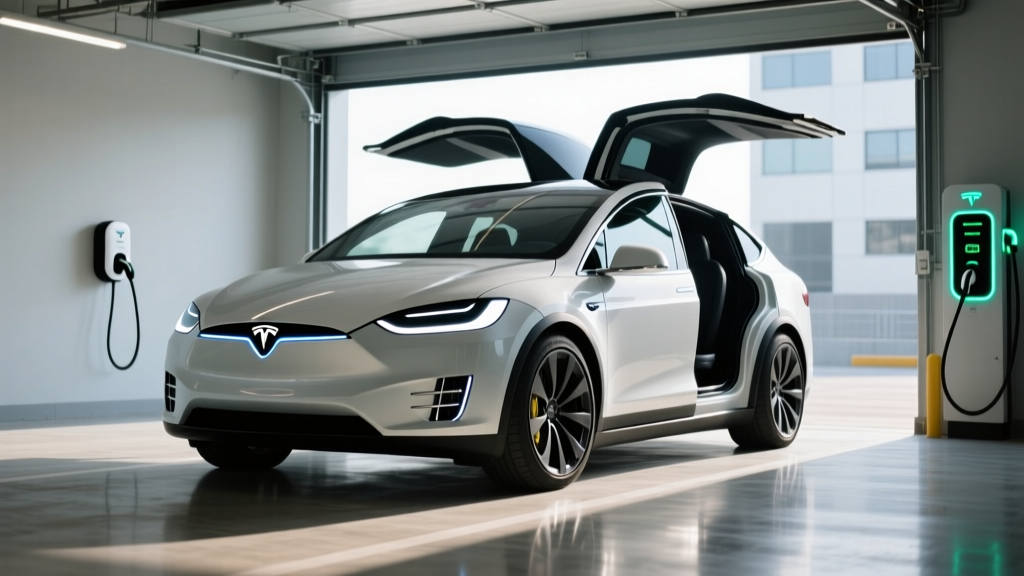
The Tesla Model X occupies a rare space in the EV market: a three-row, all-electric SUV with falcon-wing rear doors, a 1,021-horsepower Plaid variant, and Supercharger network access baked into every road trip. But for buyers researching garage fitment, third-row usability, and real-world efficiency, the details matter far more than the headlines. This profile covers every critical Tesla Model X dimension, pairs them with real-world range and charging data, and breaks down whether the 2026 Model X justifies its premium price against the Rivian R1S, BMW iX, and Mercedes EQS SUV.
Tesla Model X Dimensions: Exterior, Interior & Cargo
Garage depth, turning radius, and third-row headroom are the make-or-measure questions for any three-row SUV buyer. Here are the exact 2026 Tesla Model X dimensions, inside and out.
| Measurement | Specification |
|---|---|
| Overall Length | 199.1 in (5,057 mm) |
| Overall Width (mirrors folded) | 81.5 in (2,070 mm) |
| Overall Width (mirrors out) | 88.4 in (2,246 mm) |
| Overall Height | 66.9 in (1,699 mm) |
| Wheelbase | 116.7 in (2,965 mm) |
| Ground Clearance (adaptive, max) | 8.1 in (206 mm) |
| Curb Weight (Long Range) | 5,185 lbs (2,352 kg) |
| Front Headroom | 41.7 in |
| Second-Row Headroom | 40.9 in |
| Third-Row Headroom | 37.1 in |
| Front Legroom | 41.2 in |
| Second-Row Legroom | 40.2 in |
| Third-Row Legroom | 32.7 in |
| Cargo (behind 3rd row) | 13.0 cu ft (+ 5.7 cu ft frunk) |
| Cargo (3rd row folded) | 42.5 cu ft |
| Cargo (all rear rows folded) | 75.4 cu ft |
| Max Towing Capacity | 5,000 lbs |
Real-world fitment note: At nearly 200 inches long and over 81 inches wide with mirrors folded, the Model X requires a minimum single-car garage depth of roughly 22 feet for comfortable entry and closure. The 88.4-inch width with mirrors extended is a critical measure for tight parking structures. The falcon-wing doors require approximately 12 inches of lateral clearance to articulate — less than conventional outward-swinging doors, but overhead clearance (about 7 feet at full extension) matters in low-ceiling garages.
Range, Battery & Efficiency: EPA vs. Real World
EPA Estimated: 311 miles (Long Range AWD) | 326 miles (Plaid, per fueleconomy.gov)
Real-World Highway (70 mph, 72°F): ~260–280 miles
Real-World Cold Weather (20°F, highway): ~200–230 miles (30–35% reduction typical for NMC chemistry without heat pump preconditioning)
City/Stop-and-Go: ~290–310 miles (regenerative braking recovers energy efficiently)
The 2026 Model X Long Range AWD carries a ~100 kWh usable battery pack using NMC (nickel manganese cobalt) chemistry. Tesla does not publish exact pack capacity, but teardown data and efficiency calculations confirm approximately 100 kWh usable from a ~105 kWh gross pack — the buffer protects long-term State of Health (SoH).
Efficiency on the EPA combined cycle lands at 102 MPGe, or roughly 33 kWh per 100 miles. That's competitive for a 5,185-lb three-row SUV but noticeably thirstier than the Model Y Long Range (~28 kWh/100mi). Expect higher consumption when towing — real-world trailer pulls at highway speed can push consumption past 55 kWh/100mi, effectively halving range.
The Model X uses a heat pump (standard since the 2021 refresh), which significantly reduces cabin-heating energy draw in cold weather compared to resistive heaters. Preconditioning the battery while plugged in — set via the Tesla app before departure — recovers an estimated 5–10% of range in sub-freezing conditions.
Charging Speed: DC Fast, Level 2 & Home Setup
Charging speed is where the Model X's 2026 architecture shows both its strengths and its age. The V4 Supercharger-compatible peak rate is 250 kW on DC fast charging — respectable, but below the 350 kW peaks offered by the Hyundai Ioniq 9 and Lucid Gravity.
| Charging Level | Power / Rate | Time / Range Added |
|---|---|---|
| DC Fast Charge (V3/V4 Supercharger) | 250 kW peak | 10–80% in ~32 minutes; ~175 miles in 15 min |
| DC Fast Charge (CCS adapter, 3rd-party) | Up to 250 kW (station-dependent) | Similar to Supercharger; varies by network |
| Level 2 (Tesla Wall Connector, 48A) | 11.5 kW | ~34 miles per hour of charging |
| Level 2 (standard 240V/40A outlet) | 9.6 kW | ~28 miles per hour of charging |
| Level 1 (120V household) | ~1.4 kW | ~3–4 miles per hour (emergency/trickle only) |
Charging curve reality: The 250 kW peak is not sustained across the full session. The Model X typically holds above 200 kW from roughly 10% to 35% State of Charge (SoC), then tapers progressively — dropping to ~100 kW by 60% SoC and ~50 kW by 80%. A 10–80% session on a V3 Supercharger takes approximately 32 minutes under ideal thermal conditions. Arriving at the charger with a cold battery (below 50°F) without preconditioning can add 10–15 minutes to this time.
Home charging recommendation: A Tesla Wall Connector on a 60-amp circuit (48A continuous) delivers a full charge from 20% to 100% overnight in roughly 8–9 hours. Most owners will need an electrical panel assessment; homes with 100-amp service may require a $1,500–$3,000 panel upgrade to support a dedicated 60-amp EV circuit alongside existing loads. Always consult a licensed electrician for final installation specs.
Performance & Powertrain
Two trims define the 2026 Model X lineup, and both use dual-motor all-wheel drive:
| Spec | Long Range AWD | Plaid (Tri-Motor AWD) |
|---|---|---|
| Drivetrain | Dual-Motor AWD | Tri-Motor AWD |
| Horsepower | 670 hp | 1,021 hp |
| 0–60 mph | 3.8 seconds | 2.5 seconds |
| Top Speed | 155 mph | 163 mph |
| EPA Range | 311 miles | 326 miles |
| Battery (usable) | ~100 kWh (NMC) | ~100 kWh (NMC) |
The Long Range is the volume seller and the pragmatic pick — 670 hp in a family SUV is already absurd by any pre-EV standard. The Plaid's 2.5-second 0–60 time is a party trick that loses relevance after the first demonstration, but its tri-motor torque vectoring does improve all-weather traction and cornering stability. For 95% of buyers, the Long Range delivers the better range-to-price ratio.
Pricing, Trims & Federal Tax Credit Eligibility
| Trim | Base MSRP | Est. As-Tested (typical options) |
|---|---|---|
| Long Range AWD (5-seat) | $79,990 | $85,000–$92,000 |
| Long Range AWD (6-seat) | $84,990 | $90,000–$96,000 |
| Long Range AWD (7-seat) | $84,990 | $90,000–$96,000 |
| Plaid (Tri-Motor) | $94,990 | $100,000–$110,000 |
- MSRP Cap: SUVs/vans must be ≤ $80,000 to qualify. The Model X Long Range 5-seat base MSRP ($79,990) clears this threshold — but adding any options (paint, wheels, FSD) pushes it over, eliminating eligibility.
- Income Cap: Modified AGI ≤ $150,000 (single) / $225,000 (head of household) / $300,000 (married filing jointly).
- Battery Sourcing: Critical minerals and battery component requirements under the Inflation Reduction Act must be met. Tesla's North American battery sourcing has improved, but specific Model X pack compliance can vary by production batch. Verify via the VIN at the IRS portal or fueleconomy.gov.
- Point-of-Sale Transfer: Eligible buyers can transfer the credit to the dealer at purchase, reducing the out-of-pocket price by up to $7,500 at the time of sale.
- Plaid Ineligibility: At $94,990 MSRP, the Plaid exceeds the $80,000 SUV cap and does not qualify for the §30D new-vehicle credit.
Always confirm eligibility with a tax professional and the IRS clean vehicle credit page before purchase.
Technology, Safety & Driver Assistance
The Model X runs Tesla's current infotainment stack on a 17-inch landscape touchscreen with AMD Ryzen processing power — the same hardware found across the refreshed S/3/Y lineup. A 12.3-inch digital instrument cluster sits behind the yoke (or optional round steering wheel), and rear passengers get an 8-inch screen for climate and entertainment control.
Autopilot & FSD (Supervised): Every Model X ships with basic Autopilot (Traffic-Aware Cruise Control + Autosteer). Full Self-Driving (Supervised) remains an $8,000 option or $99/month subscription. Critically, FSD is SAE Level 2 — the driver must remain fully engaged, hands on the wheel, eyes on the road at all times. It is not autonomous driving. Tesla's camera-only vision stack handles highway merges and urban intersections competently in favorable conditions but can struggle with construction zones, faded lane markings, and heavy rain.
This is a Level 2 driver-assistance system, not a self-driving car. The driver is legally and operationally responsible for all vehicle movements. FSD does not handle: unmapped roads, severe weather, stopped emergency vehicles in all scenarios, or complex construction detours. Hands-off driving is not permitted and is monitored via cabin camera.
Safety ratings: The Model X earned a 5-star overall rating from NHTSA (2024 model year carried forward) and top scores in frontal and side crash tests. The IIHS has not fully re-evaluated the 2026 model year as of this writing; check their site for updates.
Standout features: Falcon-wing rear doors (power-operated, ultrasonic obstacle sensing), HEPA air filtration with Bioweapon Defense Mode, 22-speaker audio, power-folding second/third rows, 5,000-lb towing with integrated trailer sway control, and over-the-air software updates that add features post-purchase.
Who Should Buy the Model X — And Who Shouldn't
- You need three rows and electric powertrain with Supercharger road-trip access
- You tow up to 5,000 lbs and want integrated EV trailer management
- You value falcon-wing doors for tight parallel-parking child-seat access
- You want 670+ hp AWD performance in a family hauler
- Third-row space is a priority — the Model X third row is best for children (32.7" legroom); adults will find it cramped on trips over 30 minutes. The Rivian R1S offers more usable third-row volume.
- You need maximum cargo space — 13 cu ft behind the third row is tight for a vehicle this size
- Budget is a concern — the $80K+ MSRP plus likely ineligibility for the federal credit (once options are added) makes this one of the most expensive electric SUVs available
- You want the latest platform — the Model X architecture dates to the 2015 launch, refreshed in 2021. Competitors like the BMW iX and upcoming platforms ride on newer underpinnings
Pros, Cons & Competitive Verdict
- Supercharger network — still the most reliable DC fast-charging ecosystem
- 670 hp Long Range / 1,021 hp Plaid — no three-row SUV matches this performance
- Falcon-wing doors — genuinely useful for car-seat access in tight spots
- OTA updates continuously add features
- 5,000-lb towing capacity with trailer assist
- HEPA cabin filtration is best-in-class
- Third-row legroom (32.7") is inadequate for adults on longer trips
- Cargo behind 3rd row (13 cu ft) is below midsize SUV norms
- Tax credit eligibility is extremely fragile — any option eliminates it
- 250 kW peak DC charging trails newer 800V platforms (350 kW)
- Panel gaps and interior material quality lag BMW/Mercedes at this price
- Yoke steering is polarizing; round wheel costs extra
- Plaid exceeds $80K MSRP cap — no federal credit
Competitive landscape: The Rivian R1S (Dual-Motor, ~$75,900) offers a more usable third row, better off-road capability, and a more modern platform — but lacks Supercharger access (though NACS adapters partially close the gap). The BMW iX xDrive50 (~$87,000) delivers a far superior interior and ride quality but seats only five. The Mercedes EQS SUV (~$105,000) offers three rows with more luxury but at a steep premium and slower DC charging. The Model X wins on performance-per-dollar and charging infrastructure; it loses on interior refinement and third-row practicality.
Frequently Asked Questions
What is the real-world range of the Tesla Model X?
The EPA rates the Long Range AWD at 311 miles and the Plaid at 326 miles. In real-world highway driving at 70 mph in moderate temperatures, expect 260–280 miles. In cold weather (below 30°F), highway range drops to roughly 200–230 miles. City driving with regenerative braking can approach EPA figures.
How fast does the Model X charge at home and on the road?
On a V3/V4 Supercharger, the Model X peaks at 250 kW and charges from 10–80% in approximately 32 minutes. At home on a Tesla Wall Connector (11.5 kW / 48A), it adds about 34 miles per hour — a full overnight charge from 20% takes roughly 8–9 hours.
Does the 2026 Tesla Model X qualify for the $7,500 federal tax credit?
Only the base Long Range 5-seat at $79,990 MSRP clears the $80,000 SUV cap — and only if you add zero options that push MSRP above $80,000. You must also meet income caps ($300K joint / $150K single) and the vehicle must satisfy IRS battery-sourcing requirements. The Plaid ($94,990) does not qualify. Verify your specific VIN at fueleconomy.gov before purchase.
Is the Model X worth buying over the Rivian R1S or BMW iX?
If Supercharger access, three-row seating, and extreme performance are your top three priorities, the Model X is the only vehicle that checks all three. If third-row comfort and interior quality matter more, the Rivian R1S and BMW iX are stronger choices. Test-drive all three with your family in the second and third rows before committing.
What are the biggest pros and cons of the Model X?
Pros: Supercharger access, 670–1,021 hp, falcon-wing doors, 5,000-lb towing, OTA updates. Cons: Cramped third row, limited cargo behind the third row, fragile tax credit eligibility, 250 kW peak charging trails newer 800V rivals, interior quality doesn't match luxury competitors at this price point.
What is the battery warranty on the Tesla Model X?
Tesla covers the Model X battery and drive unit for 8 years or 150,000 miles (whichever comes first), with a guaranteed minimum 70% capacity retention over that period. This is competitive with industry norms (most rivals offer 8yr/100,000mi). Real-world degradation data from Tesla owners suggests NMC packs typically retain 85–90% capacity at 100,000 miles when DC fast charging is used moderately.