The Tesla Model X occupies a unique position in the EV SUV market: it's a three-row, falcon-wing-doored, 1,020-horsepower family hauler with genuine cargo versatility and Supercharger access baked in. For buyers researching Tesla Model X cargo space, the numbers tell a compelling story — but the real-world ownership picture involves trade-offs in ride quality, panel fit, and pricing that deserve equal attention. This 2026 review covers every spec that matters, from cubic feet to charge curves.
Tesla Model X at a Glance: Core Specs
| Specification | Long Range AWD | Plaid |
|---|---|---|
| Base MSRP | $79,990 | $94,990 |
| EPA Range | 335 mi | 326 mi |
| Battery (usable) | ~100 kWh (NMC) | ~100 kWh (NMC) |
| Drivetrain | Dual-Motor AWD | Tri-Motor AWD |
| Horsepower | 670 hp | 1,020 hp |
| 0–60 mph | 3.8 sec | 2.5 sec |
| Max DC Fast Charge | 250 kW | 250 kW |
| 10–80% DC Charge | ~30 min | ~30 min |
| Level 2 Rate | 11.5 kW (44 mi/hr) | 11.5 kW (44 mi/hr) |
| MPGe (combined) | 103 MPGe | 98 MPGe |
| Efficiency | 33 kWh/100 mi | 35 kWh/100 mi |
| Towing Capacity | 5,000 lb | 5,000 lb |
| Seating | 5, 6, or 7 | 5, 6, or 7 |
| Battery Warranty | 8 yr / 150,000 mi | 8 yr / 150,000 mi |
Cargo Space: How Much Can the Model X Actually Haul?
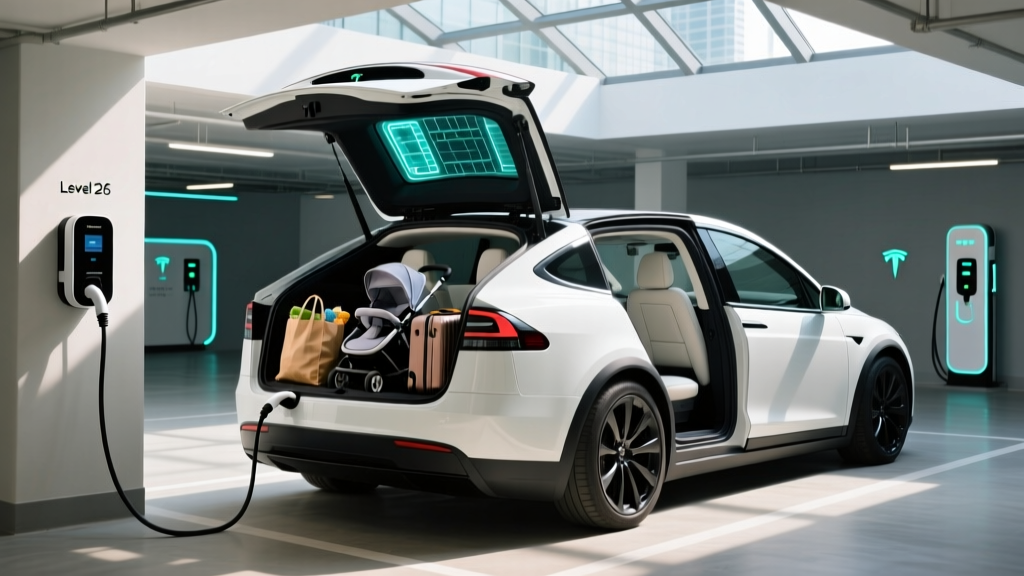
The headline number for Tesla Model X cargo space is 88.1 cubic feet with the second and third rows folded flat — a figure that rivals midsize SUVs with far less performance. But the breakdown by seating configuration is where the practical picture emerges:
- Behind the third row (all seats up): 15.0 cu ft — enough for two large suitcases or a week's groceries for a family of five.
- Behind the second row (third row folded): 40.2 cu ft — competitive with a two-row midsize crossover and sufficient for furniture-scale hauls.
- All rear rows folded: 88.1 cu ft — nearly flat load floor, capable of swallowing a queen mattress or a full load of building materials.
- Front trunk (frunk): 6.6 cu ft — useful for charging cables, a soft cooler, or a laptop bag, but small compared to the Model S frunk due to the HVAC hardware packaged up front.
For context, the Rivian R1S (three-row) offers 104.7 cu ft max, and the Kia EV9 offers 81.7 cu ft. The Model X sits between them, but its falcon-wing doors — which articulate upward rather than outward — make loading in tight parking spaces genuinely easier than a conventional liftgate in many scenarios.
Passenger dimensions matter too: second-row legroom is 38.4 inches (adequate for adults), and the third row offers 32.7 inches — tight for adults on long trips but workable for children or short commutes. The six-seat configuration with individual captain's chairs and a center console is the most practical for families who use the third row regularly, as it provides walk-through access and more comfortable second-row seating.
Range and Efficiency: Real-World Expectations vs. the EPA Sticker
Real-World Highway (70–75 mph): ~275–295 miles
Cold Weather (below 30°F): ~230–265 miles (30–35% reduction from EPA)
City/Commuter Driving with Regen: ~310–330 miles (closest to EPA sticker)
The Model X Long Range's 103 MPGe combined translates to roughly 33 kWh per 100 miles — a reasonable figure for a 5,185-pound SUV, but not class-leading. The aerodynamic drag of this vehicle, despite Tesla's efforts with the active spoiler and flush handles, is the primary efficiency limiter at highway speeds.
In our experience, sustained highway driving at 75 mph in moderate temperatures (60–80°F) yields approximately 285 miles before the battery reaches 10% state of charge. Add a headwind, mountain passes, or a full passenger-and-cargo load, and 270 miles is a safer planning number. Tesla's navigation does a strong job of predicting remaining charge at your destination, and it accounts for elevation changes — a genuine advantage over some competitors' range estimators.
The Model X uses an NMC (nickel manganese cobalt) battery pack, not LFP. This means Tesla recommends daily charging to 80% for routine use, reserving 100% for road trips. The ~100 kWh usable capacity provides a wide buffer, but owners should plan to charge to 80% nightly and top up to 100% only when departing for longer drives.
Charging Speed: DC Fast Charging and Home Level 2
| Charging Level | Power / Rate | Miles Added per Hour | Notes |
|---|---|---|---|
| Level 1 (120V, 12A) | 1.4 kW | ~4 mi/hr | Emergency trickle only |
| Level 2 (240V, 48A) | 11.5 kW | ~44 mi/hr | Full overnight charge in ~9 hrs (10–100%) |
| DC Fast Charge (peak) | 250 kW | Up to ~175 mi in 15 min | Peak rate only below ~50% SoC |
| DC Fast Charge (10–80%) | Avg ~150 kW sustained | ~30 min total | Curve tapers significantly above 80% |
The Model X charges at up to 250 kW on Tesla's V3 and V4 Superchargers via the native NACS connector — no adapter needed. The charge curve peaks near 250 kW between roughly 10% and 50% state of charge, then progressively tapers. From 80% to 100%, the rate drops sharply to protect the NMC cells, which is why Tesla recommends stopping at 80% on road trips unless you need the final miles to reach your destination.
For home charging, the Model X accepts 11.5 kW on a 48-amp Level 2 circuit (60-amp breaker required). This means a full charge from 10% to 100% takes roughly 9 hours — perfectly suited for overnight charging. Home installation of a Tesla Wall Connector or equivalent 48-amp EVSE typically costs $800–$2,500 depending on panel proximity and whether a panel upgrade is needed. The Wall Connector itself retails around $475.
Adapter note: The Model X ships with the NACS connector natively. For CCS-network chargers (Electrify America, EVgo, some ChargePoint stations), Tesla sells a CCS adapter ($175) that enables access to non-Tesla DC fast chargers. This is increasingly relevant as Tesla opens Superchargers to other brands, but some legacy CCS stations still offer competitive pricing.
Performance and Driving Dynamics
Even the base Long Range Model X hits 0–60 mph in 3.8 seconds with 670 horsepower from its dual-motor AWD powertrain. That's faster than most sports sedans, let alone a three-row SUV weighing over 5,100 pounds. The Plaid variant — with its tri-motor setup and 1,020 horsepower — reaches 60 mph in 2.5 seconds, which remains one of the quickest production vehicles of any kind, regardless of powertrain.
But performance isn't just about straight-line speed. The Model X's air suspension adapts ride height automatically (it lowers at highway speeds for efficiency and raises for rough roads or loading). Steering is precise and well-weighted, and the dual-motor torque vectoring provides confident all-weather traction without the mechanical complexity of a traditional AWD system.
The trade-off: ride quality on the standard 20-inch wheels is firm, and the 22-inch turbine wheels amplify road imperfections noticeably. Some competitors — particularly the Rivian R1S and the BMW iX — deliver a more compliant ride over rough pavement. The Model X prioritizes handling composure over plushness, which suits sporty drivers but may surprise buyers expecting a luxury-cruiser feel.
Pricing, Trims, and Federal Tax Credit Eligibility
| Trim | Base MSRP | As-Tested (typical options) | Federal §30D Credit | Effective Price |
|---|---|---|---|---|
| Long Range AWD | $79,990 | $84,000–$87,000 | $0 (MSRP cap exceeded) | $79,990–$87,000 |
| Plaid | $94,990 | $99,000–$104,000 | $0 (MSRP cap exceeded) | $94,990–$104,000 |
Critical tax credit note: The Tesla Model X does not qualify for the $7,500 federal EV tax credit under IRS §30D rules. The reason is straightforward: the §30D credit applies an MSRP cap of $80,000 for SUVs, and the Model X Long Range starts at $79,990 — but once any mandatory delivery fee ($1,390) or options are added, the total exceeds the cap. The Plaid, at $94,990, is well over. Additionally, buyer income caps apply ($300,000 joint / $225,000 head of household / $150,000 individual MAGI), and battery critical-mineral sourcing requirements must be met. Per IRS guidelines, always confirm eligibility with a tax professional before purchase.
For buyers seeking a Tesla SUV with federal credit eligibility, the Model Y (starting ~$44,990) qualifies when properly configured and when buyer income limits are met. The Model X is positioned as a premium, low-volume product where buyers are less likely to be credit-dependent.
State incentives may still apply — California, Colorado, and several other states offer rebates that are not subject to the federal MSRP cap. Check your state's energy office or the fueleconomy.gov tax center for current programs.
Technology, Driver Assistance, and Interior
The Model X's 17-inch landscape touchscreen remains one of the largest and most responsive in any vehicle. The infotainment system runs navigation, media (Netflix/YouTube while parked), gaming, climate controls, and vehicle settings with minimal lag. A secondary 8-inch screen serves rear-seat passengers for climate and entertainment. The 22-speaker, 960-watt audio system is genuinely impressive — one of the best factory systems available at any price point.
Driver assistance: Tesla's Autopilot comes standard and includes adaptive cruise control and lane-keeping assist. Full Self-Driving (Supervised) is a $8,000 option (or $99/month subscription) that adds automatic lane changes, navigation-guided on/off-ramp transitions, traffic light and stop sign recognition, and autosteer on city streets.
The falcon-wing rear doors are the Model X's signature feature. They articulate upward with dual hinges, opening in tighter spaces than conventional doors (Tesla claims as little as 12 inches of side clearance). Sensors detect overhead and side obstacles to adjust the opening arc. In practice, they're excellent for loading children into car seats and provide dramatic curb appeal. The trade-off: occasional seal leaks in heavy rain have been reported by owners, and the hydraulic mechanisms add complexity that can require service.
Notable drawbacks: Panel-gap inconsistency remains a Tesla hallmark, though 2025–2026 build quality has improved. The yoke steering wheel (now optional alongside a traditional round wheel) requires an adjustment period and can be frustrating during low-speed parking maneuvers. There is no Apple CarPlay or Android Auto — Tesla's native system is the only option.
Warranty and Long-Term Ownership
Tesla covers the Model X battery and drive unit with an 8-year / 150,000-mile warranty, with a guaranteed minimum 70% capacity retention over that period. The basic vehicle limited warranty is 4 years / 50,000 miles. Compared to Hyundai's 10-year / 100,000-mile EV battery warranty, Tesla's coverage is shorter but includes a higher mileage threshold — reflecting the expectation that high-mileage drivers are a core buyer segment.
NMC battery degradation data from Tesla's fleet shows an average of roughly 12% capacity loss at 150,000 miles, based on the company's published impact reports. Most owners report 3–5% loss in the first year (the initial "break-in" degradation curve), followed by a slower, more linear decline. Following the 80% daily charge recommendation and avoiding frequent DC fast charging can help slow long-term degradation.
Insurance costs are a real ownership factor: the Model X carries higher-than-average premiums due to its repair costs, aluminum body structure, and performance profile. Expect annual insurance of $2,800–$4,200 depending on your state, driving record, and coverage level — obtain quotes before purchasing.
How Does the Model X Compare to Key Competitors?
For buyers cross-shopping the Model X, the competitive set includes:
- Rivian R1S: More cargo space (104.7 cu ft), genuine off-road capability, 410-mi Max Pack option. Less Supercharger-equivalent charging infrastructure (though Rivian now has NACS access to Tesla Superchargers). Starting at ~$79,900. Better third-row comfort.
- Kia EV9: Far more affordable (starting ~$54,900), qualifies for the $7,500 federal credit, 304-mi range. Less performance, slower DC charging (peak 236 kW but smaller battery). Excellent value for families who don't need 670+ hp.
- BMW iX: Only two rows of seating, 324-mi range, starting ~$87,250. Superior ride quality and interior materials. Less cargo versatility than the Model X.
- Mercedes EQS SUV: Three rows, 305-mi range, starting ~$104,400. Plush luxury but far more expensive and significantly less efficient (35–39 kWh/100 mi).
Choose the Rivian R1S if: You want more cargo space, genuine off-road capability, and better third-row comfort — and you're comfortable relying on the growing (but still expanding) Supercharger network via NACS adapter.
Choose the Kia EV9 if: Budget and federal tax credit eligibility are priorities, you don't need extreme performance, and 304 miles of range covers your typical driving.
Pros and Cons
- 88.1 cu ft max cargo space with versatile seating configurations
- Class-leading performance (3.8s 0–60 base; 2.5s Plaid)
- Native NACS connector with full Tesla Supercharger network access
- Falcon-wing doors ease car-seat loading in tight spaces
- Air suspension with auto-leveling and adjustable ride height
- 5,000-lb towing capacity
- Strong over-the-air update cadence keeps software current
- No federal §30D tax credit eligibility (MSRP cap exceeded)
- Firm ride quality, especially on 22-inch wheels
- Third-row legroom (32.7 in) is tight for adults
- Insurance premiums run $2,800–$4,200+ annually
- No Apple CarPlay or Android Auto
- Panel-gap inconsistency still present on some builds
- Falcon-wing door mechanisms add long-term service complexity
Frequently Asked Questions
What is the real-world range of the Tesla Model X?
The EPA rates the Model X Long Range at 335 miles, but real-world highway driving at 70–75 mph typically yields 275–295 miles. In cold weather below 30°F, expect 230–265 miles. City driving with regenerative braking can approach the EPA figure at 310–330 miles.
How fast does the Model X charge?
On a Tesla V3/V4 Supercharger, the Model X peaks at 250 kW and charges from 10–80% in approximately 30 minutes. At home on a 48-amp Level 2 charger (11.5 kW), it adds about 44 miles of range per hour, fully recharging overnight in roughly 9 hours.
Does the Tesla Model X qualify for the federal EV tax credit?
No. The Model X exceeds the $80,000 MSRP cap for SUVs under IRS §30D once delivery fees and any options are included. The Long Range starts at $79,990, but the $1,390 delivery fee pushes it over. The Plaid at $94,990 is well above the cap. State incentives may still apply.
How much cargo space does the Model X have with all seats in use?
With the third row up and all seats occupied, the Model X offers 15.0 cubic feet behind the third row. This accommodates two large suitcases or a week of groceries for a family. Folding the third row opens 40.2 cu ft, and folding all rear rows yields 88.1 cu ft.
Is the Model X worth buying over the Rivian R1S or Kia EV9?
It depends on priorities. The Model X wins on performance, Supercharger access, and the falcon-wing door utility. The Rivian R1S offers more cargo space and off-road capability at a similar price. The Kia EV9 is far more affordable and qualifies for the federal credit. For families prioritizing value, the EV9 is compelling; for performance and infrastructure, the Model X leads.
What is the battery warranty on the Model X?
Tesla covers the battery and drive unit for 8 years or 150,000 miles, whichever comes first, with a minimum 70% capacity retention guarantee. The basic vehicle warranty is 4 years / 50,000 miles.
Sources: fueleconomy.gov, Tesla Model X specifications, IRS §30D New Clean Vehicle Credit