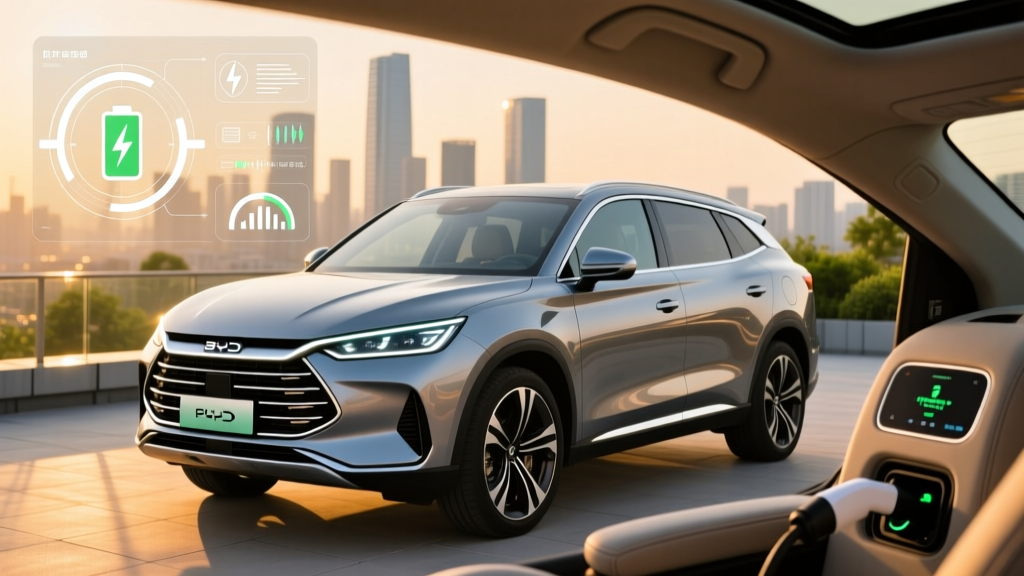
The BYD Tang has built a loyal following in China and Europe as a spacious, tech-forward electric SUV with three rows of seating and dual-motor performance. As BYD expands its global footprint, US shoppers are asking whether the Tang could become a viable alternative to established players like the Tesla Model Y, Hyundai Ioniq 9, or Kia EV9. This profile examines the Tang's known specifications, real-world expectations, and ownership economics based on the latest available data.
Range & Efficiency: What to Expect
Global-market versions of the BYD Tang EV typically feature a 108.8 kWh Blade Battery pack (LFP chemistry). In China's CLTC test cycle, the Tang is rated at approximately 458 miles (730 km). However, CLTC figures are notoriously optimistic compared to the US EPA standard.
Real-World Expectation: Expect 260–290 miles in mixed highway driving at 70 mph; 220–250 miles in freezing temperatures or mountainous terrain. LFP chemistry offers better longevity but slightly lower energy density than NMC, which partially explains the gap between CLTC and projected EPA figures.
The Tang's efficiency is estimated at around 89–95 MPGe combined (roughly 35–38 kWh/100 miles). For comparison, the Hyundai Ioniq 9 Long Range AWD achieves 90 MPGe combined with a 311-mile EPA rating from its 110.3 kWh NMC pack. The Tang's heavier curb weight (~5,300 lbs) and boxy profile work against highway efficiency.
Battery Chemistry & Degradation
BYD's proprietary Blade Battery uses lithium iron phosphate (LFP) cells arranged in a structural pack that doubles as a chassis component. LFP offers distinct trade-offs versus the nickel-manganese-cobalt (NMC) chemistry used in most Korean and American EVs:
| Factor | BYD Blade (LFP) | Typical NMC |
|---|---|---|
| Cycle Life | 3,000+ cycles | 1,000–2,000 cycles |
| Thermal Stability | Excellent (nail-penetration safe) | Good (requires active cooling) |
| Energy Density | Lower (~160 Wh/kg cell) | Higher (~250 Wh/kg cell) |
| Cold-Weather Loss | 15–25% range reduction | 10–20% range reduction |
| Recommended SoC | Can charge to 100% regularly | 80% daily, 100% for trips |
BYD warranties the Blade Battery for 8 years/150,000 km (roughly 93,000 miles) in European markets, retaining at least 70% capacity. US warranty terms would likely mirror the standard 8-year/100,000-mile requirement to comply with EPA and CARB norms.
Charging Speed: DC Fast & Home Level 2
The BYD Tang supports DC fast charging at up to 170 kW peak via CCS2 (Europe) or GB/T (China). If US-spec models adopt NACS or CCS1, peak rates should remain similar.
| Charging Level | Power (kW) | Miles Added/Hour | Time (10–80%) |
|---|---|---|---|
| Level 1 (120V) | 1.4 kW | ~4 mi/hr | Not practical |
| Level 2 (240V, 48A) | 11.5 kW | ~32 mi/hr | ~9 hours |
| DC Fast (peak) | 170 kW | ~200 mi in 30 min | ~30 minutes |
Charging curve reality: The Tang peaks at 170 kW only between roughly 10–40% state of charge. From 40–80%, the rate tapers to 90–120 kW, which is why the 10–80% time stretches to about 30 minutes. For context, the Hyundai Ioniq 9 peaks at 240 kW and completes 10–80% in ~20 minutes on a 350 kW charger.
Home charging on a Level 2 wallbox (11.5 kW) adds roughly 32 miles of range per hour. A full overnight charge from 20% to 100% takes about 8–9 hours — adequate for most commuters who plug in upon returning home.
Performance & Drivetrain
The global BYD Tang EV uses a dual-motor all-wheel-drive layout producing 510 horsepower and 516 lb-ft of torque. BYD claims a 0–100 km/h (0–62 mph) time of 4.4 seconds, which translates to roughly 4.2 seconds 0–60 mph.
| Specification | BYD Tang EV (Global) |
|---|---|
| Drivetrain | Dual-motor AWD |
| Horsepower | 510 hp |
| Torque | 516 lb-ft |
| 0–60 mph | ~4.2 seconds |
| Top Speed | 112 mph (electronically limited) |
| Towing Capacity | Not officially rated (EU: ~1,500 kg / 3,300 lbs) |
Ride quality is tuned for comfort rather than sportiness. The Tang uses a MacPherson strut front and multi-link rear suspension with available adaptive dampers on higher trims. Noise insulation is commendable, though wind noise around the A-pillars becomes noticeable above 75 mph.
Interior, Cargo & Technology
The Tang seats up to seven passengers in a 2-3-2 configuration. Second-row captain's chairs are available on premium trims, reducing capacity to six but improving access to the third row.
Cargo volume (estimated):
- Behind third row: ~8 cu ft
- Behind second row (third row folded): ~32 cu ft
- Maximum (all rear seats folded): ~70 cu ft
For comparison, the Kia EV9 offers 20.2 cu ft behind the third row and 81.7 cu ft maximum — a meaningful advantage for cargo-heavy families.
Tech highlights:
- 15.6-inch rotating center touchscreen (landscape for media, portrait for navigation)
- 12.3-inch digital instrument cluster
- Wireless Apple CarPlay and Android Auto
- Head-up display with augmented-reality navigation
- Vehicle-to-load (V2L) capability — power external devices up to 3.3 kW
- BYD DiPilot ADAS: adaptive cruise, lane centering, automatic emergency braking, blind-spot monitoring
Pricing & Federal Tax Credit Eligibility
In European markets, the BYD Tang is priced from approximately €69,000 (~$75,000 USD). If BYD enters the US market, competitive pressure from the Kia EV9 ($54,900 base) and Hyundai Ioniq 9 ($56,000 base) would likely force aggressive pricing — potentially in the $55,000–$65,000 range.
| Trim (Projected) | Est. MSRP | After §30D Credit |
|---|---|---|
| Premium (base) | ~$55,000 | ~$47,500* |
| Flagship | ~$65,000 | ~$57,500* |
*Federal tax credit eligibility depends on multiple factors under IRS §30D rules:
- MSRP cap: SUVs must not exceed $80,000 MSRP — the Tang should clear this.
- Buyer income cap: AGI ≤ $150,000 (single) or $300,000 (joint).
- Battery sourcing: Critical minerals and battery components must meet phased-in US/free-trade-agreement thresholds. BYD's China-based supply chain may disqualify the Tang from the full $7,500 credit unless BYD establishes alternative sourcing or US assembly.
- Point-of-sale transfer: Eligible buyers can apply the credit as a down-payment reduction at the dealer.
Given BYD's vertical integration and reliance on Chinese battery minerals, the Tang may qualify for only $3,750 (critical-minerals half) or potentially $0 until supply-chain adjustments are made. Consult a tax professional before assuming full credit eligibility.
Pros, Cons & Verdict
- Spacious three-row cabin with V2L capability
- LFP Blade Battery offers excellent cycle life and safety
- Strong dual-motor performance (4.2 sec 0–60)
- Rotating touchscreen is genuinely useful
- Competitive pricing if BYD enters US market
- Not yet available in the US — no confirmed launch date
- Third-row cargo space is tight (8 cu ft)
- DC charging peaks at 170 kW — slower than 800V rivals
- Uncertain federal tax credit eligibility due to China sourcing
- No hands-free driving mode (Level 2 only)
Who should consider the BYD Tang? If and when it arrives in the US, the Tang suits families needing three-row seating, V2L for camping or job-site power, and the longevity of LFP chemistry. Buyers prioritizing maximum cargo space, ultra-fast 800V charging, or hands-free highway driving should look at the Kia EV9, Hyundai Ioniq 9, or Tesla Model X instead.
FAQ
What is the real-world range of the BYD Tang EV?
Projected EPA range is 310–330 miles. Expect 260–290 miles on highway road trips at 70 mph, and 220–250 miles in sub-freezing weather. LFP chemistry is more sensitive to cold than NMC.
How fast does the BYD Tang charge?
DC fast charging peaks at 170 kW, completing 10–80% in about 30 minutes. Home Level 2 charging at 11.5 kW adds ~32 miles per hour, taking ~9 hours for a full charge.
Does the BYD Tang qualify for the $7,500 federal EV tax credit?
Uncertain. Under current IRS §30D rules, battery sourcing and critical-mineral requirements may disqualify BYD's China-supplied cells. Full eligibility would require supply-chain restructuring or US assembly.
Is the BYD Tang worth buying vs the Kia EV9 or Hyundai Ioniq 9?
If priced aggressively (~$55k base) and available in your state, the Tang's LFP battery longevity and V2L are compelling. However, the EV9 and Ioniq 9 offer faster 800V charging, more third-row cargo space, and confirmed US availability with established dealer networks.
What is the BYD Tang's battery warranty?
Global markets offer 8 years/150,000 km (~93,000 miles) with at least 70% capacity retention. US warranty terms would likely align with the 8-year/100,000-mile standard.