If you've been searching for when does the Tesla Model X come out in its latest iteration, the short answer is: the 2026 Tesla Model X is already in production and available for order as of early 2026. Tesla does not follow traditional model-year launch cycles the way legacy automakers do — instead, the company rolls running updates into production throughout the year. The current-generation Model X (internally refreshed since the 2021 "Plaid" overhaul) continues into 2026 with minor software, battery-management, and trim adjustments rather than a full redesign.
Below is everything current and prospective buyers need to know about the 2026 Model X: real-world range, charging performance, pricing after federal tax credits, and whether this three-row electric SUV still holds up against newer competitors like the Rivian R1S, Kia EV9, and BMW iX.
2026 Tesla Model X Release Timeline and Availability
Tesla opened orders for the 2026 Model X in late 2025, with deliveries beginning in Q1 2026. Unlike traditional OEMs that stage elaborate model-year launches, Tesla continuously updates vehicles on the Fremont production line. What you receive in March 2026 may carry subtle differences from a unit built in August 2026 — typically firmware revisions, supplier changes for interior materials, or thermal-management tweaks.
Current estimated delivery wait times from order to pickup range from 2 to 6 weeks for Long Range trims and 3 to 8 weeks for the Plaid, depending on region and configuration. International markets (Europe, Asia-Pacific) may see longer lead times of 6–12 weeks due to shipping logistics from Fremont or Giga Shanghai.
Range, Battery, and Real-World Efficiency
The 2026 Model X Long Range carries an EPA-estimated range of 335 miles on its dual-motor all-wheel-drive powertrain. The high-performance Plaid variant, with its tri-motor setup, drops to an EPA-rated 311 miles due to the additional weight and power draw of the third motor.
EPA 335 mi (Long Range) / 311 mi (Plaid). In mixed highway driving at 70–75 mph, expect approximately 280–300 miles from the Long Range and 260–280 miles from the Plaid. In cold weather (below 32°F / 0°C), range can drop 20–30%, bringing real-world figures down to roughly 235–270 miles for the Long Range depending on cabin heating demands and whether you precondition the battery. The Model X's standard heat pump helps mitigate this loss compared to older resistive-heating EVs, but the large cabin volume of a three-row SUV still demands significant thermal energy.
| Spec | Long Range | Plaid |
|---|---|---|
| EPA Range | 335 mi | 311 mi |
| Battery (usable) | ~95 kWh (NMC) | ~95 kWh (NMC) |
| Drivetrain | Dual-Motor AWD | Tri-Motor AWD |
| Horsepower | 670 hp | 1,020 hp |
| 0–60 mph | 3.8 sec | 2.5 sec |
| MPGe (combined) | 102 MPGe | 98 MPGe |
| Efficiency | 33 kWh/100 mi | 34 kWh/100 mi |
| Top Speed | 155 mph | 163 mph |
| Towing Capacity | 5,000 lbs | 5,000 lbs |
| Base MSRP | $79,990 | $94,990 |
Battery chemistry note: The Model X uses NMC (nickel manganese cobalt) cells in a structural pack. NMC offers higher energy density than LFP (lithium iron phosphate), which is critical for a large, heavy SUV needing 300+ miles of range. The trade-off: NMC batteries benefit from daily charging limits of 80–90% to maximize longevity, whereas LFP packs can be charged to 100% daily without accelerated degradation. Tesla's battery management system includes a buffer (roughly 3–5 kWh below the pack's gross capacity) to protect against deep discharge.
Charging Speed: DC Fast Charging and Home Level 2
Charging performance remains one of the Model X's strongest selling points, thanks to Tesla's Supercharger network and the vehicle's capable thermal management system that preconditions the battery en route to a charger.
| Charging Level | Power | Speed / Time |
|---|---|---|
| Level 1 (120V household) | ~1.4 kW | ~3–4 mi/hr |
| Level 2 (240V home / Wall Connector) | 11.5 kW (48A) | ~34 mi/hr (~9 hrs for 10–100%) |
| DC Fast Charge (V3 Supercharger) | Peak 250 kW | 10–80% in ~28 min |
| DC Fast Charge (V4 Supercharger) | Peak 250 kW* | 10–80% in ~28 min |
*The Model X's onboard architecture caps DC charge acceptance at 250 kW even at V4 posts capable of higher output. Vehicles like the Hyundai Ioniq 5 (peak 350 kW on 800V architecture) can charge faster at compatible stations.
Charging-curve reality check: The Model X peaks near 250 kW only between roughly 10–30% state of charge. By 50% SoC, the rate tapers to approximately 150 kW, and above 80% it drops significantly to protect the NMC cells — often below 50 kW. This is why Tesla (and all EV best practices) recommends charging to 80% on road trips and only topping off to 100% when you'll begin driving immediately. Plan your road-trip stops around the 10–80% window for the fastest sessions.
The Model X uses the NACS (North American Charging Standard) connector natively — the same port now adopted by Ford, GM, Rivian, and most major automakers for 2025+ models. This gives the Model X seamless access to Tesla's Supercharger network (over 6,500 V3/V4 stalls in North America as of early 2026) without adapters, a tangible advantage over CCS-equipped competitors still relying on third-party networks with variable uptime.
Pricing, Trims, and Federal Tax Credit Eligibility
| Trim | Base MSRP | §30D Credit Eligible? | Effective Price (if eligible) |
|---|---|---|---|
| Long Range | $79,990 | No (over MSRP cap) | $79,990 |
| Plaid | $94,990 | No (over MSRP cap) | $94,990 |
Tax credit breakdown: Under IRS §30D rules, the federal EV tax credit of up to $7,500 applies only to SUVs with an MSRP at or below $80,000. The Model X Long Range at $79,990 sits right at the threshold — however, any added options (paint colors beyond free white, 22-inch wheels, six-seat interior, FSD Supervised) push the transaction price above the cap, disqualifying it. The Plaid at $94,990 is well above the limit regardless of configuration.
Additionally, §30D requires the buyer to meet income caps (adjusted gross income ≤ $300,000 joint / $150,000 single) and the vehicle must satisfy critical-mineral and battery-component sourcing requirements that have tightened significantly since 2024. As of 2026, Tesla's Fremont-built vehicles with predominantly North American-sourced battery components may qualify for a partial credit ($3,750) if the MSRP cap is met — but the Model X's pricing makes this largely moot.
Buyers should also check state-level incentives. California's CVRP rebate, Colorado's innovative motor vehicle credit, and various utility-company rebates may offset costs, but these vary by jurisdiction and income. Consult your state's energy office or a tax professional for specifics.
Interior Space, Cargo, and Family Practicality
The Model X remains one of the few electric SUVs offering genuine three-row seating for up to seven passengers (or six with the optional second-row captain's chairs). Here's how the space breaks down:
- Cargo behind 3rd row: ~43 cu ft (including lower trunk + frunk)
- Cargo behind 2nd row (3rd row folded): ~78 cu ft
- Max cargo (all rear seats folded): ~92 cu ft
- Front trunk (frunk): ~6.6 cu ft — useful for charging cables and groceries
- Second-row legroom: ~41.5 inches
- Third-row legroom: ~32.7 inches (best for children or short trips)
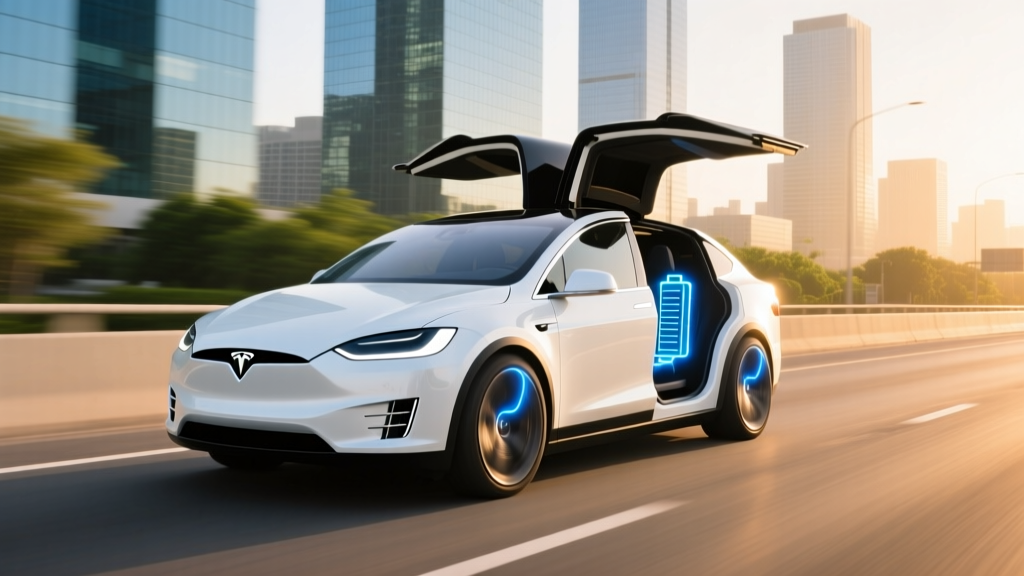
The third row is the Model X's compromise. While it exists and is usable, adults will find it cramped on drives longer than 30 minutes. If you regularly carry six or seven adults, the Rivian R1S or the Kia EV9 offer more generous third-row dimensions. For families with younger children who occupy the third row, the Model X works well — and the falcon-wing rear doors make loading car seats dramatically easier than conventional SUV doors, since the roof opening provides stand-up clearance.
Notable interior drawback: The yoke steering wheel (now standard, with a round wheel available as a no-cost option) continues to divide owners. On a vehicle this large, the yoke requires adaptation for three-point turns and parking maneuvers. We recommend test-driving both configurations before committing.
Performance, Tech, and Driver Assistance
Even the "base" Long Range Model X hits 60 mph in 3.8 seconds — faster than most V8 sport sedans — with 670 horsepower from its dual-motor setup. The Plaid's 1,020 hp and 2.5-second 0–60 time is supercar territory in a 5,100-pound family SUV. Straight-line acceleration is never a concern; where the Model X shows its age is in cornering composure and ride quality over broken pavement, where competitors like the BMW iX and Rivian R1S feel more planted and better damped.
Tech highlights:
- 17-inch center touchscreen (landscape orientation, second-gen AMD Ryzen processor)
- Rear-seat 8-inch touchscreen for climate and entertainment
- 22-speaker audio system with active noise cancellation
- HEPA air filtration with Bioweapon Defense Mode (genuinely effective — hospital-grade filtration)
- Over-the-air software updates adding features incrementally
- Phone-as-key with automatic walk-up unlock
Tesla's Autopilot (standard) and Full Self-Driving Supervised ($8,000 option or $99/month subscription) are SAE Level 2 driver-assist systems. This means the driver must remain fully engaged, hands on the wheel (or providing torque input), and eyes on the road at all times. FSD Supervised handles highway lane changes, on-ramp-to-off-ramp navigation, and some city-street driving, but it is not autonomous. Only Level 4 services like Waymo operate without a human driver in defined areas. Tesla's camera-only vision approach (no LiDAR or radar) remains a philosophical bet that continues to improve but still exhibits limitations in heavy rain, construction zones, and faded lane markings.
Warranty Coverage and Battery Longevity
Tesla provides the following warranty coverage for the 2026 Model X:
- Basic vehicle: 4 years / 50,000 miles
- Battery and drive unit: 8 years / 150,000 miles (whichever comes first), with a minimum 70% capacity retention guarantee
The 70% retention threshold is the trigger for a warranty claim — meaning if your battery degrades below 70% of its original capacity within 8 years or 150,000 miles, Tesla will repair or replace it. In practice, Tesla's NMC packs in the Model S/X fleet have shown degradation curves that plateau around 8–12% loss after the first 50,000 miles, with gradual linear decline thereafter. Data from Tesla's own impact reports and independent fleet analyses suggest most Model X batteries retain 85–90% capacity at 100,000 miles under normal charging habits (daily 80% limit, occasional 100% for trips).
Out-of-warranty replacement cost: A full Model X battery pack replacement currently runs between $15,000 and $22,000 depending on labor and whether Tesla uses a new or remanufactured pack. This is a real long-term ownership cost to factor in if you plan to keep the vehicle past the warranty period.
Model X vs. Competitors: Is It Worth Buying in 2026?
- Supercharger network access (native NACS, no adapter)
- Class-leading acceleration (both trims)
- Falcon-wing doors ease car-seat loading
- Best-in-class HEPA air filtration
- OTA updates keep the vehicle current
- 5,000-lb towing capacity
- No federal tax credit (MSRP cap)
- Third row is tight for adults
- Panel gaps and build consistency still trail German rivals
- DC fast charge capped at 250 kW (slower than 800V rivals)
- Ride quality on rough roads is firm
- High insurance premiums (avg. $3,200–$4,500/yr)
- Choose the Model X if: You need three rows, want native Supercharger access for road trips, value rapid acceleration, and your household has younger children who'll use the third row. The falcon-wing doors and HEPA filtration are genuinely unique advantages no competitor matches.
- Consider the Rivian R1S if: You need more third-row space, want off-road capability, and prefer a more traditional SUV driving feel. The R1S qualifies for the federal tax credit on certain configurations.
- Consider the Kia EV9 if: Budget is a priority (starts ~$55,000), you want a usable third row, and 800V fast charging (10–80% in ~18 min) matters to you. Trade-off: less range (~304 mi EPA) and no Supercharger access.
- Consider the BMW iX if: You only need two rows, prioritize ride quality and interior luxury, and don't need more than five seats.
Frequently Asked Questions
What is the real-world range of the 2026 Tesla Model X?
The EPA rates the Long Range at 335 miles and the Plaid at 311 miles. In real-world highway driving at 70–75 mph, expect 280–300 miles (Long Range) and 260–280 miles (Plaid). Cold weather below freezing can reduce range by 20–30%, so winter highway range may fall to 235–270 miles. Preconditioning the battery while plugged in helps preserve range and improve charging speeds in cold conditions.
How fast does the Model X charge at home and on the road?
At home on a Tesla Wall Connector (240V, 48A), the Model X charges at 11.5 kW, adding roughly 34 miles of range per hour — a full charge from 10% to 100% takes about 9 hours, ideal for overnight charging. On a V3 or V4 Supercharger, it peaks at 250 kW and reaches 10–80% in approximately 28 minutes. The charge rate tapers significantly above 80%, so plan road-trip stops around the 10–80% window.
Does the 2026 Tesla Model X qualify for the federal EV tax credit?
Effectively, no. Under IRS §30D, the SUV MSRP cap is $80,000. The Long Range starts at $79,990, but any options push it over. The Plaid at $94,990 is well above the cap. Even at base MSRP, buyers must meet income limits ($300K joint / $150K single) and the vehicle must satisfy critical-mineral and battery-component sourcing rules. Consult a tax professional to verify your specific eligibility.
Is the Tesla Model X worth buying over the Rivian R1S or Kia EV9?
It depends on your priorities. The Model X wins on Supercharger network access, acceleration, and the unique falcon-wing doors. The Rivian R1S offers better third-row space, off-road capability, and potential tax-credit eligibility. The Kia EV9 delivers strong value at a lower price point with faster 800V charging but less range. Test-drive all three with your family's car seats installed — that exercise often makes the decision clear.
How long will the Model X battery last?
Tesla warranties the battery for 8 years / 150,000 miles with a 70% capacity retention guarantee. Real-world fleet data suggests most Model X batteries retain 85–90% capacity at 100,000 miles when owners follow best practices (daily charge limit of 80%, avoid prolonged storage at 100% or near 0%). Out-of-warranty replacement costs $15,000–$22,000.
Can the Model X tow, and how does towing affect range?
Yes — both trims are rated for 5,000 lbs of towing capacity. When towing near max capacity at highway speeds, expect range to drop by 40–50%. A 335-mile EPA range becomes roughly 170–200 miles when towing a 4,500-lb trailer. Plan Supercharger stops accordingly and use Tesla's built-in trip planner, which adjusts estimates when a trailer profile is configured.