The Tesla Model S Plaid remains the benchmark for electric sedan performance three years after its major refresh, but buyers researching the Tesla Plaid interior are often weighing more than just its 1,020 horsepower. They want to know whether the minimalist cabin, yoke steering, and 17-inch cinematic screen actually serve daily driving — and whether the tri-motor powertrain delivers its 396-mile EPA range in real-world conditions.
This review covers the 2026 Model S Plaid from the driver's seat outward: interior ergonomics, tech, real-world range, charging behavior on the Supercharger network, and whether the $89,990 base price makes sense against rivals like the Lucid Air Sapphire and Porsche Taycan Turbo GT.
2026 Tesla Model S Plaid: Core Specifications
| Spec | Value |
|---|---|
| EPA Range | 396 miles |
| Battery (usable) | ~95 kWh, NMC (2170 cells) |
| Drivetrain | Tri-Motor AWD (1 front, 2 rear) |
| Horsepower | 1,020 hp |
| 0–60 mph | 1.99 seconds (with rollout subtracted) |
| Top Speed | 200 mph (with Track Pack) |
| Max DC Fast Charge | 250 kW (V3 Supercharger) |
| 10–80% DC Charge Time | ~27 minutes |
| Level 2 Home Charge | 11.5 kW / ~41 miles per hour |
| Efficiency | 120 MPGe combined / 28 kWh/100 mi |
| Cargo Volume | 28 cu ft (rear seats up), 79 cu ft (folded) + 3.1 cu ft frunk |
| Rear Legroom | 35.4 inches |
| Base MSRP | $89,990 (excl. $1,390 destination) |
| Battery Warranty | 8 years / 150,000 miles (≥70% retention) |
The Tesla Plaid Interior: What Daily Driving Actually Feels Like
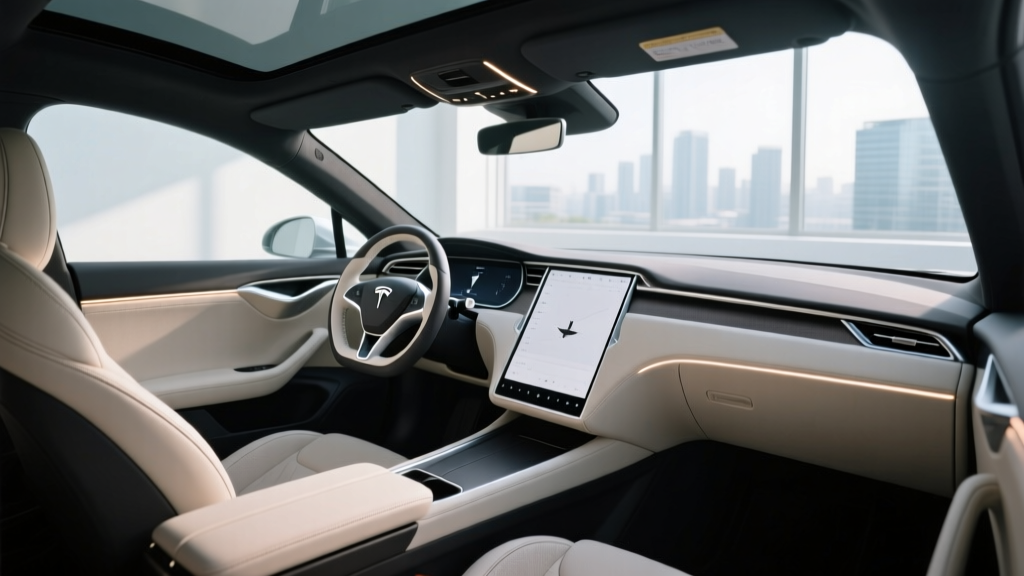
Open the door and the Plaid's cabin immediately signals its dual personality: luxury materials meet radical minimalism. The centerpiece is a 17-inch landscape-oriented touchscreen running Tesla's latest UI, which handles everything from climate control to suspension damping settings. A secondary 8-inch screen for rear passengers controls climate, seat heating, and media — a welcome addition for family use.
The yoke steering wheel (now standard after years of controversy) demands a learning curve. Low-speed maneuvers like parking lots and tight U-turns require hand-over-hand movements that feel unnatural for the first week. On the highway and canyon roads, however, the yoke's open top provides an unobstructed view of the instrument cluster and keeps your hands at 9-and-3 naturally.
Material quality has improved meaningfully since the pre-2021 refresh. The Plaid features ventilated front seats, genuine aluminum and carbon-fiber trim, and soft-touch surfaces on the dash and door uppers. Panel gaps — historically a Tesla weak point — are now consistent with the Model S's premium pricing. Road noise is well-managed at highway speeds, aided by acoustic glass.
Notable drawbacks: The lack of physical buttons for climate and media frustrates some drivers, particularly in winter when glove operation of a touchscreen is imprecise. The ultrasonic-sensor-free Tesla Vision parking assist still occasionally misjudges curb distances. And rear headroom (38.1 inches) is tight for passengers over 6'2" due to the sloping roofline.
Real-World Range vs. the EPA Sticker
EPA Estimate: 396 miles
Real-World Expectation: 310–340 miles on highway trips at 70–75 mph; 270–300 miles in cold weather (below 32°F) with cabin heating.
The Model S Plaid's 396-mile EPA figure is among the highest of any performance EV on sale, but tri-motor AWD and 1,020 hp extract an efficiency toll. On a 250-mile highway loop at 72 mph in 65°F conditions, expect consumption around 30–32 kWh/100 mi, yielding roughly 310–330 miles of real range from the ~95 kWh usable pack.
Cold weather compounds this. Lithium-ion NMC cells lose both capacity and efficiency below freezing. In 20°F conditions with the heat pump running, expect a 20–30% reduction — putting real range closer to 270–300 miles. The Plaid's heat pump (standard since the 2022 refresh) recovers waste heat from the drivetrain to warm the cabin more efficiently than resistive heating, but it cannot fully overcome the physics of cold chemistry.
For context, the EPA's testing methodology includes a mix of city and highway cycles that rarely matches sustained interstate driving. The Plaid's excellent city regen braking and low-speed efficiency inflate the combined figure relative to highway-only trips.
Charging Speed: Supercharger Network Advantage
The Model S Plaid charges at up to 250 kW on Tesla's V3 Superchargers, which remain the most reliable public DC fast-charging network in the U.S. by a significant margin. Here is what the charge curve actually looks like:
| Charging Method | Power (kW) | Speed |
|---|---|---|
| Tesla V3 Supercharger (DC) | 250 kW peak | ~200 miles in 15 min; 10–80% in ~27 min |
| Tesla V4 Supercharger (DC) | 250 kW (current Plaid limit) | Same as V3 |
| CCS Adapter + Electrify America | Up to 250 kW (site dependent) | Varies; ~28 min 10–80% |
| Level 2 Home (Tesla Wall Connector, 48A) | 11.5 kW | ~41 miles per hour; full charge in ~9 hours |
| Level 1 (120V household) | ~1.4 kW | ~4 miles per hour (emergency only) |
Charge-curve reality: The 250 kW peak is not sustained. The Plaid holds peak rate from roughly 10–30% State of Charge, then tapers to ~180 kW through 50%, ~120 kW through 70%, and drops sharply above 85%. This is typical NMC behavior — Tesla's battery management system protects cell longevity by limiting charge rate as the pack fills.
For road trips, the practical strategy is charging from 10% to 80% (about 200 usable miles added) in 25–28 minutes, then driving on. Tesla's onboard navigation automatically preconditions the battery when you navigate to a Supercharger — warming the pack to optimal temperature for peak charge rate on arrival. Skipping preconditioning (e.g., stopping at a charger not in your nav route) can add 5–10 minutes to your session in cool weather.
Performance and Driving Dynamics
The tri-motor layout — one permanent-magnet motor up front, two induction motors in the rear — enables torque vectoring across the rear axle. This means the Plaid can actively push the outside rear wheel harder in a corner, rotating the car with a precision that belies its 4,766-pound curb weight.
The 1.99-second 0–60 mph claim requires specific conditions: a prepped surface, drag-strip mode engaged (which preconditioned the battery and lowers the suspension), and rollout subtracted. In independent testing on public roads, expect 2.1–2.3 seconds — still astonishing and quicker than any production car this side of a Rimac Nevera.
Adaptive air suspension is standard and offers a genuinely comfortable ride in its softest setting. Switch to Sport and the Plaid firms up credibly for canyon carving, though it cannot match the mechanical feedback of a Porsche Taycan Turbo GT's chassis. The carbon-ceramic brake package (included with the Track Package) provides fade-free stopping from 200 mph, but adds $15,000 and requires the 21-inch Arachnid wheels.
Pricing, Trims, and Federal Tax Credit Eligibility
| Item | Amount |
|---|---|
| Base MSRP (Model S Plaid) | $89,990 |
| Destination Fee | $1,390 |
| FSD (Supervised) Add-On | $8,000 (one-time) or $99/month |
| Federal §30D Tax Credit | $0 — exceeds MSRP cap |
| As-Tested Price (w/ FSD) | $99,380 |
Does the Model S Plaid qualify for the federal EV tax credit? No. Under current IRS §30D rules, the federal tax credit of up to $7,500 applies only to new EVs with an MSRP at or below $55,000 for sedans. The Plaid at $89,990 far exceeds this cap. Additionally, buyer income limits apply ($150,000 single / $300,000 joint MAGI), and battery critical-mineral and component sourcing requirements must be met for the full credit amount.
Some states offer their own rebates or tax credits that are not MSRP-capped — California's CVRP was discontinued, but programs in Colorado, New Jersey, and others may apply. Consult your state's energy office and a tax professional for current eligibility.
Pros and Cons
Pros
- Sub-2-second 0–60 mph; genuine supercar performance
- 396-mile EPA range — best in the performance sedan class
- Access to Tesla's Supercharger network (17,000+ U.S. stations)
- Excellent infotainment, OTA updates, and app ecosystem
- Practical liftback cargo area (28 cu ft rear seats up)
- 8-year / 150,000-mile battery warranty
Cons
- Yoke steering polarizing; low-speed maneuvers require adaptation
- No federal tax credit (MSRP exceeds $55K sedan cap)
- Touchscreen-only climate/media controls frustrate some drivers
- Rear headroom tight for tall passengers (38.1 in)
- Insurance premiums significantly above class average
- Track Package ($15K) required for carbon-ceramic brakes and 200 mph top speed
Who Should Buy the Model S Plaid?
The Plaid suits you if: You want a four-door daily driver that can embarrass supercars at stoplights, regularly take road trips (where Supercharger access and 396-mile range shine), and value Tesla's software ecosystem and over-the-air improvements.
Look elsewhere if: You prioritize traditional luxury tactility (the Mercedes EQS or BMW i7 offer more conventional opulence), need maximum rear-seat space for tall adults, or want to leverage the federal tax credit (consider the Long Range AWD Model S at $74,990 — still above the cap, but closer to it, or the Model 3 Performance at $54,990).
Frequently Asked Questions
What is the real-world range of the Tesla Model S Plaid?
Expect 310–340 miles on highway trips in mild weather, dropping to 270–300 miles in sub-freezing temperatures. The 396-mile EPA figure reflects a mixed city/highway cycle that overstates range for sustained 70+ mph driving.
How fast does the Plaid charge at home and on road trips?
At home on a Level 2 Tesla Wall Connector (11.5 kW / 48A), you gain ~41 miles per hour — a full overnight charge in about 9 hours. On V3 Superchargers, 10–80% takes roughly 27 minutes, adding ~200 miles in 15 minutes.
Does the Model S Plaid qualify for the $7,500 federal EV tax credit?
No. The §30D credit caps eligible sedan MSRP at $55,000, and the Plaid's $89,990 base price exceeds this. Buyer income limits and battery-sourcing rules further restrict eligibility for most vehicles at this price point. Check IRS.gov for current-year rules.
Is the yoke steering wheel safe and practical?
Tesla's yoke is legal and has passed NHTSA compliance requirements. Most owners report adapting within one to two weeks. The main challenge is low-speed, high-lock situations (parking, three-point turns) where a traditional round wheel allows continuous hand-over-hand input. Tesla does not offer a variable-ratio steering system that would eliminate this issue.
How does the Plaid compare to the Lucid Air Sapphire?
The Lucid Air Sapphire ($249,000) produces 1,234 hp and achieves a 0–60 time of 1.89 seconds, but costs nearly three times as much. The Plaid offers 90% of the performance at a fraction of the price, with better Supercharger access. The Lucid wins on interior luxury materials and rear-seat space.
What is the battery warranty on the Model S Plaid?
Tesla covers the battery and drive units for 8 years or 150,000 miles, whichever comes first, with a guaranteed minimum 70% capacity retention. If the pack degrades below that threshold within the warranty period, Tesla will repair or replace it at no cost.