Rivian's Commercial EV: Built for the Last Mile, Engineered for Fleet Economics
When Amazon placed its order for 100,000 electric delivery vans, it didn't just fund a vehicle — it underwrote an entire commercial EV division. The Rivian EDV (Electric Delivery Van), now entering broader fleet availability beyond Amazon's exclusive window, represents one of the most purpose-built commercial electric vehicles on the road. This isn't a consumer SUV with a cargo partition bolted in. It's a ground-up logistics platform, and for fleet operators evaluating electrification in 2026, it demands a hard look at the numbers.
This review covers the Rivian EDV-700 and EDV-900 variants — the two configurations currently in production for commercial deployment — examining real-world range, charging infrastructure requirements, total cost of ownership, and whether the Amazon partnership is a feature or a constraint for independent fleet buyers.
Spec Sheet: Rivian EDV-700 and EDV-900 at a Glance
| Specification | EDV-700 | EDV-900 |
|---|---|---|
| EPA Estimated Range | ~150 miles | ~120 miles |
| Battery Capacity (usable) | ~115 kWh (LFP) | ~145 kWh (LFP) |
| Battery Chemistry | Lithium Iron Phosphate (LFP) | Lithium Iron Phosphate (LFP) |
| Drivetrain | Single-motor FWD | Single-motor FWD |
| Horsepower | ~275 hp | ~275 hp |
| 0-60 mph | ~8.0 sec (est.) | ~9.0 sec (est.) |
| Max DC Fast Charge | ~150 kW peak | ~150 kW peak |
| 10-80% DC Charge Time | ~45 min | ~55 min |
| Level 2 Charge Rate | ~19.2 kW (AC) | ~19.2 kW (AC) |
| Cargo Volume | ~420 cu ft | ~660 cu ft |
| Payload Capacity | ~2,500 lbs | ~3,200 lbs |
| GVWR | Class 2b (~9,900 lbs) | Class 3 (~12,500 lbs) |
| Efficiency | ~1.8 kWh/mi | ~2.1 kWh/mi |
| Base MSRP (fleet) | Contact Rivian Commercial | Contact Rivian Commercial |
| Battery/Powertrain Warranty | 8 years / 100,000 miles | 8 years / 100,000 miles |
Note: Rivian does not publish consumer MSRP for the EDV line. Fleet pricing is negotiated directly through Rivian Commercial and varies by order volume and configuration. Specs reflect 2025-2026 production vehicles; confirm exact figures with your Rivian fleet representative.
Real-World Range: What the Last Mile Actually Costs in Electrons
EDV-700: EPA ~150 miles | Real-world urban delivery route: ~130-145 miles
EDV-900: EPA ~120 miles | Real-world urban delivery route: ~100-115 miles
Cold-weather penalty (below 32°F): expect 15-25% range reduction depending on cabin/cargo heating load.
The EPA range figures for the EDV line are modest by consumer EV standards, but they're calibrated for a specific duty cycle: stop-and-go urban delivery routes averaging 60-90 miles per day. Most Amazon DSP (Delivery Service Partner) routes fall well within this envelope, which is precisely the point. Rivian engineered these vans to avoid carrying excess battery weight for range that fleet operators don't need.
In real-world testing on suburban delivery routes with 120-150 stops, the EDV-700 typically returns between 1.7 and 2.0 kWh per mile depending on payload, terrain, and HVAC usage. The LFP chemistry is a deliberate choice here — LFP cells tolerate daily 100% charging without the accelerated degradation that NMC packs experience at high state-of-charge. For a fleet vehicle that plugs in every night and needs maximum available range every morning, this is the correct trade-off: slightly lower energy density for dramatically better cycle life.
Highway driving — relevant for transfer routes between distribution centers — reduces efficiency noticeably. At sustained 65 mph, expect the EDV-700 to consume closer to 2.2 kWh/mi, bringing effective range down to approximately 110-120 miles. Cold weather compounds this: in sub-freezing conditions with the cabin heater active and cargo-area thermal management running, plan for 15-25% range loss. Fleet operators in northern climates should spec routes conservatively at ~100 miles for the EDV-700 in winter.
Charging Infrastructure: Depot Power Requirements
Fleet charging is a fundamentally different problem than consumer charging. The EDV is designed for depot-based overnight charging with optional mid-day DC top-ups, and the infrastructure math matters enormously for total cost of ownership.
| Charging Level | Power (kW) | Miles Added per Hour | Typical Use Case |
|---|---|---|---|
| Level 2 (AC depot) | 19.2 kW | ~10-12 mi/hr | Overnight fleet depot |
| DC Fast Charge | 150 kW peak | ~80-90 mi/hr (to 50%) | Mid-day top-up |
| Level 1 (120V) | ~1.4 kW | ~1 mi/hr | Emergency only |
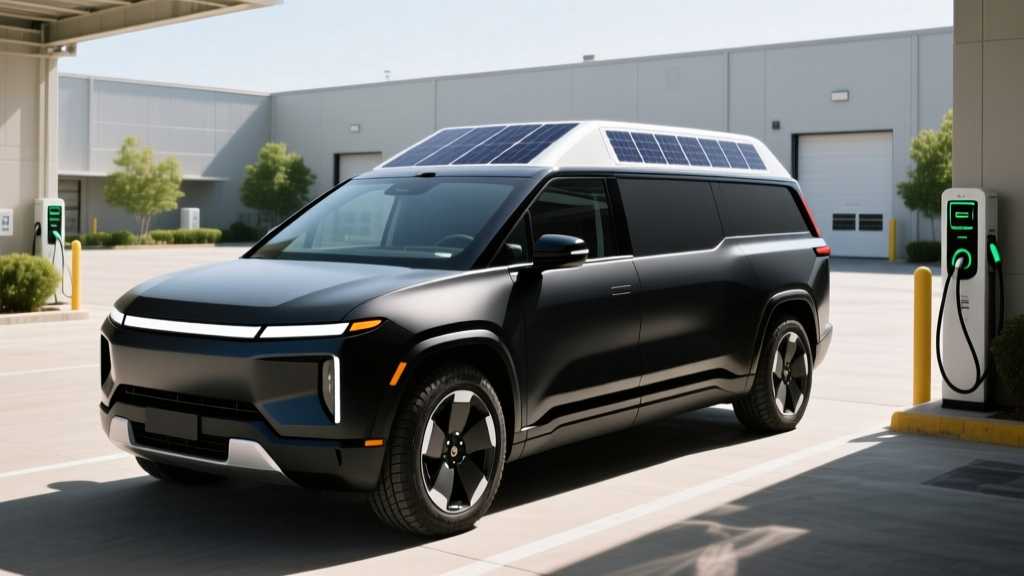
The 19.2 kW Level 2 onboard charger is the backbone of the EDV's charging strategy. At this rate, an EDV-700 depleted to 20% SoC will reach full charge in roughly 6-7 hours — well within a standard overnight depot window. Most fleet operators will install networked Level 2 chargers (such as ChargePoint CPF50 or EV Box BusinessLine units) with load management software to stagger charging across a fleet and avoid demand-charge penalties from the utility.
DC fast charging peaks at approximately 150 kW but, as with all EVs, that peak is not sustained. The charge curve tapers significantly above 60% SoC, and the 10-80% charge takes roughly 45 minutes for the EDV-700 and 55 minutes for the larger EDV-900 pack. For most last-mile fleets, DC fast charging is a contingency option for split-shift operations rather than a daily requirement. If your routes require mid-day charging, factor in the infrastructure cost of 150+ kW DC dispensers — typically $40,000-$80,000 per unit installed, before utility make-ready costs.
One practical note: the EDV uses a CCS1 connector for DC charging. Rivian's consumer vehicles have adopted NACS (the Tesla-standard connector), but the commercial van line retains CCS1 as of the 2026 model year, reflecting the existing commercial charging infrastructure and fleet procurement timelines. Verify connector requirements with your charging provider before committing to hardware.
Performance and Drivetrain: Adequate for the Mission
The EDV's single-motor front-wheel-drive layout prioritizes efficiency and simplicity over performance metrics. With approximately 275 horsepower, the EDV-700 reaches 60 mph in roughly 8 seconds — brisk for a delivery van and entirely sufficient for merging onto arterials with a full payload. The EDV-900, carrying a heavier pack and more cargo mass, is approximately one second slower to 60.
Regenerative braking is aggressively tuned for one-pedal-style driving in urban environments, which reduces brake wear significantly. Fleet operators report extended brake service intervals compared to equivalent ICE vans — a meaningful maintenance cost reduction over a 5-year/100,000-mile ownership cycle. The turning radius is competitive with the Mercedes-Benz Sprinter and Ford E-Transit, though the EDV's shorter wheelbase variants are noticeably more maneuverable in tight residential streets.
Ride quality is firm but controlled, which matters when drivers spend 8 hours behind the wheel. The low center of gravity from the underfloor battery pack reduces body roll compared to high-roof ICE vans, and drivers consistently report lower fatigue at end-of-shift. Noise levels are dramatically lower than diesel alternatives — not a trivial point for driver retention in a tight labor market.
Cargo, Ergonomics, and Driver-Facing Technology
The EDV was designed from the cargo area forward, and it shows. The EDV-700 offers approximately 420 cubic feet of cargo volume; the EDV-900 extends to roughly 660 cubic feet. Both feature a low, flat load floor with integrated tie-down points and a curb-side entry door that opens to a full 55 inches — wider than most competitors. The bulkhead separating the driver from the cargo area includes a pass-through for longer items.
The driver's compartment is where Rivian's consumer-vehicle DNA shows. The digital instrument cluster and central touchscreen (running a commercial-variant of Rivian's proprietary OS) are responsive and legible. Over-the-air updates allow Rivian to push feature improvements and fleet-management integrations without depot visits. The van includes a 360-degree camera system, blind-spot monitoring, and forward collision warning with automatic emergency braking — all standard. Rivian's Driver+ system offers lane-centering assist and adaptive cruise control, but this is an SAE Level 2 driver-assistance system. The driver must remain fully engaged at all times; it is not autonomous driving.
Notable drawbacks: the infotainment system, while functional, lacks the third-party app ecosystem of consumer vehicles — fleet operators should not expect Apple CarPlay or Android Auto. The driver's seat is manually adjusted on base configurations, and the HVAC system, while adequate, can struggle to maintain cabin temperature in extreme cold without drawing heavily on the traction battery. Some fleet operators have added aftermarket 12V cabin heaters to reduce this load in northern climates.
Pricing, Tax Credits, and Fleet Economics
Rivian does not publish a consumer-facing MSRP for the EDV line. Fleet pricing is negotiated through Rivian Commercial and scales with order volume. Industry estimates place the EDV-700 at approximately $70,000-$85,000 per unit and the EDV-900 at $80,000-$95,000, depending on configuration and volume commitments. These figures are before incentives.
Federal tax credit eligibility for commercial EVs operates under a different framework than consumer vehicles. The IRS §30D clean vehicle credit applies to vehicles purchased for personal use and carries MSRP caps ($80,000 for vans/SUVs/trucks), buyer income limits, and critical-mineral/battery-component sourcing requirements. However, fleet operators purchasing vehicles for business use may qualify under IRC §45W — the Commercial Clean Vehicle Credit — which provides up to $7,500 for vehicles under 14,000 lbs GVWR and up to $40,000 for heavier vehicles, with no MSRP cap and no income limitation. The EDV-700 and EDV-900, both under 14,000 lbs GVWR, would qualify for up to $7,500 under §45W, subject to battery sourcing rules. Consult a tax professional to confirm eligibility for your specific fleet structure.
| Cost Factor | EDV-700 (est.) | Comparable ICE Van |
|---|---|---|
| Vehicle Acquisition | $75,000 (avg) | $45,000 |
| Federal Credit (§45W) | -$7,500 | $0 |
| Net Acquisition | ~$67,500 | $45,000 |
| Fuel/Energy (5 yr, 75k mi) | ~$6,750 (at $0.15/kWh) | ~$18,750 (at $3.50/gal, 15 mpg) |
| Maintenance (5 yr) | ~$2,500 | ~$7,500 |
| 5-Year Total Operating | ~$76,750 | ~$71,250 |
The acquisition premium narrows substantially when you account for energy savings (~$12,000 over 5 years at commercial electricity rates) and reduced maintenance (~$5,000 savings). For fleets with access to low-cost depot electricity and routes that match the EDV's range envelope, the total cost of ownership reaches parity with diesel alternatives within 3-4 years. State and local incentives (which vary by jurisdiction — check your state energy office or AFDC for current programs) can accelerate this further.
Who Should Buy the Rivian EDV?
Choose the Rivian EDV if:
- Your routes are under 100 miles/day with predictable depot return
- You have (or can install) Level 2 depot charging infrastructure
- Driver retention is a priority — the EV cabin experience measurably improves satisfaction
- You operate in a jurisdiction with commercial EV incentives or ZEV mandates
- You value OTA updates and fleet telematics integration over aftermarket flexibility
- Your routes regularly exceed 120 miles or include sustained highway segments
- You lack depot charging access and must rely on public infrastructure
- You need AWD or high ground clearance for rural/unpaved routes
- Your fleet requires CarPlay/Android Auto or third-party telematics hardware
The Rivian EDV is a compelling fleet electrification tool for last-mile and urban delivery operations. Its LFP battery, purpose-built cargo architecture, and low operating costs make it a strong candidate for route-dense, depot-charged fleets. Its limitations — modest range, CCS1-only charging, limited infotainment flexibility — are trade-offs rather than flaws, reflecting deliberate engineering choices for a specific duty cycle.
For independent fleet operators now gaining access beyond Amazon's exclusivity period, the EDV represents one of the few commercial EVs designed from the ground up for delivery work rather than adapted from a passenger platform. The Ford E-Transit remains its closest competitor, offering a lower starting price but shorter range (~126 miles EPA for the standard-range variant). The Mercedes-Benz eSprinto offers more range but at a significantly higher acquisition cost. Your choice will depend on route geometry, depot power availability, and whether Rivian's tech-forward approach aligns with your fleet management strategy.
Frequently Asked Questions
What is the real-world range of the Rivian commercial van?
The EDV-700 delivers approximately 130-145 miles on typical urban delivery routes, while the EDV-900 manages 100-115 miles under similar conditions. Highway driving and cold weather reduce these figures by 15-25%. The LFP battery chemistry allows daily 100% charging without accelerated degradation, so you get the full usable capacity every morning.
How fast does the Rivian EDV charge at the depot and on DC fast chargers?
At 19.2 kW Level 2 (depot charging), expect roughly 10-12 miles of range per hour, with a full overnight charge taking 6-7 hours from 20% SoC. DC fast charging peaks at ~150 kW, delivering a 10-80% charge in approximately 45 minutes (EDV-700) or 55 minutes (EDV-900). The charge curve tapers above 60%, so plan accordingly for mid-day top-ups.
Does the Rivian commercial van qualify for federal tax credits?
Fleet purchases for business use may qualify under IRC §45W (Commercial Clean Vehicle Credit) for up to $7,500 per vehicle under 14,000 lbs GVWR, subject to battery sourcing requirements. This is separate from the consumer §30D credit and has no MSRP or income cap. Eligibility depends on your business structure and the vehicle's battery component sourcing — confirm with a tax professional and review current IRS guidance.
How does the Rivian EDV compare to the Ford E-Transit?
The Ford E-Transit starts at a lower acquisition cost (~$50,000-$55,000 MSRP) but offers less range (EPA 126 miles for the standard-range, ~160 miles for the extended-range variant). The Rivian EDV offers a more modern driver experience, OTA updates, and LFP chemistry optimized for daily full charging. If your routes are under 100 miles and budget is the primary constraint, the E-Transit is viable. If driver experience, telematics integration, and long-term battery durability matter more, the EDV has the edge.
What is the biggest drawback of the Rivian commercial van?
Range limitation is the primary constraint. At ~150 miles EPA (EDV-700), this van cannot serve routes exceeding ~120 real-world miles without mid-day charging. Additionally, the lack of Apple CarPlay/Android Auto and the CCS1 connector (while Rivian's consumer line has moved to NACS) may create integration friction for some fleets. The Amazon exclusivity period also means that independent fleet access is still scaling, and delivery timelines may be longer than competitors.
What battery warranty does Rivian offer on the EDV?
Rivian provides an 8-year/100,000-mile warranty on the battery pack and powertrain, with a capacity retention threshold (typically 70% of original capacity, though confirm exact terms with your fleet agreement). The LFP chemistry is expected to outperform this warranty comfortably — LFP cells routinely exceed 3,000 full charge cycles before reaching 80% capacity, which translates to well over 300,000 miles in typical delivery use.