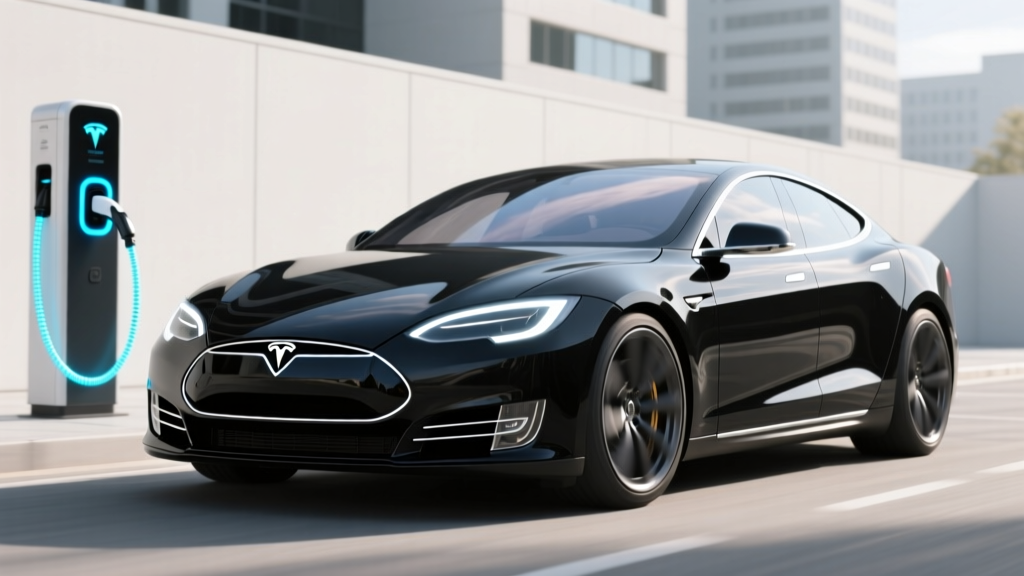
The Tesla Model S has been the benchmark for electric sedan performance for over a decade, and the 2026 Model S Performance continues that legacy with a claimed 0-60 mph time of 1.99 seconds — a number that still shocks passengers and embarrasses supercars costing three times as much. But beyond the headline acceleration, the Model S remains a practical long-range EV with over 400 miles of EPA-rated range on the Long Range trim, access to Tesla's Supercharger network, and a spacious liftback body. This review breaks down every spec that matters to real buyers: real-world range, charging speeds, pricing after tax credits, and how it stacks up against the Lucid Air, Porsche Taycan, and BMW i7.
2026 Tesla Model S: Quick Specs at a Glance
| Specification | Long Range AWD | Performance (Plaid) |
|---|---|---|
| EPA Range | 402 miles | 359 miles |
| Battery (usable) | ~95 kWh (NMC) | ~95 kWh (NMC) |
| Drivetrain | Dual-Motor AWD | Tri-Motor AWD |
| Horsepower | 670 hp | 1,020 hp |
| 0-60 mph | 3.1 seconds | 1.99 seconds |
| Top Speed | 155 mph | 200 mph |
| Max DC Fast Charge | 250 kW | 250 kW |
| 10-80% DC Charge Time | ~30 minutes | ~30 minutes |
| Level 2 Charge Rate | 11.5 kW (~44 mi/hr) | 11.5 kW (~44 mi/hr) |
| MPGe (combined) | 120 MPGe | 116 MPGe |
| EPA Efficiency | 28 kWh/100 mi | 29 kWh/100 mi |
| Cargo Volume | 28 cu ft (rear seats up) | 28 cu ft (rear seats up) |
| Base MSRP | $74,990 | $89,990 |
| Battery Warranty | 8 years / 150,000 miles | 8 years / 150,000 miles |
Performance: The Model S Plaid's 0-60 Time Explained
The headline number — and the reason many buyers land on this page — is the Model S Performance 0-60 time of 1.99 seconds. Tesla achieves this with the tri-motor Plaid powertrain, which pairs one front motor with two rear motors for a combined output of 1,020 horsepower and roughly 1,050 lb-ft of torque. The result is acceleration that outpaces the Bugatti Chiron and Rimac Nevera in the 0-60 sprint, though the Model S Plaid's advantage narrows at higher speeds where dedicated hypercars have more gearing headroom.
For context, here's how the Model S Performance stacks up against key rivals in the 0-60 benchmark:
| Vehicle | 0-60 mph | Horsepower | Base MSRP |
|---|---|---|---|
| Tesla Model S Performance (Plaid) | 1.99 sec | 1,020 hp | $89,990 |
| Lucid Air Sapphire | 1.89 sec | 1,234 hp | $249,000 |
| Porsche Taycan Turbo GT | 2.1 sec | 1,019 hp | $230,000 |
| BMW i7 M70 xDrive | 3.5 sec | 650 hp | $168,000 |
The Model S Performance delivers hypercar acceleration at roughly a third of the price of the Lucid Air Sapphire or Porsche Taycan Turbo GT. That value proposition is its strongest argument in the performance sedan segment. However, the Plaid powertrain's 359-mile EPA range is 43 miles shorter than the Long Range variant, a trade-off buyers should weigh carefully.
Real-World Range: What to Expect Beyond the EPA Sticker
Long Range AWD: EPA 402 miles. Expect ~340-360 miles in mixed highway driving at 70-75 mph, and ~300-320 miles in freezing temperatures (below 32°F).
Performance (Plaid): EPA 359 miles. Expect ~300-320 miles highway, ~260-280 miles in cold weather.
The EPA range figures for the Model S are among the highest of any production EV, and Tesla's efficiency engineering earns that reputation. According to fueleconomy.gov, the Long Range achieves 120 MPGe combined (28 kWh/100 miles), while the Performance trim rates at 116 MPGe (29 kWh/100 miles).
In practice, real-world range depends heavily on driving style, speed, and temperature. Highway driving at 75 mph consumes roughly 10-15% more energy than the EPA combined cycle, which blends city and highway. Cold weather compounds this: battery chemistry becomes less efficient, cabin heating draws significant power (the Model S uses a heat pump, which helps but doesn't eliminate the penalty), and regenerative braking effectiveness decreases. Owners in northern climates should budget 20-25% range reduction in winter months.
The Long Range's 402-mile EPA rating is genuinely usable for road trips. A Los Angeles to Las Vegas run (~270 miles each way) is achievable without a charging stop if you leave with a full charge and drive conservatively, though most drivers will want a brief top-up. The Performance trim's 359-mile range still covers most daily commutes and regional trips comfortably but requires more planning on long corridors.
Charging Speed: DC Fast Charging and Home Setup
| Charging Level | Power / Rate | Miles Added per Hour | Notes |
|---|---|---|---|
| Level 1 (120V household) | ~1.4 kW | ~5 mi/hr | Emergency/trickle only |
| Level 2 (240V home) | 11.5 kW (48A) | ~44 mi/hr | Full charge overnight (~9 hrs) |
| DC Fast Charge (V3/V4 Supercharger) | Peak 250 kW | ~200 mi in 15 min | 10-80% in ~30 min |
The Model S charges at a peak rate of 250 kW on Tesla's V3 and V4 Superchargers. The charging curve is typical of NMC lithium-ion chemistry: it holds near peak power from roughly 10% to 40% State of Charge (SoC), then progressively tapers. The 10-80% charge takes approximately 30 minutes. Above 80%, charging slows dramatically to protect battery longevity — expect another 20-30 minutes to go from 80% to 100%. For road trips, the practical strategy is to charge to 80% and move on, which is exactly how Tesla's navigation system plans Supercharger stops.
At home, the Model S accepts up to 11.5 kW on a Level 2 Wall Connector (48 amps on a 60-amp circuit). This adds roughly 44 miles of range per hour of charging, meaning a full overnight session from 20% to 100% takes about 8-9 hours. Home charging is the primary refueling method for most Model S owners — a full "tank" costs approximately $12-$18 depending on local electricity rates (assuming $0.13-$0.18/kWh nationally), compared to $60-$80 for a tank of premium gasoline in a comparable performance sedan.
Tesla's native NACS (North American Charging Standard) connector is now the industry standard, and the Model S accesses the full Supercharger network — over 6,000 stations and 65,000+ connectors in North America as of 2026. This network advantage remains one of the strongest ownership arguments for Tesla, as Superchargers consistently deliver their rated speeds with minimal downtime.
Pricing, Trims, and Federal Tax Credit Eligibility
| Trim | Base MSRP | Destination | Federal §30D Credit | Effective Price |
|---|---|---|---|---|
| Long Range AWD | $74,990 | $1,390 | See eligibility below | From $76,380 |
| Performance (Plaid) | $89,990 | $1,390 | See eligibility below | From $91,380 |
The 2026 Model S is offered in two trims: the Long Range AWD at $74,990 and the Performance (Plaid) at $89,990, before the $1,390 destination fee. Options like Ultra Red paint ($2,500), 21-inch Arachnid wheels ($4,500), and Full Self-Driving (Supervised) capability ($8,000) can push an as-tested Model S Performance past $105,000.
Does the Model S Qualify for the Federal EV Tax Credit?
This is where it gets complicated. Under IRS §30D rules, the federal EV tax credit offers up to $7,500, but several requirements apply that may disqualify some or all Model S buyers:
- MSRP Cap: Sedans must have an MSRP at or below $55,000 to qualify. Both Model S trims exceed this cap, meaning the Model S does NOT qualify for the new-vehicle §30D credit.
- Buyer Income Cap: Even if the MSRP cap were met, modified adjusted gross income must not exceed $150,000 (single) or $300,000 (joint filing).
- Battery Sourcing: Critical mineral and battery component requirements phase in annually, with increasing domestic-content thresholds through 2026.
- Point-of-Sale Transfer: Eligible credits can be transferred to the dealer at purchase for an immediate price reduction, but this only applies if the vehicle itself qualifies.
The Model S's MSRP places it firmly above the §30D sedan cap. Buyers should consult the IRS clean vehicle credit page and a tax professional for their specific situation. Some states offer separate EV rebates or tax credits that may apply — check your state's energy office for current programs.
Interior, Cargo, and Daily Practicality
The Model S uses a liftback design that provides 28 cubic feet of cargo space behind the rear seats — significantly more than traditional sedans like the BMW 5 Series (14 cu ft) and competitive with midsize SUVs. Fold the rear seats and you get approximately 64 cubic feet, enough for bulky items like furniture or camping gear. The front trunk (frunk) adds a modest but useful storage area for charging cables and small bags.
Interior dimensions include 42.1 inches of front legroom and 35.4 inches of rear legroom. The rear seat accommodates two adults comfortably, though the sloping roofline limits headroom for passengers over 6'2". The 17-inch center touchscreen handles nearly all vehicle functions, with a secondary 8-inch rear display for passenger climate and media control. Build quality on the 2026 refresh is improved over earlier generations, with better panel gap consistency and softer-touch materials, though it still doesn't match the tactile luxury of a Mercedes EQS or Porsche Taycan interior.
The yoke steering wheel remains standard on the Performance trim (a conventional round wheel is available on the Long Range). Opinions on the yoke remain polarized: it provides an unobstructed view of the instrument display but requires adaptation for low-speed maneuvers and three-point turns where hand-over-hand steering is natural.
Driver Assistance and Safety Technology
Tesla Autopilot and Full Self-Driving (Supervised) are Level 2 driver-assistance systems. The driver must remain fully engaged, keep hands on the steering wheel (or apply torque to the yoke), and monitor the road at all times. These are not self-driving systems. Only Level 4 robotaxi services like Waymo operate without a human driver.
The Model S comes standard with Tesla's Basic Autopilot, which includes adaptive cruise control, lane-keeping assist, and automatic emergency braking. The optional Full Self-Driving (Supervised) package ($8,000) adds automatic lane changes, navigation-guided on/off-ramp transitions, traffic light and stop sign recognition, and an evolving city-streets capability. FSD (Supervised) has improved substantially through neural network updates, but it still requires active supervision and can make unpredictable decisions in construction zones, unmapped areas, or adverse weather.
The Model S earned a 5-Star Overall Safety Rating from NHTSA and has historically performed well in IIHS crash testing. Standard active safety features include front and side collision warning, automatic emergency braking, blind-spot monitoring, and lane departure prevention.
Who Should Buy the 2026 Tesla Model S?
Choose the Model S Long Range if: You want maximum range (402 miles EPA), daily-drivable performance (3.1s 0-60 is still very fast), and the best road-trip EV in its class — at a lower price than the Performance.
Choose the Model S Performance (Plaid) if: You want the fastest-accelerating sedan available, plan to use track mode, and are willing to trade 43 miles of range and $15,000 for 1,020 hp and a sub-2-second 0-60.
Look elsewhere if: You need a luxury interior that rivals Mercedes or BMW, want the longest possible range (Lucid Air Grand Touring offers 516 miles EPA), or require the federal tax credit (the Model S exceeds the MSRP cap).
The Model S suits tech-forward buyers who prioritize performance, range, and charging infrastructure access above traditional luxury prestige. It's an excellent commuter (especially with home Level 2 charging), a capable road-trip vehicle thanks to the Supercharger network, and a surprisingly practical family car with its liftback cargo area. It's less ideal for buyers who prioritize interior material quality, who want the absolute longest range regardless of performance, or whose income and purchase price would benefit from the §30D credit that the Model S can't access.
Pros and Cons
- Class-leading 1.99s 0-60 (Performance)
- 402-mile EPA range (Long Range)
- Supercharger network access (65,000+ connectors)
- 250 kW DC fast charging, 10-80% in ~30 min
- Spacious 28 cu ft liftback cargo area
- Over-the-air updates improve the car over time
- 8-year/150,000-mile battery warranty
- Does not qualify for §30D federal tax credit (MSRP exceeds $55K sedan cap)
- Interior quality lags behind Mercedes EQS and Porsche Taycan
- Yoke steering requires adaptation (standard on Performance)
- Performance trim loses 43 miles of range vs. Long Range
- FSD (Supervised) still requires full driver attention
- No Apple CarPlay or Android Auto
- Rear headroom limited for tall passengers
Frequently Asked Questions
What is the real-world range of the Tesla Model S Performance?
The EPA rates the Model S Performance (Plaid) at 359 miles. In real-world highway driving at 70-75 mph, expect approximately 300-320 miles. In cold weather below freezing, plan for 260-280 miles. The Long Range trim delivers 402 miles EPA, with real-world highway figures around 340-360 miles.
How fast does the Model S charge at home and on the road?
On a Level 2 home charger (11.5 kW / 48A), the Model S adds roughly 44 miles of range per hour, fully charging overnight in about 9 hours. On a 250 kW V3 or V4 Supercharger, it charges from 10% to 80% in approximately 30 minutes, adding up to 200 miles in 15 minutes under ideal conditions.
Does the 2026 Model S qualify for the federal EV tax credit?
No. Under IRS §30D rules, new sedans must have an MSRP at or below $55,000 to qualify. Both Model S trims ($74,990 and $89,990) exceed this cap. State-level incentives may still apply depending on your location. Always verify current rules at irs.gov.
Is the Model S Performance worth it over the Long Range?
If your priority is maximum acceleration and track capability, the Performance's 1.99-second 0-60 and 1,020 hp are unmatched at any price near $90,000. If you prioritize range and value, the Long Range offers 402 miles, a still-quick 3.1-second 0-60, and saves $15,000. For most daily drivers, the Long Range is the smarter buy.
How does the Model S compare to the Lucid Air and Porsche Taycan?
The Lucid Air Grand Touring offers more range (516 miles EPA) and a more luxurious interior, but starts at $125,600. The Porsche Taycan Turbo GT delivers comparable performance (2.1s 0-60) with superior build quality and driving dynamics, but at $230,000 and with only 292 miles of range. The Model S Performance remains the value leader in the sub-2-second acceleration club, though it trails both rivals in interior refinement.
What is the battery warranty on the Model S?
Tesla covers the Model S battery and drive unit for 8 years or 150,000 miles, whichever comes first, with a minimum 70% capacity retention guarantee. If the battery degrades below 70% of its original capacity within the warranty period, Tesla will repair or replace it at no cost. The vehicle's basic limited warranty covers 4 years or 50,000 miles.