Quick Answer: Is a Honda EV Practical for Urban Drivers?
If your daily city commute is under 40 miles round-trip and you have access to Level 2 home or workplace charging, the 2026 Honda Prologue (EPA 296 miles, FWD Elite trim) covers roughly a week of urban driving between charges. Expect real-world city range of 270–290 miles thanks to regenerative braking in stop-and-go traffic, but budget $1,100–$1,800 for a 240V/48A home charger install if your panel supports it. If you lack reliable home charging or live in an apartment without EV infrastructure, a Honda CR-V Hybrid (38 MPG combined) remains a lower-friction choice until public charging access improves in your area.
Honda's EV Playbook for City Drivers
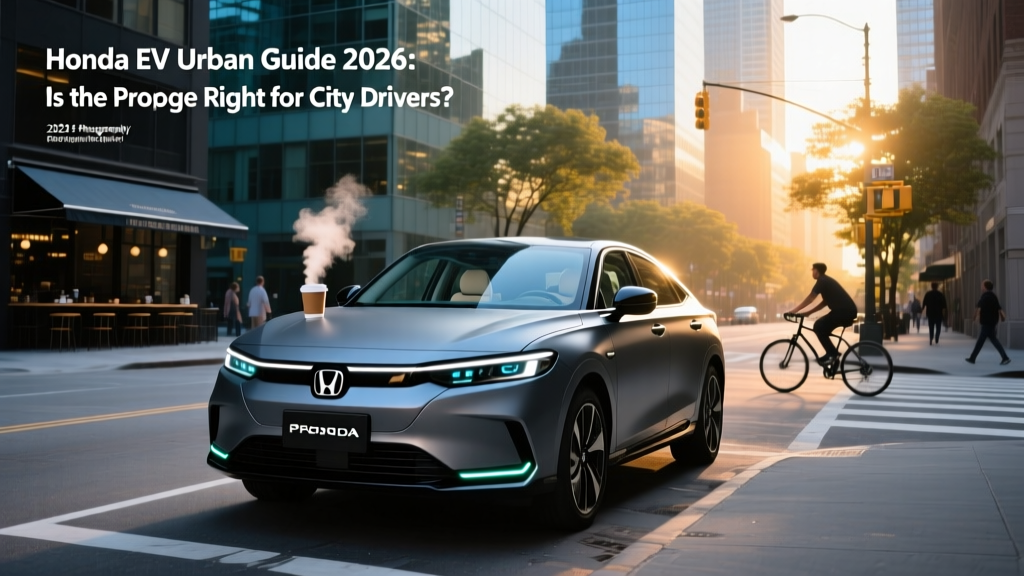
Honda was late to the battery-electric market in the U.S., and as of 2026, the Honda Prologue remains the brand's only all-electric model available to American buyers. Built on General Motors' Ultium platform (shared with the Chevy Blazer EV and Cadillac Lyriq), the Prologue is a midsize SUV rather than a compact city car, which makes it a somewhat unconventional answer to the "Honda EV urban" search query. However, its footprint — 191.7 inches long, 78.3 inches wide — is manageable for city parking, and Honda's next-generation EVs, developed in-house on a new dedicated platform, are expected to bring smaller, more urban-oriented models to the U.S. by 2027–2028.
For now, if you want a Honda-badged electrified vehicle optimized for urban use, you're choosing between the Prologue (BEV) and the CR-V Hybrid (HEV). Neither is a small hatchback, but both fit the urban crossover mold that most city-dwelling buyers actually purchase.
| Spec | Value |
|---|---|
| EPA Range | 296 miles (FWD Elite); 285 mi (AWD) |
| Battery | 85 kWh usable, NMC chemistry (Ultium) |
| Peak DC Fast Charge | ~155 kW (10–80% in ~32 min) |
| Level 2 AC Charge | 11.5 kW (max), ~8 hours 10–100% |
| Motor Output | 220 hp / 236 lb-ft (FWD); 288 hp / 325 lb-ft (AWD) |
| 0–60 mph | ~7.1 sec (FWD); ~5.9 sec (AWD) |
| MPGe (combined) | 95 MPGe (FWD Elite) |
| Base MSRP | $47,400 (EX FWD) – $53,400 (Elite AWD) |
| Battery Warranty | 8 years / 100,000 miles |
Real-World Range Reality
The EPA 296-mile sticker is measured across mixed driving. In dense urban use with frequent stops and regen braking, expect 270–290 miles in mild weather. On sustained highway trips at 70 mph, plan for 230–255 miles. In sub-30°F winter conditions without preconditioning, range can drop to 190–220 miles due to cabin heating demands and reduced battery efficiency. The Prologue's heat pump (standard on Elite trims) mitigates some of this cold-weather loss.
Prologue vs. CR-V Hybrid vs. Gas: Urban Ownership Cost Comparison
The core question for any urban buyer is whether going electric actually saves money. Below is a 5-year total cost of ownership estimate for a city-dwelling driver covering 12,000 miles per year (10,000 city / 2,000 highway), comparing the Prologue EX FWD, the CR-V Hybrid EX-L, and a gasoline CR-V EX AWD.
| Cost Category | Prologue EX FWD | CR-V Hybrid EX-L | CR-V EX AWD (Gas) |
|---|---|---|---|
| MSRP (before incentives) | $47,400 | $38,500 | $35,100 |
| Est. Federal Tax Credit (§30D) | $0–$7,500* | $0 | $0 |
| Effective Purchase Price | $39,900–$47,400 | $38,500 | $35,100 |
| Energy/Fuel (5 yr) | $2,700–$4,200 | $6,800 | $8,700 |
| Maintenance (5 yr) | $1,800 | $3,400 | $4,200 |
| Insurance (5 yr est.) | $9,500 | $7,800 | $7,500 |
| Est. Depreciation (5 yr) | $18,500 | $14,200 | $13,800 |
| Total 5-Year Cost | $72,400–$79,900 | $70,700 | $69,300 |
*The §30D federal tax credit for 2026 requires the buyer to meet income caps ($150K single / $300K joint), the vehicle to be under the $80,000 SUV MSRP cap, and critical-mineral/battery-component sourcing thresholds that shift annually. The Prologue, built on GM's Ultium platform in Mexico, has had inconsistent credit eligibility depending on model year and battery sourcing. Verify current eligibility on fueleconomy.gov before purchasing. The credit can now be transferred to the dealer at point of sale as an upfront discount.
Key takeaway: The Prologue's energy and maintenance savings are real — roughly $4,000–$6,000 less than the gas CR-V over five years. But higher insurance premiums (~$350–$400/year more for EVs, per industry data) and steeper upfront cost narrow the gap. The tax credit is the swing factor: if you qualify for the full $7,500, the Prologue becomes the cheapest option of the three. If you don't, the CR-V Hybrid wins on pure economics.
Urban Charging: What City Dwellers Actually Face
Home charging access is the single biggest variable in urban EV ownership. Here's what different urban living situations look like:
| Level | Power | Miles Added/Hour | Urban Scenario |
|---|---|---|---|
| Level 1 (120V outlet) | 1.0–1.4 kW | 3–5 mi/hr | Apartment with garage outlet; sufficient if daily driving <30 mi |
| Level 2 (240V, 48A) | 11.5 kW | 33–38 mi/hr | Home garage or dedicated spot; full overnight charge in ~8 hr |
| DC Fast (public) | 50–155 kW | 150–400 mi/hr | Public stations; 10–80% in ~32 min at peak; use for road trips |
Apartment/condo dwellers: If your building lacks EV charging infrastructure, you're reliant on public Level 2 chargers (workplace, grocery store, gym) or DC fast chargers. This works if your routine includes predictable stops near chargers, but it adds 30–90 minutes per week of "charging errands" that home-charging EV owners simply don't experience. Check PlugShare or your utility's charger map before committing.
Homeowners with a garage: A 240V/48A Level 2 charger (like the Emporia Vue or ChargePoint Home Flex) runs $500–$700 for the unit and $600–$1,200 for electrician installation, assuming your panel has a spare 240V/50A breaker slot. Older urban homes with 100A panels may need a $1,500–$3,000 panel upgrade. Total first-year home charging setup: $1,100–$1,900 in the typical case.
Street parking only: This is the hardest scenario. Without a dedicated parking spot, running a 240V line is usually impossible. Some cities (Los Angeles, Seattle) have begun installing curbside Level 2 chargers on residential streets, but coverage is sparse. If this is your situation, a hybrid is the pragmatic choice until infrastructure catches up.
Common Honda EV Misconceptions — Corrected
| Myth | Fact |
|---|---|
| "The Prologue is a Honda through and through." | The current Prologue uses GM's Ultium battery and BEV3 platform. Honda designed the exterior, interior, and tuning, but the powertrain is GM-sourced. Next-gen Honda EVs (2027+) will use Honda's own platform. |
| "EVs don't work in cold cities." | Range drops 20–35% in sub-freezing weather, but the Prologue's heat pump and battery preconditioning mitigate this. Preconditioning while plugged in preserves range by warming the battery before you drive. |
| "I need to charge every night." | With 296 miles of EPA range and typical urban driving of 20–35 miles/day, most city owners charge 1–2 times per week on Level 2. Daily charging is unnecessary and, for NMC batteries, keeping SoC between 20–80% is healthier long-term. |
| "EV batteries need replacing every few years." | Honda/GM warranties the Prologue's battery for 8 years/100,000 miles against degradation below 70% capacity. Real-world Ultium data suggests 10–15% degradation over 100K miles — meaning a 296-mile battery would still deliver ~250+ miles after a decade. |
| "Charging is more expensive than gas." | At the U.S. average residential electricity rate of ~$0.17/kWh, charging the Prologue costs roughly $0.05/mile. Gasoline at $3.40/gal in a 28 MPG CR-V costs ~$0.12/mile. Public DC fast charging at $0.35–$0.50/kWh is more expensive but still typically undercuts gas per mile. |
City Driving Dynamics: Where the Prologue Fits
Urban driving rewards different traits than highway cruising, and the Prologue has some genuine advantages here:
- Regenerative braking: The Prologue offers adjustable regen (including a one-pedal driving mode via steering-wheel paddles). In stop-and-go city traffic, this recovers meaningful energy — city MPGe often exceeds the combined rating.
- Instant torque: The FWD model's 236 lb-ft of torque is available from 0 RPM, making merging and gap-taking in urban traffic effortless compared to the turbo-lag in the gas CR-V's 1.5T engine.
- Turning radius: At 38.4 feet curb-to-curb, the Prologue is manageable for U-turns and tight parking garages, though not class-leading (the Hyundai Ioniq 5 turns at 37.4 feet).
- Cabin quietness: No engine noise at low speeds makes city driving noticeably more relaxed. The Prologue's acoustic glass on Elite trims further reduces road noise.
Where it falls short for pure urban use: At 4,600+ lbs, the Prologue is heavy for a city car. That mass means more tire wear (budget $200–$280 per tire for EV-rated rubber every 30,000–40,000 miles) and more kinetic energy to manage in emergency braking. It's also 78 inches wide — tight for older city parking structures with narrow ramps. If your urban life involves a subcompact-sized parking spot, measure before you buy.
Decision Framework: Should You Buy the Honda Prologue for Urban Driving?
Choose the Honda Prologue if:
- You have Level 2 home or workplace charging (or can install it for under $2,000)
- Your daily driving is under 50 miles and you want to charge 1–2x per week
- You qualify for the §30D federal tax credit (income caps + sourcing requirements)
- You want a midsize SUV footprint with family cargo space (25.2 cu ft rear, 57.7 cu ft folded)
- You take 2–4 road trips per year and want DC fast charging for 10–80% in ~32 minutes
Choose the Honda CR-V Hybrid instead if:
- You live in an apartment with no charging access and street-park exclusively
- You don't qualify for the federal tax credit (income above caps or sourcing disqualifies)
- Your budget tops out around $38,000–$42,000 and you can't absorb the EV premium
- You live in a region with sparse public DC fast charging and take frequent long trips
- You want the lowest-complexity ownership experience — no charger install, no range planning
Wait for Honda's next-gen EVs if:
- You want a smaller, more city-sized Honda EV (expected 2027–2028 on Honda's own platform)
- You want a fully Honda-engineered powertrain rather than the GM Ultium collaboration
- You're hoping for LFP battery chemistry (lower cost, longer cycle life, but less range per kWh)
First-Time EV Buyer Checklist
If the Prologue is your first EV, here's what to verify before signing:
- Confirm your electrical panel capacity. A licensed electrician can tell you in a $100–$150 consultation whether your panel supports a 50A/240V circuit. Don't skip this — a panel upgrade adds $1,500–$3,000.
- Verify §30D tax credit eligibility for the specific VIN. Use the DOE/IRS vehicle eligibility tool and confirm with your tax professional. Credit rules around critical minerals and battery components change annually.
- Test your actual commute for a week. Track your daily miles. If you average under 40 miles/day, even Level 1 charging (3–5 miles/hour overnight) may suffice as a temporary solution.
- Map your public charging options. Use PlugShare or your vehicle's built-in navigation to identify 3–5 reliable Level 2 or DC fast chargers within 10 minutes of your home and workplace.
- Get an insurance quote before purchase. EV insurance premiums run 15–25% higher than equivalent gas vehicles. Get a binding quote — don't rely on online estimators.
- Set a charging routine. For NMC batteries like the Prologue's, set your charge limit to 80% for daily use. Reserve 100% charges for road trips. This practice extends long-term battery health.
Frequently Asked Questions
Is the Honda Prologue eligible for the $7,500 federal tax credit in 2026?
Eligibility is VIN-specific and depends on current-year battery sourcing and critical mineral requirements under IRS §30D rules. The Prologue is assembled in Mexico on GM's Ultium platform, and its credit status has varied by model year and production batch. Always verify on fueleconomy.gov using the exact VIN before purchase. If eligible, the credit can be applied as a point-of-sale discount through the dealer.
How long does it take to charge the Prologue at home?
On a 240V/48A Level 2 charger (11.5 kW), a full charge from 10% to 100% takes approximately 8 hours. Most urban owners arriving home at 20–30% SoC will be back to 80% in 4–5 hours — easily overnight. On a standard 120V outlet (Level 1), expect roughly 3–5 miles of range per hour of charging, which is sufficient for light daily driving but not for replenishing a depleted battery quickly.
Does the Prologue support NACS (Tesla-style) charging?
The 2026 Prologue ships with a CCS1 connector. Honda has committed to adopting NACS on future models, and GM (the Prologue's platform partner) began transitioning to NACS on 2025+ Ultium vehicles. For 2026, check whether your specific Prologue trim includes a NACS adapter or CCS-to-NACS compatibility for Tesla Supercharger access. Honda has offered complimentary Electrify America charging credits on some trims as an alternative network.
What does the Prologue cost to charge per month in a city?
At the national average residential rate of ~$0.17/kWh and urban driving of 1,000 miles/month (consuming roughly 330 kWh at ~3.0 mi/kWh), expect $55–$65/month for home charging. If you rely on public DC fast charging at $0.35–$0.50/kWh, that figure rises to $115–$165/month. Compare this to $120–$140/month for gasoline in a 28 MPG CR-V at $3.40/gallon.
Is Honda making a smaller EV for city driving?
Honda has announced next-generation EVs on its own dedicated "0 Series" platform, targeting global launch beginning in 2026 (Japan) and 2027–2028 (North America). These are expected to include smaller, more urban-friendly models. However, no specific compact Honda EV has been confirmed for U.S. sale as of early 2026. If you need a small Honda electrified vehicle today, the CR-V Hybrid remains the practical urban option.