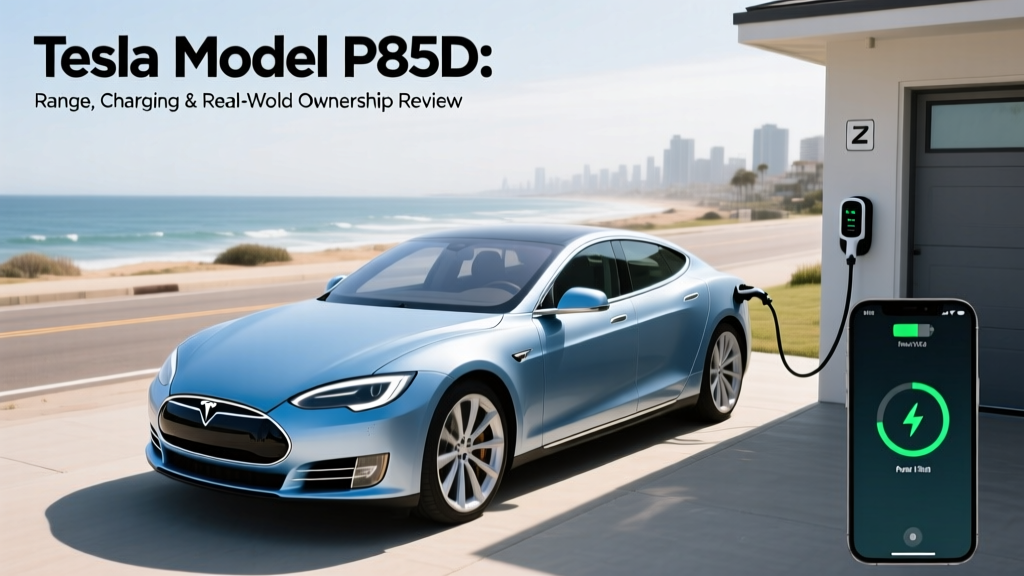
The Tesla Model S P85S occupies a unique space in the used electric vehicle market. Originally sold between 2012 and 2015, this early flagship sedan was the car that proved long-range EVs were viable for daily driving and cross-country travel. For 2026 buyers browsing the pre-owned EV market, the P85S represents a potential bargain — a premium electric sedan with genuine performance credentials, available at a fraction of its original $100,000+ MSRP. But buying a decade-old EV requires careful consideration of battery health, charging infrastructure compatibility, and realistic range expectations.
Tesla Model S P85S Core Specifications
| Specification | Value |
|---|---|
| Original EPA Range | 265 miles (85 kWh battery) |
| Battery Capacity (Usable) | ~81 kWh usable of 85 kWh gross |
| Battery Chemistry | NMC (Nickel Manganese Cobalt) |
| Drivetrain | Rear-Wheel Drive (single motor) |
| Horsepower | 416 hp |
| Torque | 443 lb-ft |
| 0-60 mph | 4.2 seconds (Performance), 5.4 seconds (standard 85) |
| EPA Efficiency | 89 MPGe combined (2013-2014), ~38 kWh/100mi |
| DC Fast Charge (Max) | ~120 kW peak (V2 Supercharger capable) |
| 10-80% DC Charge Time | ~40-50 minutes (V2 Supercharger) |
| Level 2 Home Charge | Up to 20 kW (dual charger option), ~58 miles/hr at 20 kW |
| Cargo Volume | 26.3 cu ft (rear), +5.3 cu ft (frunk) |
| Original MSRP (2013) | $87,900 - $101,900 (before incentives) |
| Used Market Price (2026) | $18,000 - $32,000 depending on mileage/battery |
| Original Battery Warranty | 8 years / unlimited miles (expired on most units) |
Real-World Range: What to Actually Expect
Battery degradation is the critical variable when evaluating any used Tesla Model S P85S. These NMC chemistry packs typically retain 75-88% of original capacity after 8-12 years and 80,000-150,000 miles, depending on charging habits and climate exposure. Vehicles that spent years in hot climates (Arizona, Texas, Florida) or were frequently DC fast-charged to 100% tend toward the lower end of that retention range.
Before purchasing, request the battery's State of Health (SoH) percentage via Tesla's service menu or a third-party diagnostic tool. A pack showing less than 75% capacity retention means you're effectively working with a ~60-64 kWh usable battery, which dramatically impacts daily usability and road-trip viability.
According to fueleconomy.gov, the 2014 Model S 85 kWh achieved 89 MPGe combined (38 kWh per 100 miles). Real-world efficiency varies: expect 34-36 kWh/100mi in city driving with regenerative braking, but 40-45 kWh/100mi on sustained highway runs at 75 mph.
Charging Speed and Infrastructure Compatibility
The P85S uses Tesla's proprietary connector (now called NACS — North American Charging Standard). This is an advantage in 2026, as the Tesla Supercharger network remains the most reliable and extensive DC fast-charging infrastructure in North America, with over 6,000 stations and 60,000+ stalls.
| Charging Level | Power (kW) | Charging Speed | Time (10-80%) |
|---|---|---|---|
| Level 1 (120V, 12A) | 1.4 kW | ~3-4 miles per hour | Not practical (50+ hours) |
| Level 2 (240V, 40A single charger) | 10 kW | ~29 miles per hour | ~7-8 hours |
| Level 2 (240V, 80A dual charger) | 20 kW | ~58 miles per hour | ~4 hours |
| DC Fast (Tesla V2 Supercharger) | 120 kW peak | ~170 miles in 30 min | ~40-50 minutes |
| DC Fast (Tesla V3/V4 Supercharger) | ~120 kW (car-limited) | Same as V2 (car is bottleneck) | ~40-50 minutes |
| CHAdeMO Adapter (if equipped) | ~50 kW | ~70 miles in 30 min | ~60-70 minutes |
Important charging curve reality: The P85S peaks at approximately 120 kW only between 10-30% State of Charge (SoC). Above 50% SoC, charging speed tapers significantly — expect 60-80 kW in the 50-70% range, and 30-40 kW above 80%. This taper is normal for NMC chemistry and protects battery longevity, but it means the last 20% takes nearly as long as the first 60%.
The dual-charger option (80A / 20 kW Level 2) was a $3,600 upgrade when new and significantly reduces home charging time. Verify whether a used P85S has single or dual chargers before purchase — it's a meaningful difference for daily charging convenience.
Performance and Driving Dynamics
The P85S Performance variant delivers 416 horsepower and 443 lb-ft of instant torque to the rear wheels, enabling a 4.2-second 0-60 mph time that remains impressive in 2026. The standard 85 kWh model (non-Performance) produces 362 hp and achieves 0-60 in 5.4 seconds. Both variants benefit from the low center of gravity afforded by the floor-mounted battery pack, resulting in composed handling and minimal body roll for a 4,600-pound sedan.
Single-motor rear-wheel drive means the P85S lacks the all-weather traction of dual-motor Tesla variants (the "D" models introduced in late 2014). If you live in a region with significant snow or ice, winter tires are essential, and you may want to consider a dual-motor Model S 85D or 90D instead.
Pricing, Tax Credits, and Total Cost of Ownership
| Cost Factor | Amount |
|---|---|
| Used Market Price (80k-120k miles) | $18,000 - $25,000 |
| Used Market Price (under 80k miles, excellent battery) | $25,000 - $32,000 |
| Federal Used EV Tax Credit (§25E) | Up to $4,000 (30% of sale price, max $4,000) |
| Effective Price After Credit | $14,000 - $28,000 |
| Estimated Annual Insurance | $1,800 - $2,800 |
| Estimated Annual Electricity Cost (12,000 mi/yr) | $550 - $850 (home charging) |
The IRS §25E Used Clean Vehicle Credit offers up to $4,000 (30% of the sale price, capped at $4,000) for qualifying used EVs. To qualify, the vehicle must:
- Have a sale price of $25,000 or less
- Be at least two model years old (all P85S vehicles qualify)
- Be purchased from a licensed dealer (private sales do not qualify)
- Buyer income must not exceed $75,000 (single), $112,500 (head of household), or $150,000 (joint filers)
- The credit is non-refundable and can only be claimed once per vehicle (check VIN history)
This credit makes the P85S remarkably affordable for buyers who find a well-maintained example under $25,000. A $22,000 P85S with a qualifying dealer purchase nets a $4,000 credit, bringing effective cost to $18,000 — extraordinary value for a 416-hp electric sedan with 200+ miles of range.
However, budget for potential battery replacement. A remanufactured 85 kWh pack from Tesla costs approximately $12,000-$16,000 installed as of 2026. Third-party options exist for $8,000-$12,000. If the battery SoH is below 80%, factor this into your purchase decision.
Technology, Interior, and Daily Livability
The P85S interior was premium for its era but shows its age in 2026. The 17-inch center touchscreen remains impressive in size, but the underlying hardware (MCU1 — first-generation Media Control Unit) is slow by modern standards and prone to failure. Many P85S vehicles have had the MCU upgraded to MCU2 (Intel Atom-based) under Tesla's recall program or as a paid upgrade — verify this before purchase, as MCU1 replacements cost $1,500-$2,500.
Notable tech features include:
- Over-the-air software updates (though newer features are limited by older hardware)
- Basic Autopilot (if equipped with hardware — early P85S vehicles predate Autopilot hardware)
- Mobile app connectivity for remote climate control and charging monitoring
- Power liftgate, panoramic roof (optional), air suspension (standard on Performance)
Cargo capacity is generous: 26.3 cubic feet behind the rear seats, plus a 5.3-cubic-foot front trunk (frunk). Rear seat legroom measures 35.4 inches — adequate for adults on shorter trips but tight for long journeys. The air suspension (standard on P85 Performance, optional on 85) provides a comfortable ride but is a known failure point; replacement air struts cost $1,000-$1,500 per corner.
Pros and Cons: Honest Assessment
Pros
- Exceptional value at $18k-$32k used
- 416 hp Performance variant is genuinely quick (4.2s 0-60)
- Access to Tesla Supercharger network
- Spacious sedan with 26+ cu ft cargo
- Low running costs (~$0.05-$0.07/mile electricity)
- Eligible for $4,000 used EV tax credit
Cons
- Battery degradation reduces range to 180-230 miles
- Original 8-year battery warranty expired
- MCU1 infotainment is slow and failure-prone
- RWD only — limited winter traction
- Air suspension failures are expensive
- No modern ADAS (Autopilot/FSD unavailable on most)
Who Should Buy the Tesla Model S P85S?
The P85S is best suited for:
- Budget-conscious enthusiasts who want premium EV performance at an economy price
- Commute-heavy drivers with home charging and round trips under 150 miles
- Second-car households where the P85S handles daily driving and a gas/hybrid vehicle covers long road trips
- DIY-inclined buyers comfortable with potential out-of-warranty repairs and proactive maintenance
Consider alternatives if you need: reliable 300+ mile road-trip range, all-wheel drive for snow, modern driver-assistance features, or a vehicle with remaining factory warranty. In those cases, a newer Model 3 Long Range, Chevrolet Bolt EUV, or Hyundai Ioniq 5 may better serve your needs despite higher upfront cost.
Frequently Asked Questions
What is the real-world range of a used Tesla Model S P85S?
Expect 180-230 miles depending on battery State of Health, driving style, and temperature. Highway driving at 70+ mph typically yields 200-220 miles; cold weather (below 40°F) reduces range by 20-30%, potentially dropping to 150-180 miles. Always verify battery SoH before purchase.
How fast does the P85S charge at home and on road trips?
At home on a 240V/40A Level 2 charger, expect ~29 miles of range per hour (7-8 hours for a full charge). With the optional dual charger (80A), that doubles to ~58 miles per hour. On Tesla V2 Superchargers, 10-80% takes approximately 40-50 minutes, with peak charging around 120 kW in the 10-30% SoC range.
Does the Tesla Model S P85S qualify for the federal EV tax credit?
Yes, under the IRS §25E Used Clean Vehicle Credit, you can receive up to $4,000 (30% of sale price, max $4,000) if the vehicle sells for $25,000 or less, you purchase from a licensed dealer, and your income falls below IRS thresholds ($75k single / $150k joint). The credit is non-refundable and can only be claimed once per VIN.
Is the P85S worth buying versus newer EVs?
For buyers prioritizing value and willing to accept range limitations and potential repair costs, yes — a $20,000 P85S after tax credit offers unmatched performance-per-dollar. However, if you need 300+ mile range, modern safety tech, or warranty coverage, newer options like the Model 3, Bolt, or Ioniq 5 are better long-term investments despite higher purchase prices.
What are the biggest risks of buying a 10-year-old Tesla?
Battery degradation (reducing range and potentially requiring $12k-$16k replacement), MCU1 infotainment failure ($1,500-$2,500 repair), air suspension failure ($1,000-$1,500 per corner), and drive unit wear. Budget $3,000-$5,000 for potential repairs in your first two years of ownership, and prioritize vehicles with documented service history and battery SoH above 80%.
The Tesla Model S P85S remains a compelling used EV proposition in 2026 for informed buyers who understand the tradeoffs. With realistic range expectations, proactive maintenance budgeting, and access to home charging, it delivers premium electric performance at an accessible price point that few competitors can match.