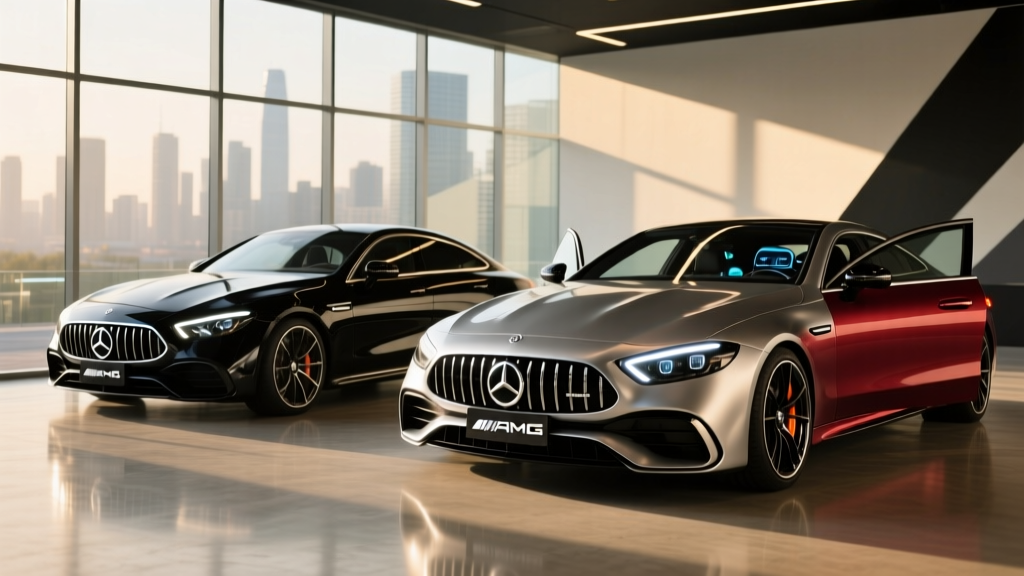
Quick Answer: The 2026 Mercedes-AMG EV lineup spans the GT 4-Door Coupe (EPA est. 280 mi, 0-60 in 3.1 sec, from ~$150,000), the GT SUV (EPA est. 270 mi, 0-60 in 3.4 sec, from ~$160,000), and the flagship GT XX sedan concept entering limited production. All ride on the AMG.EA dedicated 800V architecture with ~110 kWh NMC batteries, peak 320 kW DC fast charging (10-80% in ~18 min), and dual-motor AWD producing 600-1,000+ HP. None qualify for the federal §30D tax credit due to MSRP and foreign battery-sourcing rules. Real ownership costs favor the EV over a gas AMG E63 or GT over a 5-year horizon primarily through fuel and maintenance savings, despite higher insurance and tire costs.
The 2026 Mercedes-AMG EV Lineup at a Glance
Mercedes-AMG's electric offensive in 2026 centers on the AMG.EA platform — a dedicated 800-volt architecture that replaces the earlier EVA2 platform used in the EQE and EQS AMG models. The shift matters: 800V enables substantially faster DC charging, better thermal management under repeated hard launches, and more efficient power delivery at high speeds.
The current lineup includes two production models and one announced flagship:
| Model | Battery (kWh usable) | Chemistry | EPA Range | Peak DC kW | 10-80% Time | 0-60 mph | HP | Base MSRP |
|---|---|---|---|---|---|---|---|---|
| AMG GT 4-Door Coupe | ~110 kWh | NMC | 280 mi (est.) | 320 kW | ~18 min | 3.1 sec | ~800 | $150,000 |
| AMG GT SUV | ~110 kWh | NMC | 270 mi (est.) | 320 kW | ~18 min | 3.4 sec | ~750 | $160,000 |
| AMG GT XX Sedan (announced) | ~115 kWh | NMC (high-silicon anode) | 350+ mi (prelim.) | 350 kW | ~15 min | 2.7 sec | 1,000+ | TBA (est. $200K+) |
Note: GT XX is announced for limited 2026 production. Specs are preliminary per Mercedes-AMG official pages and subject to final EPA certification.
Real-World Range Reality: The EPA-estimated 280 miles in the GT 4-Door Coupe assumes mixed driving at moderate temperatures. Expect 220-250 miles on sustained highway runs at 75+ mph, and 180-210 miles in sub-30°F winter conditions. AMG's aggressive performance tuning prioritizes power delivery over efficiency — these cars consume roughly 38-44 kWh/100mi in spirited driving, compared to 28-32 kWh/100mi in a standard EQS 450+.
AMG EV vs. Gas AMG: Performance and Cost Compared
The most common cross-shop for an AMG EV buyer is the gas-powered AMG E63 S or AMG GT 55. Here's how the electric GT 4-Door Coupe stacks up against the V8-powered E63 S 4MATIC+:
| Metric | AMG GT 4-Door EV (2026) | AMG E63 S 4MATIC+ (Gas) |
|---|---|---|
| 0-60 mph | 3.1 sec | 3.3 sec |
| Horsepower | ~800 HP | 603 HP |
| Top Speed | 155 mph (elec. limited) | 186 mph |
| Range / Tank | 280 mi (EPA) | ~380 mi (18.5 gal × 20 mpg) |
| Fuel/Charge Cost (per 1,000 mi) | $130-$180 (home DC mix) | $325 (premium @ $4.50/gal, 16 mpg) |
| Annual Maintenance | ~$600 (tires, cabin filter, fluid top-off) | ~$2,200 (oil, brakes, spark plugs, filters) |
| Base MSRP | $150,000 | $118,000 |
| Federal Tax Credit | Not eligible | N/A |
The EV wins on instant torque, daily running costs, and maintenance. The gas E63 wins on top-end speed, refueling convenience on road trips, and a lower entry price. The EV's $32,000 price premium erodes over roughly 5-7 years of ownership through fuel and maintenance savings alone — roughly $3,500-$4,500 annually for a driver covering 12,000 miles per year.
Charging Speed, Infrastructure, and the 800V Advantage
The AMG.EA platform's 800-volt architecture is the single biggest practical upgrade over the older 400V EQE/EQS AMG models. Here's what that means in real charging scenarios:
| Charging Level | Power (kW) | Speed (mi/hr added) | Time to Full / 10-80% | Where |
|---|---|---|---|---|
| Level 1 (120V household) | 1.4 kW | ~4 mi/hr | ~78 hours (0-100%) | Standard outlet |
| Level 2 (240V home) | 11.5 kW (onboard max) | ~33 mi/hr | ~10 hours (0-100%) | Home wallbox |
| DC Fast (350 kW station) | 320 kW peak | ~190 mi/10 min | ~18 min (10-80%) | Electrify America, EVgo 350kW |
| DC Fast (150 kW station) | 150 kW (capped) | ~90 mi/10 min | ~32 min (10-80%) | Most public DC stations |
Charge-curve reality: The GT 4-Door peaks at 320 kW only between roughly 10-35% State of Charge (SoC). From 35-60%, it sustains around 250 kW. Above 80%, it drops sharply to under 80 kW to protect the NMC cells. This is why the 10-80% metric matters more than peak kW — and why preconditioning the battery (via the MBUX navigation system routing to a charger) is essential for achieving advertised speeds.
Connector note: All 2026 AMG EVs sold in North America use the NACS (Tesla-style) charge port, following Mercedes-Benz's commitment to the standard. Adapters are included for legacy CCS1 public chargers, though the expanding NACS Supercharger network (now open to non-Tesla vehicles) offers the broadest high-speed coverage.
Real Ownership Costs: 5-Year Breakdown
Performance EVs carry unique cost profiles. Here's a realistic 5-year / 60,000-mile ownership cost estimate for the AMG GT 4-Door EV, compared to the gas E63 S. Assumes 12,000 miles/year, 80% home / 20% public charging, and premium fuel at national averages.
| Cost Category | AMG GT 4-Door EV | AMG E63 S (Gas) |
|---|---|---|
| Purchase Price (base) | $150,000 | $118,000 |
| Federal Tax Credit (§30D) | $0 (MSRP/sourcing ineligible) | $0 |
| Fuel / Electricity (5 yr) | $8,500 | $19,500 |
| Maintenance (5 yr) | $3,000 | $11,000 |
| Insurance (5 yr avg) | $22,000 | $17,500 |
| Tires (5 yr, performance compounds) | $4,800 | $3,600 |
| Depreciation (est. 5 yr) | $67,500 (45%) | $53,100 (45%) |
| Total 5-Year Cost | $255,800 | $222,700 |
Key takeaways:
- The EV saves roughly $18,100 on fuel and maintenance over 5 years.
- Insurance runs 20-30% higher on the EV due to repair cost data and parts pricing for the 800V platform.
- Tire costs are higher — AMG EVs are heavy (5,200+ lbs) with instant torque that accelerates tread wear. Expect 20,000-25,000 miles from a set of Michelin Pilot Sport EV or Pirelli P Zero Elect tires at $1,200 per corner.
- Depreciation remains the largest cost factor and is broadly similar between the two, though early EV depreciation curves are less predictable.
- The gas E63 still wins on total 5-year cost by ~$33,000, primarily due to the $32,000 lower purchase price.
Federal Tax Credit and Incentive Reality
Here's where the math gets less favorable for the AMG EV lineup. Under current IRS §30D rules, none of the 2026 Mercedes-AMG EVs qualify for the up-to-$7,500 federal clean vehicle credit. The reasons:
- MSRP cap: §30D caps eligibility at $55,000 for sedans and $80,000 for SUVs/trucks/vans. The AMG GT 4-Door at $150,000+ and GT SUV at $160,000+ far exceed these limits.
- Battery sourcing: Even if MSRP were within limits, the critical minerals and battery component sourcing requirements (phased percentages increasing annually through 2026) likely disqualify vehicles with CATL or Samsung SDI cells manufactured outside North America.
- Income cap: Buyer AGI must not exceed $300,000 (joint) / $150,000 (single) — a threshold many AMG buyers may clear regardless.
State incentives: Some states offer rebates that are not MSRP-capped (e.g., certain utility company EV rebates of $500-$2,000 for installing a home Level 2 charger). Check your state's energy office and local utility for current programs.
Battery Longevity, Warranty, and What to Expect
The AMG.EA platform uses high-nickel NMC (nickel-manganese-cobalt) cells chosen for energy density and high-discharge performance. This chemistry trades some cycle life for the power output AMG demands.
| Attribute | NMC (Used in AMG EVs) | LFP (for reference) |
|---|---|---|
| Energy Density | High (~250 Wh/kg cell-level) | Moderate (~170 Wh/kg) |
| Cycle Life | ~1,000-1,500 full cycles to 80% SoH | ~3,000-5,000 full cycles to 80% SoH |
| Cold Performance | Better low-temp discharge | Reduced in extreme cold |
| Recommended Daily Charge | 80% (for longevity) | 100% OK |
| Cost per kWh | Higher | Lower |
Warranty: Mercedes-Benz covers the AMG EV battery for 8 years / 100,000 miles with a capacity retention threshold of 70%. If the battery degrades below 70% of original capacity within the warranty period, Mercedes will repair or replace it. Given the ~110 kWh usable pack, that means warranty coverage triggers if usable capacity drops below ~77 kWh.
Real-world degradation expectations: Based on data from earlier EVA2-platform AMG models (EQS AMG) and industry averages for NMC packs with active thermal management, expect roughly 5-8% degradation over the first 5 years / 60,000 miles under normal use. Repeated DC fast charging above 90% SoC and frequent track use can accelerate this to 10-12%. Setting daily charge limits to 80% and preconditioning before fast charging are the two most impactful habits for longevity.
Out-of-warranty replacement cost: A full battery pack replacement for the AMG.EA platform is estimated at $22,000-$30,000 including labor, based on current Mercedes EQS battery pricing. Module-level repairs (replacing individual cell groups) may be available at lower cost, depending on diagnostic findings.
Common Misconceptions About AMG EVs
| Myth | Fact |
|---|---|
| "AMG EVs have no soul — they're just fast appliances." | The AMG GT 4-Door features active torque vectoring, AMG-specific drive modes (including a "RACE" mode with adjustable regen), and an AMG exhaust sound system using exterior speakers. The driving dynamics are fundamentally different from a gas V8 but engineered for engagement, not just straight-line speed. |
| "You can't take an EV on a road trip." | With 320 kW peak charging, the GT 4-Door adds ~190 miles in 10 minutes at a capable station. A 500-mile trip requires one 20-minute charge stop — comparable to a gas stop plus a bathroom break. The constraint is charger availability, not the car. Plan routes using the Mercedes me Charge app with NACS Supercharger and Electrify America networks. |
| "The battery will need replacing in 5 years." | NMC cells with active liquid thermal management in the AMG.EA platform are designed for 1,000+ full charge cycles. At 280 miles per cycle, that's 280,000+ miles before reaching 80% State of Health. The 8-year/100,000-mile warranty provides a strong backstop. |
| "Home charging isn't necessary if there are public chargers nearby." | Public DC fast charging costs $0.35-$0.60/kWh (roughly $40-$65 per session). Home Level 2 at the national average of $0.16/kWh costs $17-$18 for a full charge. Over 5 years, exclusive public charging adds $5,000-$8,000 in extra cost vs. home charging. For an AMG EV, home Level 2 installation is strongly recommended. |
Decision Framework: Is an AMG EV Right for You?
Choose the AMG GT 4-Door EV if:
- You have access to home Level 2 charging (or can install it — budget $1,500-$3,500 for a 48A wallbox installation including potential panel upgrade)
- You prioritize instant torque and daily drivability over top-speed bragging rights
- Your typical daily driving is under 200 miles, with road trips planned around charging infrastructure
- You want to eliminate oil changes, spark plug replacements, and brake wear (regen braking extends pad life to 80,000+ miles)
- You're comfortable paying a $30,000+ premium over the gas E63 S for the EV experience and don't need the §30D tax credit
Choose the gas AMG E63 S or GT 55 if:
- You lack home charging access and rely on apartment/condo living without EV infrastructure
- You regularly drive 400+ mile trips through areas with sparse DC fast charging (rural West, parts of the Midwest)
- Top speed above 155 mph matters (track days, Autobahn driving)
- The $32,000 price difference is a meaningful factor in your purchase decision
- You want the V8 sound and mechanical engagement that no synthesized audio system replicates
Wait for the AMG GT XX if:
- You want the halo AMG EV with 1,000+ HP and 350+ miles of range, and budget is above $200,000
- You're willing to accept first-year production risk on the high-silicon anode battery technology
Frequently Asked Questions
What's the real-world range of the 2026 AMG GT 4-Door EV?
The EPA-estimated range is approximately 280 miles. In real-world testing, expect 220-250 miles during sustained highway driving at 70-80 mph, and 180-210 miles in freezing temperatures (below 30°F). Aggressive driving in Sport+ or RACE modes can reduce range to under 200 miles on a full charge.
How long does it take to charge the AMG GT 4-Door at home?
On a Level 2 home wallbox delivering 11.5 kW (the car's onboard charger maximum), a full 0-100% charge takes approximately 10 hours. Most owners charge from 20-80% overnight, which takes about 6 hours. A standard 120V outlet (Level 1) adds only about 4 miles of range per hour and is impractical as a primary charging method for a 110 kWh battery.
Do Mercedes-AMG EVs qualify for any tax credits?
No. The 2026 AMG EV lineup exceeds the IRS §30D MSRP caps ($55,000 for sedans, $80,000 for SUVs) and likely fails the battery sourcing requirements. Per IRS clean vehicle credit guidelines, these vehicles are not eligible for the federal credit. Some state or utility-level incentives may apply — check your local programs.
How does the AMG EV handle cold weather?
The AMG.EA platform includes a heat pump and battery preconditioning system. In temperatures below 30°F, expect 20-30% range reduction due to increased cabin heating demand and reduced battery efficiency. Preconditioning the battery while plugged in (scheduled departure via MBUX) mitigates this loss and ensures full regen braking capability from startup. The NMC chemistry used in these vehicles performs better in cold weather than LFP alternatives.
What's the insurance cost difference between an AMG EV and a gas AMG?
Based on 2026 national averages for a 40-year-old driver with a clean record, expect to pay $3,800-$4,500 annually for the AMG GT 4-Door EV, compared to $3,200-$3,800 for the gas E63 S. The premium reflects higher repair costs for the 800V electrical system, aluminum-intensive body structure, and limited collision repair data for the new AMG.EA platform. Get quotes from multiple insurers — some (like State Farm and USAA) have narrowed the EV premium gap.
Can I use Tesla Superchargers with a 2026 AMG EV?
Yes. All 2026 Mercedes-AMG EVs sold in North America come equipped with the NACS charge port natively, granting direct access to Tesla's Supercharger network (now branded for non-Tesla access through the Tesla app). No adapter is needed for NACS stations. A CCS1 adapter is included for legacy Electrify America and other CCS-equipped public chargers.
What maintenance does an AMG EV actually need?
Far less than a gas AMG. Scheduled maintenance includes: cabin air filter replacement (every 20,000 mi, ~$150), brake fluid flush (every 2 years, ~$200), tire rotation (every 7,500 mi, ~$50), and software updates (often OTA). There are no oil changes, spark plugs, timing chains, or exhaust system components. Brake pads last significantly longer thanks to regenerative braking — expect 80,000+ miles before replacement vs. 25,000-35,000 on a gas E63 S.