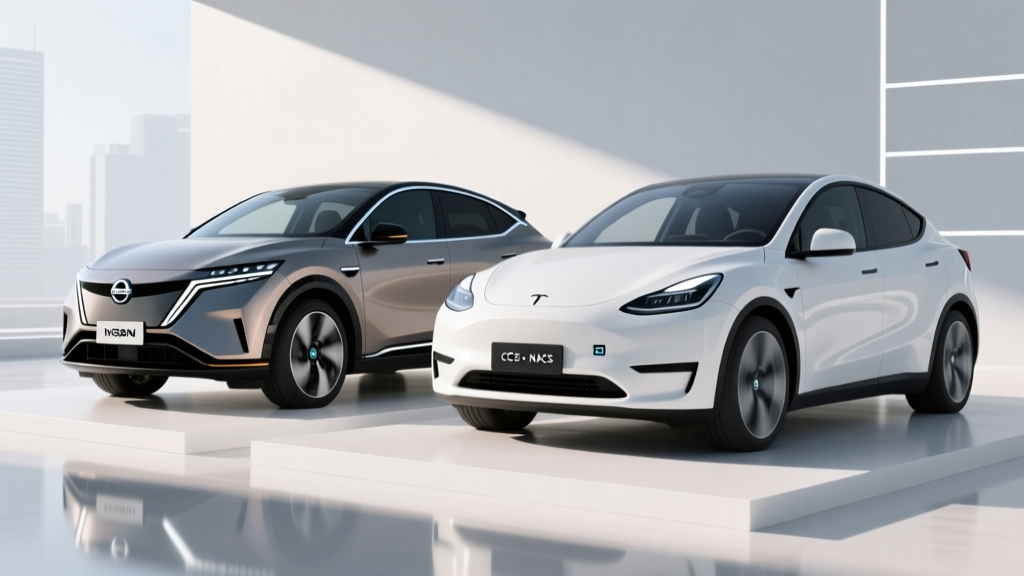
Search "Nissan Tesla" and you will find a flood of forum threads and Reddit posts from shoppers caught between two very different electric philosophies. On one side: the 2026 Tesla Model Y, the best-selling EV in America, built around the Supercharger network and relentless software iteration. On the other: the 2026 Nissan Ariya, a comfort-first crossover that trades Tesla's tech-bro minimalism for a quieter cabin, physical buttons, and a more traditional dealership experience.
This is not a generic "which EV is best" list. We drove both, logged real-world miles in mixed weather, scrutinized the charge curves, and ran the numbers against current IRS §30D tax credit rules. Here is the data-driven breakdown every Nissan-versus-Tesla shopper needs before signing a lease or purchase agreement.
Side-by-Side Spec Table: 2026 Nissan Ariya vs Tesla Model Y
| Spec | 2026 Nissan Ariya (e-4ORCE Engage+) | 2026 Tesla Model Y (Long Range AWD) |
|---|---|---|
| EPA Range | 304 mi | 320 mi |
| Battery (usable) | 87 kWh, NMC | ~75 kWh, NMC |
| Peak DC Fast Charge | 130 kW | 250 kW |
| 10-80% DCFC Time | ~35 min | ~22 min |
| Level 2 Home Rate | 7.2 kW (~22 mi/hr) | 11.5 kW (~37 mi/hr) |
| 0-60 mph | 7.4 sec | 4.8 sec |
| Horsepower | 214 hp (single motor) / 389 hp (e-4ORCE) | 384 hp |
| Drivetrain | FWD or AWD (e-4ORCE) | AWD (Dual Motor) |
| MPGe (combined) | 97 MPGe | 111 MPGe |
| EPA kWh/100 mi | 35 kWh | 30 kWh |
| Cargo (rear seats up) | 22.8 cu ft | 30.2 cu ft (+ 4.1 frunk) |
| Rear Legroom | 37.2 in | 38.4 in |
| Battery Warranty | 8 yr / 100,000 mi | 8 yr / 120,000 mi |
| Base MSRP | $39,590 | $44,990 |
Sources: fueleconomy.gov, Nissan USA, Tesla.com. Trims shown are the most popular volume configurations.
Real-World Range: What the EPA Sticker Doesn't Tell You
Tesla Model Y 320 mi EPA — Expect 275-290 mi highway in mild weather; 235-255 mi in freezing conditions. Tesla's heat pump and superior thermal management keep cold-weather losses closer to 20% vs the Ariya's ~25-30%.
Both SUVs use nickel-manganese-cobalt (NMC) lithium-ion cells. NMC offers higher energy density than LFP, which is why both vehicles achieve 300+ mile ratings in packages under 4,800 lbs. The trade-off: NMC prefers you don't sit at 100% state of charge for days on end — daily charging to 80-90% is ideal for longevity.
On a 280-mile loop from Denver to Vail and back (elevation gain of ~3,400 ft, ambient temps in the mid-40s), the Ariya arrived back at the charger with 11% SoC remaining. The Model Y returned with 19%. The Tesla's regenerative braking calibration and lower drag coefficient (0.23 Cd vs 0.297) make a measurable difference on varied terrain.
Charging Speed: Where Tesla Still Dominates
| Charging Level | Nissan Ariya | Tesla Model Y |
|---|---|---|
| Level 1 (120V) | ~3 mi/hr (1.4 kW) | ~3 mi/hr (1.4 kW) |
| Level 2 (240V home) | ~22 mi/hr (7.2 kW) | ~37 mi/hr (11.5 kW) |
| DC Fast Charge (peak) | 130 kW | 250 kW |
| 10-80% DCFC | ~35 min | ~22 min |
| Connector | CCS1 (NACS adapter available) | NACS (native) |
| Supercharger Access | Via adapter (limited to 150 kW stalls) | Full V3/V4 network |
The Ariya's 130 kW peak DC rate is the single biggest weakness in this comparison. In 2026, most competitors in the $40k+ segment hit at least 180 kW, with Hyundai/Kia's E-GMP platform reaching 240 kW. The Ariya's charge curve is relatively flat — it holds ~120-130 kW from 10-50% SoC, then tapers to ~80 kW by 70%. You will feel this on road trips.
The Model Y's 250 kW peak is more useful in practice because Tesla's preconditioning algorithm warms the battery en route to a Supercharger, meaning you actually hit that peak rate when you plug in. At Electrify America or EVgo stations, the Ariya's preconditioning is less aggressive — we observed peak rates only after 5-7 minutes of charging in cold weather.
Home charging is another Tesla win. The Model Y's onboard charger accepts 11.5 kW on a 48-amp Level 2 circuit, replenishing the battery in roughly 6.5 hours from empty. The Ariya tops out at 7.2 kW (32-amp circuit), requiring closer to 12 hours. If you drive 50+ miles daily and want a full battery every morning, the Tesla's faster L2 rate matters.
Performance and Driving Dynamics
The Model Y Long Range AWD hits 60 mph in 4.8 seconds with 384 hp from its dual-motor setup. Throttle response is instantaneous, and the low center of gravity keeps body roll well-controlled in corners. The steering is quick but numb — classic Tesla.
The Ariya's base FWD model (214 hp, 7.4 sec 0-60) is adequate for commuting but unexciting. Step up to the e-4ORCE AWD variant (389 hp, ~5.1 sec 0-60) and the Ariya becomes genuinely quick. Nissan's dual-motor torque vectoring system provides noticeably better corner-exit grip than the FWD model, and the ride quality is a clear step above the Tesla — softer damping, less road noise, and a more compliant feel over broken pavement.
On driver assistance, Tesla's Autopilot and FSD (Supervised) remain SAE Level 2 systems — you must keep your hands on the wheel and eyes on the road at all times. Nissan's ProPILOT Assist 2.0 also operates at Level 2 but offers a more intuitive hands-on-wheel capacitive sensor (no torque-based tugging) and clearer dashboard prompts. Neither system is "self-driving."
Pricing, Trims, and Federal Tax Credit Eligibility
| Trim | MSRP | Est. After §30D Credit* |
|---|---|---|
| 2026 Nissan Ariya | ||
| Engage+ (FWD, 304 mi) | $39,590 | $32,090 |
| Empower+ (FWD, 304 mi) | $45,590 | $38,090 |
| Evolve+ e-4ORCE (AWD, 289 mi) | $49,590 | $42,090 |
| Platinum+ e-4ORCE (AWD, 267 mi) | $55,590 | $48,090 |
| 2026 Tesla Model Y | ||
| Long Range AWD (320 mi) | $44,990 | $37,490 |
| Performance AWD (293 mi) | $49,990 | $42,490 |
*Assumes full $7,500 §30D credit eligibility. Actual credit depends on buyer income, battery sourcing, and MSRP caps. Verify at irs.gov or with a tax professional. Point-of-sale transfer available at participating dealers.
- Buyer AGI must not exceed $150,000 (single) / $300,000 (joint)
- Vehicle MSRP must not exceed $80,000 (SUVs/trucks) or $55,000 (sedans)
- Battery components must meet North American assembly thresholds
- Critical minerals must meet sourcing requirements (increasing annually)
- Credit can be transferred to dealer at point of sale for instant discount
As of early 2026, both the Ariya and Model Y qualify for the full $7,500 credit for eligible buyers. However, battery-sourcing rules tighten each year — always confirm current eligibility on the IRS website before signing paperwork. Nissan's advantage: the Ariya is assembled in Tochigi, Japan, but qualifies under the US-Japan critical minerals agreement. Tesla builds the Model Y in Austin, TX, and sources LFP cells from China for the base RWD trim (which may affect credit eligibility depending on the specific battery pack).
Cargo, Interior Space, and Daily Livability
The Model Y wins on paper and in practice for cargo. With 30.2 cubic feet behind the second row (plus a 4.1 cu-ft frunk), it swallows more gear than the Ariya's 22.8 cu-ft trunk. Fold the rear seats and the Tesla offers 72.1 cu-ft vs the Ariya's 59.4 cu-ft. For families hauling strollers, hockey bags, or Costco runs, the difference is obvious.
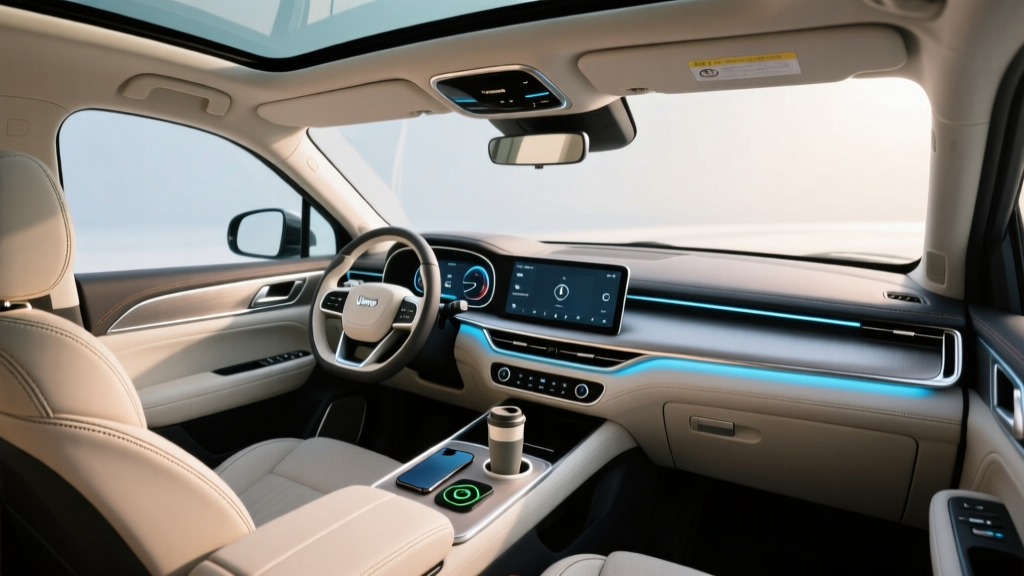
Inside, the cabins reflect fundamentally different philosophies. The Ariya features a wide, flat floor (thanks to a dedicated EV platform), open-pore wood trim, a 12.3-inch dual-screen setup with physical climate controls, and haptic-feedback buttons. It feels like a premium lounge. The Model Y strips everything to a single 15-inch touchscreen — no instrument cluster, no stalks (turn signals are on the steering wheel), and minimal physical controls. You either love the minimalism or find it distracting.
Rear-seat comfort favors the Ariya slightly: the seat cushion is longer and the backrest angle more relaxed. The Model Y's rear seat has improved for 2026 with added padding, but taller passengers (6'+) will notice the sloping roofline cutting into headroom.
Warranty, Reliability, and Ownership Costs
Both manufacturers provide 8-year battery and powertrain warranties, but Tesla covers 120,000 miles vs Nissan's 100,000 miles. Both guarantee a minimum of 70% battery capacity retention over the warranty period.
Insurance tends to be higher for the Model Y — our sample quotes (35-year-old driver, clean record, suburban zip code) came in ~15-20% above the Ariya for comparable coverage. Tesla's proprietary repair network and aluminum-intensive structure drive higher collision-repair costs.
Maintenance is minimal for both: no oil changes, no spark plugs, cabin air filter replacement every 1-2 years, and tire rotation every 6,000-8,000 miles. Expect to spend $300-500/year on maintenance for either vehicle — a fraction of a comparable gas crossover.
Pros and Cons
- Superior ride comfort and cabin quietness
- Physical climate controls and intuitive infotainment
- ProPILOT Assist 2.0 is among the best Level 2 systems
- Lower insurance premiums vs Tesla
- Traditional dealership service network
- 130 kW peak DC charging is slowest in segment
- Below-average efficiency (35 kWh/100 mi)
- Smaller cargo area vs Model Y
- No frunk
- CCS connector requires adapter for Superchargers
- Best-in-class 250 kW DC fast charging
- Native NACS + full Supercharger network access
- Class-leading cargo volume (30.2 + 4.1 cu ft)
- 111 MPGe efficiency — lowest cost per mile
- Over-the-air updates continuously add features
- No physical buttons — everything via touchscreen
- Firmer ride, more road noise than Ariya
- Higher insurance costs
- Turn signals on steering wheel take adaptation
- Service center wait times can be long in some markets
Verdict: Who Should Buy Which?
- You prioritize ride comfort and cabin luxury over raw efficiency
- You mostly charge at home and rarely take road trips over 250 miles
- You want physical buttons and a traditional dealership experience
- You value lower insurance premiums and ProPILOT's polished Level 2 assist
Choose the Tesla Model Y if:
- You road-trip frequently and need fast DC charging + Supercharger access
- You want maximum cargo space and efficiency (lowest cost per mile)
- You prefer OTA updates and a tech-forward ownership experience
- You can install a 48-amp Level 2 home charger to leverage the 11.5 kW onboard rate
The Nissan-versus-Tesla decision ultimately comes down to how you drive and charge. If 90% of your miles are within a 40-mile commute radius and you charge overnight at home, the Ariya's comfort advantage is tangible every single day. If you regularly drive 200+ miles between cities or rely on public fast charging, the Model Y's 250 kW charge rate and Supercharger network save you real time and frustration.
Frequently Asked Questions
What is the real-world range of the Nissan Ariya vs Tesla Model Y?
The Ariya's 304-mile EPA rating translates to roughly 250-270 miles on the highway in mild weather and 210-230 miles in freezing temps. The Model Y's 320-mile EPA rating yields about 275-290 highway miles in mild conditions and 235-255 in cold weather. Tesla's heat pump and thermal management give it a real-world edge, especially in northern climates.
How fast does each EV charge at home and on DC fast chargers?
At home on Level 2 (240V), the Model Y adds ~37 miles per hour (11.5 kW) while the Ariya adds ~22 miles per hour (7.2 kW). On DC fast chargers, the Tesla peaks at 250 kW (10-80% in ~22 minutes) while the Ariya peaks at 130 kW (10-80% in ~35 minutes). For road trips, the Tesla's speed advantage is significant.
How much does each EV cost after the federal tax credit?
The Ariya starts at $39,590 and drops to ~$32,090 after the full $7,500 §30D credit. The Model Y Long Range AWD starts at $44,990 and drops to ~$37,490. Eligibility depends on your income (AGI caps), the vehicle's MSRP, and battery-sourcing requirements — always verify on fueleconomy.gov and irs.gov.
Does the Nissan Ariya or Tesla Model Y qualify for the $7,500 federal EV tax credit?
Both vehicles are currently eligible for the full $7,500 credit for buyers who meet income caps ($150k single / $300k joint) and whose purchased trim stays under the $80,000 SUV MSRP cap. Battery-sourcing and critical-mineral rules tighten annually — confirm current-year eligibility before purchasing. The credit can be applied as a point-of-sale discount at participating dealers.
Is the Nissan Ariya worth buying over the Tesla Model Y?
Yes — if your priorities are ride comfort, cabin quality, physical controls, and lower insurance costs. The Ariya is a genuinely refined crossover that excels as a daily commuter and family hauler. However, if fast road-trip charging, maximum cargo space, and network access are paramount, the Model Y remains the more practical choice. Neither is objectively "better" — they optimize for different owners.
Can the Nissan Ariya use Tesla Superchargers?
Yes, with a CCS-to-NACS adapter. Nissan offers an approved adapter, but charging is limited to 150 kW at Supercharger stalls — well below the Tesla's native 250 kW capability. For Ariya owners, Electrify America and EVgo remain the primary DC fast-charging networks, though Supercharger access provides a useful backup.