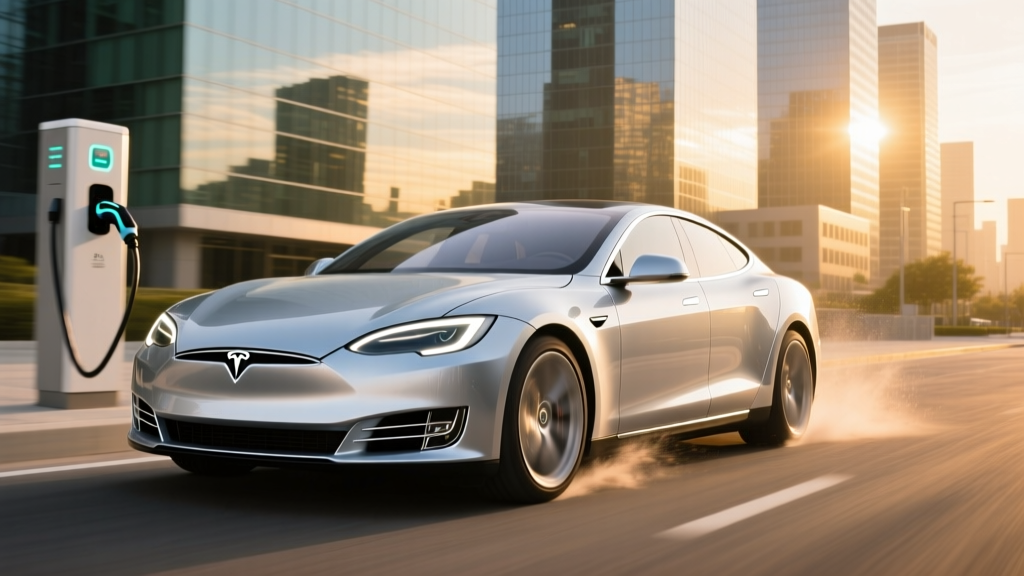
The Tesla Model S has been the benchmark luxury electric sedan for over a decade, and the current Long Range dual-motor variant — the spiritual successor to what was once badged the 100D — remains one of the most capable EVs on the road. If you've been searching for Tesla Model S 100D horsepower figures, the answer depends on which era you're referencing: the original 2017–2019 100D produced roughly 518 combined horsepower from its dual-motor setup, while the 2026 Model S Long Range AWD delivers a peak output of 670 horsepower on the same 100 kWh-class battery architecture. This review covers the current-generation Model S Long Range — its real-world range, charging behavior, ownership economics, and whether it still earns its flagship status against rising competition.
Tesla Model S Long Range: Core Specifications at a Glance
| Spec | Value |
|---|---|
| EPA Range | 402 miles |
| Battery (usable) | ~95 kWh (NMC chemistry) |
| Drivetrain | Dual-motor AWD (permanent magnet front / induction rear) |
| Peak Horsepower | 670 hp |
| 0–60 mph | 3.1 seconds |
| Top Speed | 155 mph |
| Max DC Fast Charge | 250 kW (peak) |
| 10–80% DC Charge | ~30 minutes |
| Level 2 Home Charge | 11.5 kW (~44 mi/hr) |
| EPA Efficiency | 124 MPGe combined / 28 kWh/100 mi |
| Cargo Volume | 28.0 cu ft (rear trunk + frunk) |
| Battery Warranty | 8 years / 150,000 miles |
| Base MSRP | $79,990 (before incentives) |
Real-World Range: What 402 EPA Miles Actually Means on the Road
The Model S Long Range achieves its 402-mile EPA estimate through a combination of low drag coefficient (0.208 Cd), a heat pump for efficient cabin climate control, and Tesla's mature powertrain software. However, EPA testing uses a mixed city/highway cycle with moderate speeds. On a pure highway road trip — the scenario that matters most for road-trippers — aerodynamic drag rises with the square of velocity, and the Model S consumes roughly 30–33 kWh/100 mi at 75 mph versus its rated 28 kWh/100 mi combined.
Cold weather is the great equalizer for all EVs. The Model S's battery thermal management system actively preconditions and heats the pack, which mitigates but does not eliminate range loss. In our experience with NMC packs in sub-freezing conditions, a 20–25% reduction from the EPA figure is typical. That still leaves roughly 300 miles — more than sufficient for most drives between Supercharger stops.
Charging Speed: 250 kW Peak, but the Curve Matters
| Charging Level | Power | Miles Added per Hour | Notes |
|---|---|---|---|
| Level 1 (120V) | ~1.4 kW | ~4 mi/hr | Emergency/trickle only |
| Level 2 (240V, 48A) | 11.5 kW | ~44 mi/hr | Home Wall Connector; full charge in ~9 hrs |
| DC Fast (V3 Supercharger) | 250 kW peak | ~200 mi in 15 min | 10–80% in ~30 min; tapers above 80% |
| DC Fast (V4 Supercharger) | Up to 250 kW | Similar to V3 | Newer stalls; CCS adapter not needed for Tesla |
The Model S Long Range supports a peak DC fast-charge rate of 250 kW on Tesla's V3 and V4 Supercharger network. However, like all EVs, it does not sustain peak rate across the full session. The charge curve is aggressive from 10–50% State of Charge (SoC), then progressively tapers. A typical 10–80% session takes approximately 30 minutes. Charging from 80–100% adds significant time due to cell-balancing protocols — plan to unplug at 80% on road trips for optimal throughput.
At home on a Level 2 Tesla Wall Connector (48 amps, 240V), the onboard charger accepts up to 11.5 kW, adding roughly 44 miles of range per hour. A full 10–100% charge takes about 9 hours, making overnight replenishment trivial for daily driving. If your home electrical panel supports a 60-amp dedicated circuit (typical installation), this setup is ideal. Homes with older 100-amp panels may require a panel upgrade — factor $1,500–$3,000 for that contingency.
With the industry's shift toward NACS (North American Charging Standard), the Model S uses the native Tesla connector, granting access to over 60,000 Supercharger stalls in North America without an adapter. This remains one of the strongest practical advantages Tesla holds over CCS-equipped competitors.
Performance: 670 Horsepower and a 3.1-Second 0–60
The current Model S Long Range AWD pairs a permanent-magnet synchronous motor on the front axle with an induction motor on the rear, producing a combined peak output of 670 horsepower. The 0–60 mph sprint completes in 3.1 seconds — supercar territory in a five-passenger sedan with a trunk. For context, the original 100D badge (2017–2019) produced approximately 518 hp and ran 0–60 in 4.2 seconds, so the generational leap in powertrain efficiency and inverter technology is substantial.
Those seeking even more output can step up to the Model S Plaid, which uses a tri-motor setup producing 1,020 hp and a 1.99-second 0–60 time — but at a $108,490 starting price and 359-mile EPA range, it trades efficiency for brute force. For most buyers, the Long Range's 670 hp is more than adequate and delivers better range.
The dual-motor AWD system provides excellent all-weather traction. Torque vectoring between front and rear axles is managed entirely by software, with no mechanical linkage. The adaptive air suspension adjusts ride height and damping automatically, contributing to both highway stability and ground clearance on rough roads.
Interior, Tech, and Daily Livability
The Model S interior centers on a 17-inch OLED touchscreen that controls virtually every vehicle function — climate, media, navigation, vehicle settings, and even the glovebox release. A secondary 8-inch display serves rear-seat passengers, and a yoke-style steering wheel is standard (a conventional round wheel is available at no cost). The 12.2-inch instrument cluster sits behind the yoke, visible over the top of it.
Passenger space is generous for a sedan: 42.7 inches of front legroom and 35.4 inches of rear legroom accommodate tall adults comfortably. The rear seat fits three across, though the center position is best for shorter trips. The rear trunk holds 26.0 cubic feet, and the front trunk (frunk) adds 2.0 cubic feet — enough for a charging cable bag and small soft-sided cooler.
Tesla Autopilot comes standard and includes Traffic-Aware Cruise Control and Autosteer (lane centering). The optional Full Self-Driving (Supervised) package ($8,000 one-time or $99/month) adds automatic lane changes, Navigate on Autopilot for highway interchanges, and Smart Summon. It is critical to understand that FSD is an SAE Level 2 driver-assistance system — the driver must remain attentive and keep hands on the wheel at all times. It is not autonomous driving.
Notable drawbacks include the reliance on touchscreen controls for simple functions (glovebox, mirror adjustment, wiper speed), which can be distracting while driving. Panel gap quality, while improved from earlier years, still occasionally draws criticism compared to Mercedes or BMW fit-and-finish standards. There is no Apple CarPlay or Android Auto — Tesla's proprietary infotainment is the only option.
Pricing, Trims, and Federal Tax Credit Eligibility
| Trim | MSRP | Est. After §30D Credit | EPA Range |
|---|---|---|---|
| Long Range AWD | $79,990 | $79,990 (see eligibility below) | 402 mi |
| Plaid (Tri-Motor AWD) | $108,490 | $108,490 (exceeds MSRP cap) | 359 mi |
The Model S Long Range starts at $79,990 (including destination). Adding FSD, a premium interior color, or 21-inch wheels can push the as-tested price above $92,000. The Plaid starts at $108,490.
Federal tax credit eligibility (§30D) is a nuanced topic for the Model S. Under current IRS rules, the §30D new clean vehicle credit offers up to $7,500, but several restrictions apply:
- MSRP Cap: Sedans must have an MSRP at or below $55,000 to qualify. The Model S, at $79,990 base, exceeds this cap and does not qualify for the new-vehicle §30D credit.
- Buyer Income Cap: Modified adjusted gross income must not exceed $150,000 (single) / $300,000 (joint). Even if the MSRP cap were met, higher-income buyers would be excluded.
- Battery Sourcing: The credit phases in requirements for critical minerals and battery component manufacturing in FTA-partner countries. These rules tighten annually.
Because the Model S exceeds the $55,000 sedan MSRP cap, it does not qualify for the $7,500 federal new-vehicle tax credit under current IRS rules (source: IRS §30D). Buyers seeking federal incentive value should explore the used EV credit (§25E), which offers up to $4,000 on qualifying pre-owned EVs priced at or below $25,000 — potentially applicable to older Model S vehicles from the 2017–2020 era.
Some states offer additional rebates or HOV lane access regardless of MSRP caps. Check your state's energy office or DMV for local programs, as these vary significantly by jurisdiction.
Efficiency and Ownership Costs
The EPA rates the Model S Long Range at 124 MPGe combined, which translates to approximately 28 kWh per 100 miles. At the U.S. average residential electricity rate of ~$0.17/kWh (as of early 2026), that works out to roughly $0.048 per mile for home charging. Compare this to a similarly quick gasoline sedan averaging 25 MPG at $3.50/gallon: $0.14 per mile. Over 15,000 annual miles, the Model S saves approximately $1,380 per year in energy costs alone.
DC fast charging on the Supercharger network is more expensive — typically $0.25–$0.40/kWh depending on location and time of day — but even at the high end, per-mile fuel cost remains below that of premium gasoline.
Tesla's battery and drive unit warranty covers 8 years or 150,000 miles (whichever comes first), with a guaranteed minimum 70% capacity retention over that period. Tesla's NMC packs have demonstrated strong longevity in fleet data, with typical degradation of 8–12% over the first 100,000 miles. The vehicle's basic limited warranty covers 4 years / 50,000 miles.
How the Model S Stacks Up Against Competitors
The luxury electric sedan segment has grown considerably. Here is how the Model S Long Range compares to its primary rivals:
| Model | EPA Range | 0–60 mph | Peak HP | Base MSRP | Max DC kW |
|---|---|---|---|---|---|
| Tesla Model S LR AWD | 402 mi | 3.1 sec | 670 | $79,990 | 250 |
| Lucid Air Pure | 419 mi | 3.4 sec | 480 | $69,900 | 200+ |
| BMW i5 M60 | 295 mi | 3.7 sec | 593 | $84,100 | 205 |
| Mercedes EQS 450+ | 352 mi | 5.3 sec | 355 | $104,400 | 200 |
| Porsche Taycan 4S | 318 mi | 3.8 sec | 562 | $103,800 | 320 |
The Model S remains the range leader among AWD performance sedans, though the Lucid Air Pure edges it out in pure EPA miles at a lower price. The Porsche Taycan charges faster (320 kW peak on 800V architecture) but sacrifices range. The BMW i5 and Mercedes EQS compete more on interior refinement and brand cachet than on efficiency.
Look elsewhere if: You want traditional luxury build quality (BMW/Mercedes), faster peak charging (Porsche Taycan on 800V), or a lower entry price (Lucid Air Pure).
Pros, Cons, and Final Verdict
Pros
- 402-mile EPA range — best-in-class for AWD performance sedans
- 670 hp dual-motor AWD with 3.1-sec 0–60
- Access to 60,000+ Tesla Supercharger stalls (NACS native)
- Spacious cabin with 28 cu ft total cargo (trunk + frunk)
- Continuous OTA updates improve features post-purchase
- Strong battery longevity track record (NMC, 8yr/150k warranty)
Cons
- $79,990 MSRP exceeds $55,000 §30D federal credit cap
- No Apple CarPlay or Android Auto support
- Touchscreen-dependent controls can distract while driving
- 250 kW peak DC charge is outpaced by 800V rivals (Taycan at 320 kW)
- FSD (Supervised) is costly and remains Level 2 — not autonomous
- Insurance premiums tend to be above segment average
The Tesla Model S Long Range remains a compelling package for buyers who want a fast, long-range, tech-forward sedan and can absorb the premium price without relying on the federal tax credit. Its real-world usability — especially on road trips via the Supercharger network — is still unmatched in the segment. If you need 400+ miles of range, dual-motor all-weather capability, and don't mind paying full MSRP, the Model S continues to deliver.
Frequently Asked Questions
What is the real-world range of the Tesla Model S Long Range?
The EPA rates it at 402 miles. Expect 330–360 miles on highway road trips at 70–75 mph in mild weather, and 280–310 miles in cold conditions below freezing. City driving with regenerative braking can approach or slightly exceed the EPA figure.
How much horsepower does the Tesla Model S 100D have?
The original 100D badge (2017–2019) produced approximately 518 hp. The current-generation equivalent — the Model S Long Range AWD — produces 670 hp from its dual-motor setup, a 29% increase on a similar 100 kWh-class battery.
How fast does the Model S charge at home and on the road?
At home on a Level 2 Wall Connector (11.5 kW), it adds ~44 miles per hour, fully charging overnight in ~9 hours. On a V3 or V4 Supercharger (250 kW peak), it charges 10–80% in approximately 30 minutes, adding up to 200 miles in 15 minutes at peak rate.
Does the Tesla Model S qualify for the federal EV tax credit?
No. The §30D new clean vehicle credit has a $55,000 MSRP cap for sedans. The Model S starts at $79,990, making it ineligible. Buyers may qualify for state-level incentives or the used-EV credit (§25E, up to $4,000) on qualifying pre-owned units. Consult a tax professional and check IRS guidelines for your situation.
Is the Model S worth buying over the Lucid Air or BMW i5?
The Model S wins on Supercharger network access, proven software maturity, and strong AWD performance. The Lucid Air Pure offers more range at a lower price. The BMW i5 delivers superior interior build quality and qualifies for the federal credit at lower trims. Your choice depends on whether charging infrastructure (Tesla), range-per-dollar (Lucid), or luxury refinement (BMW) is your priority.
What is the battery warranty on the Model S?
Tesla covers the battery and drive unit for 8 years or 150,000 miles, whichever comes first, with a minimum 70% capacity retention guarantee. Real-world fleet data shows typical NMC degradation of 8–12% over the first 100,000 miles, well within the warranty threshold. (source: Tesla warranty)