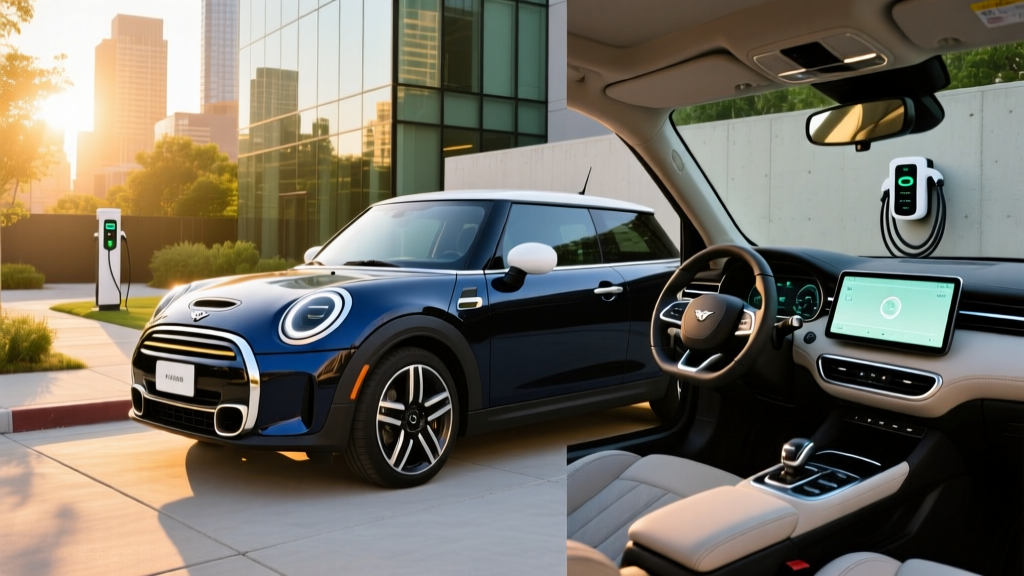
The 2024 Mini Cooper SE occupies a rare niche in the American EV market: a premium, fun-to-drive, city-sized electric hatchback that undercuts most competitors on price while delivering the iconic Mini personality. But with an EPA-estimated range of just 114 miles and a battery pack that hasn't grown since the car's 2020 debut, the Cooper SE demands honest scrutiny before you sign on the dotted line. This review breaks down the 2024 Mini Cooper SE MSRP in the USA, its real-world usability, charging behavior, and whether it still makes sense as the EV market matures around it.
2024 Mini Cooper SE MSRP & Trim Pricing Breakdown
Mini kept the Cooper SE lineup simple for its final model year before the next-generation electric Mini arrives. Two trims are available, both built on the same 32.6 kWh battery platform:
| Trim | Base MSRP | Destination | Total Starting | Key Additions Over Base |
|---|---|---|---|---|
| Signature | $30,900 | $995 | $31,895 | 16" alloy wheels, 8.8" touchscreen, heated seats, LED headlights, DC fast charging |
| Iconic | $34,900 | $995 | $35,895 | Head-up display, Harman Kardon audio, panoramic moonroof, wireless charging, navigation, parking assistant |
A well-optioned Iconic trim with premium paint, 17" wheels, and the Cold Weather package can push the as-tested price to roughly $38,000–$39,500. For context, that's the territory of a base Chevrolet Bolt EUV or a lightly optioned Nissan Leaf SV Plus — both of which offer substantially more range.
Does the 2024 Mini Cooper SE Qualify for the Federal EV Tax Credit?
This is where prospective buyers need to pay close attention. Under current IRS §30D rules, the 2024 Mini Cooper SE does not qualify for the full $7,500 federal tax credit. The reason: BMW Group (Mini's parent) sources battery cells and critical minerals that do not meet the §30D battery-component and critical-mineral sourcing thresholds established by the Inflation Reduction Act.
§30D Eligibility Checklist — 2024 Mini Cooper SE:
- MSRP cap ($55,000 for sedans/hatchbacks): ✅ Passes ($30,900–$34,900)
- Buyer income cap ($150K single / $300K joint): ✅ Buyer-dependent
- Battery component sourcing (North America): ❌ Does not meet threshold
- Critical minerals sourcing (FTA countries): ❌ Does not meet threshold
- Final assembly in North America: ❌ Assembled in Oxford, UK / Netherlands
- Result: $0 federal credit
Some buyers may still benefit from state-level incentives — California's CVRP, Colorado's state credit, or utility rebates — but these vary by jurisdiction. Check your state's energy office and local utility for current programs. A tax professional can confirm whether any partial credits apply to your situation.
Range, Battery & Real-World Efficiency
The Cooper SE uses a 32.6 kWh gross battery (approximately 28.9 kWh usable) with NMC (nickel-manganese-cobalt) lithium-ion chemistry. This is the same pack Mini has used since the SE launched for the 2020 model year — and it shows in the range figures.
EPA Estimated Range: 114 miles
Real-World Expectation:
- City/commute driving (mild weather): 105–120 miles — regenerative braking helps recapture energy in stop-and-go traffic
- Highway driving (70+ mph): 85–100 miles — the small battery and boxy aero penalize efficiency at speed
- Cold weather (below 32°F): 70–90 miles — expect 20–30% range loss due to cabin heating and reduced battery chemistry efficiency
The Cooper SE lacks a heat pump (it uses resistive PTC heating), which amplifies cold-weather range loss. If your commute exceeds 50 miles round-trip in winter, this car will require careful planning or midday charging.
| Metric | Value |
|---|---|
| Battery (gross / usable) | 32.6 kWh / ~28.9 kWh |
| Chemistry | NMC (nickel-manganese-cobalt) |
| EPA Range | 114 miles |
| EPA Combined MPGe | 110 MPGe |
| Energy Consumption | 31 kWh/100 mi (combined) |
| Drivetrain | FWD, single motor |
| Horsepower / Torque | 181 hp / 199 lb-ft |
| 0–60 mph | 6.9 seconds |
Efficiency of 110 MPGe combined is respectable but not class-leading. The Hyundai Kona Electric achieves 120 MPGe with nearly double the range. According to fueleconomy.gov, the Cooper SE's 31 kWh per 100 miles means you'll spend roughly $500–$600 per year on electricity at national average rates for 12,000 miles of driving — competitive with any EV.
Charging Speed: DC Fast Charge & Home Level 2
Charging speed is one of the Cooper SE's most debated specifications. The car's DC fast-charging capability is modest by 2024 standards, but adequate for its intended urban use case.
| Charging Level | Max Power | Connector | Speed / Time |
|---|---|---|---|
| Level 1 (120V household) | ~1.4 kW | J1772 | ~4 mi/hr — full charge in ~22 hours |
| Level 2 (240V home/public) | 7.4 kW | J1772 | ~25 mi/hr — full charge in ~4.5 hours |
| DC Fast Charge | 50 kW (peak) | CCS1 | 10–80% in ~36 minutes |
Key charging realities:
- The 50 kW peak DC charge rate is the car's ceiling. At a 150 kW or 350 kW Electrify America station, the Cooper SE will still draw only 50 kW — you're paying for capacity you can't use.
- The charge curve is relatively flat between 10–60% SoC, then tapers noticeably above 80%. That 10–80% time of roughly 36 minutes is honest; a 10–100% session will take closer to 55 minutes.
- Level 2 home charging at 7.4 kW means an overnight top-up is effortless. Most owners will plug in each evening and wake up to a full battery — the small pack is actually an advantage here, as it charges to 100% faster than a 75+ kWh pack.
- Level 1 charging is technically possible but impractical as a primary strategy. A dedicated 240V Level 2 circuit (typically $500–$1,500 installed, depending on panel proximity) is strongly recommended.
For the urban commuter who charges at home nightly, the 50 kW DC limitation rarely matters. For road trips? A 114-mile range paired with 36-minute fast-charge stops makes the Cooper SE a poor choice for frequent highway travel beyond 150 miles.
Driving Dynamics, Tech & Interior
Where the Cooper SE earns its keep is behind the wheel. The 181-hp electric motor delivers instant torque to the front wheels, and the car's low center of gravity (battery mounted under the floor) gives it the go-kart handling Mini is famous for. The 6.9-second 0–60 mph time isn't blistering by modern EV standards, but the Cooper SE feels quicker than the number suggests around town, where electric torque delivery shines.
Notable tech features:
- 8.8-inch circular touchscreen with Mini's operating system — functional, if dated compared to competitors' larger displays
- Wireless Apple CarPlay (wired Android Auto on base; wireless on Iconic)
- Head-up display (Iconic trim)
- Harman Kardon 12-speaker premium audio (Iconic trim)
- Adaptive cruise control with stop-and-go — a welcome feature for congested city commuting
- Active Driving Assistant: lane departure warning, forward collision warning, automatic emergency braking
Important ADAS note: The Mini Cooper SE's driver-assistance features are SAE Level 2 at most — they assist with steering and speed but require full driver attention and hands-on-wheel engagement. This is not a self-driving system.
What the Cooper SE's ADAS does NOT do:
- It does not autonomously navigate intersections, roundabouts, or highway exits
- It does not change lanes on its own
- It requires continuous driver supervision — removing hands from the wheel triggers alerts and eventual disengagement
Interior Space & Cargo
The Cooper SE is, unapologetically, a small car. Interior dimensions reflect its city-car mission:
| Dimension | Measurement |
|---|---|
| Front legroom | 41.4 inches |
| Rear legroom | 31.7 inches |
| Cargo volume (rear seats up) | 8.7 cu ft |
| Cargo volume (rear seats folded) | 32.0 cu ft |
| Seating capacity | 4 passengers |
That 8.7 cu ft of cargo space behind the rear seats is tight — roughly enough for two carry-on bags and a grocery run. Folding the rear seats opens 32 cu ft, which handles larger hauls but still trails the Chevrolet Bolt EV (57 cu ft max) and Hyundai Kona Electric (46 cu ft max) significantly. The Cooper SE has no frunk (front trunk) — the motor and power electronics occupy the space where the gas engine once lived.
Warranty & Long-Term Ownership
Mini provides competitive warranty coverage for the Cooper SE:
| Coverage | Term |
|---|---|
| Limited vehicle warranty | 4 years / 50,000 miles |
| High-voltage battery warranty | 8 years / 100,000 miles (below 70% capacity retention) |
| Powertrain warranty | 4 years / 50,000 miles |
| Corrosion perforation | 12 years / unlimited miles |
| Roadside assistance | 4 years / unlimited miles |
The 8-year/100,000-mile battery warranty is industry-standard and aligns with federal requirements. Mini guarantees the battery will retain at least 70% of its original capacity during that period. Real-world data from early 2020–2022 Cooper SE owners suggests degradation has been modest — most report 3–5% loss over the first 40,000 miles, which is typical for NMC chemistry with active thermal management.
A full battery replacement outside warranty, should it ever be needed, would likely cost $8,000–$12,000 including labor — though this is a worst-case scenario that few owners encounter within the vehicle's practical lifespan.
How It Compares: Cooper SE vs. Key Rivals
At the 2024 Mini Cooper SE MSRP in the USA ($30,900–$34,900), the car competes against several longer-range EVs. Here's how the numbers stack up:
| Spec | 2024 Mini Cooper SE | 2024 Nissan Leaf SV Plus | 2024 Chevy Bolt EV 2LT |
|---|---|---|---|
| Base MSRP | $30,900 | $36,190 | $29,795 (final model year) |
| EPA Range | 114 mi | 212 mi | 259 mi |
| Battery (usable) | ~28.9 kWh | ~59 kWh | ~59 kWh |
| DC Fast Charge | 50 kW | 100 kW | 55 kW |
| 0–60 mph | 6.9 sec | 6.8 sec | 6.5 sec |
| Cargo (max) | 32.0 cu ft | 30.0 cu ft | 57.0 cu ft |
| Federal Tax Credit | $0 | $3,750 (partial) | $7,500 (full) |
| Effective Price (after credit) | ~$31,895 | ~$33,485 | ~$23,290 |
The math is stark. The Chevrolet Bolt EV, even in its final year, delivers more than double the range and qualifies for the full $7,500 credit, making it roughly $8,600 cheaper effective. The Nissan Leaf SV Plus offers nearly double the range with a partial credit. The Cooper SE's advantages are driving dynamics, premium interior feel, and brand cachet — subjective qualities that don't show up in a spec sheet.
Choose the 2024 Mini Cooper SE if:
- Your daily commute is under 50 miles round-trip and you can charge at home nightly
- You prioritize driving fun, compact size for city parking, and premium interior quality over maximum range
- You rarely take road trips exceeding 120 miles one-way
- You value the Mini brand and design language
Choose a competitor if:
- You need 200+ miles of range for highway commuting or frequent road trips
- Federal tax credit eligibility significantly impacts your purchase budget
- You regularly carry more than two passengers or need substantial cargo space
- You live in a cold-weather climate where the Cooper SE's range drops below 80 miles in winter
Pros
- Engaging, go-kart-like handling with instant electric torque
- Low entry MSRP for a premium-branded EV
- Compact footprint ideal for tight urban parking
- Quick overnight Level 2 charging (small battery = full charge in ~4.5 hrs)
- Distinctive design and strong brand identity
- Standard adaptive cruise control on both trims
Cons
- 114-mile EPA range is the shortest of any current US-market EV
- No federal tax credit eligibility (§30D sourcing requirements)
- 50 kW DC fast charging is slow by 2024 standards
- No heat pump — significant cold-weather range loss
- Tiny 8.7 cu ft cargo area behind rear seats
- Infotainment feels dated vs. competitors' larger screens
Who Should Buy the 2024 Mini Cooper SE?
The Cooper SE is best understood as a purpose-built urban commuter — not a do-everything EV. Its ideal owner:
- Lives in a city or dense suburb with a garage or dedicated parking spot where a Level 2 charger can be installed
- Commutes 20–45 miles round-trip, mostly on surface streets or at moderate highway speeds
- Has access to a second vehicle (gas, hybrid, or longer-range EV) for road trips and longer excursions
- Values the tactile driving experience and doesn't view a car purely as an appliance
If that profile fits you, the Cooper SE delivers a uniquely fun daily-driver experience at a manageable price. If you need one EV to do everything — commute, road-trip, haul family — the Cooper SE's 114-mile ceiling and lack of tax credit make it a tough recommendation over the Bolt EV, Kona Electric, or a used Tesla Model 3.
Frequently Asked Questions
What is the real-world range of the 2024 Mini Cooper SE?
In mild conditions with mixed city/highway driving, expect 100–115 miles. Highway-only driving at 75 mph drops this to 85–100 miles. In freezing temperatures, plan for 70–90 miles due to resistive cabin heating and reduced battery efficiency. The EPA's 114-mile figure is achievable in optimal city conditions but optimistic for highway or cold-weather use.
How fast does the Mini Cooper SE charge at home and on DC fast chargers?
At home on a 240V Level 2 charger (7.4 kW), the Cooper SE goes from empty to full in about 4.5 hours — easily overnight. On a DC fast charger, it peaks at 50 kW and charges from 10–80% in approximately 36 minutes. The small battery means full charges are quick, but the 50 kW ceiling means you won't benefit from newer ultra-fast 150–350 kW stations.
Does the 2024 Mini Cooper SE qualify for any federal EV tax credit?
No. The Cooper SE does not meet the IRS §30D battery sourcing and final-assembly requirements. The battery cells and critical minerals do not meet North American or FTA-country thresholds, and the car is not assembled in North America. The effective purchase price is the full MSRP plus destination. State and utility incentives may still apply depending on your location.
Is the Mini Cooper SE worth buying over a Chevy Bolt or Nissan Leaf?
On pure value and range, no — the Bolt EV offers 259 miles of range and qualifies for the full $7,500 federal credit, making it dramatically cheaper effective. The Leaf SV Plus offers 212 miles. The Cooper SE makes sense only if you prioritize driving dynamics, premium interior quality, compact city-car dimensions, and brand identity over range and value. It's an emotional purchase supported by competent engineering, not a spreadsheet winner.
How long will the Mini Cooper SE battery last?
Mini warranties the high-voltage battery for 8 years or 100,000 miles against degradation below 70% capacity. Early-model owners (2020–2022) report approximately 3–5% degradation over 40,000 miles, suggesting the battery should remain functional well past the warranty period. Proper care — avoiding frequent DC fast charging, not leaving the car at 100% SoC for extended periods, and using preconditioning — can further slow degradation.
Can the Mini Cooper SE handle road trips?
Technically yes, but not comfortably. With 114 miles of range and a 36-minute 10–80% DC fast charge, a 300-mile trip requires at least two charging stops totaling roughly 75 minutes of downtime. In winter, you may need three stops. The Cooper SE is best kept within a 60-mile radius of home. For road trips, a rental or a second vehicle is the pragmatic approach.
Sources: EPA fuel economy data via fueleconomy.gov, IRS clean vehicle credit rules via irs.gov, Mini USA specifications.