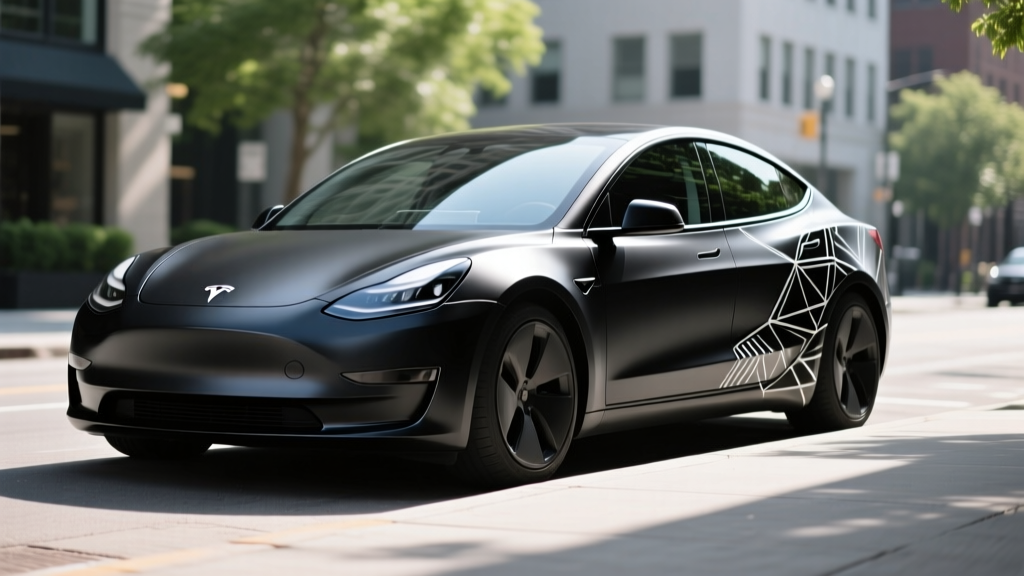
If you've searched how much to wrap a Tesla Model 3, you're likely one of the thousands of owners looking to protect the factory paint, customize the color, or both. A vinyl wrap on the 2026 Tesla Model 3 typically costs between $2,500 and $6,000 depending on material quality, shop expertise, and coverage area. But before you commit to a wrap, you need to understand exactly what you're wrapping — and whether the Model 3 itself still holds up as an EV purchase in 2026.
This guide covers the full wrap-cost breakdown alongside a comprehensive review of the current Tesla Model 3 lineup: EPA range, charging performance, battery specs, pricing, and federal tax credit eligibility under IRS §30D rules.
How Much Does It Cost to Wrap a Tesla Model 3?
The Model 3's relatively smooth body panels and lack of complex curves make it one of the more wrap-friendly sedans on the market. However, the total cost varies significantly based on material grade and installer skill.
| Wrap Type | Material | Estimated Cost | Durability |
|---|---|---|---|
| Economy (Color Change) | Calendared vinyl (e.g., Oracal 651) | $2,500 – $3,500 | 3–5 years |
| Mid-Range (Gloss/Matte/Satin) | Cast vinyl (e.g., 3M 2080, Avery Dennison Supreme) | $3,500 – $5,000 | 5–7 years |
| Premium (PPF-Style / Color PPF) | Paint Protection Film with color (e.g., STEK, XPEL) | $5,000 – $7,500+ | 7–10 years |
| Partial Wrap (Roof/Hood Only) | Any cast vinyl | $800 – $1,800 | Varies |
| Chrome Delete + Accent Wrap | Gloss/matte black vinyl | $400 – $900 | 5+ years |
What Drives the Price Up or Down?
- Material quality: Cast vinyl conforms to compound curves far better than calendared vinyl and resists shrinking. For a car you plan to keep 4+ years, cast or PPF is the move.
- Shop reputation: Certified 3M or XPEL installers charge 20-40% more but typically warranty their work against lifting, bubbling, and adhesive residue.
- Color complexity: Chameleon, brushed metal, and color-shift films add $500-$1,500 in material cost alone.
- Surface prep: Paint correction before wrapping ($300-$600) is strongly recommended — wrapping over swirl marks or chips traps them permanently until removal.
- Removal cost later: Budget $500-$1,000 for professional removal if you plan to revert to stock paint.
2026 Tesla Model 3: Full EV Specs at a Glance
Before wrapping, let's make sure the car underneath is worth the investment. Here's the complete spec sheet for the current Model 3 lineup sold in the United States.
| Spec | Model 3 RWD | Model 3 Long Range AWD | Model 3 Performance |
|---|---|---|---|
| EPA Range | 272 miles | 341 miles | 315 miles |
| Battery (Usable) | ~57.5 kWh (LFP) | ~75 kWh (NMC) | ~75 kWh (NMC) |
| Drivetrain | Rear-Wheel Drive | Dual-Motor AWD | Dual-Motor AWD |
| Horsepower | 271 hp | 346 hp | 510 hp |
| 0-60 mph | 5.8 sec | 4.2 sec | 2.9 sec |
| Max DC Fast Charge | 170 kW | 250 kW | 250 kW |
| 10-80% DC Charge | ~25 min | ~22 min | ~22 min |
| Level 2 Home Charging | 11.5 kW (~44 mi/hr) | 11.5 kW (~44 mi/hr) | 11.5 kW (~44 mi/hr) |
| MPGe (Combined) | 132 MPGe | 131 MPGe | 121 MPGe |
| Efficiency | 25 kWh/100 mi | 26 kWh/100 mi | 28 kWh/100 mi |
| Base MSRP | $38,990 | $47,740 | $54,990 |
Real-World Range: What You'll Actually Get
Real-World Expectation: 235-255 mi highway (RWD) · 290-320 mi highway (Long Range) · 270-295 mi highway (Performance)
Cold Weather (below 32°F): Expect 20-30% range reduction, particularly on the LFP-equipped RWD model. Preconditioning via the Tesla app mitigates some loss.
The Model 3 remains one of the most efficient EVs on the market, thanks to its low drag coefficient (~0.219 Cd) and Tesla's heat pump, which is standard across all trims. The heat pump recovers waste heat from the powertrain to warm the cabin, reducing the range penalty of cold-weather driving compared to older resistive-heater EVs.
On a 75°F day at 65 mph, the Long Range AWD consistently delivers 300-320 miles on a full charge — roughly 90-94% of its EPA rating. Push speeds to 80 mph and you'll see that drop to around 275-290 miles. In sub-freezing temperatures with the cabin heater active, plan for 230-260 miles from the Long Range variant.
The RWD model's LFP battery has a key advantage: Tesla recommends charging it to 100% regularly (unlike NMC batteries, which are best kept between 20-80% for longevity). This means your daily usable range on the RWD is effectively closer to its full 272 miles, whereas Long Range owners who follow the 80% daily guideline get about 273 usable miles for routine commuting — nearly identical in practice.
Charging Speed and Infrastructure
Charging performance is where the Model 3 continues to be competitive, especially when paired with Tesla's Supercharger network — widely regarded as the most reliable DC fast-charging ecosystem in the U.S.
| Charging Level | Power | Speed (Approx.) | Notes |
|---|---|---|---|
| Level 1 (120V household) | ~1.4 kW | ~5 miles/hour | Emergency/trickle only |
| Level 2 (240V home, 48A) | 11.5 kW | ~44 miles/hour | Full charge overnight (~6-8 hrs) |
| DC Fast Charge (RWD) | Peak 170 kW | 10-80% in ~25 min | LFP chemistry limits peak rate |
| DC Fast Charge (LR / Perf) | Peak 250 kW | 10-80% in ~22 min | Charge curve tapers sharply above 80% |
| Tesla Supercharger V4 | Up to 250 kW | Same as above | NACS connector native; no adapter needed |
Understanding the charge curve: The "peak 250 kW" figure applies only at a low state of charge (typically 10-20%). As the battery fills, the charge rate tapers to protect cell health. Expect an average rate of roughly 120-140 kW across the full 10-80% session. That's why the 10-80% time is a more useful metric than peak kW alone.
For home charging, a Tesla Wall Connector on a 60-amp circuit delivers the full 11.5 kW (48 amps continuous). Installation costs typically run $800-$2,000 depending on panel proximity and whether your home needs a panel upgrade. Most Model 3 owners add roughly 250-300 miles of range overnight — more than enough for any daily commute.
Pricing, Trims, and Federal Tax Credit Eligibility
| Trim | Base MSRP | Federal §30D Credit | Effective Price (if eligible) |
|---|---|---|---|
| RWD | $38,990 | $3,750* | ~$35,240 |
| Long Range AWD | $47,740 | $3,750* | ~$43,990 |
| Performance | $54,990 | $3,750* | ~$51,240 |
*Critical tax credit note: Under current IRS §30D rules, the Tesla Model 3 qualifies for a partial federal credit — currently $3,750 (meeting the critical-minerals requirement but not the full battery-component requirement as of 2026). The full $7,500 credit requires meeting both sourcing thresholds, which shift annually.
Eligibility also depends on:
- Buyer income caps: Modified AGI must not exceed $150,000 (single), $225,000 (head of household), or $300,000 (joint filing).
- MSRP cap: The vehicle MSRP must be at or below $55,000 for sedans — meaning the Performance trim at $54,990 just barely qualifies. Options and delivery fees that push the price above $55,000 may disqualify it.
- Point-of-sale transfer: As of 2024+, eligible buyers can transfer the credit to the dealer at purchase, reducing the out-of-pocket cost immediately rather than waiting for a tax return.
Always verify current eligibility on fueleconomy.gov before purchasing, as battery-sourcing compliance can change with supply-chain updates.
Tech, Interior, and Daily Livability
Standout Technology
- 15.4-inch center touchscreen: Controls virtually every vehicle function — climate, mirrors, glovebox, driving mode. The Highland refresh added a rear 8-inch screen for passengers.
- Ambient lighting and ventilated seats: The 2024+ redesign brought premium touches previously absent from the Model 3.
- Autopilot (standard): SAE Level 2 adaptive cruise and lane-centering. Competent for highway use but requires hands-on-wheel supervision at all times.
- Full Self-Driving (Supervised): $8,000 option (or $99/month subscription). Still Level 2 — despite the name, this is not autonomous driving. It handles city streets and intersections with variable reliability.
- Over-the-air updates: Tesla continues to push feature additions and efficiency improvements remotely.
Cargo and Passenger Space
- Cargo volume: 23 cu ft (rear trunk + frunk combined)
- Rear legroom: 35.2 inches — adequate for adults under 6'0", tight for taller passengers on long trips
- Front headroom: 40.3 inches
- Frunk: ~3.1 cu ft, useful for charging cables and small bags
The Model 3 is a driver's sedan first and a family hauler second. If you regularly carry rear-seat adults or need maximum cargo flexibility, the Model Y crossover is the more practical Tesla. But for a single professional or couple prioritizing efficiency and driving dynamics, the Model 3's footprint is ideal.
Battery Warranty and Long-Term Ownership
Tesla's battery and drive unit warranty provides a strong ownership backstop:
- RWD (LFP battery): 8 years / 100,000 miles, whichever comes first, with minimum 70% capacity retention.
- Long Range & Performance (NMC battery): 8 years / 120,000 miles, with minimum 70% capacity retention.
Real-world degradation data from fleet analytics suggests the Model 3's battery typically retains 90-93% capacity at 50,000 miles and 85-90% at 100,000 miles. The LFP chemistry in the RWD model shows particularly flat degradation curves — a known advantage of lithium iron phosphate cells, though they sacrifice some energy density (hence the shorter range).
Out-of-warranty battery replacement currently runs $12,000-$16,000 at a Tesla Service Center, though prices have been trending downward as cell costs fall. For most owners who trade in within 5-7 years, this is a non-issue.
Pros, Cons, and Who Should Buy
Pros
- Best-in-class efficiency (25-28 kWh/100 mi)
- Access to Tesla Supercharger network — 6,000+ U.S. stations
- Strong real-world range, especially Long Range AWD at 341 mi EPA
- LFP battery on RWD allows 100% daily charging without degradation concern
- Low running costs: ~$0.04-$0.06/mile on home electricity
- Excellent resale value relative to most EVs
- Over-the-air updates keep software current
Cons
- Minimalist interior polarizes — no physical buttons, no instrument cluster
- Rear seat is snug for tall adults
- Turn-signal stalks removed in Highland refresh (steering-wheel buttons instead)
- FSD remains Level 2 despite $8,000 price tag
- Partial $3,750 tax credit — not the full $7,500
- Insurance premiums run 15-25% higher than comparable gas sedans
- Repair costs after collision can be high due to integrated body/battery structure
Who the Model 3 Suits Best
- Commuters: Ideal. 272-341 miles of range means most owners charge once or twice a week at home.
- Tech-forward singles and couples: The minimalist cabin and software-first experience appeal to those who prefer a screen over physical controls.
- Road-trippers: Viable with Supercharger access, though the Model Y or a larger EV offers more comfort for extended travel.
- Not ideal for: Families needing 3+ car seats, frequent tow-haul users (no tow rating), or buyers who prefer traditional button-based interfaces.
Model 3 vs. Key Competitors: Is It Still the Best EV Sedan?
| Spec | Tesla Model 3 LR | Hyundai Ioniq 6 SEL | BMW i4 eDrive40 |
|---|---|---|---|
| EPA Range | 341 mi | 361 mi | 301 mi |
| Base MSRP | $47,740 | $42,750 | $57,900 |
| Max DC Charge | 250 kW | 233 kW | 205 kW |
| 10-80% Time | ~22 min | ~18 min | ~31 min |
| Federal Credit | $3,750 | $7,500 | $7,500 |
| Effective Price | ~$43,990 | ~$35,250 | ~$50,400 |
The Hyundai Ioniq 6 now beats the Model 3 on EPA range and qualifies for the full $7,500 credit, making it a compelling value. The BMW i4 offers a more traditional luxury interior but at a significant premium. The Model 3's edge remains the Supercharger network, software ecosystem, and proven long-term reliability data that newer competitors haven't yet accumulated.
Frequently Asked Questions
Does wrapping a Tesla Model 3 void the warranty?
No. A professionally installed vinyl wrap does not void Tesla's vehicle or battery warranty. However, if wrap removal damages the paint (rare with quality cast vinyl and proper technique), that paint repair would not be covered. Keep documentation of the installer and materials used.
How long does a Tesla Model 3 wrap last?
Cast vinyl wraps (3M 2080, Avery Supreme) typically last 5-7 years with proper care. Color PPF can last 7-10 years. Avoid automatic car washes with stiff brushes — touchless or hand-wash only to preserve the wrap's edges and finish.
Can I wrap a leased Tesla Model 3?
Yes, and many lessees do. A wrap protects the factory paint and can be removed before lease return. Ensure you use cast vinyl (not calendared) to minimize adhesive residue risk, and budget for professional removal ($500-$1,000) before the lease inspection.
Does the Tesla Model 3 qualify for the full $7,500 federal tax credit?
As of 2026, the Model 3 qualifies for $3,750 under §30D — meeting the critical-minerals requirement but not the battery-component sourcing threshold. Verify current eligibility on irs.gov before purchase, as sourcing rules update annually.
What's the real cost per mile to charge a Model 3 at home?
At the U.S. average residential electricity rate of ~$0.16/kWh and the Long Range's efficiency of 26 kWh/100 mi, you'll pay approximately $0.042 per mile — roughly one-quarter the per-mile fuel cost of a 30 MPG gas sedan at $3.50/gallon.
Is it worth wrapping vs. ceramic coating the Model 3?
It depends on your goal. Ceramic coating ($1,000-$2,500) protects existing paint from UV, water spots, and light scratches but doesn't change the color. A wrap ($3,500-$6,000) changes the color AND provides a sacrificial layer against rock chips. For maximum protection, some owners apply PPF over a wrap — but that can exceed $10,000 total.
Does FSD (Full Self-Driving) make the Model 3 autonomous?
No. Tesla's FSD (Supervised) is an SAE Level 2 driver-assistance system. You must keep your hands on the wheel and eyes on the road at all times. True autonomous (Level 4) driving is currently only available in geofixed robotaxi services like Waymo in select cities.