The Quick Verdict: Can You Put a Hitch on a Tesla?
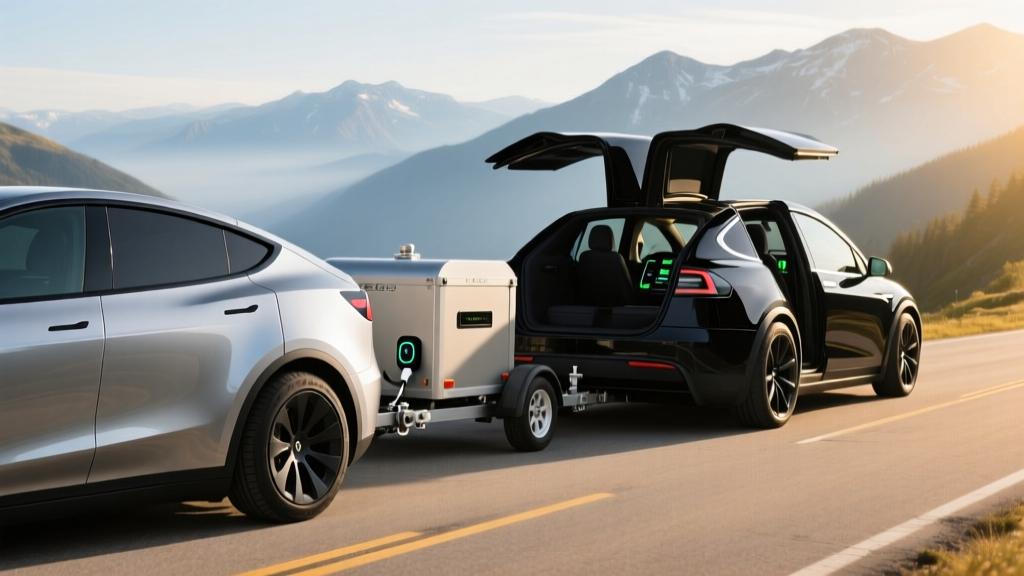
Yes — but not all Teslas are created equal when it comes to towing. If you're searching for a hitch Tesla setup, you're likely eyeing either the Model Y or the Model X, the only two current-production Teslas rated for towing. The Model Y can tow up to 3,500 lbs with the factory tow package, while the Model X maxes out at 5,000 lbs. But bolting on a hitch is only half the equation. Towing an RV, boat, or utility trailer with an EV fundamentally changes your range, charging strategy, and trip planning.
This guide breaks down the real-world towing experience with a hitch-equipped Tesla in 2026 — covering factory hitch options, aftermarket alternatives, range penalties, charging logistics, and whether a Tesla is actually the right tow vehicle for your needs.
2026 Tesla Model Y: Hitch, Towing Specs & Real-World Range
The 2026 Tesla Model Y remains the brand's best-selling vehicle and the most common platform for owners seeking a Tesla hitch setup. Tesla offers a factory-installed tow package on the Long Range AWD and Performance trims. The base RWD model does not support towing.
| Spec | Value |
|---|---|
| EPA Range (no trailer) | 320 miles |
| Battery Capacity | ~78 kWh usable, NMC (2170 cells) |
| Max DC Fast Charge | 250 kW (Supercharger V3) |
| 10–80% DC Charge Time | ~27 minutes |
| Level 2 Home Charge Rate | 11.5 kW (~44 mi/hr) |
| 0–60 mph | 4.8 seconds |
| Horsepower | 384 hp (dual motor) |
| Drivetrain | Dual-motor AWD |
| Max Towing Capacity | 3,500 lbs |
| EPA Efficiency | 122 MPGe combined / 28 kWh/100mi |
| Cargo Volume | 76 cu ft (rear seats folded) |
| Rear Legroom | 41.6 inches |
| Battery/Drive Unit Warranty | 8 years / 120,000 miles |
| Base MSRP (Long Range AWD) | $48,990 |
| Tow Package Add-On | $1,000 |
Real-World Range Note: Model Y
EPA sticker: 320 miles. Expect roughly 270–290 miles on a highway-only trip at 70 mph in mild weather. In cold conditions (below 32°F), plan for 220–250 miles without a trailer. When towing near max capacity (3,000–3,500 lbs), real-world range drops to approximately 150–190 miles depending on trailer aerodynamics, terrain, and speed. A boxy travel trailer will hit range harder than a low-profile boat or cargo trailer.
Model Y Hitch: Factory vs. Aftermarket
Tesla's factory tow package for the Model Y includes a 2-inch receiver hitch, a 7-pin wiring harness, and a software-activated Trailer Mode that adjusts stability control, regenerative braking, and the rear camera display. The $1,000 package must be ordered at the time of purchase — Tesla does not retrofit the factory tow package on vehicles that didn't ship with it.
Aftermarket hitches from brands like Curt, Draw-Tite, and EcoHitch are available for Model Y variants that didn't come with the factory package. These typically cost $200–$450 for the hardware, plus $150–$300 for professional installation. However, aftermarket hitches do not activate Trailer Mode software, meaning you lose integrated trailer sway control and the dedicated rear-camera trailer view. You also need to source a separate wiring harness for trailer lights.
2026 Tesla Model X: The Heavy-Duty Tesla Towing Option
If you need more towing capacity, the Model X is Tesla's most capable option. Its larger battery, more powerful motors, and heavier curb weight make it better suited for sustained towing — though at a significant price premium.
| Spec | Value |
|---|---|
| EPA Range (no trailer) | 335 miles |
| Battery Capacity | ~100 kWh usable, NMC |
| Max DC Fast Charge | 250 kW |
| 10–80% DC Charge Time | ~32 minutes |
| Level 2 Home Charge Rate | 11.5 kW (~34 mi/hr) |
| 0–60 mph | 3.8 seconds |
| Horsepower | 670 hp (dual motor) |
| Drivetrain | Dual-motor AWD |
| Max Towing Capacity | 5,000 lbs |
| EPA Efficiency | 109 MPGe combined / 31 kWh/100mi |
| Cargo Volume | 91 cu ft (rear seats folded) |
| Battery/Drive Unit Warranty | 8 years / 150,000 miles |
| Base MSRP (Long Range) | $79,990 |
Real-World Range Note: Model X
EPA sticker: 335 miles. Highway driving at 70 mph in moderate weather yields roughly 280–300 miles. Cold weather reduces this to around 240–260 miles. When towing at or near 5,000 lbs, expect 170–210 miles of range — a meaningful improvement over the Model Y under load, thanks to the larger battery pack, but still requiring careful route planning for trips beyond 150 miles one-way.
The Model X includes a factory 2-inch receiver hitch and integrated Trailer Mode as standard equipment on all trims — no separate tow package purchase required. The 7-pin connector is also standard. This is a significant advantage over the Model Y, where the tow package is a cost adder and must be specified at order time.
Range Loss While Towing: What the Data Shows
The single biggest concern for anyone researching a hitch Tesla setup is range degradation. EVs are not unique in this regard — gas trucks see 30–50% fuel economy drops while towing — but the EV penalty feels more acute because charging infrastructure is less ubiquitous than gas stations, especially in rural areas where towing often happens.
| Scenario | Model Y LR AWD | Model X LR AWD |
|---|---|---|
| No trailer (EPA) | 320 mi | 335 mi |
| Light trailer (~1,500 lbs) | 220–260 mi | 240–280 mi |
| Medium trailer (~2,500 lbs) | 180–220 mi | 200–240 mi |
| Max capacity trailer | 150–190 mi | 170–210 mi |
Several factors determine where you land within these ranges:
- Trailer aerodynamics: A flat-bed utility trailer creates far less drag than an enclosed travel trailer. Drag is the dominant range killer above 55 mph.
- Speed: Every 5 mph above 60 mph increases energy consumption roughly 10–15%. Towing at 70 mph versus 60 mph can mean the difference between making your next Supercharger or not.
- Terrain: Mountain passes with sustained grades will drain the battery rapidly. Regenerative braking recovers some energy on descents, but not enough to offset long climbs.
- Temperature: Cold weather compounds the towing penalty. A 30°F day with a max-load trailer can cut range by 55–65% versus the EPA sticker.
Charging While Towing: Infrastructure Reality Check
Towing with a Tesla means you'll rely heavily on the Supercharger network. Here's what that looks like in practice:
| Charging Level | Power | Speed (No Trailer) | Towing Relevance |
|---|---|---|---|
| Level 1 (120V outlet) | ~1.4 kW | ~3–5 mi/hr | Not viable for towing recovery |
| Level 2 (240V home) | 11.5 kW | ~34–44 mi/hr | Fully recharges overnight; ideal for daily tow use |
| DC Fast (V3 Supercharger) | Up to 250 kW | ~170 mi in 15 min | Best road-trip option; most can accommodate trailers in pull-through stalls |
| DC Fast (V4 Supercharger) | Up to 350 kW | Faster peak; limited availability | Newer stalls designed with pull-through for trailers |
A critical practical note: not all Supercharger stalls can accommodate a vehicle with a trailer attached. Standard pull-in stalls require you to unhitch the trailer or block adjacent spaces. Tesla has been rolling out pull-through Supercharger stalls at select high-traffic locations, but coverage is uneven. Before a towing trip, check the Supercharger details in the Tesla app or on Tesla's Supercharger map to confirm pull-through availability.
Charging speed also matters. The Model Y peaks at 250 kW but sustains that rate only up to roughly 30–35% state of charge, after which the charge curve tapers. From 10–80%, expect about 27 minutes in ideal battery-temperature conditions. If you've been towing hard and the battery is warm, preconditioning may already be optimized — but in cold weather, battery preconditioning adds time unless you've navigated to a Supercharger in the car's nav system, which triggers automatic thermal prep.
Pricing, Tax Credits & Total Cost of a Hitch Tesla Setup
| Item | Model Y LR AWD | Model X LR AWD |
|---|---|---|
| Base MSRP | $48,990 | $79,990 |
| Factory Tow Package | $1,000 | Included |
| Destination Fee | $1,390 | $1,390 |
| Total Before Credits | $51,380 | $81,380 |
| Federal §30D Credit (potential) | Up to $7,500 | $0 (exceeds MSRP cap) |
| Est. After Federal Credit | ~$43,880 | $81,380 |
Federal tax credit eligibility under IRS §30D has specific requirements that change periodically:
- MSRP cap: SUVs/pickups must be under $80,000 MSRP. The Model Y qualifies; the Model X does not.
- Buyer income cap: Modified adjusted gross income must not exceed $150,000 (single), $225,000 (head of household), or $300,000 (joint).
- Battery sourcing: Critical minerals and battery components must meet phased-in domestic/free-trade sourcing thresholds. Tesla's supply chain has adapted, but confirm current-year eligibility on fueleconomy.gov before purchasing.
- Point-of-sale transfer: As of 2024, buyers can transfer the credit to the dealer at purchase, reducing the upfront cost rather than waiting for a tax refund.
The Model X's MSRP exceeding the $80,000 cap means it does not qualify for the federal purchase credit. State-level incentives may still apply — check your state's energy office or DMV for current programs.
Pros and Cons of a Hitch-Equipped Tesla
Pros
- Instant torque provides strong, smooth acceleration even under load — no turbo lag or gear hunting
- Trailer Mode (factory hitch) integrates stability control and regenerative braking for trailer sway management
- Low "fuel" cost: electricity at $0.13/kWh costs roughly $4–6 per 100 miles unloaded vs. $15–20 for a gas truck
- Supercharger network is the most reliable DC fast-charging ecosystem in North America
- Over-the-air updates continuously improve towing software, range estimation, and route planning
- No engine maintenance (oil, spark plugs, transmission fluid) reduces long-term tow-vehicle upkeep
Cons
- Range cut by 40–55% when towing near max capacity — a 320-mile EV becomes a 160-mile EV
- Supercharger stalls aren't universally pull-through; unhitching or blocking spaces is often necessary
- Aftermarket hitches lack integrated Trailer Mode software — a meaningful safety trade-off
- Tow-package Model Y must be ordered new; Tesla won't retrofit the factory package
- Model X exceeds the $80K MSRP cap — no federal tax credit
- Charging a depleted battery while towing takes longer than filling a gas tank (25–35 min vs. 5 min)
- Insurance premiums for Teslas remain above segment average
Who Should (and Shouldn't) Tow With a Tesla?
Choose a Hitch-Equipped Tesla If:
- You tow light-to-medium loads (utility trailers, small boats, bike racks, light campers under 3,000 lbs)
- Your towing trips are under 150 miles one-way, or you have reliable charging at your destination
- You already own or plan to buy a Model Y or Model X for daily driving and want dual-purpose capability
- You value instant torque, quiet operation, and low per-mile energy cost while towing
Look Elsewhere If:
- You regularly tow heavy travel trailers (5,000+ lbs) over long distances through rural areas
- You need to tow in extreme cold where range penalties compound dramatically
- You require a truck bed or commercial-grade towing (gooseneck, fifth-wheel) — no Tesla supports this
- You need a dedicated tow vehicle with 7,000+ lb capacity — consider a Ford F-150 Lightning or Rivian R1T instead
How Does a Tesla Compare to Other EV Tow Vehicles?
The Tesla Model Y's 3,500-lb rating is competitive with other electric crossovers but trails dedicated electric trucks. Here's how the landscape looks in 2026:
- Ford F-150 Lightning: 7,700–10,000 lbs towing capacity, ~230–320 mi range. Far more capable for heavy towing but significantly larger and more expensive.
- Rivian R1T: 11,000 lbs towing capacity, ~270–400 mi range depending on pack. The current EV towing king, but starts above $70,000.
- Hyundai Ioniq 5: 2,300 lbs (with tow package). Less capable than the Model Y for towing.
- Volkswagen ID.4: 2,700 lbs. Adequate for light loads but trails Tesla.
For the crossover-SUV segment specifically, the Model Y's 3,500-lb capacity and Supercharger access make it one of the strongest EV towing options available — provided you accept the range trade-offs.
Frequently Asked Questions
Can I add a hitch to a Tesla Model Y that didn't come with the tow package?
Yes, aftermarket hitches are available from Curt, EcoHitch, and Draw-Tite. However, you will not have access to Tesla's integrated Trailer Mode software, which controls trailer sway stabilization, adjusted regen braking, and the trailer camera view. For light loads (bike racks, cargo carriers), an aftermarket hitch works fine. For towing a trailer on the highway, the factory tow package is strongly recommended for the safety integration.
Does towing void the Tesla battery warranty?
No. Towing within the vehicle's rated capacity (3,500 lbs for Model Y, 5,000 lbs for Model X) does not void the 8-year battery and drive unit warranty. However, damage caused by exceeding the rated towing capacity or using an improperly installed aftermarket hitch may not be covered. Tesla's warranty covers battery degradation below 70% capacity retention over the warranty period — towing does not change this threshold.
How much range do I actually lose when towing with a Tesla?
Expect a 40–55% range reduction when towing near max capacity. A Model Y Long Range AWD rated at 320 miles EPA will realistically deliver 150–190 miles with a 3,000–3,500 lb trailer. Aerodynamic profile matters more than weight at highway speeds — a boxy travel trailer will penalize range more than a low-profile boat trailer of equal weight.
Does the Tesla Model 3 support a hitch or towing?
The Model 3 is not rated for towing in the United States, and Tesla does not offer a factory tow package for it. Aftermarket hitches exist for the Model 3, but they are suitable only for hitch-mounted accessories (bike racks, cargo carriers) — not for pulling a trailer. Towing with a Model 3 is unsupported and could affect warranty coverage.
Are there pull-through Superchargers that accommodate trailers?
Yes, but availability is limited. Tesla has been adding pull-through Supercharger stalls at select locations, particularly along major highway corridors. Check the Tesla app or in-car navigation for stall details before planning a towing trip. In many cases, you may need to unhitch the trailer in a parking area and then move to a standard stall to charge.
Does the Tesla Model Y qualify for the $7,500 federal tax credit in 2026?
The Model Y Long Range AWD with an MSRP under $80,000 is potentially eligible for the full $7,500 federal tax credit under IRS §30D, provided the buyer meets income caps ($150K single / $300K joint) and the vehicle meets current-year battery sourcing requirements. The credit can be transferred at point of sale to reduce your purchase price. Always verify current eligibility on fueleconomy.gov and consult a tax professional for your specific situation.